Hiring Process: A Complete Guide for Small Businesses (2026)

Jatin Kashyap
Growth Lead, Acrapath

The complete hiring process for small and growing businesses: 10 steps from workforce planning to onboarding, with timelines, templates, checklists, metrics and the mistakes to avoid.
Employment law differs by country and changes over time. This guide is general information, not legal advice. Check local rules on contracts, pay and background checks before you hire.
Key Takeaways
The hiring process is the sequence of steps a business follows to fill a role: plan, define, source, screen, assess, interview, decide, verify, offer and onboard.
SHRM's 2025 benchmarking report put the median time to fill at 44 days for non-executive roles.
Employ's 2025 data found small and mid-size companies took 83.5 days from posting to accepted offer, versus 51.7 days at enterprises.
Structured interviews predict job performance more than twice as well as unstructured ones (validity .42 vs .19 in a 2022 meta-analysis).
A focused small-business hiring process can fill many roles in 3-4 weeks without lowering the bar.
You need to hire, and you need to get it right. A bad hire in a 15-person company doesn't just cost a salary. It slows projects, strains the team and eats weeks of the founder's time.
Large companies have recruiting teams, applicant tracking systems and hiring playbooks. Small businesses usually have a busy founder, a manager who's never hired before and a spreadsheet.
The good news is that a strong hiring process doesn't need a big team. It needs clear steps, a few simple templates and the discipline to follow them every time.
This guide walks you through the complete hiring process for small and growing businesses: ten steps from workforce planning to onboarding, a sample timeline, who does what, the documents you'll need, the metrics to track and the mistakes that cost the most.
What Is the Hiring Process?
The hiring process is the full set of steps a business uses to identify a need, attract candidates, evaluate them and bring the right person into the team. It starts before the job is posted and ends after the new employee has settled in.
People often use "hiring process" and "recruitment process" interchangeably. Strictly, recruitment covers attracting and selecting candidates, while hiring also includes the offer, paperwork and onboarding. This guide covers the whole journey.
Why a Structured Hiring Process Matters
A repeatable process brings four big benefits:
Better hires. Consistent assessments reveal real skills instead of interview polish.
Faster hiring. Clear steps remove waiting and back-and-forth.
Fairer decisions. Every candidate is judged against the same criteria.
A stronger employer brand. Candidates remember organised, respectful processes and tell others.
The research supports structure. A 2022 meta-analysis by Sackett, Zhang, Berry and Lievens, summarised by SIOP, estimated the predictive validity of structured interviews at .42, compared with .19 for unstructured interviews. In plain terms, asking every candidate the same job-related questions and scoring them consistently gives you a much better signal.
The 10-Step Hiring Process
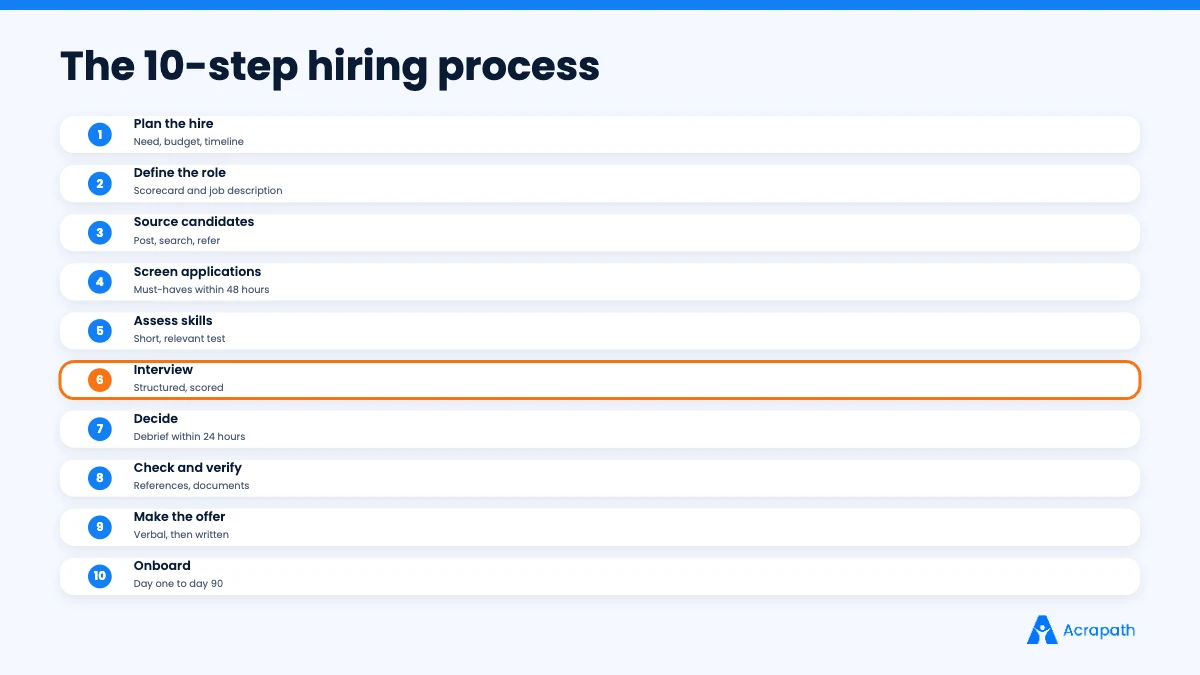
Step 1: Plan the Hire
Every good hire starts with a clear reason. Before anything else, answer:
What problem will this person solve? Revenue, capacity, a new capability?
Is a full-time hire the right answer? Could a contractor, an agency or a change in existing roles solve it?
What's the budget? Salary range, benefits, hiring costs and tools.
When do you need them productive? Work back from that date, allowing for notice periods.
For your very first employee, our guide on how to hire your first employee covers the founder-specific questions, including paperwork and payroll.
Pitfall to avoid: starting to interview before the budget is approved. It's the most common reason offers stall at the last step.
Step 2: Define the Role
Write a one-page scorecard before the job description. List:
The role's purpose in one sentence.
Three to five outcomes expected in the first 6-12 months.
The must-have skills, separated from nice-to-haves.
The values or working style that matter in your team.
Then turn the scorecard into a job description. Our guide on how to write a job description explains the structure, and you can start from our role templates for a software engineer, sales executive, accountant, HR executive, product manager or teacher.
Step 3: Source Candidates
Most small businesses rely only on job posts. Strong teams use several channels at once:
Job portals for reach and inbound applicants.
Candidate databases such as Acrapath's Talbox to search verified profiles directly.
Employee referrals, which bring in people your team already trusts.
Your own network and social media, including the founder's LinkedIn.
Campus and community partnerships for entry-level roles; see our guide to hiring freshers.
Recruitment agencies for specialist or senior roles.
Our list of 11 places to find candidates covers more options, and our comparison of a recruitment agency vs a job portal helps you decide when outside help is worth paying for.
Step 4: Screen Applications
Screening turns a large pile of applications into a shortlist. Keep it fast and consistent:
Review new applications within 48 hours.
Check each against your must-have list only.
Use a simple yes / maybe / no rating.
Write one line on why, so decisions are explainable.
Our guide on how to screen resumes gives a seven-step method that takes minutes per CV.
Step 5: Assess Skills
A short assessment shows what candidates can actually do. Options include:
Work samples: a small, realistic task from the job.
Job knowledge tests: short quizzes on essential knowledge.
Case exercises: a business scenario to analyse.
Role plays: common for sales and customer-facing roles.
Keep tests short, relevant and respectful of candidates' time. Our guide to pre-employment assessments compares nine types, and our article on skills-based hiring explains how to hire for ability rather than degrees.
Step 6: Interview
Use a structured interview: the same core questions for every candidate, each scored against clear anchors. A typical small-business sequence:
Screening call (15-20 minutes): motivation, basics, salary expectations.
Skills interview (45-60 minutes): discuss the assessment and test depth.
Final round (45-60 minutes): team fit, values, scenarios with the hiring manager or founder.
Find questions by role in our pillar on interview questions to ask candidates, and role-specific sets such as sales interview questions to ask.
Step 7: Decide
Hold a short debrief within 24 hours of the final interview. Ask each interviewer to share scores before discussion to avoid group-think. Decide against the scorecard, not on general impressions.
If no candidate meets the bar, don't settle. Revisit your sourcing or your scorecard instead.
Step 8: Check References and Verify
Before or alongside the offer, complete the checks appropriate to the role and your country:
Reference calls with former managers, using specific questions.
Education and employment verification where relevant.
Professional licence checks for regulated roles such as healthcare or finance.
Background checks only where lawful and proportionate, with the candidate's consent.
Step 9: Make the Offer
Call the candidate with a verbal offer, then send the written offer within 24 hours. Include role, start date, salary and benefits, probation and notice terms, and any conditions.
Our offer letter format includes a full template and checklist. In some countries, written terms have legal deadlines; for example, GOV.UK says employers in the UK must give a written statement of employment particulars on or before the first day.
Keep in touch through the notice period. Our case study on reducing offer drop-outs shows simple tactics that keep accepted candidates engaged.
Step 10: Onboard
Hiring isn't finished when the offer is signed. A clear onboarding plan helps new employees become productive faster and stay longer:
Before day one: paperwork, equipment, accounts and a welcome message.
Week one: introductions, tools, first small task and a buddy.
Days 30, 60 and 90: check-ins against the scorecard outcomes.
A Sample Hiring Timeline
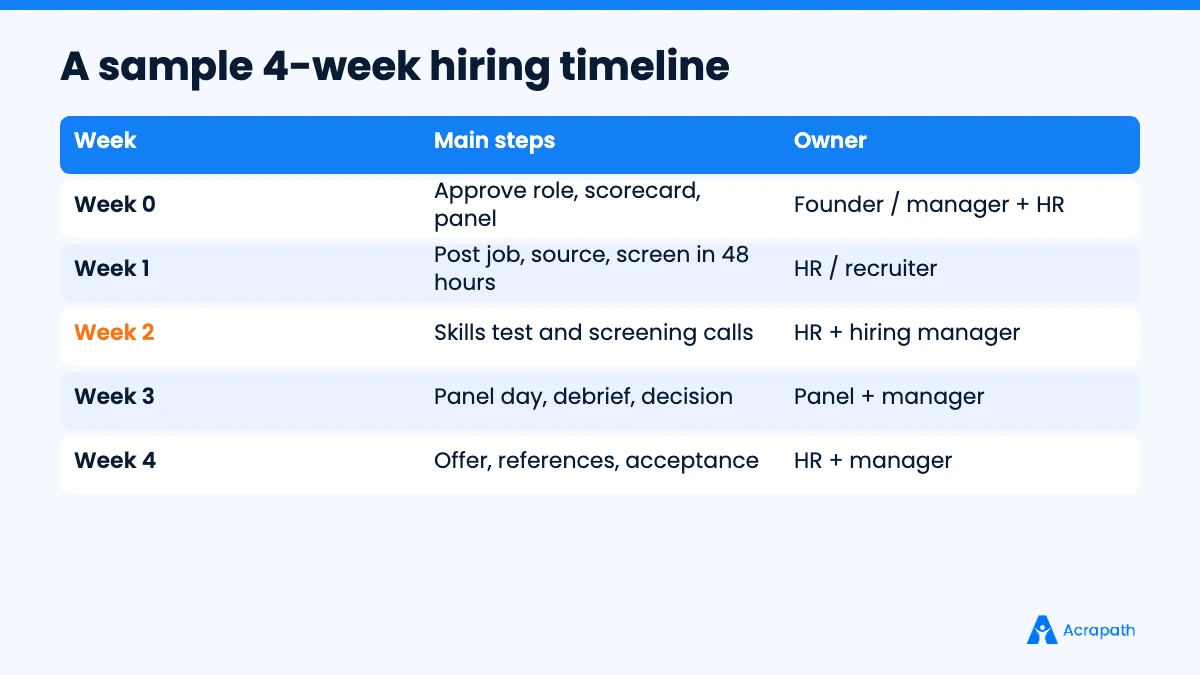
Senior, specialist and regulated roles usually take longer, mainly because of smaller candidate pools, notice periods and verification.
Who Does What in the Hiring Process
Confusion about ownership causes many delays. Agree roles at the start.
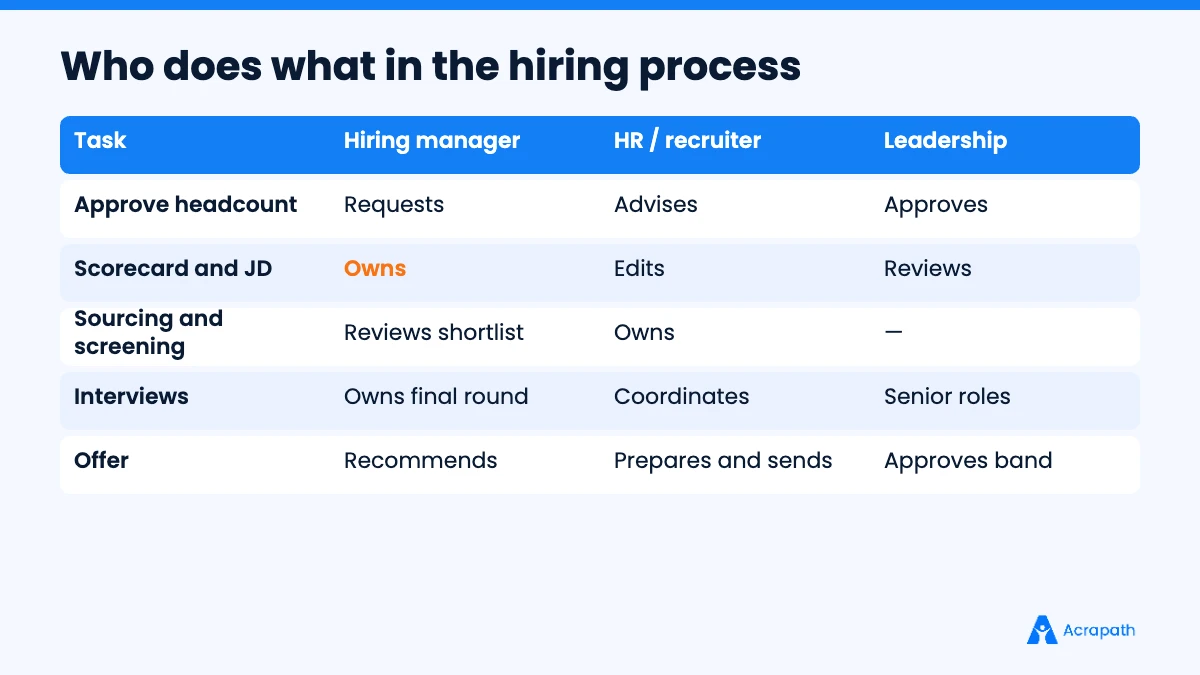
In a very small company, the founder may cover the leadership and hiring manager roles, with an office manager or external partner handling coordination.
Hiring Process Checklist
Copy this checklist into your next hiring project:
Hiring need and budget approved
Scorecard written and agreed with the panel
Job description published with salary range where possible
Sourcing channels chosen (posts, search, referrals, agency)
Screening slot booked every 48 hours
Skills assessment and scoring rubric ready
Structured interview questions and scorecards shared
Panel dates blocked for interviews and debrief
Offer template and salary band ready
Reference questions prepared
Onboarding plan for day one to day 90 drafted
Rejection emails prepared for unsuccessful candidates
Interview Scorecard Template
A scorecard keeps every interviewer focused on the same evidence. Adapt this simple version:
Criterion (from your role scorecard) | Evidence heard | Score 1-5 |
|---|---|---|
Core skill 1, e.g. problem solving | ||
Core skill 2, e.g. customer communication | ||
Core skill 3, e.g. tool or technical knowledge | ||
Working style or values | ||
Motivation for this role | ||
Overall recommendation | Hire / No hire / Unsure |
Use anchors so a "3" means the same to everyone. For example: 1 = no evidence, 3 = solid evidence for the role's level, 5 = strong evidence beyond the level. Ask interviewers to submit scores before the debrief, not during it.
Questions to Ask References
Reference checks are most useful when questions are specific. Try:
"In what capacity did you work with this person, and for how long?"
"What were they hired to achieve, and how did they do against it?"
"What's one area where they grew while working with you?"
"How did they handle pressure, deadlines or a difficult colleague?"
"What kind of manager or environment brings out their best work?"
"Would you hire or work with them again? Why?"
Listen for hesitation and for specifics. Vague praise tells you little; concrete examples tell you a lot. Always get the candidate's consent before contacting referees.
Day-One Onboarding Checklist
Prepare these before your new employee arrives:
Laptop, accounts and access to the tools they'll use in week one
Signed paperwork and payroll set-up complete
A welcome message from the manager and the team
A written plan for the first week, including one small, achievable task
A named buddy for questions
Meetings booked with key colleagues
30-60-90 day goals linked to the role scorecard
A new hire who knows what to do on day one settles faster and is far more likely to stay.
How to Improve Your Hiring Process Every Quarter
Treat hiring like any other business process: review it regularly.
Look at the numbers. Time to hire, offer acceptance and probation pass rates by role.
Ask hiring managers. What slowed them down? Which candidates surprised them?
Ask candidates. A two-question survey after the final round reveals friction you can't see.
Fix one thing. Choose a single change for the next quarter, such as panel days or a new assessment, and measure the result.
Small improvements compound. A process that gets a little faster and fairer every quarter becomes a real advantage when competing for talent.
Legal and Compliance Basics
Every country has its own employment rules, but a few principles apply almost everywhere. Build them into your process from the start:
Non-discrimination: don't make decisions based on protected characteristics such as gender, religion, caste, age, disability or marital status, and don't ask about them in interviews.
Right to work: confirm that the person is legally allowed to work for you in that country before they start.
Written terms: give clear written terms of employment. Some countries set deadlines; the UK, for example, requires a written statement on or before day one.
Minimum pay and working hours: check statutory minimum wages, overtime rules and leave entitlements.
Data protection: collect only the candidate data you need, store it securely and delete it when no longer required.
Background checks: run them only where lawful and relevant to the role, and with the candidate's consent.
If you hire in a new country or for a regulated role, a short consultation with a local employment lawyer or HR adviser is money well spent.
Documents You'll Need When Hiring
Requirements vary by country, but most hires involve:
Document | Purpose |
|---|---|
Job description and scorecard | Defines the role and assessment criteria |
Offer letter | Confirms the offer terms |
Employment contract or written terms | Legal terms of employment |
Identity and right-to-work proof | Confirms the person can legally work for you |
Tax and payroll forms | Sets up correct salary deductions |
Bank details | For salary payments |
Policies acknowledgement | Code of conduct, data protection, leave |
Keep candidate and employee data secure and only as long as you need it.
Hiring Process Metrics to Track
You can't improve what you don't measure. Track these for every role:
Time to hire and time to fill. See our guide to time to hire for benchmarks and fixes.
Cost per hire. Our guide to cost per hire shows the formula.
Source of hire. Which channels deliver people who stay and perform.
Offer acceptance rate. Low rates suggest pay or process problems.
Quality of hire. For example, the share of new hires who pass probation or meet 90-day goals.
Candidate experience. A short survey after interviews.
Benchmarks help with context. SHRM's 2025 recruiting benchmarking report found a 44-day median time to fill for non-executive roles, and Employ's 2025 platform data, reported by HR Dive, showed small and mid-size companies averaging 83.5 days from posting to accepted offer.
Hiring Process for Small Businesses: What's Different
Small businesses face specific challenges, and a few adjustments help:
Founders are the bottleneck. Limit founder involvement to the final round, and delegate screening.
Brand awareness is low. Explain the mission, growth path and team in your job post; candidates may not know you.
Budgets are tight. Use referrals, direct candidate search and free channels first.
Every hire shapes culture. Make values part of the scorecard, not a gut feel.
No HR team. Use templates and a simple hiring pipeline instead of email threads.
The structured hiring pipeline case study shows how one team moved from spreadsheets to a clear pipeline.
Hiring for Different Role Types
Your process should flex by role:
Role type | Adjust the process by |
|---|---|
Entry-level and freshers | Group assessments, campus partnerships, training plan |
Technical roles | Take-home or live coding task; see hiring a React Native developer |
Sales roles | Role play and target discussion |
Finance roles | Modelling test; see hiring a financial analyst |
Senior and leadership | More stakeholder interviews, references from several angles |
Regulated roles | Licence and background checks started early |
Hiring Remotely or Across Countries
Remote hiring widens your talent pool but adds steps:
Run all interviews on video with the same structure.
Test written communication, which matters more in remote teams.
Check time-zone overlap and working-hour expectations.
Confirm how you'll employ the person legally in their country, through a local entity, contractor agreement or an employer of record.
Ship equipment and set up accounts before day one.
Budgeting for a New Hire
The salary is only part of what a hire costs. Build a simple budget before you approve the role:
Cost item | What to include |
|---|---|
Salary | The approved range, not a single number |
Statutory costs | Employer contributions such as provident fund, social security or pension, depending on your country |
Benefits | Insurance, allowances, learning budget |
Hiring costs | Job posts, agency fees, assessment tools, interviewer time |
Equipment and software | Laptop, licences, accounts |
Onboarding time | Manager and buddy hours in the first months |
A common rule of thumb is to plan for total first-year cost well above base salary once these items are added. Seeing the full number upfront also helps you decide whether a contractor or an agency would be better value for short-term needs.
Employer Branding Basics for Small Teams
Candidates research you before they apply and before they accept. Small companies can build a credible brand without a big budget:
A clear careers page with your mission, team photos and open roles.
Honest job posts that describe real challenges and growth, not only perks.
Founder and team posts on LinkedIn about what you're building and what it's like to work with you.
Fast, respectful communication at every stage, which candidates mention to friends.
Up-to-date company profiles on the job portals and review sites you use.
Your hiring process itself is part of your brand. An organised process tells candidates the company is well run.
Candidate Communication at Every Stage
Silence is the most common candidate complaint. Plan short messages for each stage so updates take seconds:
Stage | Message | Timing |
|---|---|---|
Application received | Thanks, what happens next, expected timeline | Same day, automated |
Shortlisted | Invitation to screening call or assessment | Within 48 hours of review |
After interview | Thanks and the date they'll hear back | Same day |
Decision | Offer call, or a respectful rejection | Within the promised date |
Offer accepted | Welcome note and onboarding details | Within 24 hours |
Sample post-interview message
Hi Neha, thank you for speaking with us today. We're meeting two more candidates this week and will share an update by Friday, 14 March. If you have any questions in the meantime, just reply to this email.
Respectful Rejection Emails
Every rejected candidate is a potential future hire, customer or referrer. Keep rejections short, kind and prompt:
Hi Arjun, thank you for your time and the effort you put into the assessment. After careful review, we've decided to move forward with another candidate whose experience more closely matches this role. We were impressed by your analysis of the pricing case, and we'd be glad to consider you for future openings. We wish you every success.
For candidates who reached the final round, consider a short phone call and one or two specific pieces of feedback.
Fair and Inclusive Hiring
Fairness improves both legal safety and hiring quality:
Use the same criteria for everyone, written down before you see applicants.
Remove unnecessary requirements such as degrees for roles that don't need them.
Write inclusive job posts with neutral language and clear salary ranges.
Use diverse interview panels where possible.
Make reasonable adjustments for candidates who need them, such as extra time on tests.
Avoid questions about personal life, such as marriage plans, religion or age, which can be unlawful in many countries and are irrelevant to the job.
Tools for Managing the Hiring Process
As hiring volume grows, simple tools save hours:
A hiring pipeline or applicant tracking system to see every candidate's stage.
Interview scheduling links connected to the panel's calendars.
Assessment platforms for skills tests.
Shared scorecards so feedback is captured the same day.
Offer letter and email templates.
An onboarding checklist shared with IT, finance and the new hire's manager.
Start with the tool that fixes your slowest step. For many small businesses, that's a single shared pipeline instead of scattered email threads.
When to Use a Recruitment Agency
Situation | In-house process | Agency or hiring partner |
|---|---|---|
Simple, high-volume roles | Usually enough | Rarely needed |
Specialist or niche roles | Slow without networks | Often faster |
Senior leadership | Possible with strong networks | Common choice |
No time to screen | Hard to sustain | Good fit |
Hiring in a new country | Risky without local knowledge | Helpful |
Example: Hiring a Customer Success Executive in 25 Days
Here's an illustrative example of the process for a 30-person software company:
Day 0: The founder approves the budget; the support lead writes a scorecard with three outcomes, including resolving 90% of tickets within one day.
Day 1: The job is posted with a salary range; the team shares it in their networks.
Days 2-8: HR screens applicants every two days and sends a 30-minute written support scenario to 12 candidates.
Days 9-12: Six candidates have 20-minute screening calls.
Day 15: Three finalists meet the support lead and a product manager in one panel morning.
Day 16: Debrief; one clear winner.
Days 16-18: Verbal offer, written offer, references.
Day 25: Offer accepted; start date set after the notice period, with weekly check-ins until joining.
The key moves: approval and scorecard before posting, a fixed screening rhythm, a single panel day and a next-day decision.
Probation and the First 90 Days
Many employers use a probation period to confirm fit. Make it fair and useful:
Share clear goals for the probation period on day one, linked to the scorecard.
Hold short reviews at 30, 60 and 90 days.
Give feedback early if something isn't working, with support to improve.
Confirm the employee in writing when probation ends.
Probation rules and notice terms vary by country and contract, so check local law and your offer letter wording.
Common Hiring Process Mistakes
Hiring for urgency over fit. A fast bad hire costs more than a slower good one.
Unclear role definitions. If you can't describe success, you can't assess it.
Unstructured interviews. Pleasant conversations predict little.
Too many rounds. Each extra round adds about a week and rarely changes the decision.
Silence after interviews. Send timely updates and respectful rejections.
No onboarding plan. New hires who feel lost leave early.
Not tracking results. Without metrics, every hire is a fresh guess.
How Acrapath Supports Your Hiring Process
Acrapath acts as a job portal, recruitment agency and technology partner, so you can use as much or as little help as you need:
Post jobs to reach verified professionals across categories and countries.
Search Talbox to find verified candidates directly.
Manage every applicant through stages in a simple hiring pipeline.
Ask Acra, Acrapath's AI assistant, for help drafting job descriptions and interview questions.
Hand over hiring to Acrapath's hiring desk, which can run sourcing, screening and interview scheduling end to end.
Conclusion
A strong hiring process is a set of simple, repeatable steps: plan the hire, define the role, source widely, screen fast, assess real skills, run structured interviews, decide quickly, verify, make a clear offer and onboard well.
Start small. Pick your next open role and write the scorecard before you write the job post. That single habit improves every step that follows.
When you're ready to fill your next role, start hiring with Acrapath, or let our hiring desk run the process for you.
- #hiring process
- #recruitment process
- #small business hiring
- #hiring checklist
- #hiring timeline
Frequently asked questions
What are the steps in the hiring process?
A typical hiring process has 10 steps: plan the hire, define the role and job description, source candidates, screen applications, assess skills, interview, decide, check references and documents, make the offer, and onboard the new employee. Small businesses can combine some steps but shouldn't skip skills assessment or structured interviews.
How long does the hiring process take?
It varies by role and company size. SHRM's 2025 benchmarking report put the median time to fill at 44 days for non-executive roles, and Employ's 2025 data found small and mid-size companies took an average of 83.5 days from posting to accepted offer. A focused process can fill many roles in three to four weeks.
How can a small business improve its hiring process?
Agree the budget and interview panel before posting, write a specific job description, screen applicants within 48 hours, use a short skills test and a structured interview, decide within 24 hours of the final round and send the offer quickly. Track time and quality of hire for every role.
What documents are needed when hiring an employee?
Commonly needed documents include a signed offer or appointment letter, an employment contract or written terms, identity and right-to-work proof, tax and payroll details, and bank details for salary. Exact requirements differ by country, so check local labour and tax rules or speak with an adviser.
Should a small business use a recruitment agency?
Use an agency when you need specialist or senior hires fast, lack in-house recruiting time, or have struggled to fill a role. For simpler, high-volume roles, a job portal plus a clear internal process is often cheaper. Many small businesses combine both depending on the role.