Legal Counsel Job Description Template (In-House)

Jatin Kashyap
Growth Lead, Acrapath
A copy-ready in-house legal counsel job description with responsibilities, qualifications, skills and KPIs, plus versions for a startup's first lawyer and a senior counsel role.
Rules on qualifications, admission and in-house practice differ by country. This template is general information, not legal advice; confirm requirements for your jurisdiction.
Key Takeaways
A legal counsel job description should define the legal scope, business context, reporting line, qualifications, experience and salary range.
The copy-ready template below works for a mid-level in-house counsel, with 2 variants: a startup's first lawyer and a senior counsel.
In the US, the BLS reported a median wage of $151,160 for lawyers in May 2024; in-house pay varies widely by country, industry and level.
Be specific about the work mix, for example 60% commercial contracts, 25% regulatory, 15% corporate, so candidates can judge fit.
Pair the JD with a contract review exercise and a structured interview focused on judgement.
Your sales team waits a week for every contract review. Outside legal bills keep rising. A new regulation affects your product, and nobody inside the company owns it.
These are the moments when businesses decide to hire in-house legal counsel. But "lawyer wanted" attracts candidates with very different backgrounds: litigators, transactional associates, compliance specialists and generalists.
A clear legal counsel job description narrows the field to people who can actually do the work you need, in the way your business needs it done.
This guide gives you a copy-ready in-house legal counsel job description, variants for a startup's first lawyer and a senior counsel, the skills and KPIs to include, and tips for assessing candidates.
What Is an In-House Legal Counsel?
An in-house legal counsel is a lawyer employed directly by a company, rather than by a law firm, to advise the business on legal matters. They handle contracts, manage legal risk, support compliance and work with external lawyers on specialist issues and disputes.
Unlike outside counsel, they know the business closely and are judged on how well they help the company move safely and quickly, not on billable hours.
What to Include in a Legal Counsel Job Description
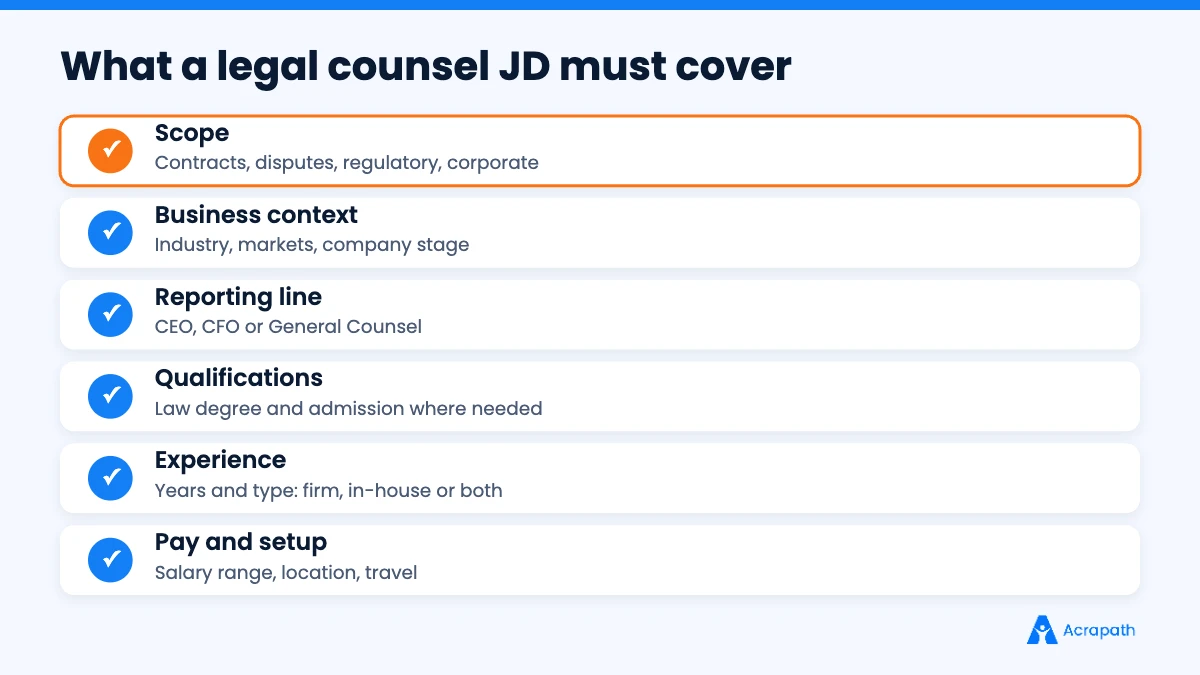
For the general rules of writing a strong JD, see our guide on how to write a job description.
Legal Counsel Job Description Template
Copy this template and customise the bracketed parts.
Job title: Legal Counsel ([Commercial / Corporate / Regulatory])
Location: [City] · [On-site / hybrid / remote] · [Travel, if any]
Reports to: [General Counsel / CFO / CEO]
About us: [Two lines on your company, industry, markets and size.]
Role summary: We're looking for an in-house legal counsel to be the trusted legal partner for our [sales, product and operations] teams. You'll draft and negotiate contracts, advise on legal and regulatory risk, support our corporate compliance and help the business move quickly while staying protected.
Key responsibilities:
Draft, review and negotiate commercial contracts, including customer, vendor, partnership and NDAs
Build and maintain contract templates and a simple contract approval process
Advise teams on legal risks in new products, markets and campaigns
Track relevant laws and regulations and help implement required changes
Support corporate and secretarial compliance, board documents and filings, with the company secretary where applicable
Manage external counsel on disputes, specialist matters and transactions, including scope and budgets
Support data protection, employment and intellectual property matters
Run short legal training sessions for business teams
Qualifications:
Law degree from a recognised university
[Admission or enrolment as a lawyer in (jurisdiction), where required for the role]
[3-7] years of experience at a law firm, in-house or both, with strong commercial contracts exposure
Experience in [industry, e.g. SaaS, fintech, healthcare, manufacturing] is a strong plus
Skills:
Clear, practical drafting and negotiation
Ability to explain legal risk in plain language and recommend options
Commercial judgement: knowing when risk is acceptable
Organisation and prioritisation across many requests
High integrity and discretion with confidential information
What we offer: [Salary range], [bonus or equity], [benefits], [learning budget], [work setup].
How to apply: Send your resume and a short note on a contract or legal issue you handled that you're proud of.
Variant 1: Startup's First In-House Lawyer
For your first legal hire, adjust:
Title: "Legal Counsel (First Legal Hire)" or "Head of Legal" if they'll build the function.
Summary: Make clear they'll set up templates, processes and the external counsel panel from scratch.
Responsibilities: Add fundraising support, ESOP documentation, policies and a contract management system.
Skills: Emphasise breadth, independence and comfort with ambiguity.
Our case study on hiring a startup's first in-house counsel shows how one company defined and filled this role.
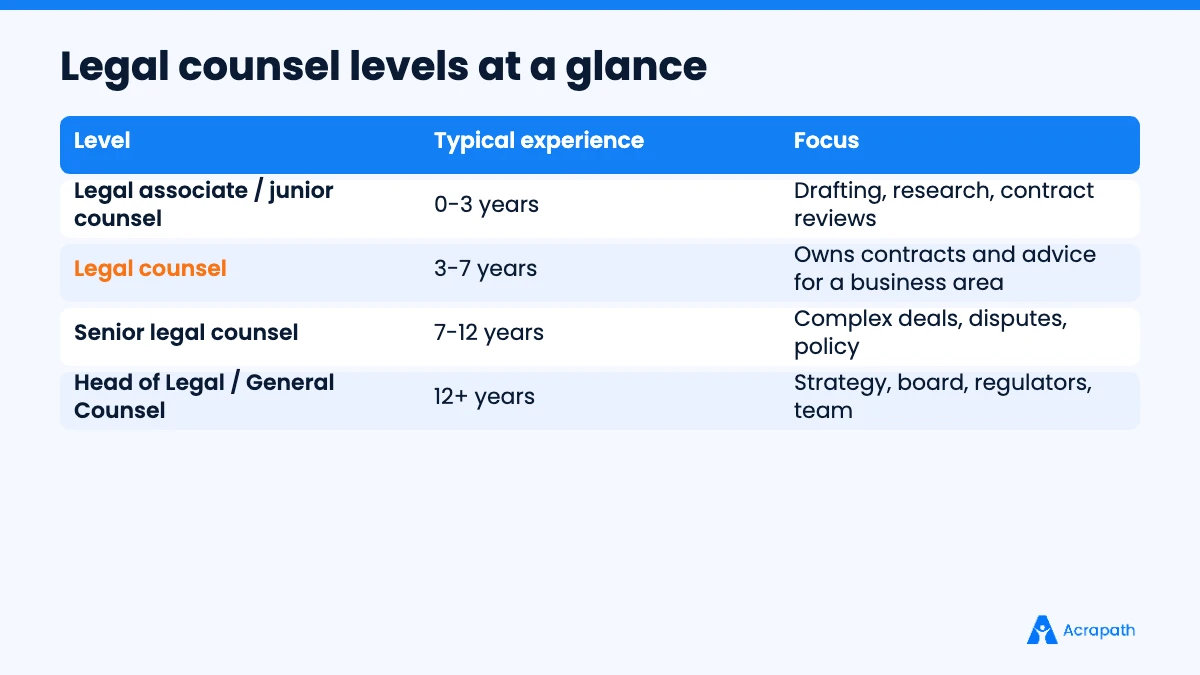
Variant 2: Senior Legal Counsel
For a senior role, add:
Ownership of complex transactions, major disputes or a regulatory area.
Leading or mentoring junior lawyers and paralegals.
Board and leadership reporting.
Building legal policies and risk frameworks.
Legal Counsel KPIs to Include
Including how success is measured helps candidates understand expectations:
KPI | What it shows |
|---|---|
Contract turnaround time | Whether legal speeds up or slows down the business |
Share of contracts on standard templates | Process efficiency and risk control |
External legal spend vs budget | Smart use of outside counsel |
Regulatory deadlines met | Compliance reliability |
Internal stakeholder satisfaction | Whether teams see legal as a partner |
Disputes avoided or resolved early | Risk prevention |
Legal Counsel Salary: How to Set the Range
In-house legal pay varies by country, city, industry, company stage and level. Build your range from current local postings and recruiter feedback.
As a reference point, the US Bureau of Labor Statistics reported a median annual wage of $151,160 for lawyers in May 2024. Startups often combine a lower base salary with equity, while regulated industries such as banking and pharma usually pay a premium.
Sharing a range in the job post saves time for both sides and reduces late-stage drop-outs.
How to Assess Legal Counsel Candidates
The job description attracts the right applicants. Your process selects the best one.
Screen for relevant experience, not only the law school or firm name.
Run a contract review exercise: give a sample vendor or customer contract and ask for a marked-up version and a five-line summary of key risks for a non-lawyer. Keep it to about 60-90 minutes.
Hold a structured interview on judgement, business sense and communication. Our guide to structured interviews includes a scorecard you can adapt.
Ask scenario questions, such as "Sales wants to sign today, but the indemnity clause is uncapped. What do you do?"
Check references with former managers and internal clients, not only partners at the firm.
Send a clear offer. Use our offer letter format.
For a full step-by-step approach, see our complete hiring process guide. For more question ideas, use our interview questions to ask candidates.
Common Mistakes in Legal Counsel Job Descriptions
Listing every area of law. Name the 3-4 areas that make up most of the work.
Asking for big-firm pedigree only. Strong in-house lawyers come from many backgrounds.
Hiding the business context. Lawyers want to know the industry and how legal supports growth.
Not stating the reporting line. It signals the role's influence and seniority.
No salary range. Expect more drop-outs at the offer stage.
Conclusion
A strong legal counsel job description names the legal scope and business context, sets out qualifications and experience clearly, shares KPIs and a salary range, and reflects whether you need a first lawyer or a specialist. Use the template above, choose the variant that fits, and pair it with a contract review exercise and structured interview.
Your next step: write down the three types of legal work that take up most of your outside counsel's time. That list is the core of your role scope.
When you're ready to hire, find verified legal and compliance professionals through Acrapath.
- #legal counsel job description
- #in-house counsel
- #JD template
- #legal hiring
- #corporate lawyer
Frequently asked questions
What does an in-house legal counsel do?
An in-house legal counsel advises a company on legal matters from inside the business. They draft and negotiate contracts, manage legal risk, support corporate and regulatory compliance, handle disputes with outside lawyers, train teams on legal issues and help leadership make decisions that are commercially sound and legally safe.
What qualifications should a legal counsel have?
Most legal counsel roles require a law degree and, where the role involves practising law, admission or enrolment as a lawyer in the relevant jurisdiction. Employers also look for experience in contracts, corporate law or their industry's regulations. Rules on in-house practice vary by country, so check local requirements.
What is the difference between legal counsel and general counsel?
Legal counsel is usually a specialist or mid-level in-house lawyer who handles contracts and day-to-day legal advice. General counsel is the most senior lawyer, often leading the legal function, advising the board and owning overall legal strategy. Small companies may hire one person who grows into the general counsel role.
When should a startup hire its first in-house lawyer?
Many startups hire their first in-house lawyer when contract volume, fundraising, regulation or outside legal bills grow enough that a full-time lawyer is better value than relying only on external firms. A common trigger is when sales or partnerships are slowed by waiting for contract reviews.
How do you assess a legal counsel candidate?
Use a short written exercise, such as reviewing a sample contract and flagging risks with suggested edits, plus a structured interview on judgement, business sense and communication. Ask how they would explain a legal risk to a non-lawyer and how they decide when to escalate to outside counsel.


