Candidate Rejection Emails That Don't Burn Bridges (7 Templates)

Jatin Kashyap
Growth Lead, Acrapath
Seven copy-ready candidate rejection email templates for every stage, from application to final round, plus how to give feedback, what to avoid and how fast to send them.
This article is general guidance, not legal advice. Employment and data protection rules differ by country; check local requirements for candidate communication and record keeping.
Key Takeaways
A good candidate rejection email is prompt, personal, clear about the decision and kind in tone, and it leaves the door open when you mean it.
Silence is common: Greenhouse platform data reported by Axios found only 4% of about 6,500 companies contacted all rejected applicants in Q2 2024.
It costs you later: LiveCareer's survey found 48% of candidates won't apply again to an employer that ghosted them.
Use 7 templates to cover every stage, from unshortlisted applicants to final-round runners-up.
For final-round candidates, call first, then confirm by email within 1-2 working days.
A candidate spends a week preparing for your final round. They take a half-day off work, meet three of your team and send a thoughtful thank-you note. Then they hear nothing. Ever.
Most hiring teams don't mean to ghost anyone. They're busy, the role is still open, and writing rejections feels uncomfortable. But silence leaves a lasting impression, and that candidate will tell friends, colleagues and sometimes the internet.
A short, respectful rejection takes two minutes with a good template. It protects your employer brand, keeps strong runners-up interested in future roles and reflects how you treat people.
This guide gives you seven copy-ready candidate rejection email templates for every hiring stage, plus guidance on timing, feedback and what to avoid.
Why Candidate Rejection Emails Matter
Rejection emails are part of your hiring process, not an afterthought. They matter because:
Candidates expect them. iHire's 2025 survey found 53% of job seekers had been ghosted by a potential employer.
Silence damages your brand. LiveCareer's Ghosting Consequences Report found 48% of candidates won't apply again after an employer ghosts them.
Few employers do it well. Greenhouse data, reported by Axios, showed only 4% of roughly 6,500 companies on its platform contacted all rejected applicants in Q2 2024.
Today's rejected candidate is tomorrow's hire, customer or referrer. Especially in small industries and cities.
Good rejection practice is one of the cheapest ways to stand out as an employer.
Which Template to Use, and When
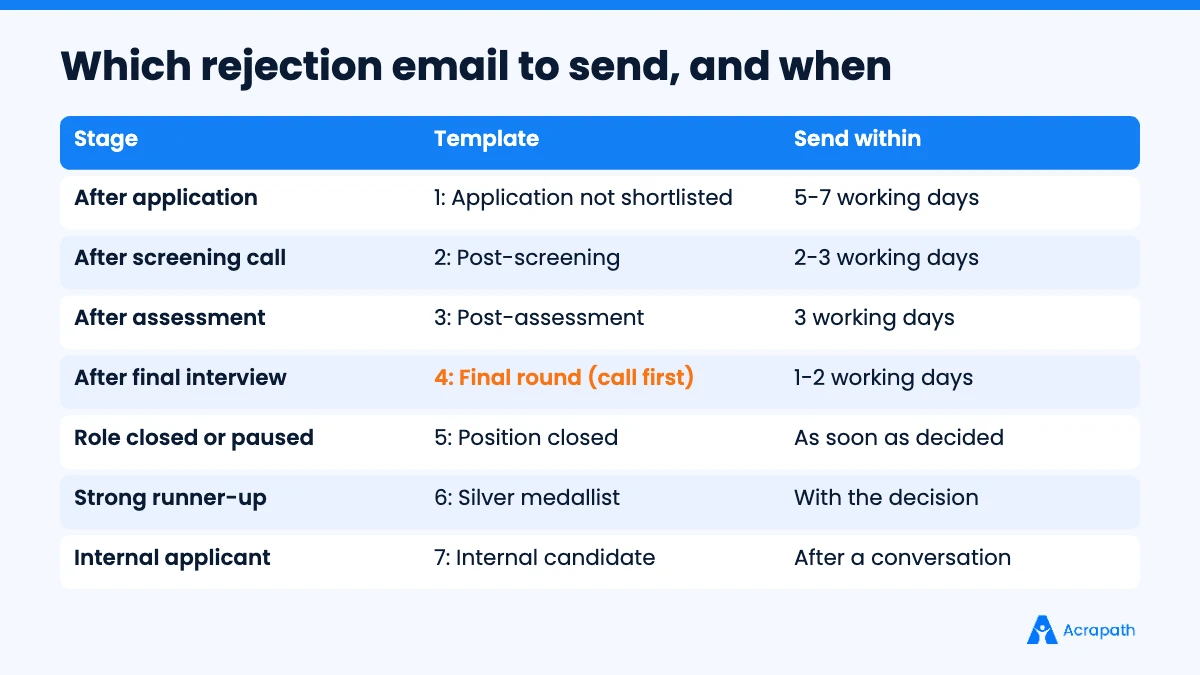
7 Candidate Rejection Email Templates
Personalise the bracketed parts. Send from a real person's address for later-stage candidates.
Template 1: Application Not Shortlisted
Subject: Your application for [Job title] at [Company]
Hi [First name],
Thank you for applying for the [Job title] role at [Company] and for your interest in joining our team.
We received many strong applications. After careful review, we've decided not to move forward with your application for this role, as we're focusing on candidates whose experience more closely matches our current requirements.
We appreciate the time you took to apply and wish you every success in your job search.
Best regards,
[Name], [Title]
Template 2: After a Screening Call
Subject: Update on your [Job title] application
Hi [First name],
Thank you for speaking with me on [day]. I enjoyed learning about your work at [Current company].
After reviewing all our conversations, we've decided to move forward with candidates whose experience in [specific area, e.g. enterprise sales] is closer to what this role needs right now.
Thank you again for your time. I wish you all the best with your next step.
Kind regards,
[Name]
Template 3: After an Assessment or Take-Home Task
Subject: Your [Job title] assessment
Hi [First name],
Thank you for completing the [assessment name]. We know it takes real time and effort, and we appreciate it.
After reviewing all submissions against our scoring criteria, we won't be progressing your application this time. [Optional: One area that stood out was (positive point). The strongest submissions went further on (job-related criterion).]
Thank you again, and we wish you every success.
Best regards,
[Name]
Template 4: After the Final Interview
Call the candidate first if you can, then send this email.
Subject: Thank you, [First name]
Hi [First name],
Thank you again for your time throughout our process and for speaking with me earlier today.
As I mentioned, it was a close decision, and we've offered the role to another candidate whose experience in [specific, job-related area] was a slightly closer match for our needs.
The team was impressed by [specific strength, e.g. your analysis of the pricing case]. If you'd like more detailed feedback, I'm happy to set up a short call.
We'd genuinely like to stay in touch for future roles that fit your experience.
Warm regards,
[Name], [Title]
Template 5: Position Closed or Paused
Subject: Update on the [Job title] role
Hi [First name],
I wanted to let you know that we've decided to [close / pause] hiring for the [Job title] role due to [a change in business priorities / budget changes].
This isn't a reflection of your application, and we're sorry for any inconvenience. If the role reopens, we'll reach out to let you know.
Thank you for your interest in [Company].
Best regards,
[Name]
Template 6: Silver Medallist (Strong Runner-Up)
Subject: Staying in touch, [First name]
Hi [First name],
Thank you for everything you put into our process for the [Job title] role. While we've offered the position to another candidate, you were one of our final two, and the team would very much like to keep in touch.
With your permission, we'd like to contact you first when a similar role opens in the coming months. Would that work for you?
Thank you again, and all the best until then.
Warm regards,
[Name]
Template 7: Internal Candidate
Always speak to internal candidates in person or on a call before sending anything in writing.
Subject: Following up on our conversation
Hi [First name],
Thank you for applying for the [Job title] role and for the time you spent with the panel. As we discussed today, we've selected another candidate for this position.
Your manager and I would like to support your growth toward roles like this. Let's set up time in the next two weeks to agree on development steps, such as [specific skill or project].
Thank you for your commitment to the team.
Best,
[Name]
How to Give Useful Feedback
Feedback is most valuable for candidates who reached later stages. Keep it:
Job-related: tie it to the criteria on your scorecard.
Specific: "Your case answer was strong on analysis but light on the customer impact" beats "not quite the right fit".
Balanced: mention a strength and one area to develop.
Brief: one or two points are enough.
Structured interviews make feedback easier and fairer, because you can refer to scored criteria. Our guide to structured interviews explains how to set up a scorecard.
What to Avoid in a Rejection Email
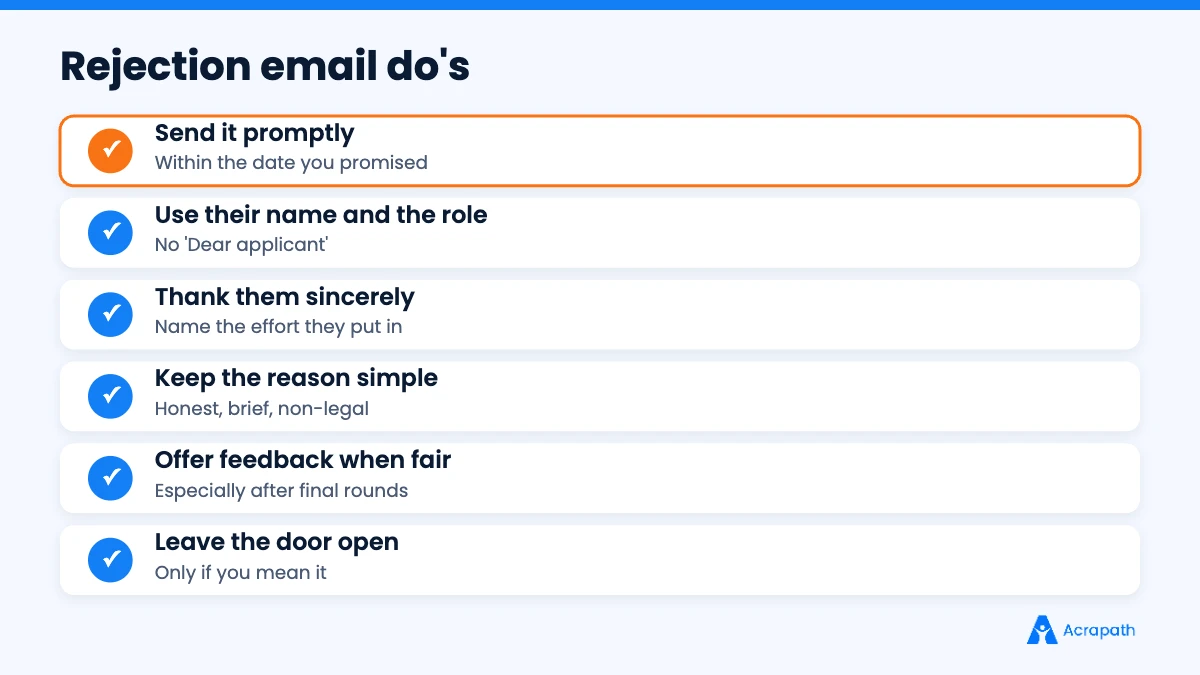
Avoid these common mistakes:
Generic greetings such as "Dear applicant".
False promises like "we'll keep your CV on file" if you won't.
Detailed comparisons with the selected candidate.
Personal comments about age, family, religion, health or appearance. These are irrelevant and may be unlawful.
Over-apologising or long explanations that invite debate.
No-reply addresses for anyone who interviewed with you.
How to Handle Replies to Rejection Emails
Some candidates will reply. Common responses and how to handle them:
Candidate reply | How to respond |
|---|---|
Thanks you for the update | No reply needed, or a short "Thank you, all the best" |
Asks for feedback | Offer one or two job-related points, by email or a short call |
Asks to be considered for other roles | Point them to your careers page or note them for relevant openings |
Disagrees with the decision | Thank them, acknowledge their view, and confirm the decision politely |
Asks why someone else was chosen | Explain at a general, job-related level without naming or comparing |
When to Send Rejection Emails
Timing matters as much as wording:
Send early-stage rejections in batches every few days.
Send post-interview rejections within one to three working days of the decision.
Never miss a date you promised. If you need more time, send a short update.
Avoid sending late at night or just before weekends where possible.
Faster decisions also help: our guide to cutting time to hire shows how to remove delays between stages.
Automating Rejections Without Losing the Human Touch
Use your applicant tracking system or hiring pipeline to automate early-stage rejections, but personalise the name and role. For candidates who interviewed, send emails individually from a named person.
Track rejection status alongside other stages in your hiring pipeline, so no candidate is left waiting. Acrapath's hiring pipeline lets you move candidates through stages and record rejection reasons, which also helps you spot patterns in your process.
Conclusion
Candidate rejection emails take minutes but shape how people talk about your company for years. Send them promptly, personalise the name and role, keep the reason brief and job-related, and offer feedback to candidates who invested real time.
Your next step: save these seven templates in your email tool or hiring pipeline today, so the next decision goes out the same day.
For the bigger picture, read our complete guide to the hiring process. And if you'd like help running candidate communication end to end, Acrapath's hiring desk can manage it for you.
- #candidate rejection email
- #rejection email after interview
- #regret letter
- #candidate experience
- #HR templates
Frequently asked questions
How do you write a rejection email to a candidate?
Address the candidate by name, thank them for their time and interest, state clearly that you won't be moving forward with their application for the named role, give a brief, neutral reason if appropriate, offer feedback where fair, and close by wishing them well. Keep it short, warm and prompt.
Should you give a reason when rejecting a candidate?
A short, honest reason is helpful, such as choosing a candidate with more direct experience in a specific area. Avoid detailed comparisons, comments on personal characteristics or anything that could suggest discrimination. For final-round candidates, offer one or two specific, job-related pieces of feedback if they ask.
How long after an interview should you send a rejection email?
Send it as soon as the decision is made, ideally within one to three working days after an interview and always by the date you promised. Fast rejections are more respectful than long silence and let candidates focus on other opportunities.
Is it better to reject a candidate by phone or email?
For early stages, email is fine. For candidates who reached the final round or spent significant time on assessments, a short phone call followed by an email is more respectful. The call lets you thank them personally and share feedback, and the email confirms the decision.
What should you avoid in a candidate rejection email?
Avoid vague delays, generic 'Dear applicant' greetings, false promises to keep CVs on file, detailed comparisons with other candidates, and any comment about age, gender, family, religion, health or other personal characteristics. Also avoid sending rejections at odd hours or from no-reply addresses for late-stage candidates.