How to Write a Job Offer Letter (Free Template Included)

Jatin Kashyap
Growth Lead, Acrapath
Use this offer letter format and free template to write clear job offers: what to include, how to send an offer that gets accepted, country notes and common mistakes.
General information, not legal advice. Employment rules differ by country and state, so check local law or take advice before finalising your offer letter template.
Key Takeaways
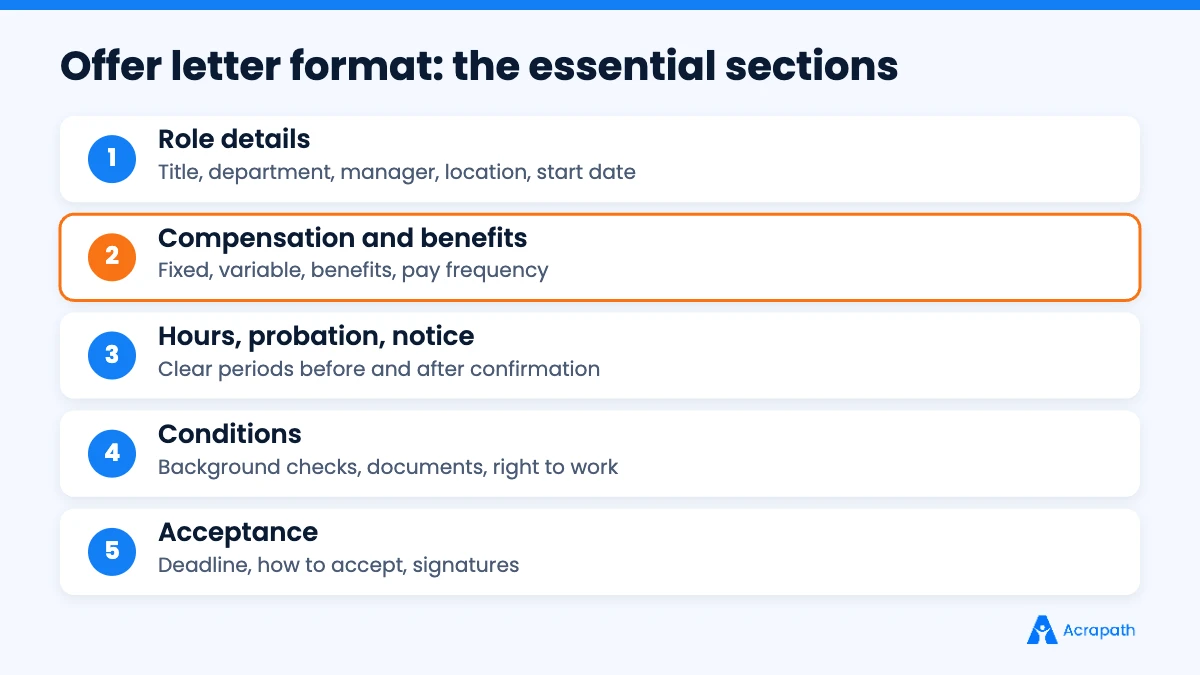
A clear offer letter format covers 10–12 essentials: job title, start date, location, reporting line, compensation, benefits, working hours, probation, notice period, conditions of the offer, acceptance deadline and signatures.
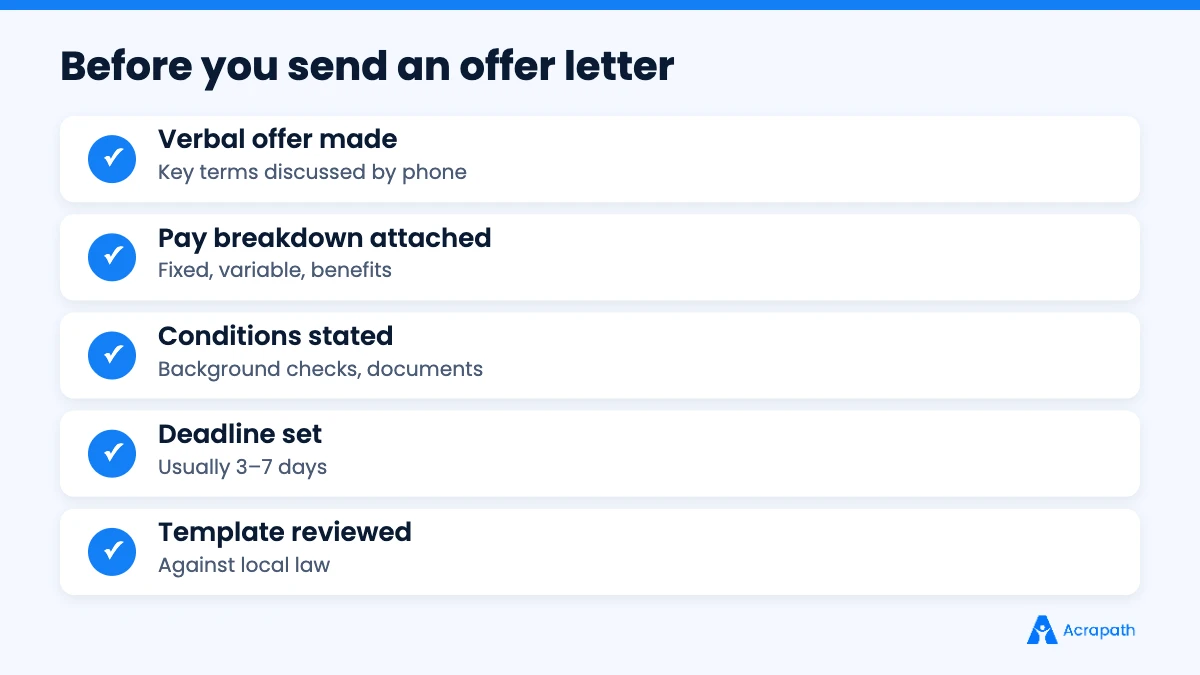
Send the written offer within 24–48 hours of a verbal offer, and give candidates a reasonable deadline, usually 3–7 days.
Break down pay clearly: fixed salary, variable pay, bonuses and benefits. Vague numbers cause renegotiation and dropouts.
State any conditions upfront, such as background verification or document checks.
An offer letter is not always the full employment contract. Many employers follow it with an appointment letter or detailed contract.
You've found the right candidate after weeks of searching and interviewing. Now one document decides whether they actually join: the offer letter. A clear, warm and accurate offer gets a quick yes. A vague or confusing one invites questions, delays and sometimes a better offer from somewhere else.
The good news is that a strong offer letter isn't complicated. It needs the right details, in the right order, written in plain language.
This guide explains the standard offer letter format, what each section should include, a copy-ready template, how to send an offer so it gets accepted, and the mistakes that cause candidates to hesitate.
What Is a Job Offer Letter?
A job offer letter is a formal document an employer sends to a selected candidate to confirm the job and the main terms of employment, such as the role, start date, pay and conditions. The candidate signs to accept. It turns a verbal "we'd like to hire you" into a written record both sides can rely on.
People often confuse three related documents:
Document | Purpose | When it's issued |
|---|---|---|
Offer letter | Confirms the job and key terms; candidate accepts | After selection, before joining |
Appointment letter | Confirms appointment with fuller terms and conditions | Often on or after joining |
Employment contract | Detailed legal agreement covering all terms | Before or at joining, depending on country and company |
Some companies combine these into one document. Others use a short offer letter first, then a detailed contract. Either way, keep the terms consistent across all of them.
What to Include in an Offer Letter
Company details: letterhead with company name, address and contact details.
Date and candidate details: name and address of the candidate.
Job title and department: exactly as it will appear in records.
Reporting manager: name and title.
Start date and work location: office address, hybrid arrangements or remote setup.
Employment type: full-time, part-time, fixed-term or contract.
Compensation: fixed salary, variable pay, bonuses and pay frequency, with a breakdown annexure where useful.
Benefits: insurance, leave, retirement contributions and allowances.
Working hours and probation: standard hours, shifts and the probation period.
Notice period: during and after probation.
Conditions of the offer: background verification, reference checks, document submission, any required licences or right-to-work checks.
Acceptance instructions and deadline: how to accept and by when.
Signatures: an authorised company signatory, with space for the candidate's signature.
Offer Letter Template
Copy this template and replace everything in square brackets. Have it reviewed against local law before using it as your standard template.
[Company Name]
[Company Address] | [Email] | [Phone]
Date: [Date]
To: [Candidate Name], [Candidate Address]
Subject: Offer of Employment – [Job Title]
Dear [Candidate First Name],
We are delighted to offer you the position of [Job Title] in our [Department] team at [Company Name]. We were impressed by [one specific strength from the interviews], and we believe you'll make a great contribution to the team.
Position details
Job title: [Job Title]
Reporting to: [Manager Name, Title]
Employment type: [Full-time / Part-time / Fixed-term until date]
Work location: [Office address / Hybrid – X days in office / Remote]
Start date: [Date]
Compensation and benefits
Fixed salary: [Amount and currency] per [year / month], paid [monthly / fortnightly]
Variable pay or bonus: [Amount or % and how it is calculated], subject to [performance criteria and company policy]
Benefits: [health insurance, leave entitlement, retirement contributions, allowances]
A detailed compensation breakdown is attached as Annexure A.
Working hours and probation
Standard working hours: [hours and days]
Probation period: [number] months, during which the notice period is [number] days
Notice period after confirmation: [number] days
Conditions of this offer
This offer is subject to [satisfactory background verification, reference checks, submission of the documents listed in Annexure B and confirmation of your right to work in country].
Acceptance
To accept this offer, please sign and return a copy of this letter by [deadline date]. If you have any questions, contact [HR contact name] at [email or phone].
We're excited to welcome you to [Company Name] and look forward to working with you.
Sincerely,
[Name]
[Title], [Company Name]
Acceptance by candidate: I accept the offer of employment on the terms set out above.
Signature: ________ Name: ________ Date: ________
Variations for Common Situations
Freshers and graduate hires: include training period details, any service agreement clearly explained, and the joining date with the documents needed. Our guide on how to hire freshers explains how to reduce reneges between offer and joining.
Interns: state the internship duration, stipend, working hours, learning goals and whether a full-time offer is possible at the end.
Contract or fixed-term roles: include the end date or project scope, renewal conditions and how payment works.
Senior hires: you may need sections on equity or long-term incentives, confidentiality, non-solicitation and relocation support.
Your first employee: keep it simple but complete. Our guide on how to hire your first employee covers the paperwork around it.
How to Send an Offer Letter (Step-by-Step)
Step 1: Make a verbal offer first
Call the candidate, share the good news and walk through the key terms: title, pay, start date. Listen for questions or concerns before you put anything in writing.
Step 2: Send the written offer within 24–48 hours
Speed matters. Good candidates often have other options, and a quick written offer shows you're organised and serious.
Step 3: Give a reasonable deadline
Three to seven days is common. Too short feels like pressure; too long invites shopping around.
Step 4: Make acceptance easy
Use e-signature where possible, and give a named contact for questions.
Step 5: Handle negotiation professionally
Candidates may ask for more pay, a joining bonus or a different start date. Decide your limits in advance and respond quickly. If you agree changes, issue a revised offer letter rather than relying on email.
Step 6: Stay in touch until joining
Send a welcome note, share what the first day looks like and confirm documents. Candidates who feel connected are far less likely to accept a last-minute counter-offer.
Country Considerations
Requirements vary, so treat these as starting points to check with local guidance:
UK: employers must give employees a written statement of the main terms of employment on or before their first day. See GOV.UK's guidance on written statements.
India: many employers issue an offer letter followed by an appointment letter. State-level shops and establishments rules and other labour laws may apply depending on your location and business type.
UAE: private-sector employment is governed by contracts under the UAE's labour framework, with registration through the relevant authorities.
US: many jobs are "at will", and offer letters often say so. Some states also have pay transparency or notice requirements.
Make sure the notice period in your offer matches your actual policy. Candidates read it closely, as our jobseeker guide to the notice period shows.
Common Offer Letter Mistakes
Unclear pay. Mixing up CTC, fixed and variable pay causes disputes. Add a clear breakdown.
Missing conditions. If the offer depends on background checks, say so upfront.
Inconsistent terms between the offer letter, appointment letter and policies.
No acceptance deadline, which leaves roles open for weeks.
Cold, generic wording. One personal line about why you chose them makes a difference.
Slow delivery. Every day between verbal and written offer increases the risk of losing the candidate.
Before You Send the Offer
An offer is only as good as the hiring decision behind it. Make sure you chose fairly and consistently with a structured interview and the right interview questions to ask candidates. Candidates are preparing too: many read guides like ours on how to negotiate salary, so expect thoughtful questions and be ready with clear answers.
Conclusion
A clear offer letter format confirms the role, pay, benefits, start date, probation, notice period and conditions in plain language, with a deadline and an easy way to accept. Make a verbal offer first, send the written letter within 24–48 hours, handle negotiation professionally and stay in touch until joining day.
Get it right, and your offer letter becomes the first great experience your new employee has with your company.
Want help from shortlist to signed offer? Acrapath's hiring desk can support your hiring end to end.
- #offer letter format
- #job offer letter template
- #appointment letter
- #hiring process
- #HR templates
Frequently asked questions
What should a job offer letter include?
Include the job title, department, reporting manager, start date, work location, employment type, compensation breakdown, benefits, working hours, probation and notice periods, conditions such as background verification, acceptance instructions with a deadline, and signatures from an authorised company representative and the candidate.
What is the difference between an offer letter and an appointment letter?
An offer letter confirms that the candidate has been selected and sets out the main terms for acceptance before joining. An appointment letter, often issued on or after joining, confirms the appointment with fuller terms and conditions. Some employers combine both into one document.
How long should a candidate get to accept an offer?
Three to seven days is common. A shorter deadline can feel like pressure, while a much longer one gives the candidate time to collect other offers. If a candidate needs a little more time for a good reason, a short extension is usually reasonable.
Is an offer letter legally binding?
It depends on the country, the wording and what has been agreed. In some places a signed offer letter can form part of the employment contract. Because rules differ, have your offer letter template reviewed against local law and keep its terms consistent with your contracts and policies.
Can an employer withdraw a job offer?
Employers sometimes withdraw offers, for example if background checks fail or stated conditions are not met. Withdrawing for other reasons may carry legal or reputational risk depending on local law and how far the process has gone. State conditions clearly in the offer to avoid disputes.