How to Hire an SEO Specialist: Skills Test and Interview Questions

Jatin Kashyap
Growth Lead, Acrapath

Learn how to hire an SEO specialist: types of SEO roles, skills to look for, red flags, a ready-to-use skills test with a scoring rubric, interview questions and a 90-day plan.
Key Takeaways
To hire an SEO specialist who delivers, first decide what you need most: technical SEO, content and on-page SEO, local SEO, e-commerce SEO or link building and digital PR.
Judge candidates on evidence: past traffic and ranking results they can explain, plus a short practical skills test on your own site.
A 60–90 minute audit-style test, scored with a rubric, reveals far more than a CV or a list of tools.
Treat promises of guaranteed rankings or cheap link packages as red flags. Google's spam policies warn against manipulative link schemes.
Set realistic expectations: SEO results usually build over several months, so agree leading indicators for the first 90 days.
Organic search can become one of your most valuable growth channels: steady traffic, qualified leads and sales that don't stop the moment you pause an ad budget. But it only works if the person running it knows what they're doing.
The problem is that SEO is easy to talk about and hard to do well. Many candidates can list tools and buzzwords. Fewer can explain exactly how they grew traffic, why it worked and what they'd do on your site.
This guide shows you how to hire an SEO specialist step by step: the different types of SEO roles, the skills that matter, red flags to avoid, a ready-to-use skills test with a scoring rubric, interview questions and the KPIs to set once they join.
What Does an SEO Specialist Do?
An SEO specialist improves a website's visibility in search engines so it attracts more relevant, unpaid traffic. They research the keywords customers use, optimise pages and content, fix technical issues that stop search engines crawling and understanding the site, earn quality links and mentions from other websites, and measure results using tools such as Google Search Console and Google Analytics.
Good SEO specialists work closely with content writers, developers, designers and marketers. Much of their impact depends on getting other people to make changes, so communication matters as much as technical skill.
Types of SEO Roles
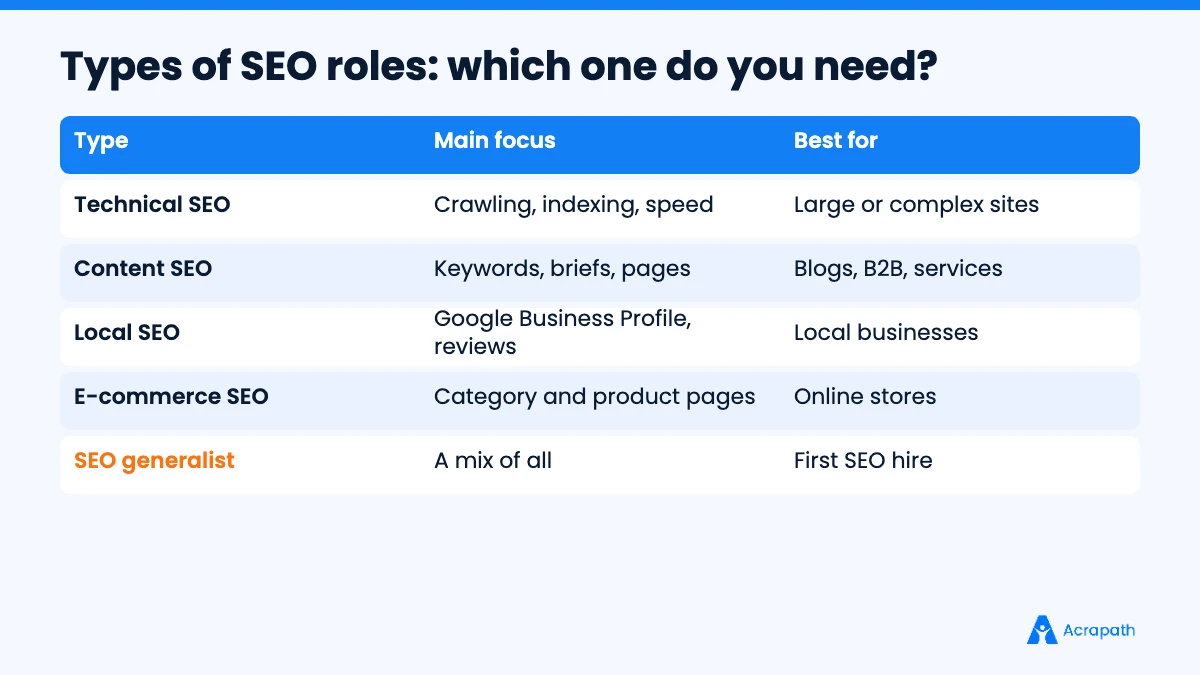
"SEO specialist" can mean very different jobs. Decide which one you need before you write the job post.
Type | Main focus | Best for |
|---|---|---|
Technical SEO | Site speed, crawling, indexing, site structure, structured data | Large, complex or developer-heavy websites |
Content and on-page SEO | Keyword research, content briefs, page optimisation | Blogs, publishers, B2B and service businesses |
Local SEO | Google Business Profile, local listings, reviews | Clinics, stores, restaurants and local services |
E-commerce SEO | Category and product pages, filters, catalogue structure | Online stores with large catalogues |
Off-page SEO and digital PR | Earning links and brand mentions | Brands that need authority in competitive markets |
SEO generalist | A mix of all the above | Small teams hiring their first SEO person |
Most small and mid-sized companies need a generalist with one or two strong areas. Larger teams often hire specialists for technical SEO and content separately.
In-House, Agency or Freelancer?
Option | Strengths | Watch out for |
|---|---|---|
In-house SEO specialist | Deep knowledge of your product, works closely with your team | Needs ongoing tools budget and management |
SEO agency | Broad expertise, tools and capacity | Less context, quality varies by account manager |
Freelancer | Flexible, cost-effective for specific projects | Limited availability and continuity |
Many companies start with a freelancer or agency for an audit, then hire in-house once SEO proves its value. If you're building a broader marketing team, our guide to hiring a digital marketer and our digital marketing manager job description show how SEO fits into the wider team.
Skills to Look For
Hard skills
Keyword and search intent research: finding what customers search for and what kind of page answers it best.
On-page optimisation: titles, headings, internal links, content structure and meta descriptions.
Technical SEO basics: crawling, indexing, sitemaps, robots rules, canonical tags, redirects, page speed and mobile usability.
Content strategy: turning keyword research into briefs and editorial plans.
Analytics: Google Search Console, Google Analytics 4 and reporting dashboards.
SEO tools: crawlers such as Screaming Frog and keyword tools such as Semrush or Ahrefs.
Link building or digital PR: earning links through useful content, outreach and relationships.
Soft skills
Prioritisation: choosing the few changes that will matter most.
Communication: writing clear briefs and explaining technical issues to non-technical people.
Patience and persistence: SEO results take time and repeated effort.
Curiosity: search engines change often, so the best specialists keep learning.
A good grounding in Google's own guidance is a must. Ask candidates how they use Google Search Central's SEO starter guide and documentation in their work.
Experience by Level
Level | Typical experience | What they should own |
|---|---|---|
SEO executive | 0–2 years | On-page updates, keyword research, reporting under guidance |
SEO specialist | 2–5 years | SEO for a site or section, audits, content strategy, results |
Senior SEO or SEO manager | 5+ years | Strategy, team or agency management, complex technical projects |
Years of experience matter less than results. A candidate with three years who grew a site's organic leads significantly can be stronger than one with eight years of routine reporting.
Red Flags When Hiring for SEO
Guaranteed rankings or "first page in 30 days" promises. No one controls search results.
Cheap link packages or private blog networks. Google's spam policies describe link schemes as manipulative, and they can damage your site.
Can't explain past results. They show a traffic graph but can't say what caused the change.
Only talks about tools. Tools support thinking; they don't replace it.
Ignores content quality and users. Modern SEO is built around helpful content.
No interest in measurement. If they don't ask about your analytics, be cautious.
How to Hire an SEO Specialist (Step-by-Step)
Step 1: Define goals and KPIs
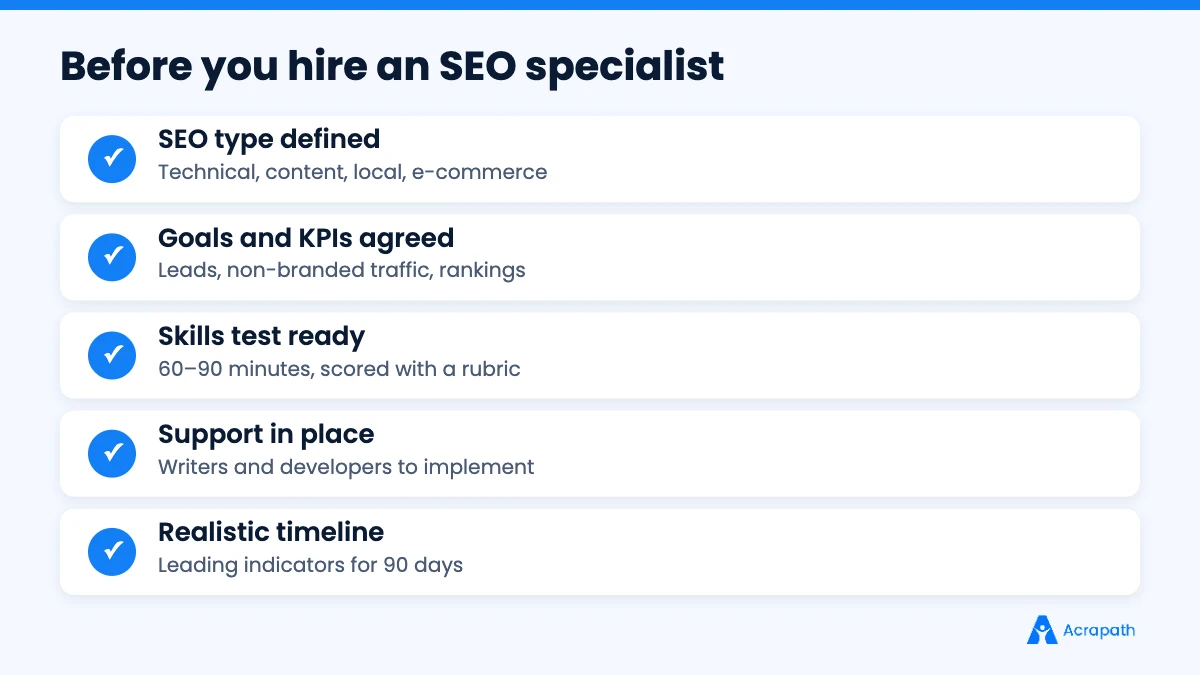
Decide what success looks like in 6–12 months: more qualified organic leads, growth in non-branded traffic, better rankings for key product pages or improved local visibility. These goals shape the job description, the test and your interview questions.
Step 2: Write a focused job description
Name the type of SEO you need, the website and audience, the tools you use and the team they'll work with. Our guide on how to write a job description covers the structure.
Step 3: Source candidates
Look on job portals and candidate databases, SEO and marketing communities, LinkedIn, and among content writers who've grown into SEO. Our list of places to find candidates covers each channel.
Step 4: Screen for evidence
Ask applicants for two short case studies: the site, the problem, what they did and the results, with screenshots from Search Console or analytics where they're allowed to share them. Shortlist candidates who can explain cause and effect clearly.
Step 5: Run a practical skills test
Use the test below. It's the most reliable way to see how a candidate thinks about your site.
Step 6: Hold a structured interview
Ask every finalist the same questions and score answers against a simple rubric. Our structured interview guide includes a scorecard template.
Step 7: Check references and make an offer
Ask references about results, reliability and how well the candidate worked with writers and developers. Then move quickly with a clear offer.
A Ready-to-Use SEO Skills Test
Give finalists 60–90 minutes, or up to 48 hours to fit around their schedule, and keep the scope tight. Pay candidates if you ask for more than a couple of hours.
Task: Review [your website or one section of it] and prepare a short written report or a 10-minute presentation covering:
The three most important technical or on-page issues you see, and why they matter
Five keyword or content opportunities, with the search intent behind each
A suggested priority order for the first 30 days
How you would measure whether your changes worked
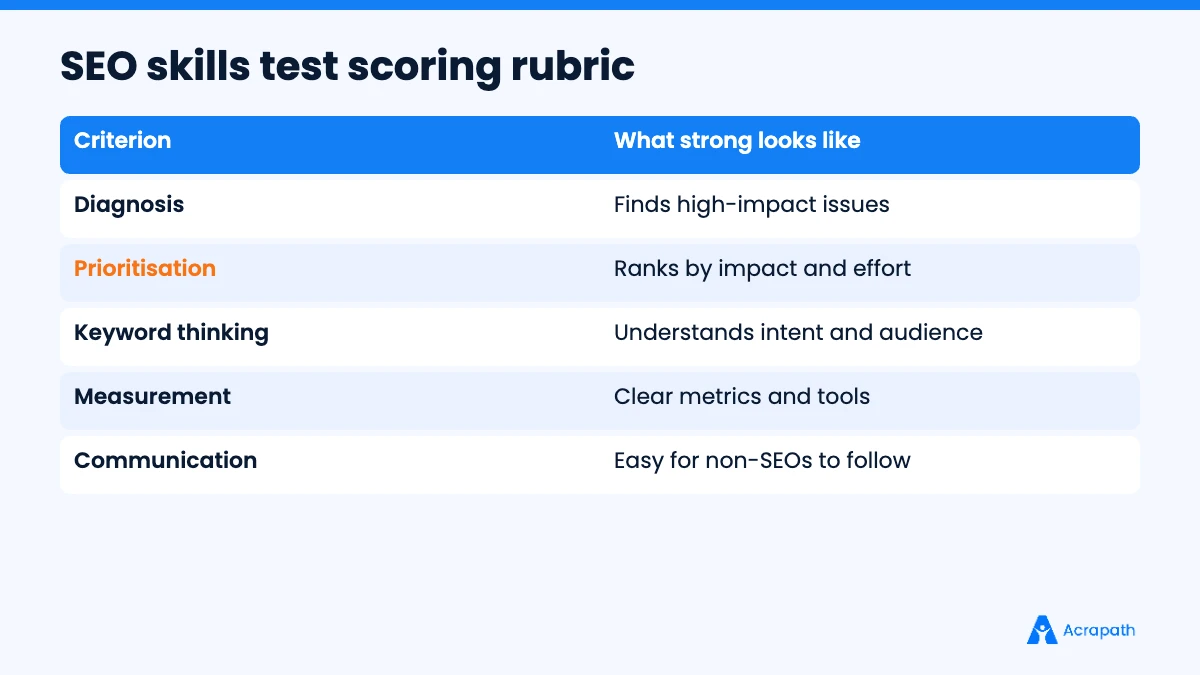
How to score it:
Criterion | What strong looks like | Score (1–4) |
|---|---|---|
Diagnosis | Finds real, high-impact issues, not trivial ones | |
Prioritisation | Ranks fixes by impact and effort | |
Keyword thinking | Understands intent and your audience | |
Measurement | Names clear metrics and tools | |
Communication | Clear, concise, easy for non-SEOs to follow |
Avoid asking candidates to write large amounts of live content or fix your site for free. Our overview of pre-employment assessments explains how to keep tasks fair, and our guide to skills-based hiring shows how tests fit a wider process.
SEO Specialist Interview Questions
"Walk me through an SEO project that grew traffic or leads. What did you change, and how do you know it worked?" Look for a clear baseline, specific actions and an honest explanation of results.
"How do you decide which keywords to target?" Strong answers mention search intent, business value and realistic competition.
"A key page dropped in rankings last week. How do you investigate?" Expect a methodical approach: Search Console, recent site changes, competitors and search result changes.
"How would you approach SEO for a brand-new site with no authority?" Look for a focus on useful content, technical basics and earning links over time.
"What technical issues do you check first in an audit?" Crawling, indexing, redirects, duplicate content, page speed and mobile usability are good signs.
"How do you work with content writers?" Listen for clear briefs, feedback and shared goals.
"How do you get developers to prioritise SEO fixes?" Strong candidates explain business impact and keep requests small and specific.
"What's your view on buying links?" The answer should reflect search engine guidelines and long-term risk.
"Which SEO metrics do you report to leadership?" Look for business outcomes, not just rankings.
"How do you keep up with search changes?" Expect official sources, reputable communities and their own testing.
"Tell me about an SEO change that didn't work." Honesty and learning matter.
"What would you do in your first 30 days here?" Look for audit, quick wins and a measured plan.
For more questions across roles, see our list of interview questions to ask candidates.
Budgeting for an SEO Hire
Salary is only part of the cost. Before you hire, plan for:
Salary: benchmark against current job posts for the same level and city, since pay varies widely by market and specialism.
Tools: a crawler, a keyword research tool and rank tracking can add a meaningful monthly cost. Free tools such as Google Search Console cover the essentials.
Content production: writers, editors or freelance budget to turn keyword research into pages.
Developer time: technical fixes need engineering hours, so agree a regular slot in your development schedule.
Link building or digital PR: time and budget for creating content other sites want to reference.
An SEO specialist without content or development support often ends up producing recommendations that never get implemented.
What Your SEO Specialist Needs on Day One
Set your new hire up to make progress quickly by preparing:
Access to Google Search Console, Google Analytics and your content management system
Access to any SEO tools you already pay for, or a budget to choose them
A list of your priority products, services, markets and audiences
Past SEO reports or audits, and any known issues
Introductions to your content, design and development teams
A clear owner who approves changes, so work doesn't stall
KPIs and a 90-Day Plan
SEO results often take several months to show fully, so agree leading indicators early.
Days 1–30: audit the site, set up or check tracking, agree priorities and fix urgent technical issues.
Days 31–60: improve key pages, publish the first optimised content and build internal links.
Days 61–90: review early signals and expand what's working.
Useful KPIs include non-branded organic clicks, impressions and rankings for priority keywords in Search Console, organic leads or sales, the number of indexed and well-performing pages, and progress on the technical fix list.
Common Mistakes When Hiring for SEO
Hiring on tools and jargon instead of explained results
Expecting instant rankings and judging performance too early
No developer or content support, so recommendations never get implemented
Skipping the skills test, the clearest signal of real ability
Ignoring internal talent: content writers often grow into strong SEO specialists, as our content writer to SEO specialist case study shows
Want to see what candidates prepare? Our jobseeker guide on how to become an SEO specialist shows the skills and tools they're building.
Conclusion
To hire an SEO specialist who delivers, decide which type of SEO you need, set clear goals, and look for candidates who can explain real results. Use a short audit-style skills test scored with a rubric, run a structured interview, avoid anyone promising guaranteed rankings, and give your new hire the content and development support to act on their recommendations.
With the right person and realistic expectations, organic search can become one of your most reliable growth channels.
Ready to find SEO talent? Hire verified marketing professionals through Acrapath.
- #hire SEO specialist
- #SEO skills test
- #SEO interview questions
- #marketing hiring
- #in-house SEO
Frequently asked questions
What should I look for when hiring an SEO specialist?
Look for evidence of results the candidate can explain, strong keyword and search intent research, on-page and technical SEO knowledge, comfort with Search Console and analytics, clear communication with writers and developers, and an approach that follows search engine guidelines rather than shortcuts.
How do I test an SEO specialist's skills?
Give a short, paid or time-limited audit task on your own site. Ask for the top three issues, five keyword or content opportunities, a 30-day priority plan and how they would measure success. Score every candidate with the same rubric for diagnosis, prioritisation, keyword thinking, measurement and communication.
Should I hire an in-house SEO specialist or an agency?
An in-house specialist builds deep product knowledge and works closely with your team, while an agency brings broad expertise and tools but less context. Many companies start with an agency or freelancer for an audit, then hire in-house once SEO proves its value.
How long does SEO take to show results?
It usually takes several months for SEO changes to show their full effect, depending on your site, competition and how quickly changes are implemented. Agree leading indicators for the first 90 days, such as technical fixes completed, impressions and rankings for priority pages.
What are red flags when hiring for SEO?
Be cautious of guaranteed rankings, quick-result promises, cheap link packages or private blog networks, candidates who cannot explain what caused their past results, an obsession with tools over thinking, and little interest in content quality, users or measurement.