9 Pre-Employment Assessments That Predict Job Performance

Jatin Kashyap
Growth Lead, Acrapath
Compare 9 types of pre employment assessment, from work samples to structured interviews, with what research says about each, how to choose a mix and how to keep testing fair.
Key Takeaways
A pre employment assessment is any structured test or exercise used to judge whether a candidate can do the job, such as a work sample, skills test or structured interview.
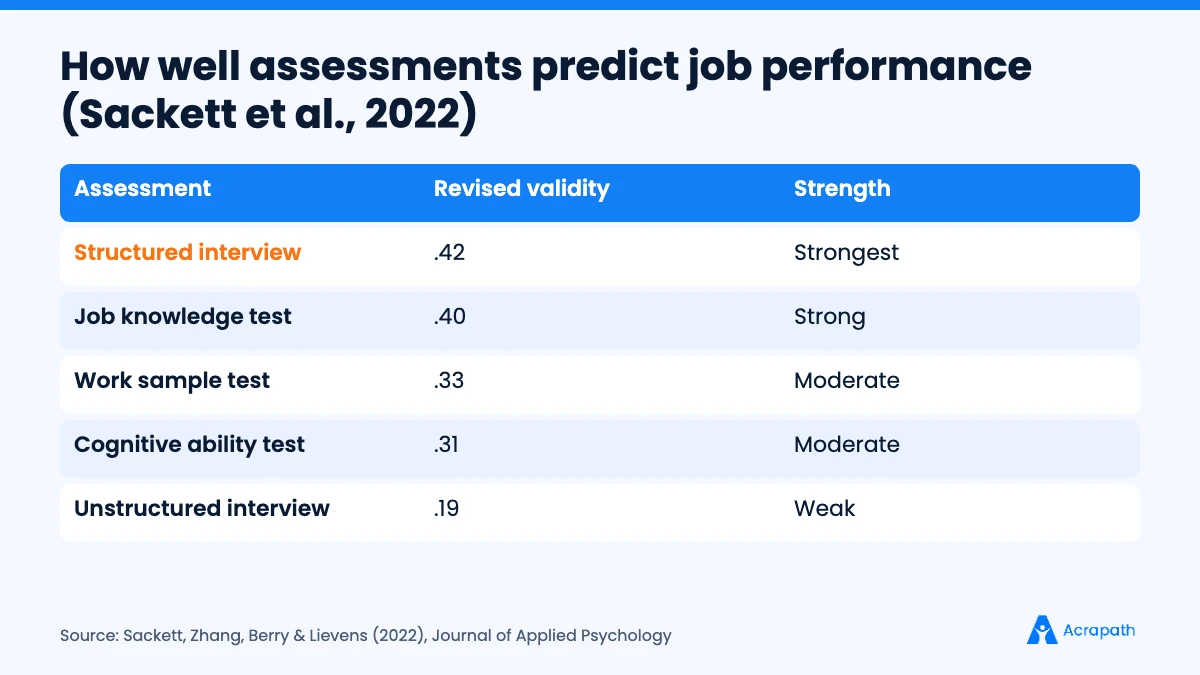
In a 2022 re-analysis of selection research, structured interviews (.42) and job knowledge tests (.40) were among the strongest predictors of job performance, ahead of cognitive ability tests (.31) and unstructured interviews (.19).
Combine 2–3 assessments that match the role rather than piling on tests. Candidates drop out of long processes.
Keep take-home tasks to 1–2 hours, use the same scoring rubric for everyone and explain each step upfront.
Every test must relate to the job, be applied consistently and respect candidates' data and accessibility needs.
Interviews feel informative. You meet the candidate, ask good questions and come away with a strong impression. The trouble is that impressions are a weak predictor of how someone will actually perform. Confident talkers win. Quiet, highly capable people get missed.
A well-chosen pre employment assessment fixes that by adding evidence. Instead of guessing whether a developer can debug code, a marketer can plan a campaign or an accountant can reconcile accounts, you see them do a version of the work.
This guide explains the nine most useful types of assessment, what the research says about how well each one predicts job performance, how to choose the right mix for each role and how to keep the process fair, legal and candidate-friendly.
What Is a Pre-Employment Assessment?
A pre-employment assessment is a structured way to measure a candidate's skills, knowledge, abilities or work behaviours before you hire them. It can be a test, a task, a simulation or a scored interview. What makes it an assessment, rather than a chat, is that every candidate faces the same task and is judged against the same criteria.
Assessments usually sit between the resume screen and the final interview. Used well, they help you:
Predict performance more accurately than resumes and unstructured interviews alone
Reduce bias by judging every candidate against the same standard
Widen your talent pool, because people without a "perfect" resume can prove their ability
Save interview time, since only candidates who pass the assessment reach your senior team
Give candidates a realistic preview of the work, which reduces early dropouts
How Well Do Assessments Predict Job Performance?
Researchers measure this with a "validity" score: the correlation between assessment results and later job performance. Zero means no relationship; higher numbers mean better prediction.
For decades, many HR teams relied on estimates from a 1998 review. In 2022, a team led by Paul Sackett re-analysed the evidence and found that earlier corrections had inflated many figures. Their revised estimates changed the ranking:
Assessment type | Revised validity (Sackett et al., 2022) |
|---|---|
Structured interviews | .42 |
Job knowledge tests | .40 |
Empirically keyed biodata | .38 |
Work sample tests | .33 |
Cognitive ability tests | .31 |
Unstructured interviews | .19 |
Two practical lessons follow. First, no single method is perfect, so combining two or three well-designed assessments gives you a more reliable picture. Second, structure matters: the same interview becomes far more useful when every candidate gets the same questions and a consistent scoring guide.
9 Pre-Employment Assessments That Predict Job Performance
1. Work sample tests
Candidates complete a small, realistic piece of the actual job. Because the task mirrors real work, it shows both skill and approach, and candidates generally see it as fair.
Best for: Roles with visible output: developers, designers, writers, marketers, analysts, accountants.
Example: Ask an accountant to prepare a bank reconciliation from sample statements, or a content writer to edit a 300-word draft.
Watch out for: Long unpaid tasks. Keep it to 1–2 hours, or pay for longer assignments.
2. Technical skills tests
Short tests of a specific tool or skill: coding challenges, Excel tasks, typing speed, design software or language proficiency. They are quick to run and easy to score.
Best for: Roles where one tool or skill is essential from day one.
Example: A 30-minute Excel test with lookups, a pivot table and a simple chart for an MIS executive.
Watch out for: Testing tools the person won't use, or puzzles unrelated to the job.
3. Job knowledge tests
Questions that check what a candidate knows about the field: accounting rules, nursing procedures, tax basics, sales methods or legal concepts. They were among the strongest predictors in the 2022 re-analysis.
Best for: Experienced and regulated roles where knowledge is essential.
Example: Twenty multiple-choice and short-answer questions on GST, TDS and payroll deductions for a senior accountant.
Watch out for: Outdated questions. Review them whenever rules or tools change.
4. Cognitive ability and aptitude tests
Timed tests of reasoning: numerical, verbal, logical or abstract. They show how quickly someone learns and solves new problems.
Best for: Graduate and fresher hiring, and roles that involve learning complex material fast.
Example: A 25-minute numerical and logical reasoning test for a management trainee programme.
Watch out for: Over-reliance. Validity is lower than once thought, and some tests can show group differences, so pair them with job-related assessments.
5. Situational judgement tests (SJTs)
Candidates read realistic workplace scenarios and choose or rank the best responses. SJTs test judgement and priorities without needing job-specific knowledge.
Best for: Customer-facing, supervisory and high-volume roles.
Example: "A customer is angry about a late refund and threatens to post a bad review. What do you do first?" with four options.
Watch out for: Generic scenarios. Base them on real situations from your own workplace.
6. Structured interviews
Every candidate gets the same job-related questions, and answers are scored on a defined scale with examples of good and poor responses. In the 2022 re-analysis, structured interviews ranked as the strongest predictor of performance.
Best for: Every role. This should be part of almost every hiring process.
Example: Five behavioural questions linked to the role's key skills, each scored 1–4 by two interviewers.
Watch out for: Interviewers drifting off-script or scoring by gut feel. Train them and use a scorecard.
7. Personality assessments
Questionnaires that measure work-related traits such as conscientiousness, sociability or emotional stability. They can add useful context about working style.
Best for: Adding context for roles where working style matters, alongside skill-based assessments.
Example: A validated work-personality questionnaire reviewed with the candidate in the final interview.
Watch out for: Using them as pass-fail filters, or using popular "type" tests that weren't designed for selection.
8. Integrity and reliability tests
Questionnaires about attitudes to rules, honesty and dependability. Some employers use them where trust and reliability are central to the role.
Best for: Roles handling cash, sensitive data, stock or security.
Example: A short questionnaire for cashiers or warehouse staff, reviewed alongside references.
Watch out for: Candidate discomfort and legal limits in some countries. Explain why you use it and check local rules.
9. Role-plays, simulations and assessment centres
Candidates act out a realistic situation, such as a sales call, a difficult conversation with a team member or a client presentation. Larger employers sometimes combine several exercises into an assessment centre.
Best for: Sales, customer service, management and leadership roles.
Example: A 15-minute role-play where the interviewer plays a price-sensitive customer.
Watch out for: Unclear scoring. Decide in advance what a strong performance looks like.
Some roles need additional checks, such as physical ability for certain field jobs or language tests for international roles. Use them only where the job genuinely requires that ability.
How to Choose the Right Assessments for Each Role
Start from the job, not the test catalogue. List the 4–6 skills that most predict success, then pick the assessment that tests each one most directly.
Role | Recommended mix |
|---|---|
Software developer | Short coding task + structured technical interview |
Sales executive | Role-play + structured behavioural interview |
Accountant | Job knowledge test + reconciliation work sample |
Digital marketer | Campaign critique work sample + structured interview |
Customer support | Situational judgement test + written reply exercise |
Operations manager | Process case study + structured interview |
Graduate trainee | Aptitude test + group exercise + structured interview |
For role-specific examples, see how we approach a take-home task in our guide to hiring a React Native developer, the case exercise in how to hire an operations manager and the role-play prompts in our sales interview questions to ask.
How to Build a Fair Assessment Process (Step-by-Step)
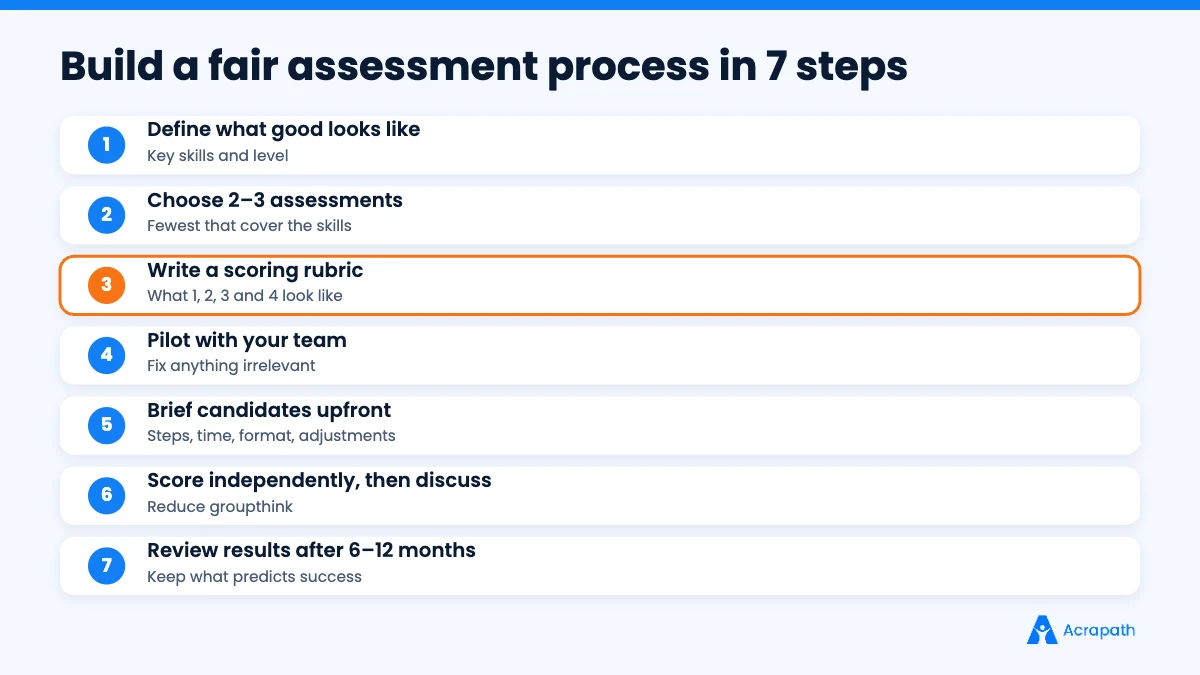
Step 1: Define what good looks like
Write down the key skills and the standard you expect at this level. A junior analyst and a senior analyst should not face the same bar.
Step 2: Choose 2–3 assessments
Pick the fewest assessments that cover your key skills. More stages mean more dropouts, especially among strong candidates with other options.
Step 3: Write a scoring rubric
For each task or question, describe what a 1, 2, 3 and 4 look like. Rubrics make scoring consistent and help you explain decisions later. Our guide to the structured interview includes a scorecard template you can adapt.
Step 4: Pilot it
Ask one or two current team members to try the assessment. If your strong performers struggle or find it irrelevant, fix it before candidates see it.
Step 5: Tell candidates what to expect
Share the steps, time needed, format and deadline at the start. Offer reasonable adjustments for candidates with disabilities or access needs.
Step 6: Score independently, then discuss
Have assessors score on their own before comparing notes. This reduces the influence of the most senior or most confident voice in the room.
Step 7: Review results over time
After six to twelve months, compare assessment scores with how hires actually performed. Keep what predicts success, and drop what doesn't.
Legal, Ethical and Data Considerations
Assessments must be fair and job-related. In the US, the Equal Employment Opportunity Commission explains that employment tests can be unlawful if they screen out protected groups without being job-related and consistent with business necessity. Other countries have their own rules, so check local requirements or take advice for large-scale programmes. This section is general information, not legal advice.
Good practice everywhere:
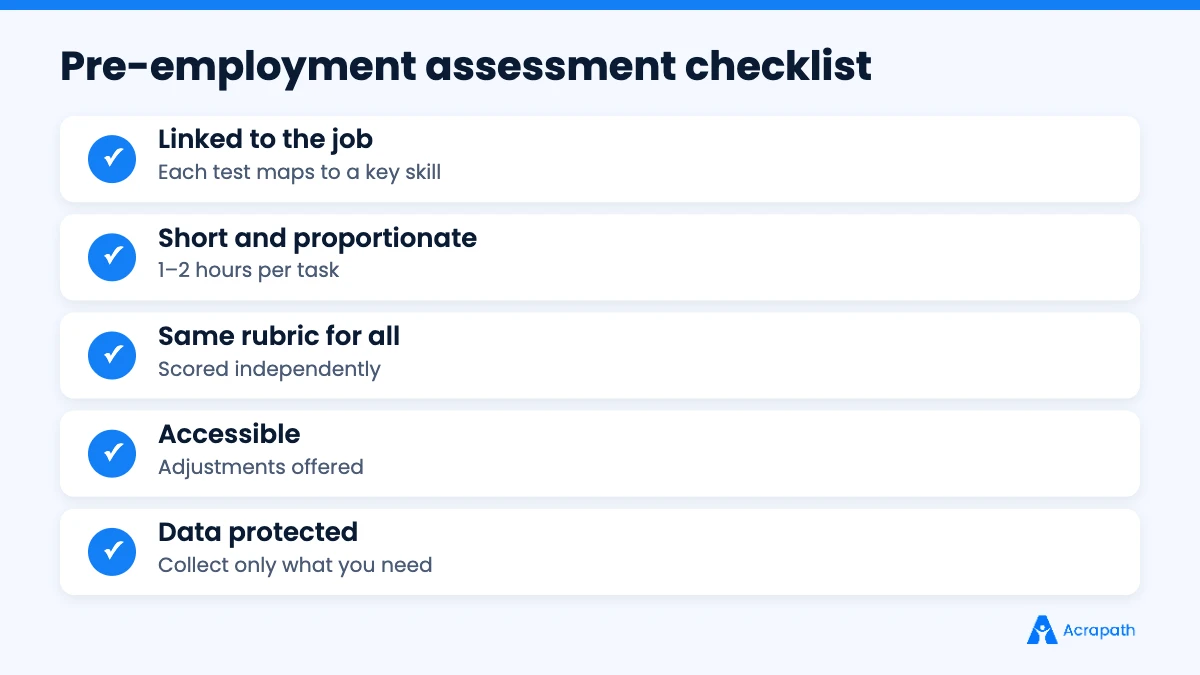
Test only what the job needs, and document why each assessment is relevant.
Apply assessments consistently to every candidate at the same stage.
Provide accessibility adjustments such as extra time or alternative formats when requested.
Protect candidate data. Collect only what you need, store it securely and follow data protection laws such as the EU's GDPR or India's Digital Personal Data Protection Act.
Be careful with AI scoring tools. Ask vendors how their models were validated and checked for bias, and keep a human in the decision.
Keep the Candidate Experience Positive
Assessments can feel like hurdles. A few habits keep strong candidates engaged:
Explain why each assessment exists and how it relates to the job.
Keep total assessment time reasonable for the seniority of the role.
Pay for substantial take-home projects.
Give candidates a short piece of feedback, especially after a task.
Move quickly between stages. Delays cost you more candidates than tests do.
Common Mistakes to Avoid
Testing everything. Five assessments for a junior role drives away good applicants.
Using generic off-the-shelf tests that don't match the job.
No rubric. Without one, assessments become as subjective as unstructured interviews.
Treating one score as final. Use assessments as evidence, alongside other stages.
Never reviewing results. If you don't check which assessments predicted success, you can't improve them.
Assessments work best inside a well-run process. Shortlist fairly with our resume screening process, and see how assessments fit a wider skills-first approach in our guide to skills-based hiring. For marketing roles specifically, our guide to hiring a digital marketer includes skills test ideas.
Conclusion
A good pre employment assessment replaces gut feel with evidence. Choose two or three assessments that test the skills your role truly needs, such as a work sample, a job knowledge test and a structured interview. Score them with a clear rubric, keep the process short and fair, and review the results over time.
You'll hire people who can do the job, not just people who interview well.
Want a head start? Browse verified professionals by function on Acrapath and search candidates in Talbox before you assess them.
- #pre employment assessment
- #skills assessment test
- #work sample test
- #aptitude test
- #hiring process
Frequently asked questions
What is a pre employment assessment?
A pre employment assessment is a structured test or exercise used to measure whether a candidate has the skills, knowledge or behaviours a job needs. Examples include work sample tasks, technical skills tests, job knowledge tests, situational judgement tests, structured interviews and role-plays, all scored against the same criteria.
Which pre-employment test best predicts job performance?
In a 2022 re-analysis by Sackett and colleagues, structured interviews ranked highest with a validity of about .42, followed closely by job knowledge tests at about .40. Work samples and cognitive ability tests also predict performance but less strongly than once believed. Combining two or three methods works best.
Are pre-employment assessments legal?
Generally yes, if they are job-related, applied consistently and do not unfairly screen out protected groups without a genuine business need. Rules differ by country, so check local employment and data protection laws, provide accessibility adjustments and keep records of why each assessment is used.
How long should a pre-employment assessment take?
For most roles, keep individual tasks to about 30 minutes to two hours, and the full assessment process proportionate to seniority. Long unpaid assignments drive strong candidates away. If a task needs more than a few hours, consider paying candidates for their time.
Should I use personality tests in hiring?
Use them, if at all, as additional context rather than a pass-fail filter. Choose validated work-personality questionnaires designed for selection, not popular type tests, and combine them with skill-based assessments and structured interviews that measure what the job actually requires.