How to Hire a React Native Developer: Screening, Tasks and Interview

Jatin Kashyap
Growth Lead, Acrapath

Learn how to hire a React Native developer: skills by level, a 3-stage process, a take-home assignment brief with rubric, interview questions and red flags.
Key Takeaways
To hire a React Native developer, start by deciding the level you need: someone who can ship features, or someone who can own architecture, native modules and releases.
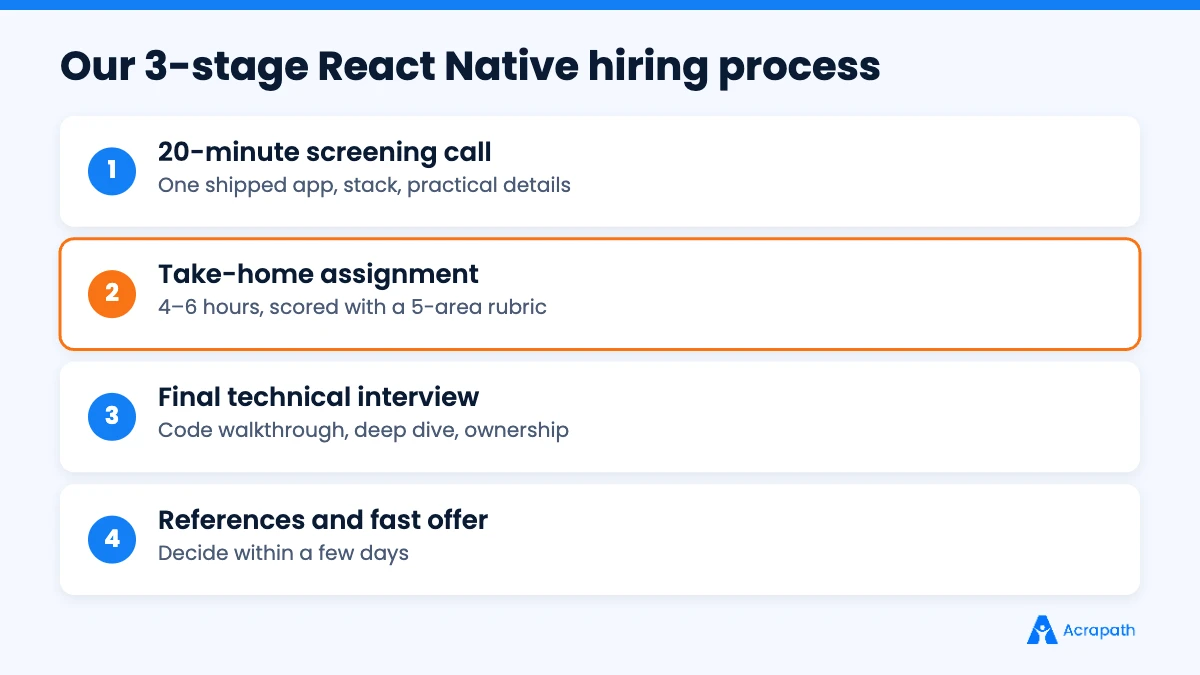
A 3-stage process works for most teams: a 20-minute screening call, a short take-home assignment, and a final technical interview of 60–120 minutes.
Test real skills: state management, list performance, navigation, API handling, offline behaviour and debugging on both Android and iOS.
Keep the take-home under 4–6 hours of work and review it with the candidate. The walkthrough tells you more than the code alone.
Watch for 4 red flags: no published apps, no native or platform awareness, copy-paste architecture, and weak debugging stories.
Your app is your product. When the person building it can't handle a slow list on low-end Android phones, a crash that only happens on iOS or a release that keeps getting rejected, your users feel it immediately. That's why a React Native hire matters more than most.
The challenge is that React Native sits between two worlds. A good developer needs strong JavaScript and React skills, plus enough understanding of Android and iOS to debug what happens below the JavaScript layer. Plenty of CVs mention React Native. Far fewer candidates have shipped and maintained a real app.
This guide shows how to hire a React Native developer step by step, based on the screening, assignment and final-round process we use for our own developer hiring at Acrapath. You'll get the skills to test, a sample assignment brief, interview questions with what good answers sound like, and salary and sourcing tips.
What Does a React Native Developer Do?
A React Native developer builds mobile apps for Android and iOS from one JavaScript or TypeScript codebase using React Native. They build screens and components, connect the app to APIs, manage app state, handle navigation, optimise performance, integrate native features like the camera or push notifications, and prepare builds for the Play Store and App Store.
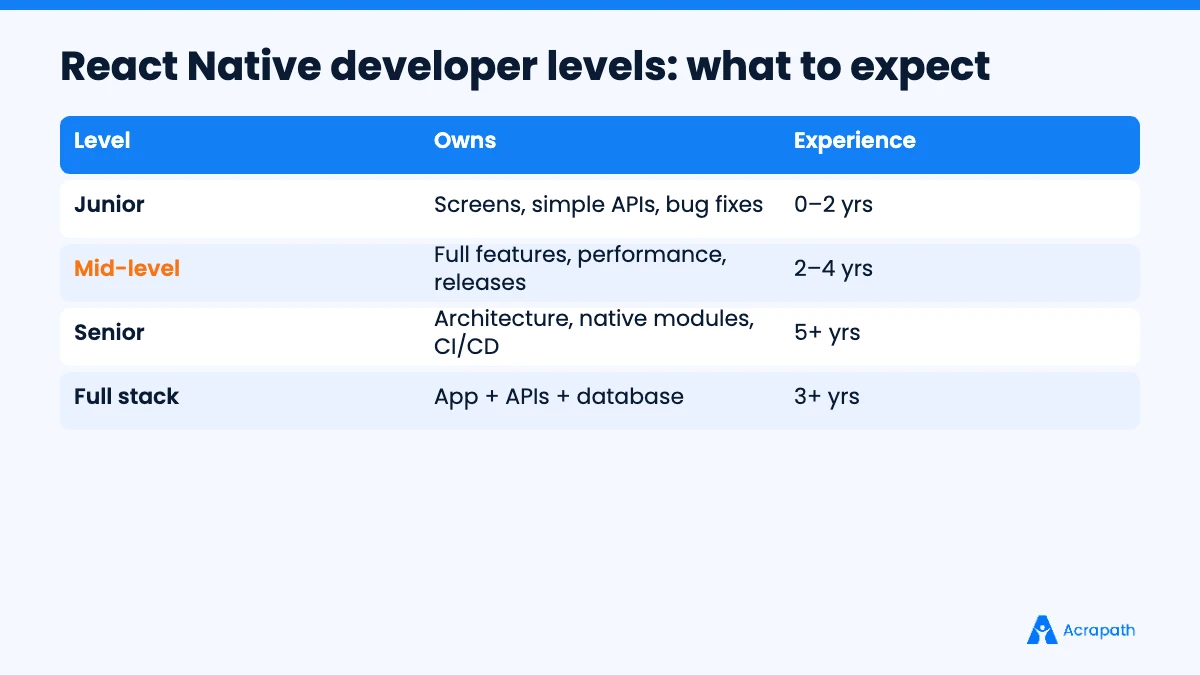
The scope changes a lot with seniority:
Level | What they own | Typical experience |
|---|---|---|
Junior | Screens and components from designs, simple API calls, bug fixes | 0–2 years, with personal or college apps |
Mid-level | Full features end to end, state management, performance fixes, releases with support | 2–4 years, at least one app in production |
Senior | App architecture, native modules, CI/CD and releases, code review, mentoring | 5+ years, several apps shipped and maintained |
Full stack (React Native + backend) | Mobile app plus APIs and database, often in Node.js | 3+ years across mobile and backend |
If you're a small team, a full stack developer who can build both the app and its APIs is often the best first hire. If you already have backend engineers, a specialist mobile developer will usually go deeper on app quality.
Skills to Look For
Split your list into must-haves and nice-to-haves. Asking for everything narrows your pool without improving quality.
Must-have skills
JavaScript and TypeScript: async/await, closures, types and clean, readable code.
React fundamentals: hooks, component design, props versus state, and avoiding unnecessary re-renders.
State management: Context, Redux Toolkit, Zustand or similar, and knowing when local state is enough.
Navigation: React Navigation or Expo Router, deep links and passing data between screens.
Lists and performance: FlatList or FlashList, memoisation, image handling and smooth scrolling on low-end devices.
APIs and data: fetching, caching, loading and error states, pagination and authentication tokens.
Debugging on both platforms: reading logs, using developer tools, and fixing issues that appear only on Android or only on iOS.
Nice-to-have skills
Native modules in Kotlin or Swift, and understanding of the React Native New Architecture
Expo and EAS builds, over-the-air updates
Push notifications, analytics, crash reporting
Offline storage and sync
Automated testing (Jest, React Native Testing Library, Detox or Maestro)
Backend skills in Node.js and a database, for full stack roles
How to Hire a React Native Developer (Step-by-Step)
Step 1: Define the role and the first 90 days
Before writing anything, answer three questions. What will this person build first? Which level do you need? Will they work alone or inside a team? Write down what success looks like after 90 days, for example "ship the new onboarding flow and cut crash rate on Android". That single sentence will shape your job description, your assignment and your interview.
Step 2: Write a clear job description
Name the stack (React Native CLI or Expo, TypeScript, state library, backend), the apps or features they'll work on, the level and whether the role includes backend work. Our software engineer job description template gives you the structure. Add the salary range and your hiring steps so candidates know what to expect.
Step 3: Source candidates beyond job posts
Strong mobile developers often aren't actively applying. Look at GitHub for React Native contributions, developer communities, people who have published apps on the Play Store or App Store, and referrals from your engineers. Our guide to where to find candidates lists 11 channels.
Step 4: Screen CVs for evidence, not keywords
Shortlist candidates who can point to real work: apps you can download, GitHub repositories, or detailed descriptions of features they shipped. Look for numbers such as "cut app start time by 40%" or "maintained an app with 50,000 monthly users". Our resume screening process explains how to do this fairly and quickly.
Step 5: Run a 20-minute screening call
This is a conversation, not a technical exam. In our own hiring we keep it to about 20 minutes on a video call. Cover:
One app they're proud of: what it did, their part in it and the hardest problem they solved.
The stack they've used and how comfortable they are with Android and iOS builds.
Practical details: notice period, location or remote setup, and salary expectations.
By the end of the call you should know whether their experience matches the level you need.
Step 6: Give a short take-home assignment
The assignment shows how someone actually builds. Keep it realistic and limited, ideally 4–6 hours of work with a deadline of three to five days. Here is a brief you can adapt:
Assignment: Job listings app
Build a small React Native app (Expo or CLI, TypeScript preferred) with two screens:
1. A list of jobs fetched from [public or mock API], with pull-to-refresh, infinite scroll and loading, empty and error states.
2. A job detail screen with a "Save" button. Saved jobs should persist after the app restarts.
Include a short README explaining your folder structure, state management choice and anything you would improve with more time. Share a GitHub link and a screen recording on a real device or emulator.
Score it with a simple rubric so every candidate is judged the same way:
Area | What good looks like | Score |
|---|---|---|
Functionality | All requirements work, including edge states | 1–4 |
Code structure | Clear folders, reusable components, typed data | 1–4 |
Performance | Efficient list rendering, no needless re-renders | 1–4 |
Persistence and state | Sensible choice, explained in the README | 1–4 |
Communication | Clear README and honest trade-offs | 1–4 |
This is skills-based hiring in practice: you're judging what the person can do, not where they studied. Read more in our guide to skills-based hiring.
Step 7: Hold a final technical interview
Our final round runs up to two hours on a video call, and you can shorten it to about 60–90 minutes for junior roles. Use three parts:
Assignment walkthrough (20–30 minutes): the candidate shares their screen and explains decisions. Ask them to change something live, such as adding a filter.
Technical deep dive (30–45 minutes): questions on React, performance, native behaviour and debugging, using the questions below.
Team and ownership (15–20 minutes): how they handle code review, deadlines, unclear requirements and production bugs.
Ask every candidate the same core questions and score them on a 1–4 scale. Our broader list of interview questions to ask candidates has more behavioural questions you can add.
Step 8: Check references and make the offer
Speak to a former manager or tech lead about reliability, code quality and ownership. Then move quickly. Good mobile developers often have more than one offer, so a decision within a few days of the final round makes a difference.
React Native Interview Questions to Ask
1. How would you make a long list scroll smoothly on a low-end Android phone?
A good answer: Mentions FlatList or FlashList, stable keys, keyExtractor, getItemLayout where possible, memoised row components, avoiding inline functions in props, optimised images and testing on a real low-end device.
Red flag: Only says "use a ScrollView" or has never profiled performance.
2. How do you decide where state should live?
A good answer: Keeps state local when only one component needs it, lifts it up when siblings share it, and uses a global store or server-state library for data shared across screens or fetched from APIs. Explains a real example.
Red flag: Puts everything in a global store by default with no reasoning.
3. Tell me about a bug that only happened on iOS or only on Android.
A good answer: Describes the symptom, how they isolated it (logs, device testing, native debugging tools), the root cause and the fix, plus how they prevented it recurring.
Red flag: Can't recall any platform-specific issue, which suggests limited production experience.
4. How would you handle the app losing internet connection mid-request?
A good answer: Detects connectivity, shows a clear message, retries sensibly, caches previous data, queues user actions where needed and avoids duplicate submissions.
Red flag: No plan beyond showing a generic error.
5. When would you write a native module?
A good answer: When a needed platform feature or SDK has no reliable library, or when performance requires native code. Mentions maintaining it for both platforms and checking existing community libraries first.
Red flag: Writes native code for everything, or has no idea how native code connects to JavaScript.
6. Walk me through releasing an update to the Play Store and App Store.
A good answer: Covers versioning, signing, build tools (for example EAS or Fastlane), testing tracks such as internal testing or TestFlight, store review, staged rollout and monitoring crashes after release.
Red flag: Has never been involved in a release.
7. How do you store a user's login token securely?
A good answer: Uses secure storage such as the platform keychain or keystore rather than plain local storage, handles token refresh and clears data on logout.
Red flag: Stores tokens in plain AsyncStorage without considering security.
8. How do you test a React Native app?
A good answer: Unit tests for logic, component tests for key screens, and some end-to-end tests for critical flows like login and checkout, plus manual testing on real devices.
Red flag: "QA tests it" with no personal testing habit.
Red Flags to Watch For
No shipped or maintained app. Tutorials and clones are fine for juniors, but mid-level and senior candidates should have production experience.
Zero platform awareness. React Native developers still need to understand Android and iOS builds, permissions and store rules.
Can't explain their own assignment. If they struggle to walk through code they submitted, ask how it was produced.
Copy-paste architecture. Heavy libraries for simple problems, with no reasoning.
Weak debugging stories. Every experienced mobile developer has battle stories. Missing ones are a warning sign.
Freelancer, Agency or Full-Time?
Option | Best when | Watch out for |
|---|---|---|
Full-time employee | The app is core to your business and needs ongoing work | Longer hiring process |
Freelancer | A defined project or short-term feature work | Availability and long-term maintenance |
Development agency | You need a full team quickly | Higher cost, less control over who works on it |
For most companies whose app is the product, a full-time developer is worth the wait. You can also see how one SaaS company sped up its developer hiring in our full-stack developer hiring case study, and read our general guide on how to hire software engineers.
How Long Does It Take to Hire a React Native Developer?
With a clear job description, a 20-minute screen, a take-home and one final round, many teams can go from job post to offer in about three to five weeks. The biggest delays usually come from slow feedback between rounds and long notice periods. Give candidates feedback within two to three working days after each round, and ask about notice periods during the screening call.
Conclusion
To hire a React Native developer who can really ship, define the level and the first 90 days, write a specific job description, source beyond job posts and screen for real apps. Then use a 20-minute screening call, a short realistic assignment scored with a rubric, and a final technical interview that includes a walkthrough of their code.
That process filters out CV keyword-matchers and finds the developers who can build, debug and release an app your users will enjoy.
Need a shortlist quickly? Hire verified engineers through Acrapath and meet React Native candidates who match your stack.
- #hire react native developer
- #mobile app developer
- #developer hiring
- #take-home assignment
- #tech recruitment
Frequently asked questions
How do I hire a React Native developer?
Define the level and what they must deliver in 90 days, write a specific job description, source from GitHub, communities and referrals as well as job posts, then run a short screening call, a 4–6 hour take-home assignment scored with a rubric, and a final technical interview with a code walkthrough.
What skills should a React Native developer have?
Core skills are JavaScript and TypeScript, React hooks and component design, state management, navigation, list performance, API handling and debugging on both Android and iOS. Native modules, Expo or EAS builds, testing and backend skills are valuable extras depending on the role.
What should a React Native take-home assignment include?
Keep it realistic and limited to about 4–6 hours: for example, a two-screen app that fetches a list from an API with loading and error states, a detail screen and saved items that persist. Ask for a README and a screen recording, and score it with a rubric.
How much experience should a React Native developer have?
Junior developers may have 0–2 years with personal or college apps. Mid-level developers usually have 2–4 years and at least one app in production. Senior developers typically have 5+ years and have shipped, maintained and released several apps.
Should I hire a freelancer or a full-time React Native developer?
Hire full-time when the app is core to your business and needs continuous work, maintenance and releases. A freelancer suits a defined, short-term project. An agency helps when you need a full team quickly but costs more and gives you less control.