HR Executive Job Description Template

Jatin Kashyap
Growth Lead, Acrapath
Copy this HR executive job description template with responsibilities by HR area, skills, KPIs and qualifications, plus tips to customise it for your team size.
Key Takeaways
An HR executive job description should say which HR areas the person owns: recruitment, onboarding, payroll inputs, compliance, employee relations or engagement.
In small companies, HR executives are generalists. In larger ones, they often focus on 1–2 areas, so name yours.
Ask for 1–4 years of experience for most HR executive roles, and an MBA in HR only if the role truly needs it.
Add 3–4 KPIs such as time to hire, onboarding completion and on-time payroll inputs.
Copy the template below and customise it in about 10 minutes.
As your team grows, the people work piles up: hiring, joining paperwork, attendance, leave, payroll inputs, policy questions and the occasional difficult conversation. At some point the founder or manager can't do it all, and you need an HR executive.
The challenge is that "HR executive" means different things in different companies. A clear HR executive job description tells candidates which parts of HR they'll own, how much they'll do alone and how success will be measured.
Below you'll find a copy-ready template, responsibilities by HR area, skills, KPIs and common mistakes.
What Does an HR Executive Do?
An HR executive runs the day-to-day people operations of a company: supporting hiring, onboarding new joiners, maintaining employee records, coordinating attendance, leave and payroll inputs, helping with compliance and handling employee queries. They usually report to an HR manager or, in smaller companies, directly to a founder or operations head.
HR area | Typical tasks | Who usually needs it |
|---|---|---|
Recruitment | Posting jobs, screening, scheduling interviews | Growing teams |
Onboarding | Offer letters, documents, induction | All companies |
HR operations | Records, attendance, leave, HRMS | All companies |
Payroll inputs and compliance | Payroll data, statutory deductions, filings with finance | All companies |
Employee relations and engagement | Queries, grievances, events, surveys | Teams of 30+ people |
HR Executive Job Description Template
Copy this into your job post and replace the square brackets. It follows the structure in our guide on how to write a job description.
Job title: HR Executive [or HR Generalist / Recruitment and HR Executive]
Location: [City / Hybrid]
Employment type: Full-time
Reports to: [HR Manager / Founder / Operations Head]
About us: [Two or three sentences about your company, team size and growth.]
About the role: We're looking for an HR Executive to manage day-to-day HR for our team of [number] people in [locations]. You'll own [recruitment coordination, onboarding and HR operations] and support [payroll inputs and compliance]. In your first six months, success means [e.g. a smooth onboarding process for every new joiner and up-to-date employee records].
What you'll do:
Post jobs, screen applications and schedule interviews with hiring managers
Prepare offer letters and manage joining documents and background checks
Run induction for new employees and track onboarding tasks
Maintain employee records and the HRMS [name of tool]
Manage attendance, leave and holiday calendars
Share monthly payroll inputs with [finance / payroll partner] and track statutory deductions such as [PF, ESI, professional tax]
Answer employee questions on policies, leave and benefits
Support exits: resignations, notice periods, clearance and full and final settlement inputs
Help organise engagement activities and feedback surveys
What you'll bring:
[1–4] years in HR, ideally as a generalist or in HR operations
A graduate degree; an MBA or PG diploma in HR is [preferred / not required]
Working knowledge of employment basics in [country], including statutory deductions
Experience with an HRMS and good Excel skills
Clear communication, discretion with confidential information and an organised approach
Nice to have:
Experience recruiting for [roles you hire most]
Exposure to performance reviews or policy writing
What we offer:
Salary: [range]
[Benefits, leave policy, learning budget]
The chance to shape HR processes as the company grows
How to apply: [Steps and timeline.]
Responsibilities and KPIs to Include
Pick the HR areas that match your needs and put the most important first. Then add a few measurable goals.
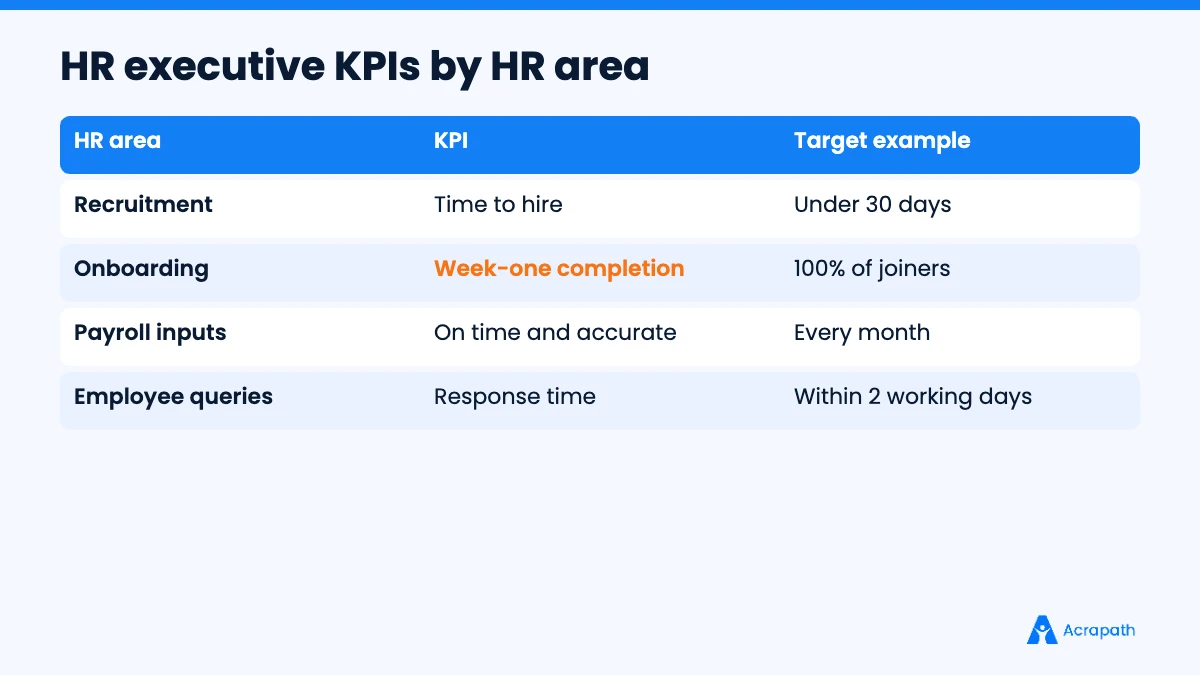
Time to hire: days from job post to accepted offer for roles they coordinate.
Onboarding completion: every joiner has documents, accounts and induction done in week one.
Payroll inputs: accurate and on time every month.
Query response time: employee questions answered within an agreed time.
Skills to Look For
Organisation: HR runs on deadlines and documents.
Discretion: salaries, health information and disciplinary issues must stay private.
Communication: explaining policy simply and handling sensitive conversations calmly.
Compliance awareness: knowing which rules apply and when to involve a specialist.
Tools: HRMS, spreadsheets and job portals.
If you're hiring a fresher into HR, our jobseeker guide on how to start a career in HR shows what entry-level candidates learn, which helps you set fair expectations.
How to Customise the Template
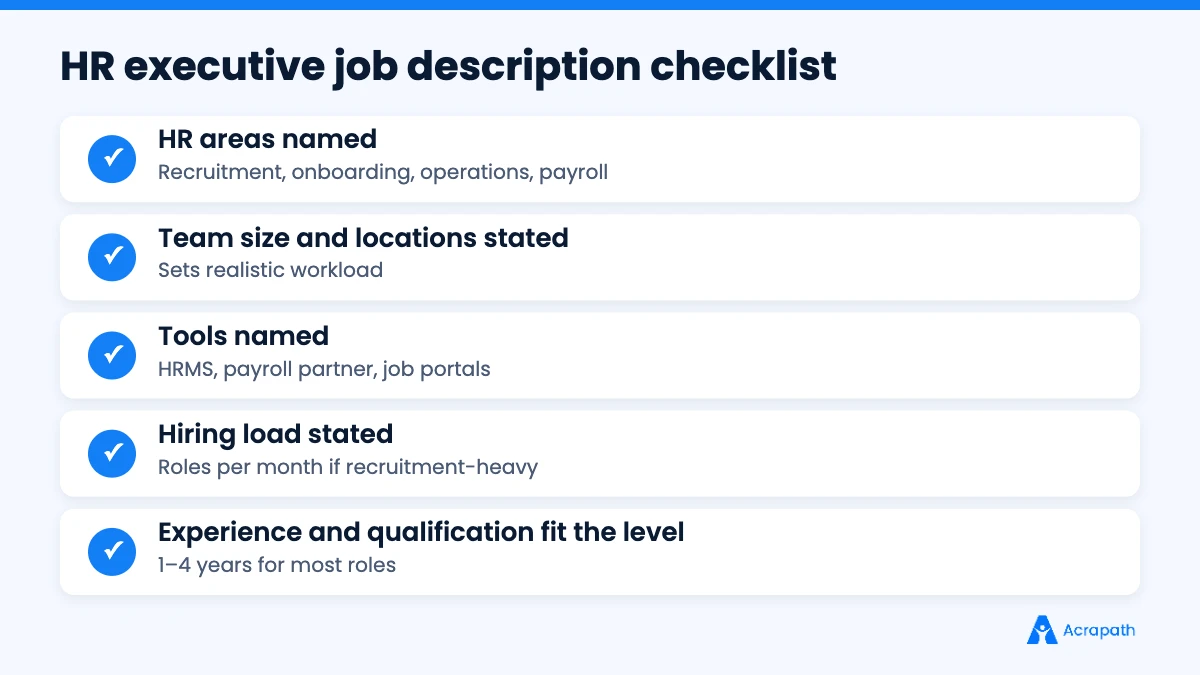
Name the HR areas this person owns, and which ones stay with someone else.
State team size and locations. HR for 20 people in one office is very different from 200 across cities.
Name your tools (HRMS, payroll partner, job portals).
Be honest about recruitment load. If they'll hire 10 people a month, say so.
Set the experience range and qualifications to match the level.
Common Mistakes to Avoid
"Handle all HR activities". Too vague to attract the right candidate.
Hiding a heavy hiring target. Recruitment-heavy roles need recruiters, and candidates should know.
Requiring an MBA for operations work. It narrows your pool without adding value.
No reporting line. Candidates want to know who they'll learn from.
After You Post
Shortlist candidates who have handled your most important HR area, then ask scenario questions: an employee disputes their leave balance, a new joiner hasn't submitted documents, a manager wants to skip a policy. Our resume screening guide helps you build a fair shortlist, and our list of places to find candidates covers HR communities. For a consistent set of job posts, see our accountant job description template, which follows the same format.
Conclusion
A clear HR executive job description names the HR areas, team size, tools and KPIs the person will own. Copy the template, choose your priorities, set the right experience level and describe your hiring steps.
The right HR executive will see exactly where they fit, and you'll spend less time screening the wrong ones.
Need HR talent quickly? Hire verified HR professionals through Acrapath.
- #HR executive
- #job description template
- #HR hiring
- #HR generalist
- #recruitment
Frequently asked questions
What should an HR executive job description include?
Include a company intro, team size and locations, the HR areas the person will own, 7–9 responsibilities, required experience and skills, the tools they will use, a few KPIs, salary and benefits, and your hiring process. Naming the HR areas is the most important detail.
What is the difference between an HR executive and an HR manager?
An HR executive handles day-to-day HR tasks such as onboarding, records, attendance and payroll inputs. An HR manager owns HR strategy, policies, performance management and often leads the HR team. In small companies one person may cover both, so describe the real scope.
How much experience should an HR executive have?
Most HR executive roles ask for 1–4 years of HR experience. Freshers with an HR internship can suit junior roles with good training. For roles that handle compliance or employee relations alone, look for a bit more experience.
Is an MBA in HR required for an HR executive?
Not usually. An MBA or postgraduate diploma in HR can help, but practical experience with onboarding, HR operations, payroll inputs and an HRMS often matters more. Make the qualification "preferred" rather than "required" unless the role truly needs it.
What KPIs are used for HR executives?
Common KPIs include time to hire for coordinated roles, onboarding completion in the first week, accuracy and timeliness of payroll inputs, employee query response time, and record accuracy. Two to four KPIs are enough to list in a job description.