11 Places to Find Candidates When Job Posts Aren't Enough

Jatin Kashyap
Growth Lead, Acrapath

Wondering where to find candidates beyond job posts? See 11 sourcing channels, what each is best for, and how to choose and track the right mix for every role.
Key Takeaways
The best answer to where to find candidates is a mix: 2–3 channels for active jobseekers plus 2–3 for passive talent who aren't applying anywhere.
Employee referrals, your own past applicants and candidate databases are usually the fastest and cheapest sources.
Niche communities, colleges and LinkedIn outreach reach people who never see your job post.
Track 3 numbers per channel: applicants, shortlisted candidates and hires. Drop channels that bring volume but no hires.
Use a recruitment agency when a role is urgent, senior or very hard to fill.
You posted the job a week ago. Applications came in, but most don't fit, and the strong candidates you hoped for haven't appeared. That doesn't mean they don't exist. It usually means they're not looking at job boards right now.
Knowing where to find candidates beyond your job post is what separates teams that hire in two weeks from teams that wait two months. Below are 11 sourcing channels, what each is best for and how to get results from it, plus a simple way to decide where to spend your time.
Why Job Posts Alone Aren't Enough
A job post reaches active jobseekers: people searching right now. Many strong candidates are passive. They're employed, doing good work and only open to moving if the right opportunity reaches them. To hire them, you have to go to where they already are.
Job posts also attract volume, not always fit. Mixing channels gives you a better shortlist and reduces your dependence on any single source.
Candidate type | Where they are | Best channels |
|---|---|---|
Active | Job portals, career pages | Job posts, candidate databases, past applicants |
Open but not searching | LinkedIn, communities, referrals | Referrals, outreach, communities |
Early career | Colleges, bootcamps, internships | Campus hiring, institutes, internships |
11 Places to Find Candidates
1. Employee referrals
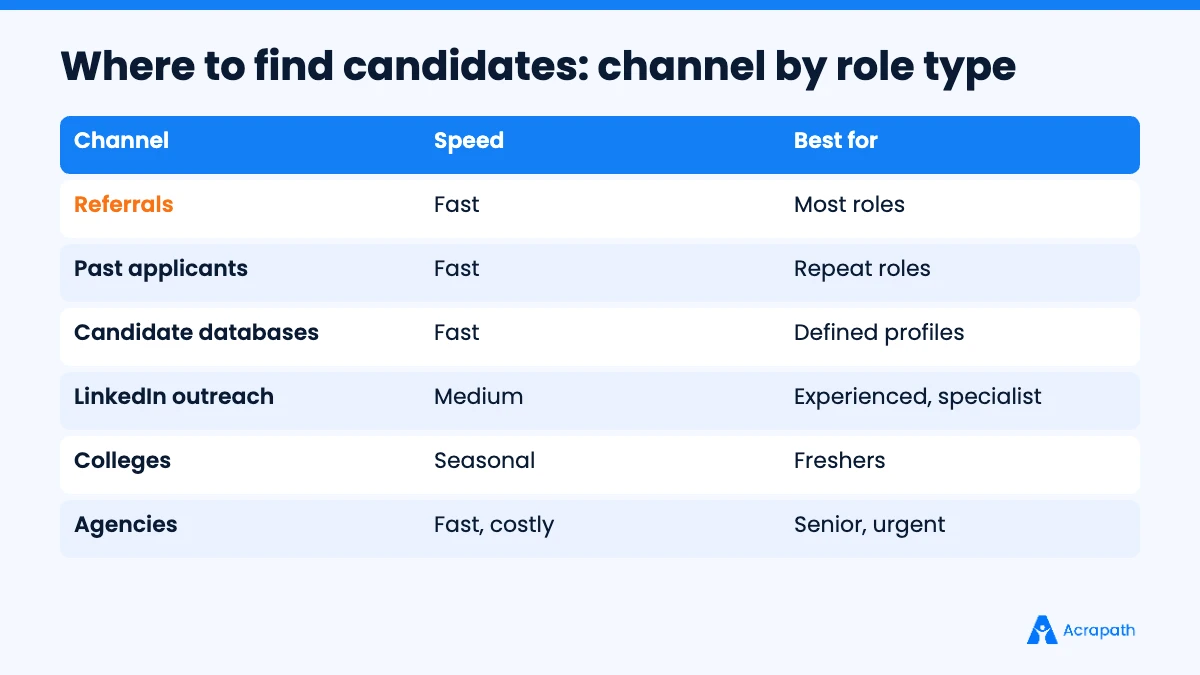
Ask your team who they know. Referred candidates often come pre-screened for culture fit, because your employee has already vouched for them.
Best for: Every role, especially mid-level hires and small teams.
Tip: Make it easy: share a short role summary your team can forward, and offer a clear referral reward paid after the new hire completes probation.
2. Your past applicants
People who applied earlier and narrowly missed out, or who were great but applied for a different role, are a ready-made shortlist.
Best for: Repeat roles and roles similar to past openings.
Tip: Tag strong "silver medallists" in your hiring tool or spreadsheet so you can reach them first next time.
3. Candidate databases
Searchable databases of verified professionals let you find people by skill, experience and location without waiting for applications. On Acrapath, employers can search verified candidates in Talbox.
Best for: Roles where you know the exact profile you want.
Tip: Filter tightly on must-have skills, then send a short, personalised message rather than a generic template.
4. LinkedIn outreach
Search by title, company, skills and location, then message candidates directly. It is the main way to reach passive talent at scale.
Best for: Experienced professionals and specialist roles.
Tip: Mention something specific from their profile and the one reason the role might interest them. Keep the first message under 100 words.
5. Niche communities and groups
Professional Slack, Discord, WhatsApp and Telegram groups, subreddits, and associations gather people in one field.
Best for: Developers, designers, marketers, healthcare and other specialist roles.
Tip: Join and contribute before posting jobs. Many communities have dedicated job channels and rules about recruiters.
6. Colleges and placement cells
Campus and off-campus drives connect you with final-year students and recent graduates.
Best for: Freshers, trainee programmes and roles you can train for.
Tip: Build relationships with two or three colleges and come back every season, instead of one-off visits.
7. Skill-based platforms and portfolios
GitHub, Behance, Dribbble, Kaggle and similar sites show real work, not just CVs.
Best for: Engineers, designers, data analysts and writers.
Tip: Look at recent work and contributions, then reference it in your message.
8. Industry events and meetups
Conferences, webinars and local meetups put you in a room with people who care about their field.
Best for: Senior and specialist roles, employer branding.
Tip: Have one person from the hiring team attend and follow up within a week.
9. Your careers page and social channels
People who already follow your company are warm candidates. A clear careers page and regular hiring posts on your social channels turn interest into applications.
Best for: Growing companies with an audience.
Tip: Share real stories from your team, not just "we're hiring" graphics.
10. Former employees (boomerangs)
People who left on good terms already know your company and can ramp up fast.
Best for: Roles where context matters.
Tip: Keep in touch through an alumni group or occasional check-ins.
11. Recruitment agencies and hiring partners
Agencies bring networks and dedicated recruiters to fill roles for you.
Best for: Urgent, senior, confidential or very hard-to-fill roles.
Tip: Brief them as thoroughly as you would a team member, and agree fees and replacement terms upfront. Our comparison of a recruitment agency vs a job portal helps you decide when it's worth it.
How to Choose the Right Channels
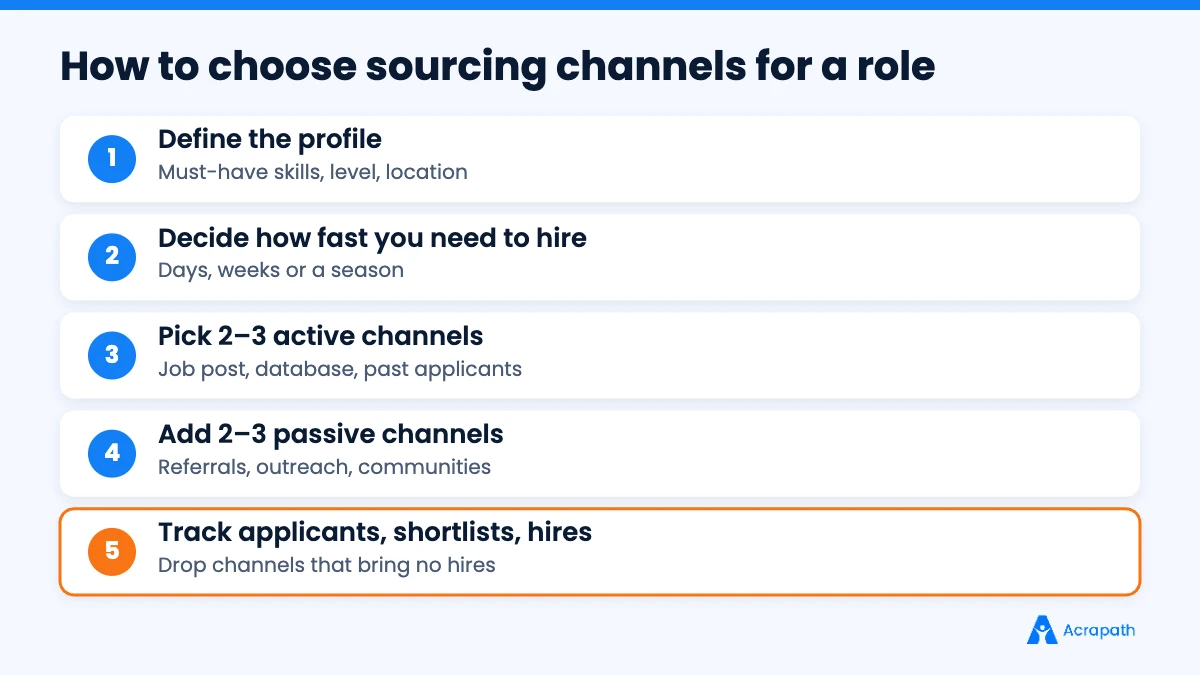
You don't need all eleven at once. Match channels to the role and how fast you need to hire.
Need someone in two weeks? Start with past applicants, referrals and a candidate database.
Hiring a specialist? Add LinkedIn outreach, skill platforms and niche communities.
Hiring freshers in volume? Focus on colleges, institutes and internships.
Senior or confidential role? Use a trusted agency plus your leadership team's networks.
Track What Works
For each channel, record three numbers: how many candidates it produced, how many you shortlisted and how many you hired. After two or three roles, patterns appear. A channel that sends 200 applicants and no hires is costing you screening time. One that sends 10 with two hires deserves more effort.
Channel choice also affects your hiring budget. See our guide to cost per hire to compare sources fairly, including the hidden cost of your team's time.
Make Every Channel Work Harder
Write a clear job description first. Every channel performs better when the role is well defined. Start with our guide on how to write a job description.
Respond quickly. Good candidates have options. Reply within two or three working days.
Screen consistently. Use the same criteria across channels so you compare like with like. Our resume screening process shows how.
Personalise outreach. One specific line beats a long template every time.
Hiring your first employee? Start with referrals and your own network, then follow our guide to hiring your first employee.
Conclusion
Knowing where to find candidates means looking beyond your job post. Combine channels for active jobseekers, like job portals and candidate databases, with channels for passive talent, like referrals, outreach and communities. Track results by channel and double down on what produces hires.
The best candidate for your role may not be searching today. Go to where they already are.
Want a faster shortlist? Browse verified professionals by function on Acrapath and search candidates in Talbox.
- #candidate sourcing
- #where to find candidates
- #recruitment
- #passive candidates
- #hiring
Frequently asked questions
Where can I find candidates for a job quickly?
Start with your past applicants, employee referrals and a searchable candidate database, since these produce candidates within days. Post the job on a relevant job portal at the same time, and add LinkedIn outreach for experienced roles if the first week doesn't produce a strong shortlist.
How do I find passive candidates?
Go to where they already spend time: LinkedIn, professional communities, skill platforms like GitHub or Behance, industry events and your employees’ networks. Send short, personalised messages that mention something specific about their work and explain why the role might interest them.
What is the best sourcing channel for hiring?
No single channel is best for every role. Referrals and past applicants often produce strong hires at low cost, databases and job portals bring speed and volume, and agencies help with senior or urgent roles. Track hires by channel to find what works for your company.
How many sourcing channels should I use?
Most roles work well with four to six channels: two or three for active jobseekers and two or three for passive candidates. Using too many at once makes tracking hard. Start focused, measure results and adjust after a few hires.
When should I use a recruitment agency?
Use an agency when a role is urgent, senior, confidential or very hard to fill, or when your team doesn't have time to source and screen. Agree fees, timelines and replacement guarantees upfront, and brief the agency thoroughly on the role and your culture.