Cost per Hire: How to Calculate It and 7 Ways to Lower It

Acrapath Team

Learn the cost per hire formula, calculate it step by step with a worked example, compare 2025 SHRM benchmarks, and see 7 ways to cut recruitment cost.
Key Takeaways
Cost per hire is the average amount you spend to fill one role: total internal plus external recruiting costs in a period, divided by the number of hires in that period.
SHRM's 2025 Recruiting Benchmarking survey of 2,371 members put the median cost per hire at $1,200 for non-executive roles and $10,625 for executive roles (US-led data).
The ANSI/SHRM cost-per-hire standard, approved in 2012, lists 19 external and 7 internal cost types, so you count hiring manager time and recruiter pay, not just ads and agency fees.
In our worked example, 10 hires in a quarter cost ₹6,45,000 in total, or ₹64,500 per hire, and agency fees made up 37% of that spend.
The fastest ways to lower recruitment cost are tracking cost by source, writing sharper job descriptions, cutting agency dependence and reducing offer drop-outs.
You know hiring costs money. What's harder to see is where it goes. Job ads and agency invoices are obvious, but the hours your managers spend in interviews, the tools you pay for every month and the offers that fall through never show up as a "recruiting" line in your accounts.
One metric pulls all of that into a single number. Once you can see it, you can compare roles, sources and quarters, and set a realistic hiring budget.
This guide gives you the standard cost per hire formula, a step-by-step calculation with a worked example, dated benchmarks, and seven practical ways to bring the number down. If you're building your first team, pair it with our guide on how to hire your first employee.
What Is Cost per Hire?
Cost per hire (CPH) is the average cost of filling one position in a given period. It adds every internal and external recruiting expense, from job ads and agency fees to recruiter salaries and interview time, then divides the total by the number of people hired.
It is one of the most widely used hiring metrics because it turns a scattered set of expenses into a figure you can track over time. HR teams use it to justify budgets, finance teams use it for planning, and founders use it to decide whether to recruit in-house or outsource.
CPH measures efficiency, not quality. A cheap hire who leaves in three months is expensive, so read it alongside quality-of-hire and time-to-fill metrics.
The Cost per Hire Formula
The standard cost per hire formula is: (total external costs + total internal costs) ÷ total number of hires in the period.
This comes from the ANSI/SHRM 06001.2012 cost-per-hire standard, approved by the American National Standards Institute in February 2012. Using the same formula every time lets you compare quarters, teams and even companies fairly.
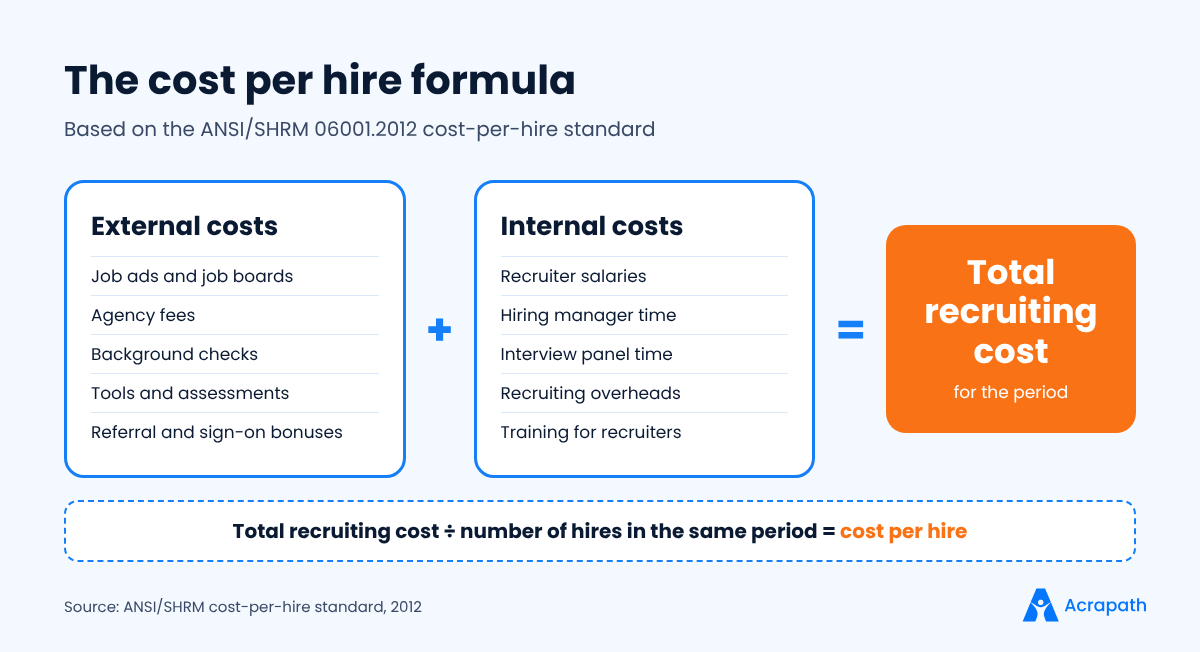
External vs internal recruitment costs
External costs are what you pay outside parties. Internal costs are what your own organisation spends in people time and overheads. The standard lists 19 external and 7 internal cost types; these are the ones most employers have.
External costs (paid to others) | Internal costs (your own spend) |
|---|---|
Job board and advertising fees | Recruiter and sourcer salaries (share of time) |
Third-party agency fees | Hiring manager time spent screening and interviewing |
Background checks and pre-hire screening | Recruiting training and development |
Assessment and recruiting technology | Office and overhead costs of the recruiting team |
Employee referral bonuses and sign-on bonuses | Compliance overhead tied to hiring |
Candidate and recruiter travel, relocation, job fairs | Management time at recruiting events |
Leave out costs that come after the hire, like onboarding and training for the new employee. Those belong in separate metrics.
How to Calculate Cost per Hire (Step by Step)
You can calculate it in a spreadsheet in under an hour once your data is in one place.
Step 1: Pick a period
Choose a quarter or a year. Short periods swing wildly when one senior hire or one agency invoice lands, so a quarter is the minimum for a stable number.
Step 2: Add up external costs
Pull every invoice tied to recruiting from finance: job ads, agency fees, background checks, tools and referral bonuses paid in the period.
Step 3: Estimate internal costs
Multiply each person's hourly cost by the hours they spent on hiring. Include recruiters, hiring managers and interview panellists. Rough estimates are fine; leaving internal time out is not.
To get an hourly cost, divide a person's monthly cost to the company by their working hours. A manager costing ₹1,60,000 a month over roughly 160 working hours costs about ₹1,000 an hour, so 10 hours of interviews adds ₹10,000.
Step 4: Count hires
Count people who accepted and started in the period. Don't count offers that were declined or candidates who didn't join.
Step 5: Divide and segment
Divide total costs by total hires. Then repeat the sum for each department, role level or source, because a single company-wide average hides where your money goes.
Worked Example: One Quarter of Hiring, Calculated
Here's a sample calculation for a company in India that made 10 hires in one quarter: eight through job portals and referrals, and two senior roles through an agency. The figures are illustrative.
Cost item | Type | Amount (₹) |
|---|---|---|
Job portal and ad spend | External | 60,000 |
Agency fees (2 senior hires) | External | 2,40,000 |
Background checks (10 × ₹1,500) | External | 15,000 |
Assessment tool subscription | External | 30,000 |
Referral bonuses (2 × ₹25,000) | External | 50,000 |
Candidate travel | External | 15,000 |
Total external costs | 4,10,000 | |
Recruiter salary (60% of one quarter) | Internal | 90,000 |
Hiring manager interview time (120 hours × ₹1,000) | Internal | 1,20,000 |
ATS share for the quarter | Internal | 25,000 |
Total internal costs | 2,35,000 | |
Total recruiting cost | 6,45,000 | |
Cost per hire (÷ 10 hires) | 64,500 |
Now segment it. The two agency hires carried ₹2,40,000 in fees alone, or ₹1,20,000 each before any internal time. That single line is 37% of the quarter's spend, so it's the first place to look for savings.
Recruiting Cost Benchmarks (2025)
Benchmarks give you a reference point, not a target. The most cited figures come from SHRM, the US-based HR professional body.
Median: SHRM's 2025 Recruiting Benchmarking report, based on 2,371 members surveyed in early 2025, found a median of $1,200 for non-executive hires and $10,625 for executive hires.
Average: SHRM's October 2025 benchmarking announcement reported averages of $5,475 (non-executive) and $35,879 (executive), with executive hires nearly 7x more expensive.
Share of HR budget: the same 2025 announcement found organisations allocate an average of 26% of their HR budget to recruiting.
The gap between median and average tells you a few costly hires pull the average up. Use the median as your "typical" reference.
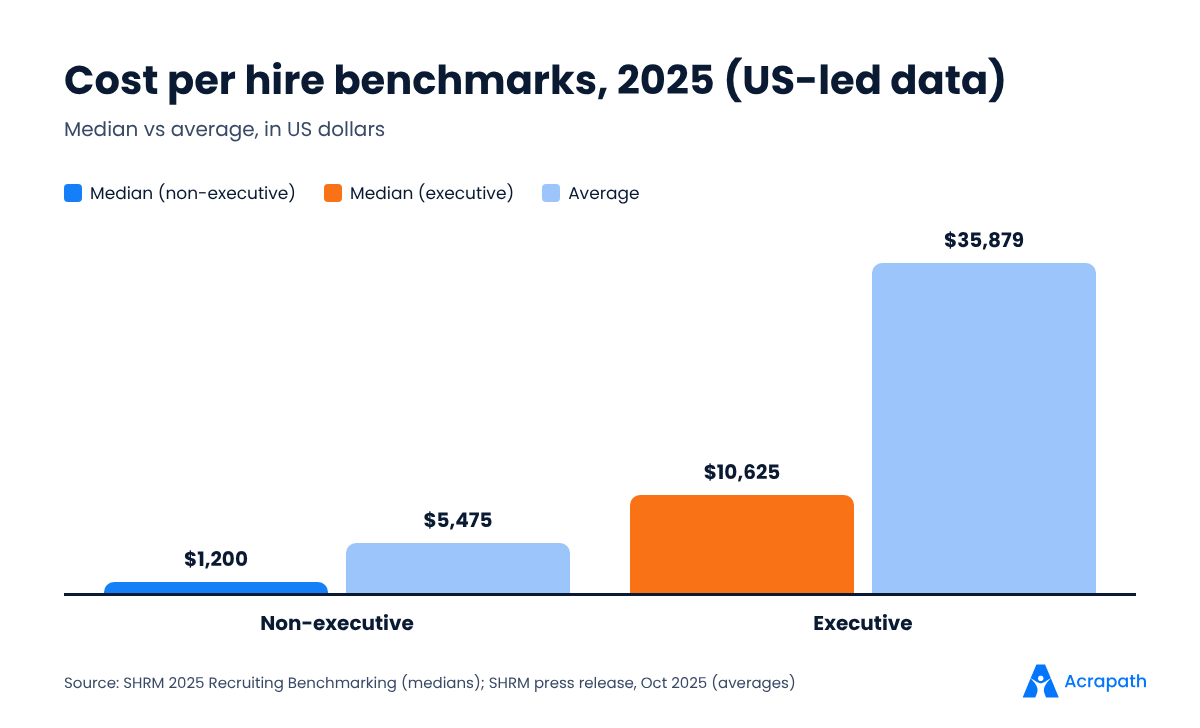
Treat these as directional if you hire outside the US. Salaries, agency fee structures and job-board pricing differ by market, so your own trend line over several quarters is the benchmark that matters most.
What Drives Your Recruitment Cost Up
Four drivers explain most high recruitment cost figures.
Agency fees: usually charged as a percentage of the hire's first-year pay, so they scale with seniority. Check your contract for the exact rate and replacement terms.
Time to fill: every extra week means more interview hours, more re-posted ads and longer vacancy costs.
Low-yield ads: paying for job slots that bring volume but few qualified applicants.
Tool sprawl: overlapping ATS, assessment and scheduling subscriptions that nobody fully uses.
7 Ways to Lower Your Cost per Hire
Lowering CPH is mostly about removing waste, not cutting corners. These seven changes reduce spend without hurting candidate quality.
1. Track cost by source
Tag every applicant with the source they came from and calculate CPH for each one. You'll often find one channel brings most of your hires at a fraction of the cost of another.
2. Write sharper job descriptions
Vague job descriptions attract hundreds of mismatched applicants, and someone has to screen them. A clear title, must-have skills and a salary range filter people before they apply. Our guide on how to write a job description walks through each part.
3. Use agencies only where they earn their fee
Agencies make sense for senior, niche or urgent roles. For volume and mid-level roles, a job portal plus in-house screening usually costs less. Our comparison of a recruitment agency vs a job portal breaks down when each wins.
Before you brief an agency, try one round of direct sourcing first. Post the role, search existing candidate profiles, and set a deadline. If the shortlist is thin after two weeks, you'll brief the agency with better information on the market.
4. Build an employee referral programme
Referrals come pre-screened by people who know your culture. Set a clear bonus, pay it after the new hire's probation, and remind your team about open roles every month.
5. Screen faster and more consistently
Hiring manager time is often the largest hidden cost. A short scorecard and a fixed shortlist size stop teams from interviewing too many people. See our step-by-step guide on how to screen resumes.
6. Reduce offer drop-outs
Every declined offer or no-show resets the cost clock. Share a clear salary breakup early, keep in touch during the notice period, and move quickly from final round to offer. This case study on improving offer acceptance shows what that looks like in practice, and our jobseeker guide on CTC vs take-home pay shows what candidates check first.
7. Keep a talent pool
Your strong second-choice candidates are your cheapest future hires, because you have already paid to find and assess them. Keep their details (with consent), tag them by skill, and contact them before you post a new ad.

How It Compares With Other Hiring Metrics
CPH works best as one of a small set of metrics. Pair it with these to avoid optimising for cheap but poor hires.
Metric | What it measures | Why pair it with cost per hire |
|---|---|---|
Time to fill | Days from job approval to accepted offer | Faster hiring usually lowers internal costs |
Quality of hire | Performance and retention of new hires | Shows whether cheaper sources produce good hires |
Offer acceptance rate | Accepted offers ÷ offers made | Low acceptance wastes the whole process cost |
Source of hire | Where successful hires came from | Tells you where to shift budget |
Quality of hire is the one most teams skip. SHRM's October 2025 announcement found only 20% of organisations track it.
How to Set a Hiring Budget From Your Numbers
Once you know your CPH, a hiring budget is simple arithmetic: planned hires × CPH for that role level, plus a buffer for re-hires and drop-outs.
For example, if you plan 12 mid-level hires next year at ₹50,000 each and 2 senior hires at ₹1,50,000 each, your recruiting budget is ₹9,00,000 before a buffer. Recalculate every quarter and move money toward the sources with the lowest cost and best retention.
The structured hiring pipeline case study shows how a consistent process makes those numbers easier to track.
Common Mistakes to Avoid
Counting only invoices: skipping internal time can make your figure look far lower than it is.
Mixing executive and non-executive roles: one senior hire distorts the average for everyone else.
Including onboarding costs: they belong after the hire, not in recruiting.
Chasing the lowest number: a low CPH with high early attrition is a false saving.
Conclusion
Cost per hire turns scattered recruiting expenses into one clear number: internal plus external costs, divided by hires. Track it by source and role level every quarter, and it will show you exactly where your hiring budget leaks.
Start this week by pulling last quarter's recruiting invoices and estimating interview hours. Even a rough first number gives you a baseline to improve.
If you'd rather have it handled, Acrapath's hiring desk can run sourcing, shortlisting and interviews for you, alongside job posting and Talbox candidate search.
- #cost per hire
- #cost per hire formula
- #recruitment cost
- #hiring budget
- #agency fees
- #hiring metrics
Frequently asked questions
What is a good cost per hire?
A good cost per hire is one that falls over time without hurting quality of hire. As a reference, SHRM's 2025 Recruiting Benchmarking report found a median of $1,200 for non-executive and $10,625 for executive hires, mostly from US employers. Compare yourself mainly with your own past quarters and similar roles in your market.
What is included in cost per hire?
Cost per hire includes external costs such as job ads, agency fees, background checks, recruiting tools and referral bonuses, plus internal costs such as recruiter salaries and the time hiring managers spend screening and interviewing. The ANSI/SHRM standard lists 19 external and 7 internal cost types. Onboarding and training after the hire are left out.
How do you calculate cost per hire?
Add all external and internal recruiting costs for a period, such as a quarter, then divide by the number of hires who started in that period. For example, ₹6,45,000 in total recruiting costs across 10 hires gives a cost per hire of ₹64,500. Repeat the calculation by source and role level for useful detail.
Does cost per hire include onboarding costs?
No, cost per hire should stop at the point the candidate accepts and starts. Onboarding, induction training and equipment for the new employee are post-hire costs and are tracked separately. Mixing them in makes your recruiting spend look higher than it is and makes comparisons with other periods or benchmarks unreliable.
How can a small business lower its cost per hire?
Start by tracking where each hire came from and what that source cost. Then write clearer job descriptions, use a job portal before an agency for mid-level roles, set up a simple referral bonus, and keep strong runner-up candidates on file. Faster, consistent screening also cuts the hidden cost of manager time.


