

CTC vs in-hand salary explained: what CTC includes, which deductions cut your pay, and a worked ₹12 lakh example. Learn to calculate your take-home pay.
Key Takeaways
CTC vs in-hand salary: CTC (cost to company) is everything an employer spends on you in a year, while in-hand salary is the money that reaches your bank account each month after deductions.
In our worked example, a ₹12 lakh CTC (India) becomes about ₹79,400 a month in hand, roughly 79% of CTC ÷ 12.
In India, you and your employer each put 12% of basic pay plus DA into provident fund, mandatory on wages up to ₹15,000 a month, per EPFO.
Gratuity sits inside many CTCs, but regular employees usually receive it only after 5 years of continuous service.
Under India's new tax regime, salaried people get a ₹75,000 standard deduction and pay no income tax on taxable income up to ₹12 lakh, thanks to the Section 87A rebate.
You just got an offer for ₹12 LPA (lakh per annum, or ₹12,00,000 a year). You divide by 12, expect ₹1 lakh a month, and your first payslip says closer to ₹79,000.
Nothing went wrong. You just met the gap between CTC vs in-hand salary, the most common source of offer-letter confusion for jobseekers in India. It often comes up in HR round salary questions, too.
This guide explains what CTC and in-hand salary mean, which salary deductions sit between them, how PF and gratuity work, and how to calculate your take-home pay from any CTC, with a full worked example.
This is general information, not tax or legal advice. The rules below are for India and were checked in October 2026.
What Is CTC? (CTC Meaning)
CTC, or cost to company, is the total amount an employer spends on one employee in a year. It includes your salary plus the employer's provident fund and gratuity contributions, insurance premiums, bonuses and some perks.
CTC is an Indian payroll term, and Indian offer letters almost always quote it. Because it includes money you never see each month, CTC is always higher than your take-home pay. Think of it as the employer's budget line for you, not your pay.
What Is In-Hand Salary?
In-hand salary (also called take-home pay or net salary) is the amount credited to your bank account each month. It equals your monthly gross salary minus your own PF contribution, professional tax and income tax deducted at source (TDS).
This is the number that pays your rent, EMIs and bills. That's why the CTC vs in-hand salary question matters most when you weigh two offers.
CTC vs Gross vs In-Hand Salary at a Glance
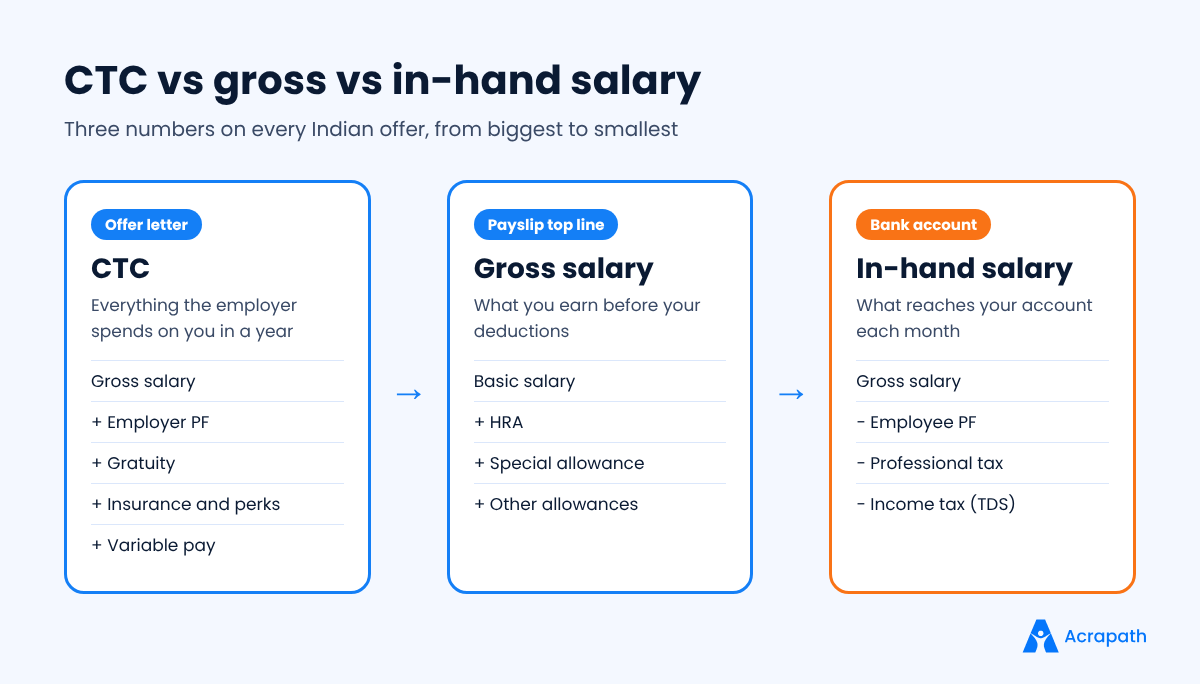
Every Indian salary really has three numbers. Gross salary sits in the middle: what you earn before your deductions, after removing employer-side costs that never reach your payslip.
Term | What it includes | Where you see it | Closest global term |
|---|---|---|---|
CTC | Gross salary + employer PF + gratuity + insurance + variable pay + perks | Offer letter | Total compensation |
Gross salary | Basic + HRA + special and other allowances | Top line of payslip | Gross pay |
In-hand salary | Gross salary − employee PF − professional tax − TDS | Bank account | Net pay |
What's Included in CTC?
Most Indian CTCs use the same building blocks, though names vary by employer.
Basic salary: the core of your pay. PF and gratuity are calculated on it.
House rent allowance (HRA): often 40-50% of basic; tax-exempt only under the old tax regime.
Special allowance: the balancing figure that makes the parts add up. Fully taxable.
Employer PF and gratuity: retirement and long-service savings that don't reach your bank account monthly.
Variable pay: a bonus paid only if targets are met, so it isn't guaranteed.
Insurance and perks: group health cover, meal cards, phone or fuel reimbursements.
The first three items form your gross salary. The rest is CTC you don't receive as monthly cash.
India's labour codes, in force since 21 November 2025, add a wrinkle. The Ministry of Labour and Employment's 2026 FAQs on the labour codes say that if excluded allowances exceed 50% of total pay, the excess counts as wages for benefits such as gratuity. Employers who raise basic pay to meet this rule may also raise PF, which trims take-home pay.
Salary Deductions That Reduce Your In-Hand Pay
Three salary deductions explain most of the gap between gross and in-hand pay in India.
Employee PF: 12% of basic plus dearness allowance (DA), matched by your employer.
Professional tax: a small state tax, capped at ₹2,500 a year. Several states don't levy it.
Income tax (TDS): deducted monthly, based on your tax regime and expected annual income.
Some payslips also show loan recoveries, voluntary PF top-ups or parents' health cover. Check each line on your first payslip.
How to Calculate In-Hand Salary From CTC
An in-hand salary calculation takes five steps. Start with your offer letter's salary breakup (the annexure). If the offer shows only one CTC figure, ask HR for the breakup before you sign.
Remove variable pay. It's paid later and only if earned, so leave it out of your monthly budget.
Remove employer-only costs. Subtract employer PF, gratuity, insurance and non-cash perks. What's left is annual gross salary.
Divide by 12. This is your monthly gross salary.
Subtract monthly deductions. Take away employee PF and professional tax, if your state charges it.
Subtract TDS. Estimate your annual income tax, divide by 12 and subtract it.
Worked Example: ₹12 Lakh CTC to In-Hand Salary
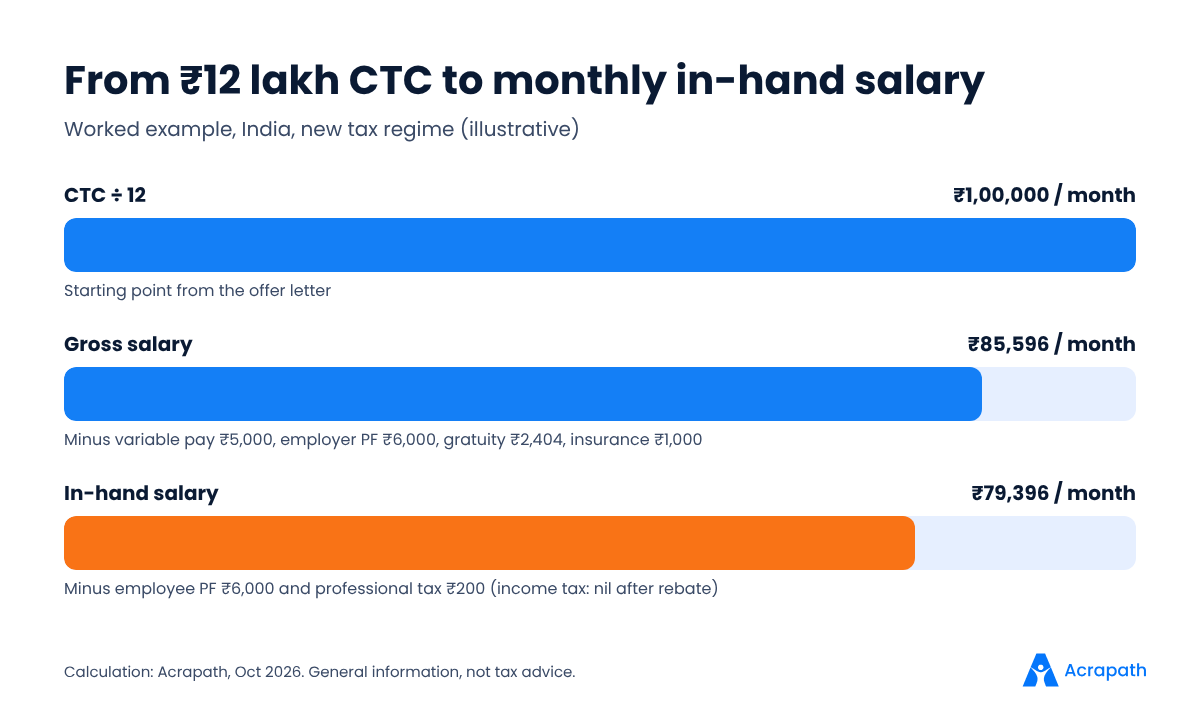
Here's a sample ₹12,00,000 CTC for a salaried employee in India on the new tax regime. Basic is 50% of CTC, HRA is 40% of basic, and gratuity uses the 15/26 formula explained below.
Line item | Annual (₹) | Monthly (₹) |
|---|---|---|
CTC | 12,00,000 | 1,00,000 |
− Variable pay (paid yearly, if earned) | 60,000 | 5,000 |
− Employer PF (12% of basic) | 72,000 | 6,000 |
− Gratuity provision | 28,846 | 2,404 |
− Group health insurance | 12,000 | 1,000 |
= Gross salary (basic 6,00,000 + HRA 2,40,000 + special allowance 1,87,154) | 10,27,154 | 85,596 |
− Employee PF (12% of basic) | 72,000 | 6,000 |
− Professional tax (example rate) | 2,400 | 200 |
− Income tax (new regime) | 0 | 0 |
= In-hand salary | 9,52,754 | 79,396 |
Why is tax zero? Gross salary plus the bonus is ₹10,87,154. After the ₹75,000 standard deduction, taxable income is ₹10,12,154, below the ₹12 lakh rebate limit.
So in this CTC vs in-hand salary example, a ₹1 lakh-a-month CTC pays about ₹79,400 a month in hand, plus any bonus. Most of the 21% gap sits in PF, which is still your money, just saved for later.
PF and Gratuity: How They Work in India
PF and gratuity are the two biggest reasons CTC and in-hand salary differ. Both are savings, not lost money, but you can't spend them this month.
Provident fund rates
The EPFO's EPF scheme page says employee and employer each contribute 12% of basic wages plus DA, mandatory on wages up to ₹15,000 a month. The EPFO employer information booklet shows the employer's share split into 8.33% for the pension scheme (EPS) and 3.67% for your EPF account.
The ceiling matters. On a ₹50,000 basic, 12% of the capped ₹15,000 is ₹1,800, while 12% of the full basic is ₹6,000. Ask which method your employer uses.
Gratuity formula
For a monthly-paid employee, gratuity = 15/26 × last drawn monthly basic + DA × completed years of service. The 15/26 method comes from Section 4(2) of the Payment of Gratuity Act, 1972.
The rate of 15 days' wages per year now continues under the Code on Social Security, 2020, and the Ministry's 2026 FAQs put the ceiling at ₹20 lakh. With a ₹50,000 basic and 5 years of service, gratuity is about ₹1,44,231.
Regular employees usually need 5 years of continuous service to qualify. Per the Government of India's November 2025 labour reforms note, fixed-term employees now qualify after 1 year.
How Income Tax Affects Your In-Hand Salary
Income tax is the most variable deduction. In India, the new regime has been the default since assessment year 2024-25, according to the Income Tax Department's guide for salaried individuals, though you can choose the old regime.
Standard deduction: ₹75,000 under the new regime and ₹50,000 under the old, per the Income Tax Department's FAQ.
New-regime slabs (FY 2025-26): nil up to ₹4 lakh, rising in ₹4 lakh steps from 5% to 30% above ₹24 lakh, plus cess.
Section 87A rebate: up to ₹60,000 when taxable income is ₹12 lakh or less.
Old regime: allows HRA exemption and Section 80C deductions, so it can suit high-rent or high-investment earners.
The Union Budget of 1 February 2026 left these slabs unchanged, and the Income-tax Act, 2025 took effect on 1 April 2026. Check current limits each year.
CTC vs Gross vs Net Pay Outside India
Outside India you'll rarely see "CTC". Most countries quote gross annual salary, and your payslip shows net pay after taxes and contributions.
Gross pay matches India's gross salary.
Net pay matches in-hand salary.
Total compensation is the nearest match to CTC, adding employer pension, health cover, equity and bonuses.
Indian CTC bundles employer costs into the headline figure, while many markets list them separately. Comparing an Indian offer with one from the UAE, UK or US? Compare gross with gross and net with net, never CTC with gross.
How to Compare Offers on In-Hand Salary
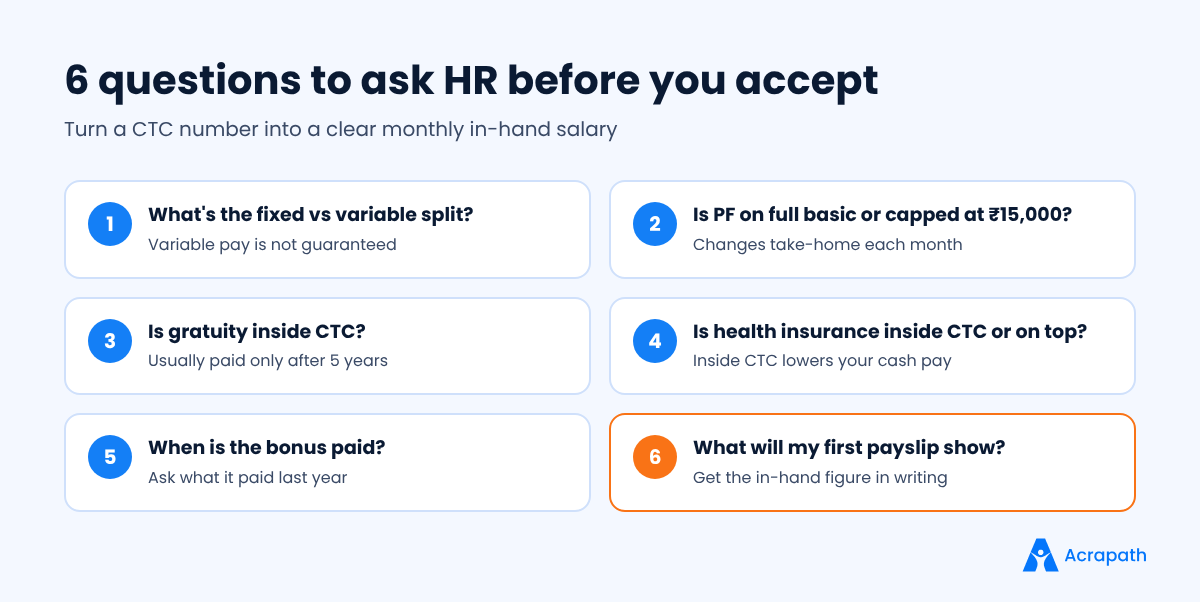
A higher CTC isn't always the better offer. Ask HR these questions before you accept:
What's the fixed vs variable split? More variable pay means more risk.
Is PF on full basic or capped at ₹15,000? It can change take-home by thousands a month.
Is gratuity inside CTC? Discount it if you may leave within 5 years.
Is health insurance inside CTC or on top?
When is the bonus paid, and what did it pay last year?
What will my first payslip show? Ask for the monthly in-hand figure in writing.
When you negotiate, focus on fixed pay. Moving part of the variable component into fixed salary often helps more than a small bump to CTC. Heading for a finance career? Our guides on becoming a financial analyst and accountant interview questions cover payroll basics like these.
It also helps to see the employer's side. Companies budget for the full CTC plus recruiting costs, so every component in your offer is a real cost to them. And unclear salary breakups often lead to late drop-outs, as this case study on offer dropouts shows.
Common Mistakes When Reading a CTC Offer
Dividing CTC by 12 and treating the result as monthly pay.
Counting variable pay as guaranteed income.
Ignoring the gratuity qualifying period when you plan to switch soon.
Accepting without the annexure. Freshers especially should ask; our guide to a resume with no experience can help you reach that offer stage.
Conclusion
The CTC vs in-hand salary gap comes down to one idea: CTC is what you cost the employer, and in-hand salary is what you get each month. Variable pay, employer PF, gratuity, insurance and your own deductions sit in between.
Before you accept your next offer, get the salary breakup, run it through the five steps above, and compare offers on fixed in-hand pay.
Ready to find a role with a package that works for you? Find your next role with Acrapath, an exclusive job portal, hiring agency and career consultation service in one place.
- #ctc vs in hand salary
- #CTC meaning
- #in-hand salary calculation
- #salary deductions
- #PF and gratuity
Frequently asked questions
How much is the in-hand salary for a 12 LPA CTC?
It depends on the salary structure, but in our India example a ₹12 lakh CTC gives about ₹79,400 a month in hand. That assumes ₹60,000 variable pay, PF on full basic, professional tax of ₹200 a month and no income tax under the new regime. Different PF, bonus or insurance terms will change the figure.
Is PF part of CTC?
Yes, in most Indian offers the employer's PF contribution is included in CTC. Your own PF contribution is then deducted from gross salary, so PF reduces in-hand pay twice compared with CTC ÷ 12. Both contributions go to your PF account, so the money is saved for you, not lost.
How do I calculate in-hand salary from CTC?
Start with CTC, subtract variable pay and employer-only costs such as employer PF, gratuity and insurance to get gross salary. Divide by 12, then subtract employee PF, professional tax and monthly income tax (TDS). Use the salary breakup in your offer letter's annexure, and ask HR for it if it is missing.
Is gratuity included in CTC?
Many Indian employers include a gratuity provision in CTC, usually about 4.8% of basic salary. You only receive it when you leave after the qualifying service, normally 5 years of continuous service for regular employees in India. If you expect to switch jobs sooner, leave gratuity out when you compare offers.
What is the difference between CTC and gross salary?
CTC is the employer's total yearly cost for you, while gross salary is the pay you earn before your own deductions. The difference is employer-side items such as employer PF, gratuity, insurance premiums and variable pay. Gross salary is the top line of your payslip; CTC appears in your offer letter.