

Learn how to become an SEO specialist: 4 core skills, free tools to start, a 6-step plan, salary, career path and how to land your first SEO job.
Key Takeaways
To become an SEO specialist, learn 4 areas (keyword research, on-page SEO, technical SEO and link building), practise on a real website, and show results in a small portfolio. A degree helps but isn't required.
Google still dominates search, with 76.38% of worldwide desktop search engine share in September 2026 (StatCounter), so SEO skills stay in demand.
Start with free, official resources: Google's SEO Starter Guide, Search Essentials and Search Console.
In the UK, the National Careers Service lists SEO specialist pay from about £25,000 for starters to £50,000 for experienced specialists.
A 90-day plan (learn, build, show) is enough to apply for junior SEO roles if you practise every week.
You've written a blog post, hit publish, and then nothing. No visitors, no clicks, no rankings. Then you wonder how some pages reach the top of Google and stay there for years.
That question is where most SEO careers begin. An SEO specialist's job is to help the right pages get found by the right people, and it's one of the most practical skills in digital marketing. You can learn it with free tools, practise it on your own website, and prove it with numbers.
This guide explains how to become an SEO specialist step by step: what the job involves, the skills and tools you need, how pay works, and how to land your first role. If you're still exploring marketing careers, our digital marketing career guide gives you the wider map.
What Does an SEO Specialist Do?
An SEO (search engine optimisation) specialist improves a website so it appears higher in search results for relevant searches, bringing in more qualified visitors without paying for ads. They research what people search for, improve pages and site structure, fix technical problems, and earn links from other websites.
According to the UK National Careers Service, day-to-day work includes developing content strategies to improve rankings, monitoring SEO performance with digital tools, adding keywords to headings and content, and reporting on how SEO affects the business.
A typical week might include:
Finding keywords for 3-5 new pages and briefing writers.
Rewriting titles and meta descriptions on pages that get impressions but few clicks.
Checking Google Search Console for crawl and indexing errors.
Reaching out to websites for links or mentions.
Reporting traffic, rankings and leads to your manager or client.
SEO specialists work in-house at brands, at digital agencies, or as freelancers and consultants.
SEO Specialist Skills You Need
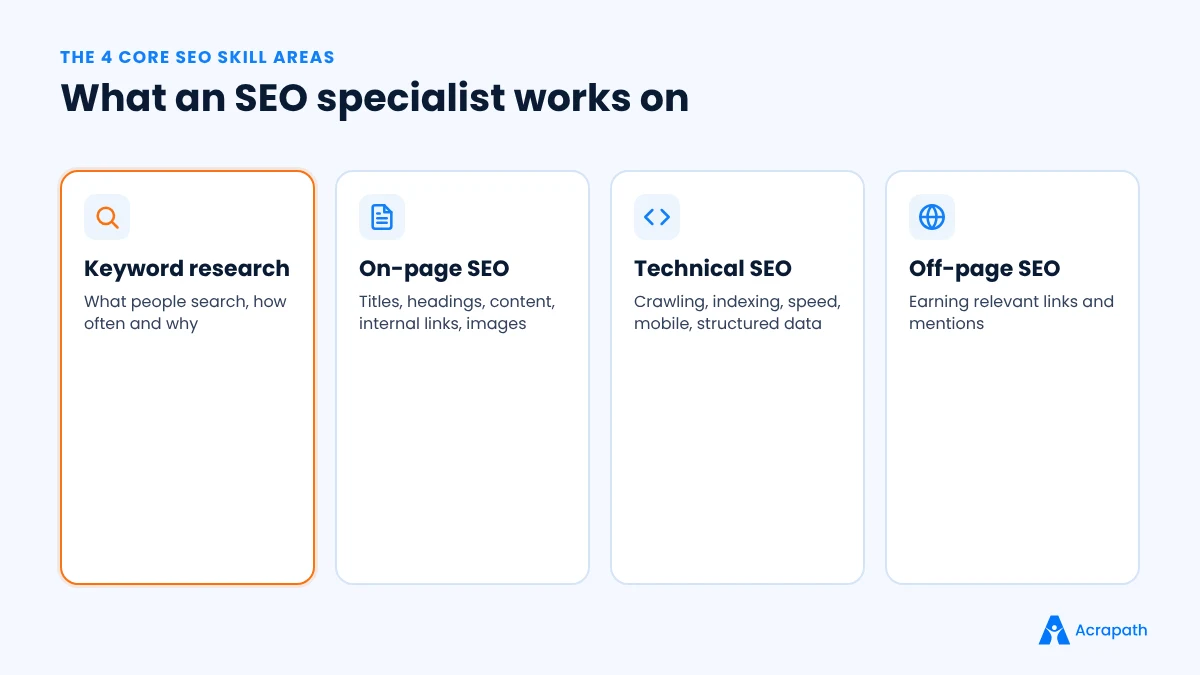
The core SEO specialist skills fall into 4 areas: keyword research, on-page SEO, technical SEO and off-page SEO (links and mentions). Writing, analytics and communication tie them together.
Skill area | What you'll do | Beginner milestone |
|---|---|---|
Keyword research | Find what people search, how often, and why | Build a keyword list of 50 terms grouped by intent for one topic |
On-page SEO | Optimise titles, headings, content, internal links and images | Rewrite 10 page titles and meta descriptions and track clicks |
Technical SEO | Crawling, indexing, site speed, mobile, structured data | Fix every indexing error in Search Console for a small site |
Off-page SEO | Earn links and mentions from relevant sites | Get 3 genuine links from relevant websites |
Content | Brief or write pages that answer searches completely | Publish 5 articles that each target one clear keyword |
Analytics | Measure traffic, rankings and conversions | Build a monthly report in Google Analytics and Search Console |
The National Careers Service also highlights analytical thinking, attention to detail, persistence and strong written English. SEO results take time, so patience is a real skill here.
SEO Tools Every Beginner Should Learn
Learn free tools first. Google gives you most of what you need to start, and paid tools make more sense once you're working on bigger sites.
Google Search Console: shows the searches your site appears for, clicks, indexing status and errors. Start with Google's Search Console getting-started guide.
Google Analytics: shows what visitors do after they arrive.
PageSpeed Insights: checks loading speed and Core Web Vitals.
A keyword tool: Google Keyword Planner (free with a Google Ads account) or the free tiers of paid tools.
A site crawler: Screaming Frog's free version crawls up to 500 URLs to find broken links, missing titles and redirects.
Paid suites (later): Semrush, Ahrefs or similar for competitor research and backlink data.
Tools change; principles don't. Spend most of your learning time on why rankings move, not on which buttons to click.
How to Become an SEO Specialist (Step-by-Step)
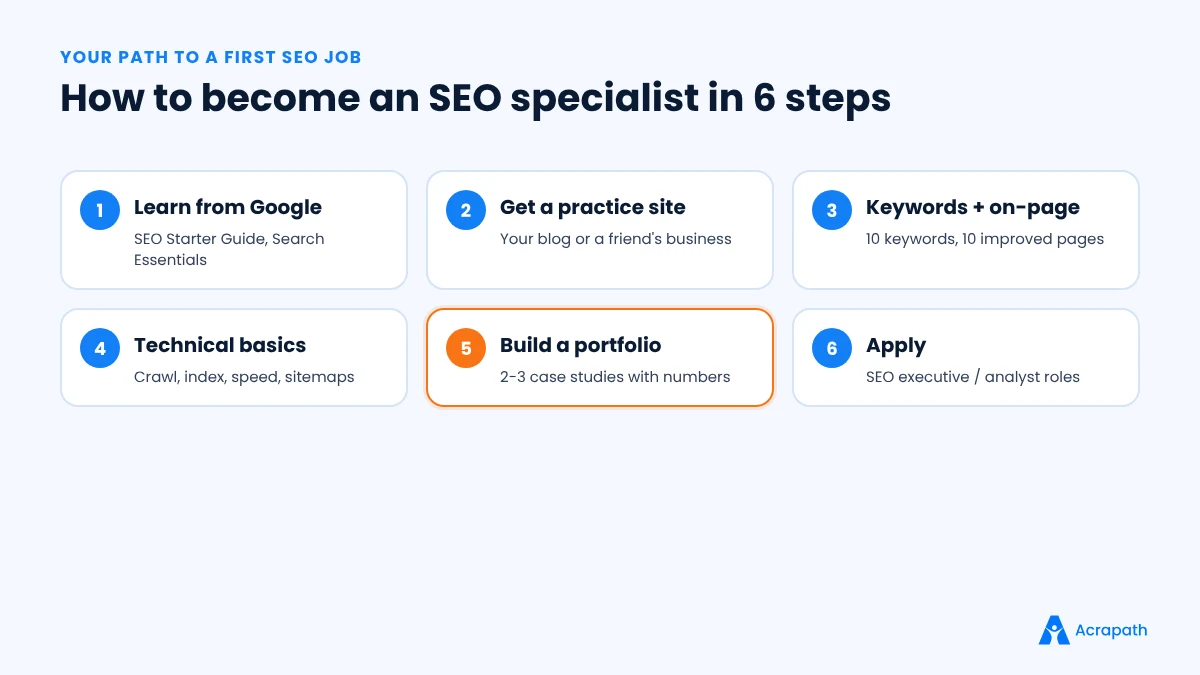
Follow these 6 steps. Each one produces something you can show an employer.
Step 1: Learn the Fundamentals From Google
Read Google's SEO Starter Guide and Search Essentials first. They explain how Google finds, understands and ranks pages, in plain language.
Google is refreshingly honest about shortcuts. Its starter guide says "there are no secrets here that'll automatically rank your site first."
Pitfall: starting with "SEO hacks" videos. Learn the official basics first so you can spot bad advice.
Step 2: Build or Borrow a Website to Practise On
Create a simple blog on a topic you know, or offer to help a friend's business, a college society or a non-profit with their site. Real practice beats any certificate.
Pitfall: waiting for the perfect niche. Any real site with real visitors teaches you more than theory.
Step 3: Practise Keyword Research and On-Page SEO
Pick 10 keywords, write or improve one page for each, and track impressions and clicks in Search Console. Google's guide on creating helpful, people-first content is your quality bar.
Pitfall: stuffing keywords. Write for the reader first; Google's own guidance lists keyword stuffing as a myth that doesn't help.
Step 4: Learn Technical SEO Basics
Learn how crawling and indexing work, how to read robots.txt and sitemaps, what canonical tags do, and how site speed and mobile usability affect users. Crawl your practice site and fix what you find.
Pitfall: avoiding anything "technical". You don't need to code, but you do need to talk clearly with developers.
Step 5: Document Results in a Mini Portfolio
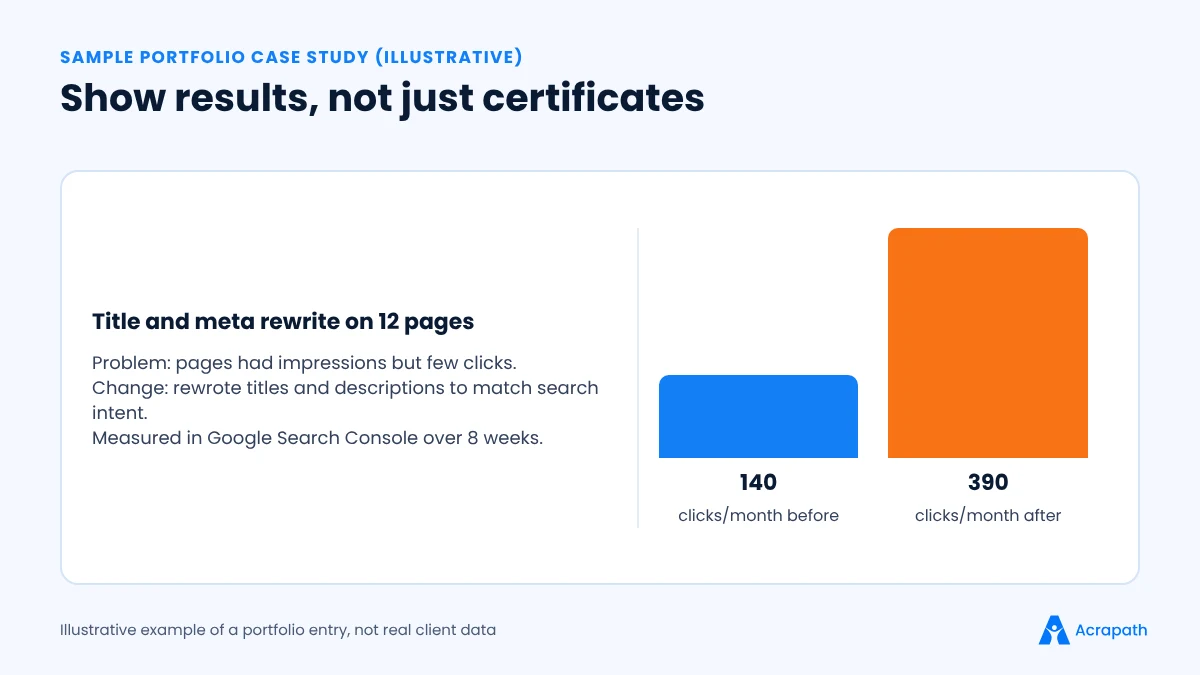
Write 2-3 short case studies: the problem, what you changed, and the result with screenshots. "Rewrote titles on 12 pages; clicks rose from 140 to 390 a month in 8 weeks" is exactly what hiring managers want to read.
Pitfall: only listing courses. Certificates show interest; results show ability.
Step 6: Apply for Junior SEO Roles
Look for titles like SEO executive, SEO analyst, junior SEO specialist, content and SEO associate, or digital marketing executive with SEO duties. Put your portfolio link at the top of your resume. If you're applying without formal experience, our guide to a resume with no experience shows how to lead with projects.
Pitfall: applying with a generic marketing resume. Name the tools, the sites and the numbers.
A 90-Day Plan to Get Job-Ready
A 90-day plan keeps your learning focused and gives you results to show by the end. Spend about an hour a day, and more at weekends if you can.
Days 1-30 (Learn): read Google's SEO Starter Guide and Search Essentials, set up a practice site with Search Console and Analytics, and research 50 keywords for your topic.
Days 31-60 (Build): publish or improve 5-10 pages, fix technical issues from a crawl, and add internal links between related pages.
Days 61-90 (Show): measure what changed, write 2 short case studies, update your resume and LinkedIn, and start applying.
Don't worry if your traffic is still small at day 90. Hiring managers care that you can explain what you tested, what moved and what you'd try next.
SEO Specialist Salary and Career Path
An SEO specialist salary depends on country, company size and whether you work in-house, at an agency or as a freelancer. Public benchmarks give a sense of the range.
United Kingdom: the National Careers Service lists about £25,000 for starters and £50,000 for experienced SEO specialists (2026 profile).
India and other markets: pay varies widely by city and company. Compare live listings for SEO executive and SEO specialist roles, and ask for the fixed and variable split in any offer.
Demand comes from one simple fact: people still search before they buy, apply or decide. Google held 76.38% of worldwide desktop search engine share in September 2026, according to StatCounter.
A common path looks like this:
Stage | Typical titles | Focus |
|---|---|---|
Entry (0-2 years) | SEO executive, SEO analyst | Keyword research, on-page fixes, reporting |
Mid (2-5 years) | SEO specialist, senior SEO executive | Owning a site's strategy, technical audits, link building |
Senior (5+ years) | SEO manager, head of SEO, SEO consultant | Leading teams, budgets and multi-site strategy |
Many specialists later move into broader digital marketing, product or growth roles. See how one writer made the switch in our content writer to SEO specialist case study.
SEO for Freshers: How to Stand Out
As a fresher, you stand out by showing proof of work, not by listing every SEO term you know. Hiring managers look for curiosity, clear writing and measurable results from your own projects.
Share a live site: even a small blog with Search Console data shows initiative.
Explain your thinking: in interviews, walk through why you chose a keyword and what you'd test next.
Keep learning publicly: short LinkedIn posts about what you tested build credibility.
Prepare for the interview: our digital marketing interview questions include the SEO questions you're likely to hear.
Common Mistakes to Avoid
Chasing rankings, not results. Traffic only matters if it brings leads, sales or sign-ups.
Buying links. It breaks Google's spam policies and can harm a site.
Expecting fast wins. Google notes changes can take from hours to months to show up.
Ignoring content quality. Thin, copied or AI-padded pages rarely rank for long.
Not tracking anything. If you didn't measure the before, you can't prove the after.
Conclusion
If you want to know how to become an SEO specialist, the path is clear: learn from Google's own guides, practise on a real website, measure everything, and turn your results into a short portfolio. You don't need expensive tools or a specific degree to start.
Start this week: set up Search Console on a practice site, pick 10 keywords and improve one page. In 90 days, you'll have real numbers to talk about.
Ready to put this into practice? See open marketing and SEO roles on Acrapath and apply with your portfolio link.
- #how to become an seo specialist
- #SEO specialist skills
- #SEO tools
- #SEO specialist salary
- #SEO for freshers
- #digital marketing careers
Frequently asked questions
Can I become an SEO specialist without a degree?
Yes, you can become an SEO specialist without a degree. Employers care most about proof that you can improve rankings and traffic. Learn from Google's official guides, practise on a real website, and document your results in a short portfolio. A degree in marketing, IT or communications can help, but it isn't required.
How long does it take to become an SEO specialist?
With steady weekly practice, you can learn enough to apply for junior SEO roles in about 3 to 6 months. Becoming a confident, independent SEO specialist usually takes 1 to 2 years of hands-on work across different websites, because rankings move slowly and you learn most from seeing real results.
What tools does an SEO specialist use?
An SEO specialist typically uses Google Search Console, Google Analytics, PageSpeed Insights, a keyword research tool such as Google Keyword Planner, and a site crawler like Screaming Frog. Many teams also use paid suites like Semrush or Ahrefs for competitor and backlink research. Beginners can start with the free tools.
Is SEO a good career for freshers?
SEO is a good career for freshers who enjoy writing, analysis and problem solving. Entry barriers are low, you can practise for free, and results are easy to show with data. Expect patience to be part of the job, since SEO changes can take weeks or months to show measurable results.
What is the difference between an SEO executive and an SEO specialist?
An SEO executive is usually an entry-level role that carries out tasks such as keyword research, on-page updates and reporting. An SEO specialist typically has a few years of experience and owns strategy, technical audits and link building for a site. Titles vary by company, so check the job description.


