

Learn how to become a sales executive: the skills employers want, how salary and incentives work, B2B vs B2C, and a 6-step plan to land your first job.
Key Takeaways
How to become a sales executive: build 5 core skills (prospecting, communication, listening, objection handling and closing), learn one CRM, get practice through an internship or entry-level role, and apply with a number-led resume.
Most entry-level sales roles don't need a specific degree. Employers hire for confidence, communication and persistence, and train you on the product.
Pay usually has 2 parts: a fixed salary plus incentives. In the US, wholesale and manufacturing sales reps earned a median of $76,460 in May 2025 (BLS); UK starters earn about £23,000.
The US alone expects about 123,400 openings a year for these sales reps from 2025 to 2035, so demand for good salespeople stays steady.
A strong first 90 days (product knowledge, pipeline habits, a mentor) matters more than your first job title.
You're good with people. You can explain things clearly, you don't mind hearing "no", and you like the idea of being paid more when you perform. Sales sounds like a fit. But where do you actually start?
Learning how to become a sales executive is less about a perfect degree and more about proving you can find customers, talk to them and move them to a decision. Hiring managers know freshers don't have a sales record yet. What they look for is evidence that you'll learn fast and keep going.
This guide walks you through what a sales executive does, the skills that matter, how pay works, B2B vs B2C sales, and a step-by-step plan to land your first sales job. When your resume is ready, our sales executive resume examples will help you present it well.
What Does a Sales Executive Do?
A sales executive finds potential customers, understands what they need, shows how a product or service solves that need, and closes the sale. They also keep existing customers happy so they buy again. Most sales executives work to a monthly or quarterly target and are measured on revenue, new accounts and conversion rates.
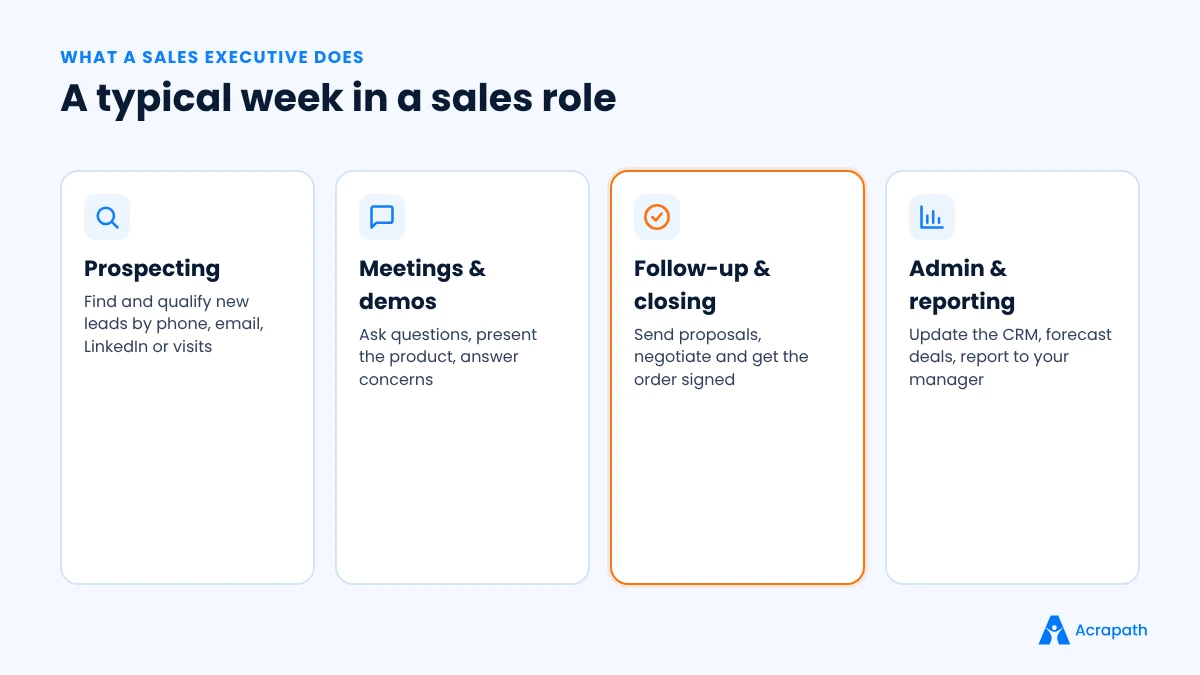
A typical week mixes four kinds of work:
Prospecting: finding new leads through calls, emails, LinkedIn, referrals, walk-ins or field visits.
Meetings and demos: asking questions, presenting the product and answering concerns.
Follow-up and closing: sending proposals, negotiating terms and getting the order signed.
Admin and reporting: updating the CRM, forecasting deals and sharing progress with your manager.
The job title changes by company. You'll see sales executive, business development executive (BDE), sales associate, inside sales representative, account executive and territory sales officer. The core work is the same: create and close revenue.
Sales Executive Skills You Need
The sales executive skills that matter most are prospecting, clear communication, active listening, objection handling and closing. Tools like a CRM and spreadsheets come next. The UK's National Careers Service lists selling and negotiating, persuasion, persistence and verbal communication among the key skills for sales representatives.
Skill | What it looks like on the job | How to practise it before your first job |
|---|---|---|
Prospecting | Finding and qualifying 20-50 new leads a week | Build a list of 30 local businesses that could use a product you like, and note who decides |
Communication | Explaining value in 30 seconds, by phone or in person | Record a 60-second pitch for any product and cut it down until it's sharp |
Active listening | Asking good questions before pitching | In every conversation, ask 3 follow-up questions before giving your view |
Objection handling | Responding calmly to "too expensive" or "not now" | Write the 5 most common objections for one product and your answer to each |
Closing | Asking for the order and agreeing next steps | Practise ending every pitch with a clear question: "Shall we start on Monday?" |
CRM and data | Logging calls, tracking pipeline, forecasting | Take a free CRM course (for example HubSpot Academy) and learn basic Excel or Google Sheets |
Resilience ties all of these together. You'll hear more "no" than "yes", especially in your first months. The people who succeed treat rejection as data, adjust their approach and pick up the phone again.
Language skills are a quiet advantage. In regional, export and field sales, speaking the customer's language often wins trust faster than any pitch.
Sales Executive Salary: How Pay Works
A sales executive salary usually combines a fixed monthly pay with variable incentives or commission tied to targets. That means two people with the same title can earn very different amounts in the same year.
Here's what public data shows in two markets:
United States: wholesale and manufacturing sales representatives earned a median of $76,460 a year in May 2025, according to the US Bureau of Labor Statistics.
United Kingdom: the National Careers Service puts starters at about £23,000 and experienced sales representatives at up to about £50,000 (2026 profile), and advises checking how much of an advertised package is on-target earnings (OTE).
In India and the Gulf, offers are usually shown as CTC (cost to company, the total annual cost of employing you) with a fixed part and an incentive part. Before you accept, ask three questions:
What is the fixed monthly in-hand pay?
How are incentives calculated, and what percentage of the team hit target last quarter?
Are travel, phone and fuel costs reimbursed for field roles?
Your earning potential grows fast with results. Sales is one of the few careers where a strong second year can noticeably raise your pay without a change of title.
B2B vs B2C Sales: Which Should You Choose?
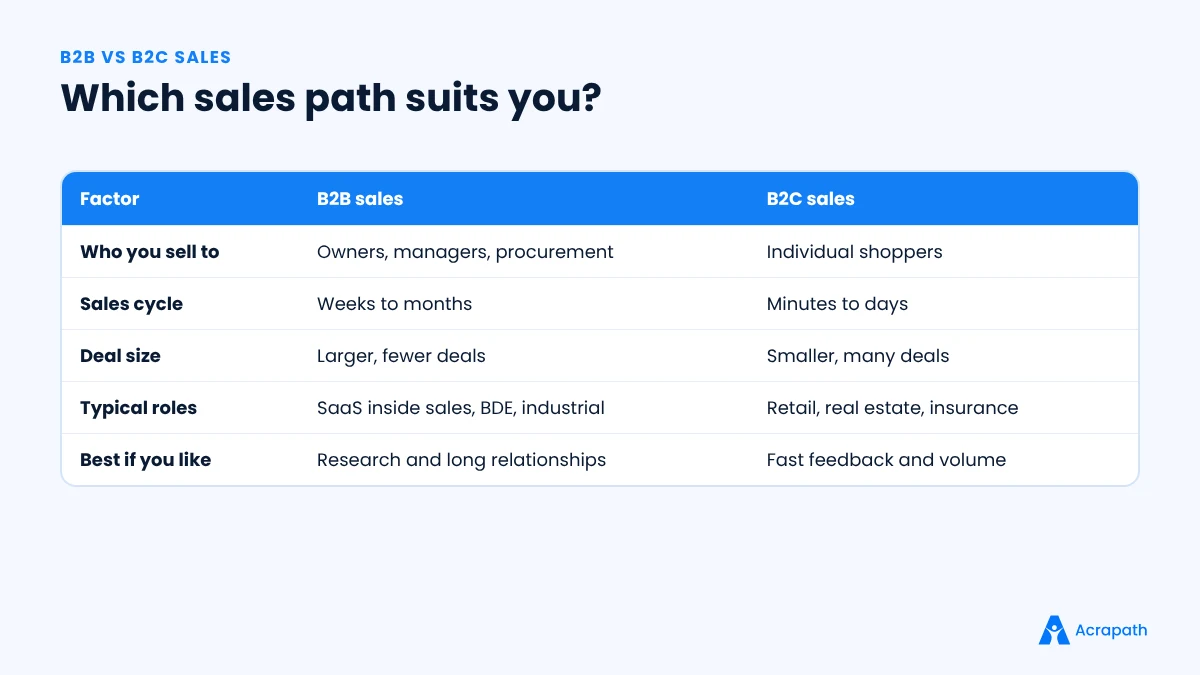
B2B (business-to-business) sales means selling to companies, while B2C (business-to-consumer) sales means selling to individual customers. Both are good first jobs. They suit different personalities.
Factor | B2B sales | B2C sales |
|---|---|---|
Who you sell to | Owners, managers, procurement teams | Individual shoppers and families |
Sales cycle | Weeks to months | Minutes to days |
Deal size | Larger, fewer deals | Smaller, many deals |
Typical roles | SaaS inside sales, industrial sales, BDE, account executive | Retail, real estate, insurance, education counselling, telesales |
Best for you if | You like research, planning and long relationships | You like fast feedback, energy and volume |
Many people start in B2C, where you learn to talk to lots of customers quickly, then move into B2B for larger deals. Either path builds the same core skills.
How to Become a Sales Executive (Step-by-Step)
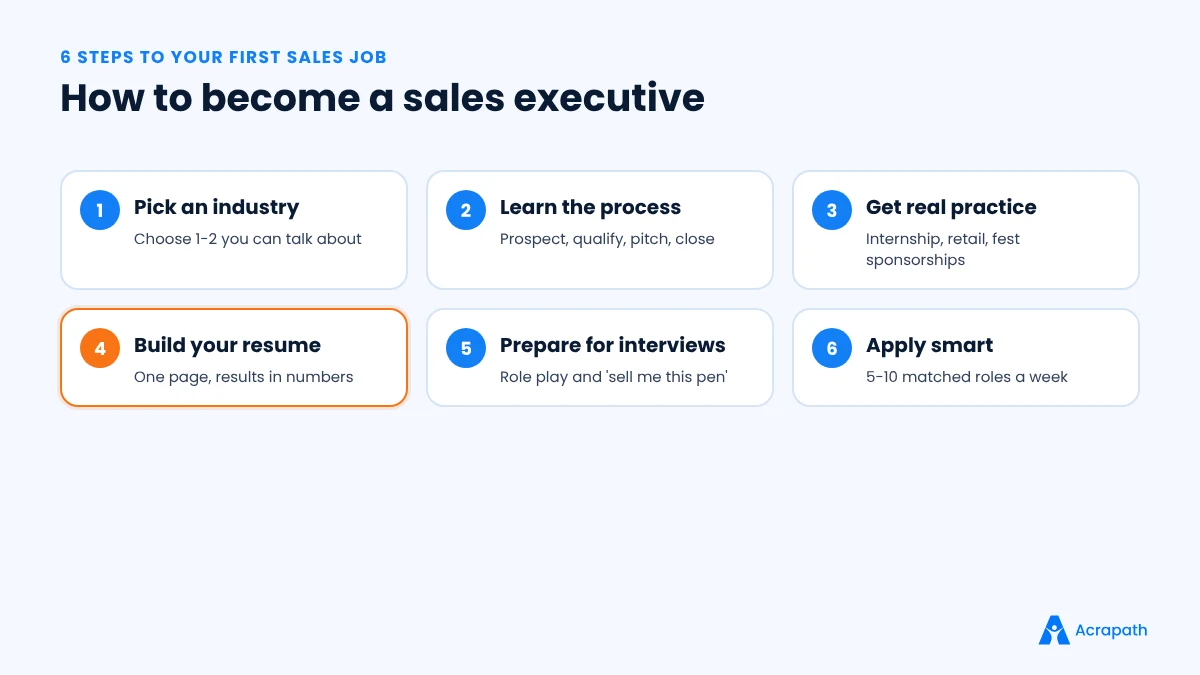
Follow these 6 steps in order. Each one gives you something concrete to show an employer.
Step 1: Pick an Industry You Can Talk About
Choose 1-2 industries you understand or enjoy: software, consumer goods, real estate, education, banking, healthcare or industrial products. You'll sell better when you're curious about the product.
Pitfall: applying to every sales job at once. A focused search lets you speak the industry's language in interviews.
Step 2: Learn the Basics of the Sales Process
Learn the standard stages: prospecting, qualifying, discovery, presenting, handling objections, closing and follow-up. Free CRM courses and YouTube sales trainings cover these in a weekend.
Pitfall: memorising scripts. Understand why each stage exists so you can adapt in a real conversation.
Step 3: Get Real Practice, Even Small
Get any experience where you persuaded someone: a sales internship, a weekend retail job, college fest sponsorships, selling for a family business, or freelancing on commission. One measurable result ("raised ₹40,000 in fest sponsorship from 6 local brands") beats a page of soft skills.
Pitfall: thinking only paid sales jobs count. Hiring managers value any proof that you can win a "yes".
Step 4: Build a Number-Led Resume
Write a one-page resume with a results-first summary and bullets that show numbers. If you have no formal experience, use projects, internships and campus roles. Our guide to writing a resume with no experience shows how.
Pitfall: listing duties such as "talked to customers". Show what changed because you did it.
Step 5: Prepare for the Sales Interview
Sales interviews test you live. Expect "Sell me this pen", a short role play, questions about handling rejection, and a check on how you'd plan your first month. Practise out loud with a friend and time yourself.
Also prepare for the HR round, where you'll discuss salary, notice period and fit. Our HR interview questions and answers cover the common ones.
Pitfall: pitching features. Start the role play with 2-3 questions about the buyer's needs, then pitch to those needs.
Step 6: Apply Where Sales Teams Are Hiring
Apply to 5-10 well-matched roles a week rather than 50 random ones. Tailor your summary to each job ad, follow up after 5-7 working days, and ask people already in sales roles for referrals.
Pitfall: ignoring smaller companies. Startups and SMEs often give freshers bigger targets and faster learning.
Sales Jobs for Freshers: Where to Start
The best sales jobs for freshers are roles with clear training and a defined target: inside sales, business development executive, retail sales and field sales trainee programmes.
Inside sales / SDR (sales development representative): calling and emailing leads, booking meetings for senior sellers. Great for learning SaaS and B2B.
Business development executive: a mix of prospecting and closing smaller deals, common in education, services and tech.
Field sales trainee: visiting shops, distributors or businesses in a territory. Common in FMCG, pharma and telecom.
Retail and showroom sales: fast feedback and lots of customer conversations every day.
Look closely at training. A role with a structured first month, a mentor and realistic targets is worth more than a slightly higher fixed salary with no support.
If you later find you enjoy campaigns and content more than closing deals, the skills transfer well. Our digital marketing career guide shows how the two fields overlap.
Your First 90 Days in a Sales Role
Your first 90 days decide how quickly you start earning incentives. Use them to learn the product, build daily habits and win your first deals.
Days 1-30: learn the product, the ideal customer and the CRM. Shadow top performers on calls and meetings.
Days 31-60: run your own outreach every day, track your numbers (calls, meetings, proposals) and ask for feedback weekly.
Days 61-90: close your first deals, build a steady pipeline for next month and agree targets with your manager.
Sales demand is steady. In the US, the BLS projects about 123,400 openings a year for wholesale and manufacturing sales reps from 2025 to 2035, mostly to replace people who move on. Strong performers with a few years of results often move into key accounts, team lead or area manager roles, or into marketing and product.
Common Mistakes to Avoid
Talking more than listening. Buyers trust sellers who understand their problem first.
Ignoring the CRM. If your activity isn't logged, your manager can't help you and you can't learn from your numbers.
Chasing only fixed salary. Check training and incentive structure too; they decide your real earnings.
Giving up after one bad month. Most sales careers start slowly, then build as your pipeline grows.
Over-promising to close a deal. It costs repeat business and your reputation.
Conclusion
Learning how to become a sales executive comes down to a simple loop: build the core skills, get small but real practice, show your results in numbers, and keep improving after every conversation. You don't need a perfect background. You need curiosity, resilience and the habit of asking for the next step.
Start this week: write your 60-second pitch, list 10 companies you'd like to sell for, and update your resume with one measurable win.
Ready to put this into practice? See open sales roles on Acrapath and apply to the ones that match your industry.
- #how to become a sales executive
- #sales executive skills
- #sales executive salary
- #sales jobs for freshers
- #B2B vs B2C sales
- #sales career
Frequently asked questions
What qualifications do you need to become a sales executive?
You usually don't need a specific degree to become a sales executive. Many employers hire graduates from any stream, and some accept school leavers for entry-level roles. Technical sales, such as medical devices or software, may prefer a related degree. Employers mainly look for confidence, clear communication, persistence and some proof that you can persuade people.
How long does it take to become a sales executive?
Most people can land an entry-level sales role within 1 to 3 months of focused preparation: learning the sales process, getting small practical experience and applying to well-matched roles. Becoming a consistently strong sales executive usually takes 12 to 18 months on the job, as you build product knowledge, a pipeline and a track record.
Can a fresher become a sales executive?
Yes. Sales is one of the most fresher-friendly careers. Look for inside sales, business development executive, retail sales or field sales trainee roles with structured training. Show any experience where you persuaded people, such as fest sponsorships, part-time jobs or internships, and prepare for a live role play in the interview.
Is a sales executive a good career?
A sales executive role can be a strong career if you enjoy people and targets. Pay grows with performance, demand stays steady across industries, and the skills transfer to marketing, account management and leadership. The trade-off is pressure: monthly targets and frequent rejection, so resilience matters as much as talent.
What is the difference between a sales executive and a business development executive?
A sales executive mainly closes deals and manages existing customers, while a business development executive usually focuses on finding new leads, markets or partners. In many companies the titles overlap, and one person does both. Read the job description to see whether the role is weighted towards prospecting or closing.

