Recruitment Agency vs Job Portal: Which Fills Roles Faster?

Acrapath Team

Recruitment agency vs job portal: compare cost, speed and control, see how agency fees work, and use a 5-factor checklist to choose for every role.
Key Takeaways
Recruitment agency vs job portal: a job portal is usually cheaper and gives you more control; a recruitment agency is usually faster for hard-to-fill, senior or urgent roles because it hands you a pre-screened shortlist.
SHRM's 2025 benchmarking found a median cost per hire of $1,200 for non-executive roles and $10,625 for executive roles, with both taking about a month and a half to fill.
Agencies typically charge a fee linked to the hire's first-year salary; portals charge for job posts, subscriptions or database access.
Use 5 factors to choose: role difficulty, urgency, hiring volume, budget and your team's screening time.
Many employers use both: a portal for volume roles and an agency for the 1-2 roles they can't afford to get wrong.
You need to fill a role, and the clock is ticking. One option is to post the job yourself on a job portal. The other is to call a recruitment agency and let them bring you candidates. Both promise speed. Both cost money. Which one actually fills the role faster?
The honest answer is: it depends on the role. The recruitment agency vs job portal decision comes down to how hard the role is to fill, how much screening time your team has, and what a delay would cost you.
This guide compares both options side by side, explains how each charges, and gives you a simple way to choose for every role. If you're hiring for the first time, read our guide on how to hire your first employee alongside it.
What Is the Difference Between a Recruitment Agency and a Job Portal?
A job portal is an online platform where employers post jobs and search candidate profiles themselves. A recruitment agency is a service that finds, screens and shortlists candidates for you, and usually earns a fee when you hire. With a portal, your team does the work; with an agency, you pay someone else to do most of it.
Job portal: you write the job ad, receive applications, search the database, screen and interview. You control every step.
Recruitment agency: you brief the recruiter, they source (including people not actively looking), screen and send a shortlist. You interview the finalists.
In-house recruitment: your own recruiter or HR team runs hiring, often using portals, referrals and LinkedIn together.
According to SHRM's 2025 recruiting benchmarking, 55% of US organisations had dedicated in-house recruiters in 2025. The rest lean on HR generalists, agencies or contracted recruiters to fill roles.
Recruitment Agency vs Job Portal: Side-by-Side Comparison
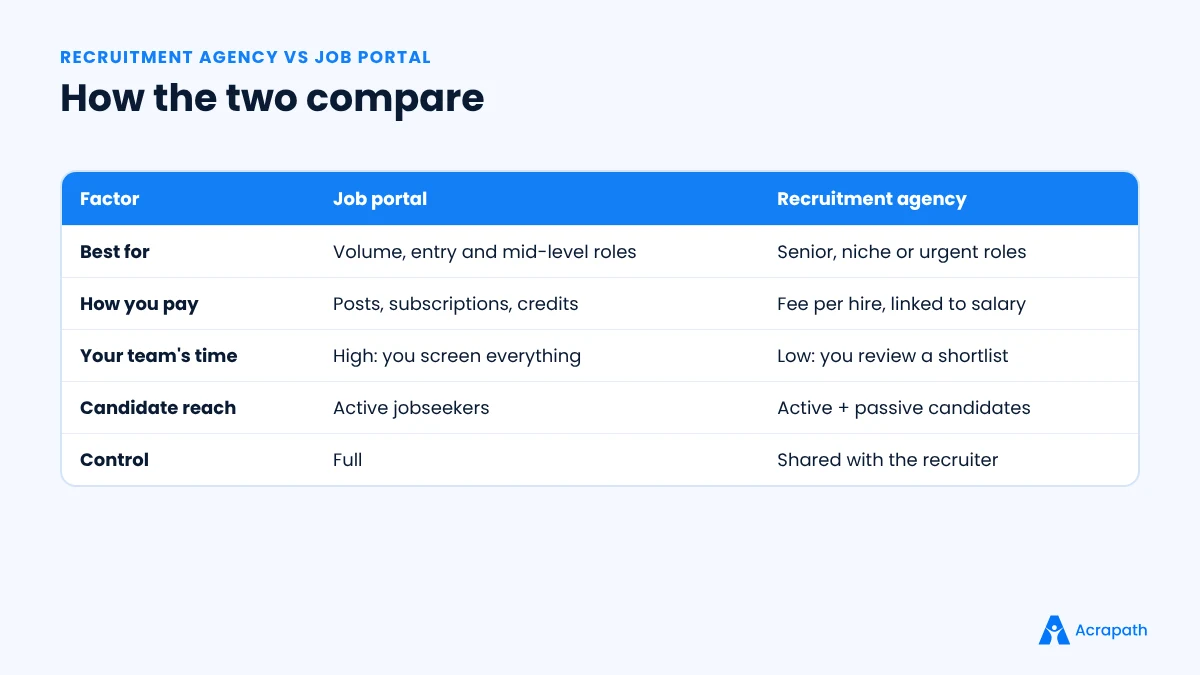
A job portal wins on cost and control; a recruitment agency wins on reach and screening effort. Here's how they compare on the factors that matter most.
Factor | Job portal | Recruitment agency |
|---|---|---|
Best for | Volume, entry and mid-level roles | Senior, niche, confidential or urgent roles |
How you pay | Job post fees, subscriptions or database credits | Fee per successful hire, usually linked to first-year salary |
Upfront cost | Low to moderate | Often none until you hire (contingency model) |
Cost per hire | Lower, especially across many hires | Higher per hire |
Your team's time | High: you screen every application | Low: you review a shortlist |
Candidate reach | Active jobseekers on that platform | Active plus passive candidates in the recruiter's network |
Speed to shortlist | Fast for common roles; slow for rare skills | Usually faster for hard-to-fill roles |
Control over process | Full | Shared with the recruiter |
Replacement guarantee | None (you can repost) | Often offered if the hire leaves early; check terms |
Pros and Cons of Each Option
Each channel has clear strengths and trade-offs. Knowing both helps you set the right expectations before you start.
Job Portal: Pros and Cons
Pro: lower cost per hire. One subscription can cover many roles over a year.
Pro: full control. You decide who to call, how to screen and when to move.
Pro: fast first applications. Common roles often get responses on day one.
Con: screening load. Popular roles bring many unsuitable applications.
Con: limited reach. You mostly reach people actively looking on that platform.
Recruitment Agency: Pros and Cons
Pro: pre-screened shortlist. You spend time only on likely fits.
Pro: passive candidates. Good recruiters reach people who aren't applying anywhere.
Pro: market insight. Agencies can tell you if your salary or requirements are unrealistic.
Con: higher fee per hire. The cost is hard to justify for routine roles.
Con: less control. Quality depends heavily on the individual recruiter and your brief.
Recruitment Agency Fees: What to Expect
Recruitment agency fees are most often charged on a contingency basis: you pay only when you hire, and the fee is usually a percentage of the candidate's first-year salary or CTC. Rates vary by country, seniority and how hard the role is to fill, so always get the exact rate in writing.
The three common models are:
Contingency: no fee unless you hire. Common for junior to mid-level roles.
Retained: part of the fee paid upfront, with the agency dedicated to your search. Common for leadership roles.
RPO (recruitment process outsourcing): an agency runs part or all of your hiring for a monthly or per-hire fee. Useful when you're scaling fast.
Before signing, ask about the replacement period (what happens if the hire leaves in the first 60-90 days), exclusivity, payment terms, and whether the fee is calculated on fixed pay or total CTC.
Questions to Ask a Recruitment Agency Before You Sign
How many similar roles have you filled in the last 12 months, and how long did they take?
Who exactly will work on our search, and how many other roles do they handle?
How do you screen candidates before sending them to us?
What happens if the hire leaves in the first 90 days?
Is the fee based on fixed pay or total CTC, and when is it due?
Clear answers to these five questions tell you more about an agency's quality than any sales deck.
Job Portal Costs and Hidden Costs
Job portals look cheaper on paper, and per hire they usually are. But the biggest cost isn't the subscription. It's your team's time.
A single job post for a common role can attract hundreds of applications. Someone has to read them, screen them, call candidates and schedule interviews. If your founder or hiring manager spends 15 hours on that, the "cheap" option may not be cheap at all.
You can cut that time sharply with a clear job description and a fast screening routine. Our guides on writing a job description and screening resumes quickly show how.
Which Fills Roles Faster?
For common roles, a job portal usually fills faster because applications start arriving within hours. For hard-to-fill roles, a recruitment agency is usually faster because it can approach passive candidates and skip the screening backlog.
For context, SHRM's 2025 benchmarking found both executive and non-executive roles took about a month and a half to fill, with a median of 45 days for executive roles. Every extra week a role sits open costs you output, overtime or lost sales.
Speed also depends on what happens after the shortlist. Slow interview scheduling and long gaps between rounds lose good candidates, whichever channel found them. Use the same structured interview for everyone; our list of sales interview questions to ask shows how that looks for one role.
How to Choose: A 5-Factor Checklist
Score each factor for the role you're hiring. If most point to the right-hand column, use an agency; if most point left, use a portal.
Factor | Points to a job portal | Points to a recruitment agency |
|---|---|---|
Role difficulty | Common skills, many qualified applicants | Rare skills, senior or specialised |
Urgency | Can wait 4-6 weeks | Needed in 2-3 weeks |
Hiring volume | Several similar roles | One critical role |
Budget | Tight per-hire budget | Cost of a vacancy is higher than the fee |
Screening time | HR or a hiring manager has time to screen | No one has time to screen |
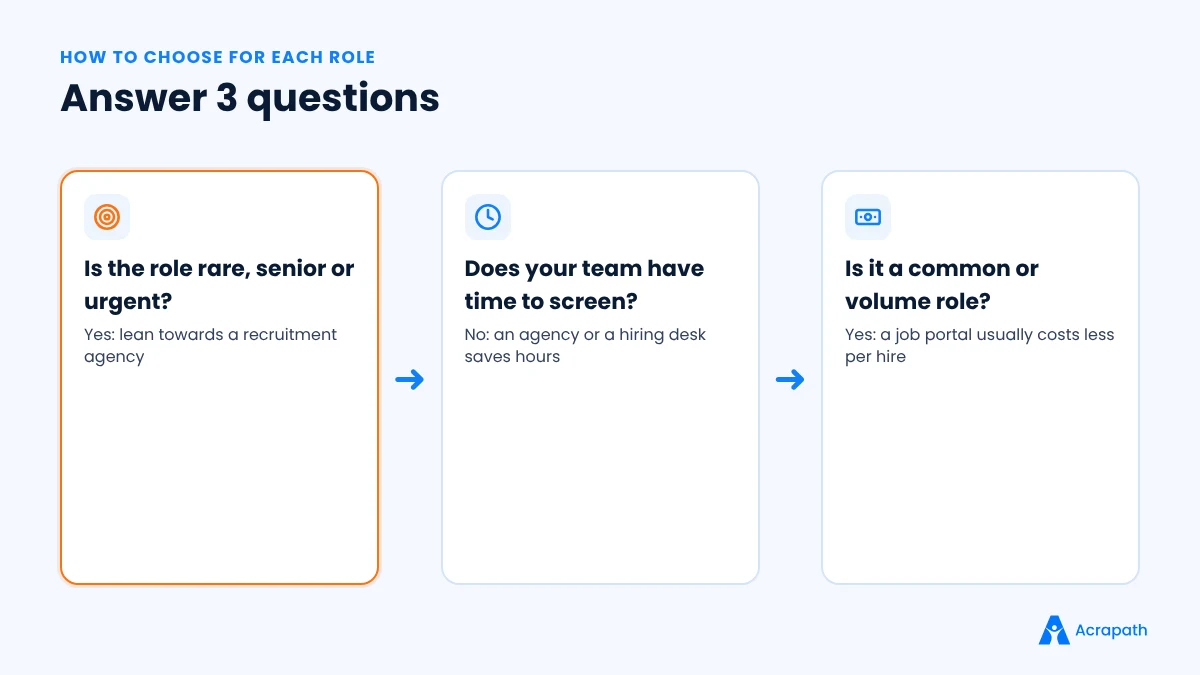
Many companies use a hybrid: portals for steady volume hiring and an agency for leadership or niche roles. As one example, our structured hiring pipeline case study shows how an HR team moved from spreadsheets to a repeatable process.
Where Acrapath Fits
Acrapath works both ways, so you don't have to choose one model for every role. You can post jobs and search verified candidates yourself in Talbox, like a job portal. Or Acrapath's hiring desk can run sourcing, shortlisting and interview coordination for you, like a recruitment agency.
That's useful when your needs change from role to role: self-serve for routine hiring, full support when a role is urgent or hard to fill. See current plans and services on the employer site before you decide.
Common Mistakes to Avoid
Choosing on fee alone. A slow or wrong hire often costs more than any agency fee.
Using several agencies on one role without clear terms. You may face duplicate submissions and fee disputes.
Posting vague job ads. Unclear ads attract unsuitable applicants and slow screening.
Not tracking source of hire. Record where every hire came from, so you know which channel works for which role.
Skipping the agency contract details. Check the replacement period, payment terms and fee base. This is general information, not legal advice.
Conclusion
In the recruitment agency vs job portal debate, there's no single winner. A job portal is the better choice for common, volume roles when your team has time to screen. A recruitment agency is the better choice for senior, niche or urgent roles where speed and reach matter more than the fee.
Next step: list the roles you need to fill this quarter, run each through the 5-factor checklist, and pick the right channel for each.
Want one partner for both? Hire through Acrapath by posting jobs yourself or letting the hiring desk run the search for you.
- #recruitment agency vs job portal
- #recruitment agency fees
- #in-house recruitment
- #job portal for employers
- #cost per hire
- #hiring process
Frequently asked questions
Is a recruitment agency better than a job portal?
A recruitment agency is better for senior, niche, confidential or urgent roles, where reaching passive candidates and getting a pre-screened shortlist saves time. A job portal is better for common and volume roles, where you have time to screen and want lower cost per hire. Many employers use both, depending on the role.
How much do recruitment agencies charge?
Most recruitment agencies charge a contingency fee, paid only when you hire, usually set as a percentage of the candidate's first-year salary or CTC. Rates vary by country, seniority and role difficulty. Retained searches and RPO services use different pricing. Always get the fee base, payment terms and replacement period in writing.
Which is faster, a recruitment agency or a job portal?
For common roles, a job portal is usually faster because applications arrive within hours. For hard-to-fill or senior roles, a recruitment agency is usually faster because it can approach passive candidates and send a ready shortlist. Fast interview scheduling matters just as much as the channel you choose.
When should a company use a recruitment agency?
Use a recruitment agency when a role needs rare skills, is senior or confidential, must be filled within two to three weeks, or when your team has no time to screen applications. It also makes sense when the cost of the vacancy, such as lost sales or delayed projects, is higher than the agency fee.
Can I use a job portal and a recruitment agency together?
Yes. Many employers post roles on a job portal for volume hiring and use a recruitment agency for one or two critical roles. Some providers, including Acrapath, offer both: a self-serve platform to post jobs and search candidates, and a hiring desk that can run the search for you.


