

Sales interview questions to ask candidates, with what good answers sound like, red flags, a role play format and a free scorecard. Hire proven sellers.
Key Takeaways
The best sales interview questions to ask test 5 things: past results, prospecting habits, objection handling, coachability and motivation. Ask the same core questions to every candidate and score answers on a 1-5 scale.
Structured interviews had the highest mean validity (r = .42) of the selection methods in a 2022 meta-analysis by Sackett and colleagues, so a fixed question set beats a free-flowing chat.
Add a 10-15 minute role play. It shows how a candidate sells in real time, which no answer about "being a people person" can.
Below you'll find 21 questions in 5 groups, what a strong answer sounds like, red flags, and a ready-to-use scorecard.
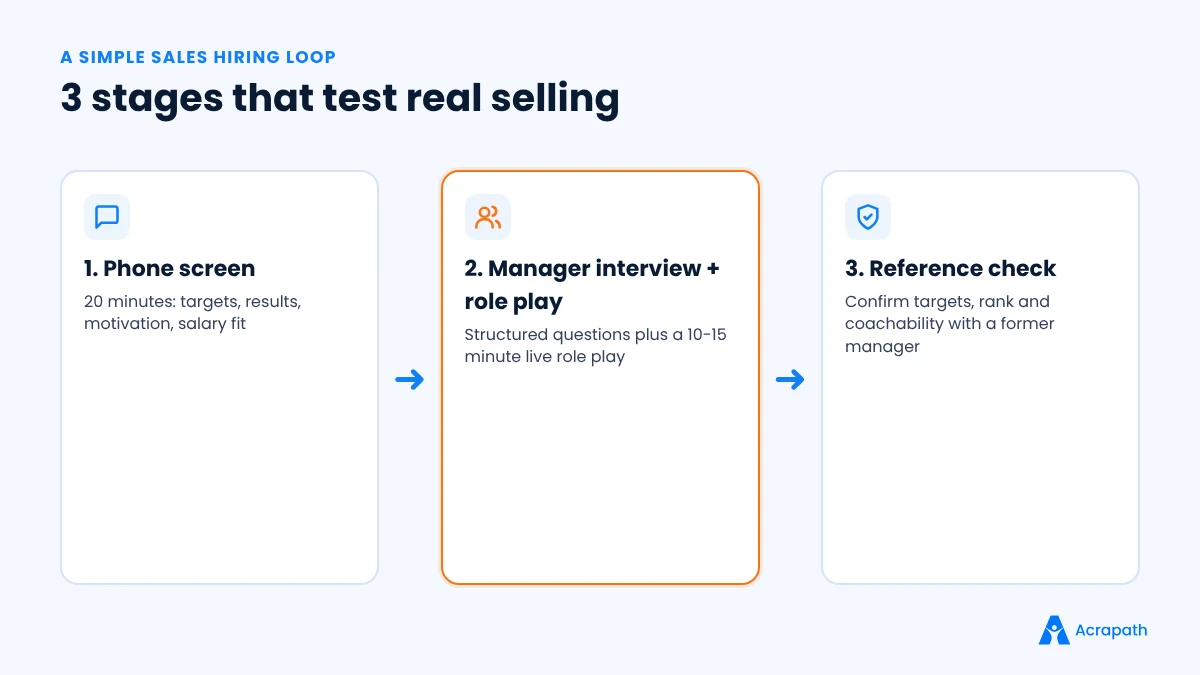
Most sales hiring loops need just 3 stages: a 20-minute screen, a manager interview with role play, and a reference check.
Every sales candidate interviews well. That's the problem. People who sell for a living are good at selling themselves, so a friendly conversation tells you how charming someone is, not how they'll perform against a target in month three.
The fix is a better set of sales interview questions to ask, used the same way with every candidate. Good questions pull out specific examples, numbers and habits. A short role play then shows you the skill directly.
This guide gives you 21 questions grouped by what they test, what good and weak answers sound like, a role play brief and a simple scorecard. If you're still shortlisting, start with our guide on how to screen resumes so only the strongest profiles reach this stage.
What Makes a Good Sales Interview Question?
A good sales interview question asks for a specific past situation, the candidate's own actions and a measurable result. It's open-ended, hard to answer with a rehearsed line, and linked to a skill the role actually needs.
Compare these two:
Weak: "Are you good at handling rejection?" (Everyone says yes.)
Strong: "Tell me about a month when you were behind target. What did you change, and what happened?"
The strong version uses the behavioural method: past behaviour is the best guide to future behaviour. Ask every candidate the same core questions in the same order, then score each answer before moving on. That's the heart of a structured interview.
The evidence supports it. In a 2022 re-analysis of selection research summarised by SIOP, structured interviews had the highest mean operational validity (r = .42) of the methods studied.
Before you write questions, make sure your role is clearly defined. A clear job description tells you which skills to test: inside sales needs phone prospecting; field sales needs territory planning; key accounts need relationship depth.
Sales Interview Questions to Ask About Results and Experience
Start with results. These questions show whether the candidate understands their own numbers, which is the first sign of a disciplined seller.
1. "What was your target last year, and how much of it did you achieve?"
Why ask: top performers know their numbers instantly.
Good answer: a clear figure with context. "My annual target was ₹72 lakh; I closed ₹81 lakh, about 112%, and ranked 3rd of 15."
Red flag: vague answers ("I always do well") or no idea of the target.
2. "Walk me through the biggest deal you closed. How did it start, and how long did it take?"
Why ask: it reveals the candidate's sales process and deal size.
Good answer: a step-by-step story with stakeholders, objections and a timeline.
3. "Which deal did you lose that you think you should have won? What would you do differently?"
Why ask: it tests honesty and learning.
Red flag: blaming price, the product or the customer for everything.
4. "How is your current pipeline split by stage right now?"
Why ask: sellers who manage pipelines well can describe them without notes.
Prospecting and Pipeline Questions
Prospecting questions tell you whether a candidate creates their own opportunities or waits for leads. For most roles, this is where performance is won or lost.
5. "Where did your best customers come from last year?"
Good answer: specific channels, such as referrals, LinkedIn, cold calling or partner networks, with rough numbers.
6. "How many calls, emails or visits did you make in a typical week, and what were your conversion rates?"
Good answer: activity numbers linked to outcomes. "About 200 calls, 25 conversations, 8 demos, 2 deals a week."
7. "How do you research a new account before your first call?"
Good answer: company website, LinkedIn, news, the decision-maker's role, and a hypothesis about their problem.
8. "Tell me about a time you got a meeting with someone who was hard to reach."
Why ask: it shows creativity and persistence without crossing into pushiness.
Objection Handling and Closing Questions
These questions test how a candidate behaves under pressure, which is exactly where deals are won or lost.
9. "A prospect says, 'Your price is too high.' What do you do next?"
Good answer: asks questions first ("Compared to what?"), reframes on value or cost of inaction, and only then discusses terms.
Red flag: jumps straight to a discount.
10. "Tell me about a deal you rescued after it stalled."
11. "How do you know when it's time to ask for the order?"
Good answer: clear buying signals, such as questions about timelines, onboarding or payment terms.
12. "What do you do when a decision-maker goes silent for two weeks?"
Good answer: a planned follow-up sequence that adds value each time, and a check for other stakeholders.
Coachability, Motivation and Fit Questions
Skills can be taught. Attitude is harder. These questions show how a candidate learns, what drives them and whether they'll work well with your team.
13. "What's the best piece of feedback a manager gave you, and how did you use it?"
14. "Tell me about a month when you were behind target. What did you change?"
Good answer: concrete changes in activity or approach, plus the result.
15. "Why sales, and why this product?"
Red flag: only talks about money, or knows nothing about your product.
16. "How do you work with marketing, operations or customer support after the sale?"
17. "What would your previous manager say you need to improve?"
Good answer: an honest weakness and what they're doing about it.
Sales Interview Questions for Freshers and Entry-Level Roles
For freshers, ask about any situation where they persuaded someone, plus potential and learning speed. Don't expect quota stories.
18. "Tell me about a time you convinced someone to change their mind."
19. "Have you ever sold anything, raised money or recruited people? What happened?"
Good answer: college fest sponsorships, a family business, a part-time job, with a result.
20. "How would you learn about our product in your first two weeks?"
21. "Sell me something you use every day."
Good answer: starts with a question about your needs before pitching.
Want to know what candidates are being told to expect? Our jobseeker guide on how to become a sales executive shows how freshers prepare for these rounds.
Sales Hiring Questions by Role Type
Sales roles differ a lot, so add 2-3 role-specific questions to your core set. Here's what to add for the most common types.
Role type | What matters most | Questions to add |
|---|---|---|
Inside sales / SDR | Activity, phone confidence, speed | "How do you open a cold call in the first 10 seconds?" · "What's your best-performing email subject line, and why does it work?" |
Business development executive (BDE) | Prospecting new markets, early-stage deals | "How would you find our first 20 customers in a new city?" · "Which partnership did you open that others had missed?" |
Field sales | Territory planning, relationships with retailers or distributors | "How do you plan a week of visits across your territory?" · "How did you recover a distributor who stopped ordering?" |
Key account / enterprise | Multi-stakeholder deals, renewals, upselling | "Who were all the decision-makers on your largest renewal?" · "How do you grow an account that's already happy?" |
For BDE interview questions in particular, give extra weight to prospecting answers. A BDE who can't describe a repeatable way to open new conversations will struggle, however good they are at closing.
How to Run a Sales Role Play Interview
A sales role play interview asks the candidate to sell to you live for 10-15 minutes, using a short brief. It's the closest you can get to watching them do the job.
Send a one-page brief 24 hours ahead: the product, a buyer persona, and the goal (book a demo or close a pilot).
Play a realistic buyer: busy, a little sceptical, with 2-3 standard objections (price, timing, an existing vendor).
Score live: discovery questions, listening, value framing, objection handling, and a clear ask for next steps.
Give one piece of feedback and run 3 more minutes: how well they adjust shows coachability.
Keep it fair. Use the same brief and the same objections for every candidate, and avoid "trick" scenarios that don't reflect the real job.
A Simple Sales Interview Scorecard
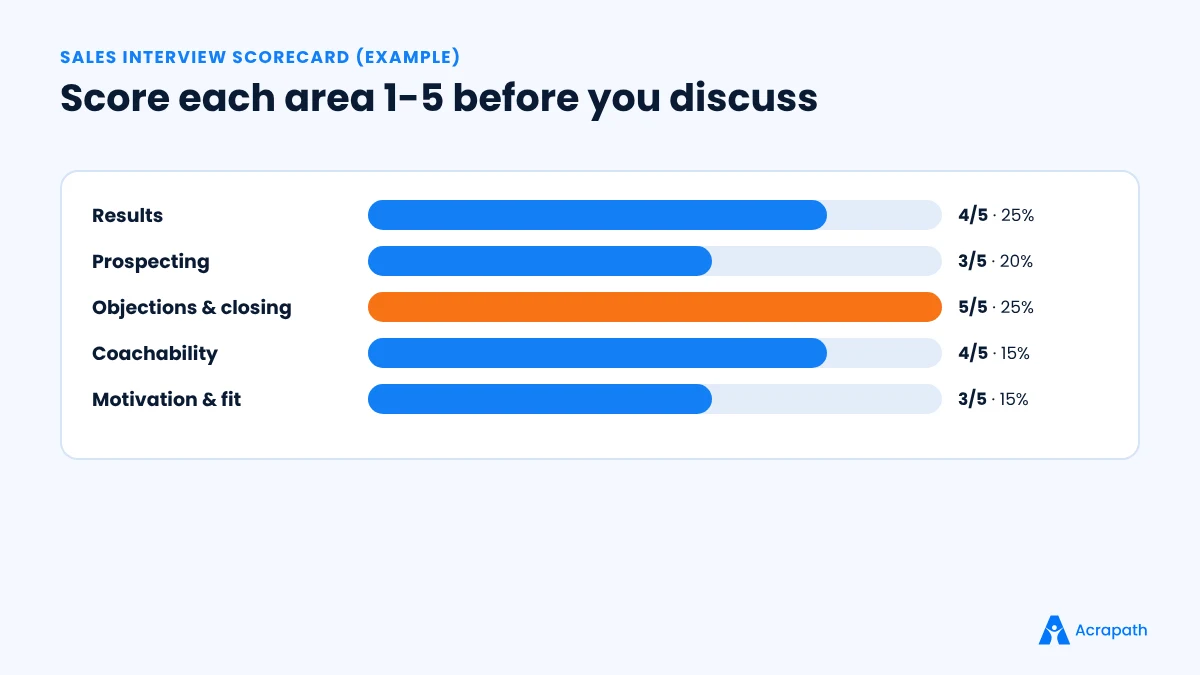
A scorecard turns gut feel into comparable scores. Rate each area from 1 (weak) to 5 (excellent) straight after each section, before you discuss the candidate with anyone else.
Area | Questions | What a 5 looks like | Weight |
|---|---|---|---|
Results | 1-4 | Knows numbers precisely; consistent target achievement | 25% |
Prospecting | 5-8 | Creates own pipeline; clear activity-to-outcome math | 20% |
Objections and closing | 9-12, role play | Asks before answering; protects price; clear ask | 25% |
Coachability | 13-14, 17, role play feedback | Uses feedback within minutes | 15% |
Motivation and fit | 15-16 | Researched your product; team-minded | 15% |
Hiring your first salesperson? Our step-by-step guide on how to hire your first employee covers offers, paperwork and onboarding.
How to Check References for Sales Hires
A reference check confirms what the candidate told you, especially their numbers. Speak to at least one former manager, not just a colleague, and ask the same questions for every candidate.
"What was their target, and how much of it did they achieve?" Compare the answer with what the candidate said.
"How did they rank against the rest of the team?" Rankings are harder to inflate than percentages.
"How did they respond to coaching?" This confirms what you saw in the role play.
"Would you hire them again for a sales role?" Listen for hesitation as much as the words.
Always ask the candidate's permission before contacting references, and don't contact their current employer without explicit consent.
Common Mistakes When Interviewing Sales Candidates
Hiring the best talker. Confidence matters, but numbers and process matter more.
Skipping the role play. It's the single best view of real selling behaviour.
Not checking claims. Ask for proof in references: "What percentage of target did they hit?"
Changing questions for every candidate. You can't compare answers fairly.
Asking personal questions. Avoid questions about age, marital status, religion or family plans. They're irrelevant and, in many countries, unlawful. This is general information, not legal advice.
Conclusion
The right sales interview questions to ask are specific, behavioural and scored the same way for every candidate. Combine them with a short role play and a reference check, and you'll hire for proven selling behaviour instead of interview charm.
Next step: copy the 21 questions and the scorecard into your hiring template, and agree the weights with your sales manager before the next interview.
Need a shortlist to interview? Hire sales professionals through Acrapath and spend your interview time on candidates who already fit the role.
- #sales interview questions to ask
- #sales role play interview
- #sales hiring questions
- #BDE interview questions
- #interview scorecard
- #hiring sales executives
Frequently asked questions
What are the best sales interview questions to ask?
The best sales interview questions to ask are behavioural questions about real results: your target last year and how much you achieved, your biggest closed deal, a deal you lost, where your best customers came from, and how you handled a month behind target. Ask every candidate the same questions and score each answer.
How do you assess a sales candidate in an interview?
Assess a sales candidate with three tools: structured behavioural questions about results and habits, a 10 to 15 minute role play using the same brief for everyone, and a reference check that confirms targets and achievement. Score each area from 1 to 5 on a shared scorecard before discussing candidates with your team.
What should you look for when hiring a salesperson?
Look for proven results with clear numbers, a repeatable prospecting habit, calm objection handling, coachability and genuine interest in your product. Confidence matters, but it should be backed by specifics. Be wary of candidates who can't state their own targets or who blame others for every lost deal.
How long should a sales role play interview be?
A sales role play interview should usually last 10 to 15 minutes, plus 3 to 5 minutes for feedback and a short second attempt. Send the brief 24 hours in advance, play a realistic buyer with two or three standard objections, and use the same scenario for every candidate so scores are comparable.
What questions should you avoid in a sales interview?
Avoid questions about age, marital status, pregnancy or family plans, religion, caste, health or other personal characteristics. They don't predict sales performance and may be unlawful in many countries. Keep every question tied to the skills and results the role requires. This is general information, not legal advice.