Interview Questions to Ask Candidates: 60 Questions by Role

Acrapath Team
Get 60 interview questions to ask candidates, grouped by role, with what a good answer shows, a free scorecard and the research on structured interviews.
Key Takeaways
The best interview questions to ask candidates are job-related, asked the same way to every applicant, and scored against a written rubric, which is what a structured interview is.
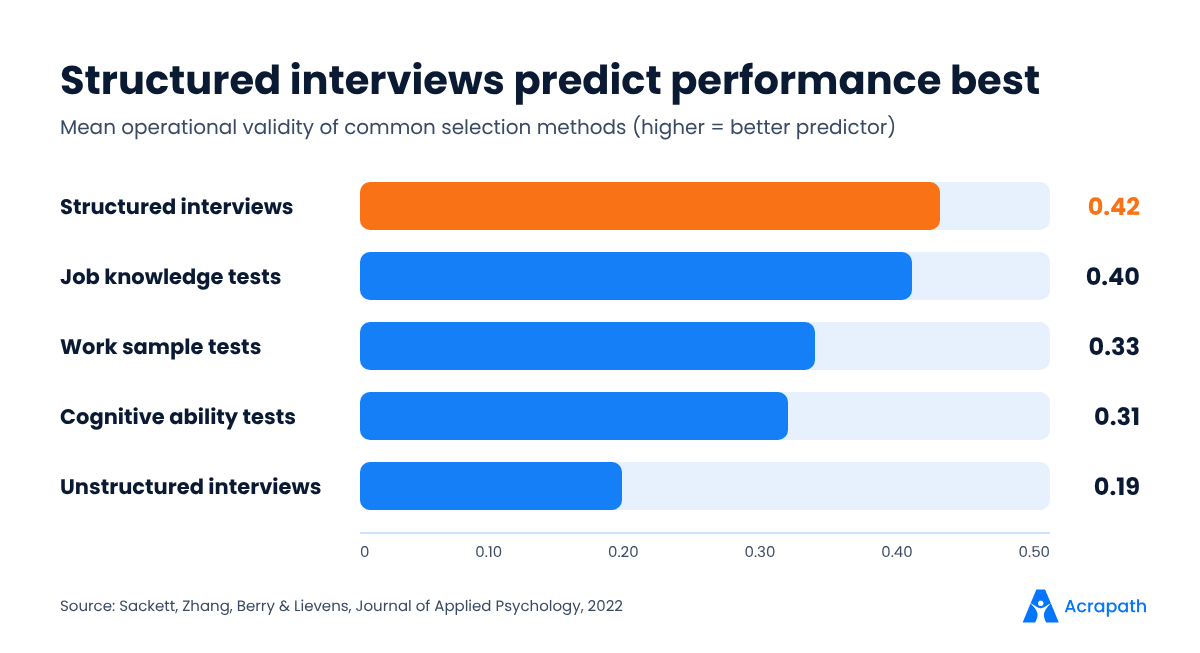
A 2022 meta-analysis by Sackett and colleagues ranked structured interviews as the top predictor of job performance (validity of 0.42), more than double unstructured interviews (0.19).
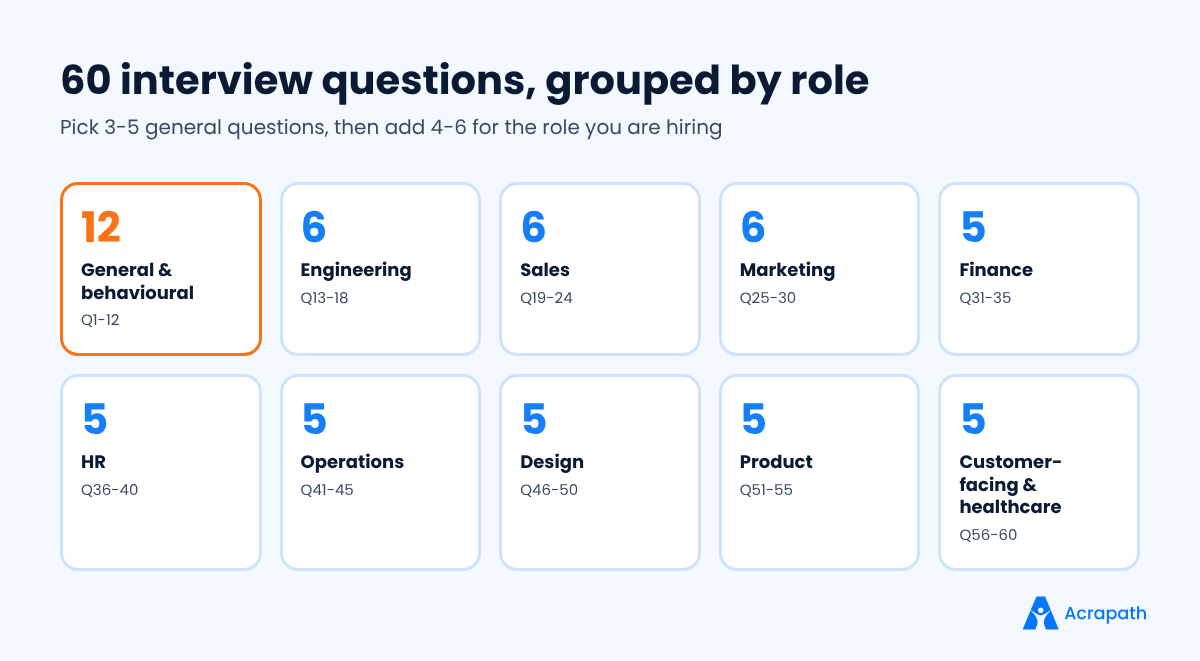
This guide gives you 60 questions: 12 general and behavioural questions plus 48 role-specific ones across 9 job categories, each with what a good answer shows.
Use a 1-5 scorecard with 4-6 competencies per role, and have each interviewer score independently before the debrief.
Never ask about age, religion, marital status, pregnancy, health or other protected characteristics; the exact rules vary by country.
Most hiring mistakes don't happen at the offer stage. They happen in a 45-minute conversation where the interviewer asked whatever came to mind and went with a gut feeling.
You can fix that without a big HR team. The fix is choosing the right interview questions to ask candidates before the interview starts, asking every candidate the same ones, and scoring the answers the same way.
This guide gives you 60 ready-to-use questions, grouped by role: engineering, sales, marketing, finance, HR, operations, design, product, and customer-facing and healthcare roles. Each question comes with what a strong answer shows, so you know what to listen for. You'll also get a scorecard template, the research behind structured interviews, and a short list of questions you should never ask.
Why the Interview Questions You Ask Matter
The questions you ask decide what you learn. Vague questions ("Tell me about yourself") produce rehearsed answers; specific, job-related questions produce evidence you can compare across candidates.
Decades of research back this up. In their widely cited 1998 review of 85 years of research, Schmidt and Hunter estimated the validity of structured interviews at 0.51 and unstructured interviews at 0.38. A 2022 re-analysis by Sackett, Zhang, Berry and Lievens in the Journal of Applied Psychology corrected for overestimation in earlier methods and found lower figures overall, but structured interviews came out on top at 0.42, while unstructured interviews fell to 0.19.
In plain terms: a consistent, scored interview tells you far more about future performance than a free-flowing chat. A summary in SIOP's TIP journal notes that this ranking also put structured interviews ahead of cognitive ability tests (0.31) and work samples (0.33).
Structure also makes interviews fairer. When every candidate answers the same questions against the same rubric, it's harder for first impressions, shared hobbies or a confident accent to swing the decision.
How to Run a Structured Interview in 5 Steps
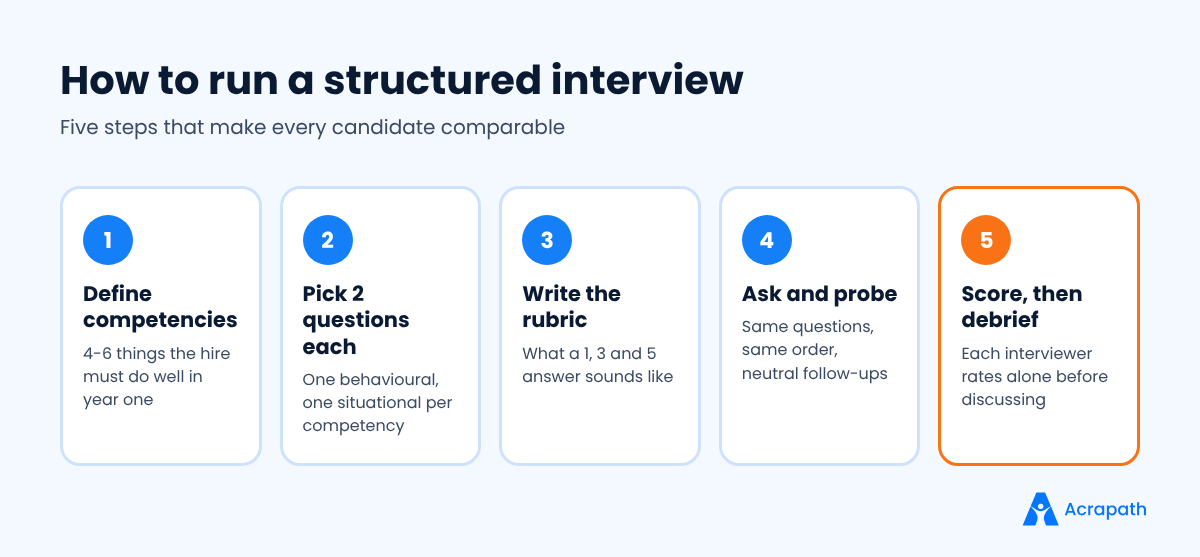
A structured interview has three ingredients: the same job-related questions for every candidate, a scoring guide for each question, and independent ratings before discussion. Here's how to set one up.
Step 1: Define 4-6 Competencies for the Role
Start from the job description, not from the question bank. List the 4-6 things this person must do well in the first year, such as "writes production-ready code", "manages a sales pipeline" or "handles difficult patients calmly". If your JD is vague, fix it first; our software engineer job description template shows what a specific one looks like.
Step 2: Pick 2 Questions per Competency
Choose one behavioural question ("Tell me about a time…") and one situational question ("What would you do if…") for each competency. Google's re:Work guide to structured interviewing recommends this mix: past behaviour shows patterns, while hypotheticals show how someone reasons through new problems.
Step 3: Write What Good Looks Like
For each question, write a short description of a weak, acceptable and strong answer. The "what a good answer shows" notes in this guide are a starting point.
Step 4: Ask, Probe and Take Notes
Ask every candidate the same core questions in the same order. Use neutral follow-ups ("What did you do next?", "What was the result?") and write down what they said, not what you felt.
Step 5: Score Independently, Then Debrief
Each interviewer scores alone before the panel discusses. This stops the most senior or loudest person from anchoring everyone else.
Interview Scorecard: How to Rate Candidates Consistently
An interview scorecard is a one-page form that lists the competencies for the role, the questions linked to each, and a 1-5 rating with written evidence. It turns opinions into comparable data.
Competency | Question # | 1 (Poor) | 3 (Solid) | 5 (Outstanding) | Score | Evidence (notes) |
|---|---|---|---|---|---|---|
Problem-solving | Q3, Q13 | Vague; no clear approach | Logical steps, reasonable result | Structured, weighs trade-offs, measurable outcome | __ | |
Ownership | Q2, Q5 | Blames others; no lessons | Takes responsibility, fixes the issue | Owns it, fixes root cause, shares learning | __ | |
Communication | Q8, Q57 | Rambling or unclear | Clear, answers the question | Concise, adapts to audience, checks understanding | __ | |
Role skill (e.g. pipeline management) | Q19, Q21 | No method or numbers | Clear process, some data | Repeatable system, strong results with context | __ | |
Collaboration | Q4, Q10 | Works alone; conflict avoided or escalated | Works well with others | Builds alignment, resolves conflict constructively | __ |
Add a final "Overall recommendation" row: strong no, no, yes, strong yes. Avoid a "maybe"; it forces interviewers to decide.
Scorecards pair well with a structured screening step before the interview. Our guide on how to screen resumes shows how to build the shortlist that feeds into these interviews.
Behavioural vs Situational Interview Questions
Behavioural interview questions ask what a candidate did in a real past situation; situational questions ask what they would do in a realistic future one. The best interview questions to ask candidates mix both.
Type | Sounds like | Best for | Watch out for |
|---|---|---|---|
Behavioural | "Tell me about a time you…" | Experienced hires; checking resume claims | Rehearsed stories; probe for the candidate's own actions |
Situational | "What would you do if…" | Freshers, career switchers, new challenges | Ideal-world answers; ask for specific first steps |
Technical / practical | "Walk me through how you'd build…" | Engineering, finance, design, data roles | Trivia questions that don't reflect the real job |
Motivational | "Why this role, and why now?" | Every role, briefly | Over-weighting enthusiasm over evidence |
When a candidate answers a behavioural question, listen for the STAR pattern: Situation, Task, Action and Result. If one part is missing, ask a neutral follow-up such as "What was your role specifically?" or "How did it turn out?"
Watch for "we" answers. Teamwork is good, but you're hiring the individual, so gently ask what they personally did.
How Many Questions to Ask in Each Round
Most interviews should cover 6-10 core questions in 45-60 minutes, leaving 10 minutes for the candidate's own questions. Fewer, deeper questions beat a long list asked in a rush.
Round | Length | Questions | Focus |
|---|---|---|---|
Phone or video screen | 15-30 min | 3-5 | Motivation, must-have skills, salary and notice period |
Hiring manager interview | 45-60 min | 6-10 | Behavioural and role-specific competencies |
Practical or technical round | 45-90 min | 1 task + 3-4 follow-ups | Job skills in action |
Final or panel round | 30-60 min | 4-6 | Collaboration, values, gaps from earlier rounds |
Split the questions across interviewers so nobody repeats the same ground. One person can own problem-solving and role skills; another can cover collaboration and ownership.
Keep the whole process short. Strong candidates often have more than one offer in progress, and every extra round is another chance to lose them.
General and Behavioural Interview Questions (1-12)
These 12 behavioural interview questions work for almost any role, and they're the backbone of any list of interview questions to ask candidates. Pick 3-5 for every interview, then add role-specific questions from the sections below.
1. Walk me through the last two roles you held and why you moved from one to the next.
What a good answer shows: a clear career story, honest reasons for moving, and a link between past choices and this job.
2. Tell me about a time you made a mistake at work. What happened and what did you change afterwards?
What a good answer shows: ownership without excuses, a specific fix, and a lasting change in how they work.
3. Describe the hardest problem you solved in the last year. How did you approach it?
What a good answer shows: a structured approach, use of data or advice, and a measurable result.
4. Tell me about a time you disagreed with a manager or colleague. How did you handle it?
What a good answer shows: respectful challenge, listening, and a resolution focused on the work rather than winning.
5. Give an example of a goal you set yourself that you didn't reach. Why not?
What a good answer shows: self-awareness, honest analysis of what went wrong, and realistic goal-setting since.
6. Tell me about a time you had too much work and not enough time. What did you prioritise?
What a good answer shows: a method for prioritising, early communication with stakeholders, and calm under pressure.
7. Describe a time you learned a new skill or tool quickly. How did you do it?
What a good answer shows: learning agility, resourcefulness and how fast they become productive.
8. Tell me about a time you had to explain something complex to someone without your background.
What a good answer shows: clear communication, empathy for the listener, and checking for understanding.
9. What's an achievement you're proud of that isn't on your resume?
What a good answer shows: what motivates them and whether their values fit the team.
10. Tell me about a time you helped a colleague succeed.
What a good answer shows: generosity, collaboration and potential to mentor or lead.
11. What would you want to achieve in your first 90 days in this role?
What a good answer shows: preparation, realistic expectations and understanding of the job.
12. What questions do you have for us?
What a good answer shows: genuine interest and research. Thoughtful questions about the team, goals or challenges are a strong signal.
Engineering Interview Questions (13-18)
Engineering interviews should test how candidates think, build and debug, not just what they've memorised. Pair these with a short practical task. For sourcing and assessment advice, see our guide on how to hire software engineers, and when you're ready, find engineering professionals on Acrapath.
13. Walk me through a system or feature you built from scratch. What trade-offs did you make?
What a good answer shows: design thinking, awareness of trade-offs (speed, cost, scale, maintainability), and honest reflection on what they'd change.
14. Tell me about the hardest bug you've tracked down. How did you find it?
What a good answer shows: systematic debugging, use of logs and tools, and persistence.
15. How do you decide when code is ready to ship?
What a good answer shows: a view on testing, code review, monitoring and acceptable risk.
16. Describe a time you pushed back on a product requirement for technical reasons.
What a good answer shows: clear reasoning, alternatives offered, and collaboration with non-engineers.
17. If our main API slowed down by 3x overnight, what would you check first?
What a good answer shows: a calm, ordered investigation: recent deploys, database load, external dependencies, metrics.
18. How do you keep your technical skills current?
What a good answer shows: specific habits (side projects, reading, communities) rather than buzzwords.
Sales Interview Questions (19-24)
Sales candidates are usually good talkers, so focus on numbers, process and evidence. Our deeper list of sales interview questions to ask includes role-play prompts. To shortlist faster, browse sales professionals.
19. What was your quota last year, and what percentage did you hit? Walk me through how.
What a good answer shows: comfort with numbers, honesty, and a repeatable approach behind the result.
20. Tell me about a deal you lost. What would you do differently?
What a good answer shows: self-reflection and learning rather than blaming price or the product.
21. How do you manage and prioritise your pipeline each week?
What a good answer shows: a clear system, CRM discipline and focus on the highest-value opportunities.
22. Sell me our product in two minutes, based on what you learned before this interview.
What a good answer shows: preparation, discovery questions before pitching, and clear value framing.
23. A prospect says, "Your competitor is 20% cheaper." How do you respond?
What a good answer shows: objection handling based on value and fit, not instant discounting.
24. How do you generate leads when inbound is slow?
What a good answer shows: initiative, multiple prospecting channels and persistence.
Marketing Interview Questions (25-30)
Marketing roles range from content to performance, so ask about channels, metrics and judgement. Our guide on how to hire a digital marketer covers role scoping, and you can search marketing professionals when the role is open.
25. Tell me about a campaign you ran from start to finish. What were the results?
What a good answer shows: ownership, clear goals, channel choices and honest metrics.
26. Which metrics do you watch most closely, and why?
What a good answer shows: focus on business outcomes (leads, revenue, retention) over vanity numbers.
27. Describe a test or experiment that failed. What did you learn?
What a good answer shows: an experimental mindset and willingness to kill ideas that don't work.
28. If you had a small budget to launch our product in a new country, how would you spend it?
What a good answer shows: prioritisation, audience research and a plan to measure results.
29. How do you work with sales to make sure leads convert?
What a good answer shows: shared definitions of a qualified lead, feedback loops and collaboration.
30. What's a brand or campaign you admire right now, and why?
What a good answer shows: curiosity, taste and the ability to explain why something works.
Finance Interview Questions (31-35)
Finance hires need accuracy, judgement and integrity. Our guide on hiring an accountant or finance executive covers tests and checks, and you can find finance professionals on Acrapath.
31. Walk me through your month-end close process. Where do errors usually creep in?
What a good answer shows: process knowledge, attention to detail and controls to catch mistakes.
32. Tell me about a time you found a significant error in the numbers. What did you do?
What a good answer shows: diligence, escalation when needed, and fixing the root cause.
33. How would you explain our cash flow position to a non-finance founder?
What a good answer shows: the ability to translate numbers into decisions for non-specialists.
34. A senior manager asks you to book an expense in a way you think is wrong. What do you do?
What a good answer shows: integrity, knowledge of policy, and a calm, documented response.
35. Which tools and spreadsheet functions do you use most, and for what?
What a good answer shows: practical tool skills matched to the role's real tasks.
HR Interview Questions (36-40)
HR candidates handle sensitive information and difficult conversations, so test judgement as much as knowledge. When you're hiring for the people team, browse HR professionals.
36. Tell me about a hiring process you improved. What changed?
What a good answer shows: process thinking and results such as faster time-to-hire or better retention.
37. Describe a difficult employee relations case you handled. How did you stay fair to both sides?
What a good answer shows: confidentiality, fairness, documentation and knowledge of policy.
38. How would you measure whether our recruitment is working?
What a good answer shows: familiarity with metrics like cost per hire, time-to-hire, offer acceptance and quality of hire.
39. A manager wants to fire someone tomorrow without warning. What do you advise?
What a good answer shows: risk awareness, respect for process and local law, and the courage to push back.
40. How do you keep up with changes in labour law and HR practice?
What a good answer shows: reliable sources, professional networks and continuous learning.
Operations Interview Questions (41-45)
Operations roles keep the business running, so look for systems thinking and calm problem-solving. Find operations professionals when you're ready to shortlist.
41. Tell me about a process you made faster or cheaper. How did you measure it?
What a good answer shows: before-and-after metrics and a clear method for improvement.
42. Describe a time something went badly wrong on the ground. What did you do in the first hour?
What a good answer shows: crisis handling, prioritisation and clear communication.
43. How do you manage vendors who keep missing deadlines?
What a good answer shows: firm but fair escalation, contracts and SLAs, and backup plans.
44. Which reports or dashboards would you look at every morning in this role?
What a good answer shows: understanding of the key operational metrics for your business.
45. How do you get a team to follow a new process?
What a good answer shows: change management, training and listening to frontline feedback.
Design Interview Questions (46-50)
Design interviews should centre on a portfolio walkthrough, with these questions to probe thinking. See our guide on hiring a UI/UX designer for portfolio review tips, and browse design professionals for open roles.
46. Walk me through one portfolio project from problem to outcome.
What a good answer shows: a clear problem, research, iterations and a measurable result.
47. Tell me about a design decision you made that users didn't like. What happened next?
What a good answer shows: openness to feedback and willingness to iterate.
48. How do you handle feedback from a stakeholder who "just doesn't like it"?
What a good answer shows: turning opinions into goals, using evidence and keeping relationships intact.
49. How do you work with developers to make sure designs are built as intended?
What a good answer shows: handoff habits, design systems knowledge and collaboration.
50. How do you make sure your designs are accessible?
What a good answer shows: awareness of contrast, keyboard navigation, screen readers and inclusive design.
Product Management Interview Questions (51-55)
Product managers need judgement, prioritisation and influence without authority. Search product professionals on Acrapath when you open the role.
51. Tell me about a product or feature you shipped. How did you decide it was worth building?
What a good answer shows: customer evidence, business reasoning and clear success metrics.
52. You have 10 feature requests and capacity for 3. How do you choose?
What a good answer shows: a prioritisation framework, trade-off thinking and stakeholder communication.
53. Describe a time you killed a feature or project. How did you convince others?
What a good answer shows: data-led decisions and the courage to say no.
54. How would you improve our product? Pick one thing.
What a good answer shows: preparation, user empathy and focus.
55. How do you work with engineering when a deadline is at risk?
What a good answer shows: scope negotiation, transparency and shared ownership.
Customer-Facing and Healthcare Interview Questions (56-60)
For nurses, support agents and other customer-facing roles, test empathy, judgement under pressure and safety. Our guide on how to hire nurses for a hospital covers licence checks and clinical scenarios. When you're ready, find medical and nursing professionals.
56. Tell me about a time a patient or customer was angry. How did you handle it?
What a good answer shows: calm listening, empathy, and resolving the issue within policy.
57. How would you explain a complicated instruction to someone who is anxious or confused?
What a good answer shows: plain language, patience and checking understanding.
58. Describe a time you noticed a safety risk or error. What did you do?
What a good answer shows: vigilance, speaking up, and following escalation procedures.
59. How do you prioritise when several patients or customers need you at once?
What a good answer shows: triage based on urgency and impact, plus clear communication with those waiting.
60. What do you do to avoid burnout in a demanding, people-facing job?
What a good answer shows: self-awareness and sustainable habits, which matter for retention.
Adapting These Questions for Freshers and Senior Hires
The same question bank works across seniority levels if you adjust the context you accept and the depth you expect.
Freshers and interns: let them answer behavioural questions with examples from college projects, internships, part-time jobs or volunteering. Lean on situational questions, since they have fewer past examples to draw on.
Mid-level hires: expect specific work examples with numbers, and probe for their individual contribution.
Senior and leadership hires: ask about scale, team building, strategy and hard trade-offs. Add questions on how they hired, developed and let go of people.
Remember that candidates prepare too. Many will have read lists like our jobseeker guide to common HR interview questions and answers. That's fine: a prepared candidate is a serious one. Your follow-up questions are what separate a rehearsed answer from real experience.
If a story sounds polished, ask for one more detail: the date, the metric, the person who disagreed, or what they'd do differently today.
Interview Questions You Should Not Ask
Don't ask questions about personal characteristics that are unrelated to the job and protected by anti-discrimination law. Even if your local law allows a question, it can create bias and damage your employer brand.
Age or date of birth: "How old are you?" or "When did you graduate from school?"
Family and relationships: marital status, plans for children, pregnancy, childcare arrangements
Religion, caste, race, ethnicity or national origin: "Where is your family from?", "Which festivals do you celebrate?"
Health and disability: medical history, medication, sick days taken
Sexual orientation or gender identity
Appearance: requests for photos, height or weight, unless genuinely job-related
Rules vary by country. In the US, the EEOC says pre-employment questions should be limited to what's needed to judge whether someone is qualified, and bars pre-offer disability questions. In the UK, Acas guidance says employers generally must not ask about health or disability before a job offer and lists nine protected characteristics under the Equality Act 2010. In the UAE, Federal Decree-Law No. 33 of 2021 prohibits discrimination on grounds including race, colour, sex, religion, national or social origin and disability.
Ask instead about the job: "This role needs occasional weekend shifts. Are you able to do that?" is fine; "Do you have young children?" is not.
This is general information, not legal advice. Labour and discrimination rules vary by country and change over time; check with a local employment lawyer or HR advisor before finalising your interview process.
Common Interviewing Mistakes to Avoid
Even with good interview questions to ask candidates, a few habits can undo a structured process.
Talking more than the candidate. The candidate should do most of the talking; your job is to ask and probe.
Asking leading questions. "You're good with deadlines, right?" invites a yes.
Skipping the scorecard. Scoring from memory hours later brings bias back in.
Changing questions mid-process. You lose the ability to compare candidates fairly.
Overvaluing confidence. A polished speaker isn't always the strongest performer.
Leaving candidates waiting. Slow feedback costs you good people. Tell every candidate when they'll hear back.
If you're building your first team, our guide on how to hire your first employee covers the full process. If you're weighing outside help, read our comparison of a recruitment agency vs a job portal.
Conclusion
The right interview questions to ask candidates are the ones tied to the job, asked the same way every time, and scored against a clear rubric. That simple structure is what the research rewards and what candidates experience as fair.
Your next step: pick the 4-6 competencies for your open role, choose 8-12 questions from this list, and build a one-page scorecard before your next interview.
When you need a stronger shortlist to interview, browse professionals by function on Acrapath and search verified candidates in Talbox.
- #interview questions to ask candidates
- #best interview questions
- #behavioural interview questions
- #interview questions by role
- #interview scorecard
- #structured interview
Frequently asked questions
What are the best interview questions to ask candidates?
The best interview questions to ask candidates are job-related, asked the same way to everyone, and scored with a rubric. Mix behavioural questions about real past situations, such as a mistake they fixed, with situational questions about realistic future problems. Add two or three role-specific questions that test the skills the job actually needs.
How many questions should you ask in an interview?
Most interviews should cover six to ten core questions in 45 to 60 minutes, plus about ten minutes for the candidate's own questions. A short phone screen needs only three to five. Fewer, deeper questions with good follow-ups tell you more than a long list asked in a rush.
What is a structured interview?
A structured interview is one where every candidate for a role answers the same job-related questions, in the same order, and each answer is scored against a written rubric. Interviewers rate independently before discussing. A 2022 meta-analysis by Sackett and colleagues found structured interviews were the strongest predictor of job performance among the methods studied.
What should be on an interview scorecard?
An interview scorecard should list four to six competencies for the role, the questions linked to each, a one-to-five rating scale with short descriptions of poor, solid and outstanding answers, space for written evidence, and an overall recommendation. Each interviewer fills it in alone, right after the interview, before the hiring team debriefs.
What questions should employers not ask in an interview?
Employers should not ask about age, marital status, pregnancy or family plans, religion, caste, race, national origin, health, disability or sexual orientation unless a specific legal exception applies. Rules differ by country, so check local law. Ask instead whether the candidate can meet the job's real requirements, such as shifts or travel.


