Skills-Based Hiring: How to Hire for Skills, Not Degrees

Jatin Kashyap
Growth Lead, Acrapath
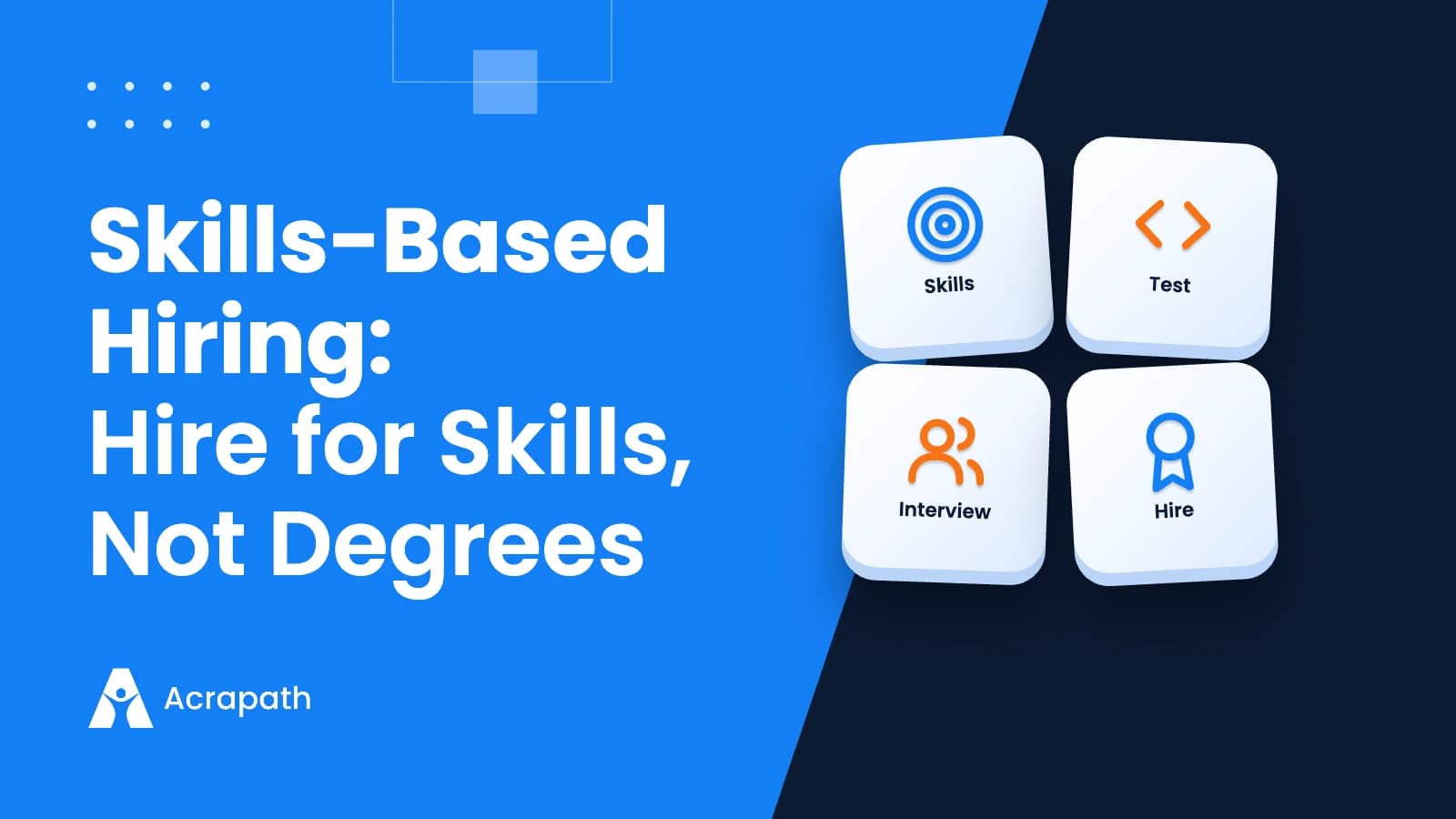
Learn skills based hiring step by step: define the skills that matter, rewrite job descriptions, use work samples and structured interviews, and avoid common mistakes.
Key Takeaways
Skills based hiring means choosing candidates on proven abilities, not degrees, college names or years of experience alone.
Start by listing the 4–6 skills that actually predict success in the role, then remove requirements that don't map to any of them.
Test skills directly with short work samples or structured questions, scored the same way for every candidate.
It widens your talent pool to career switchers, self-taught professionals and people from non-elite colleges.
Keep degree requirements only where a licence or law demands them, such as medicine, law or chartered accountancy.
You've seen it happen. The candidate with the perfect CV, top college and ten years' experience struggles in the role. Meanwhile, someone you nearly rejected for not having a degree turns out to be your best performer.
That's the case for skills based hiring. Instead of using degrees and job titles as a shortcut for ability, you define what the job needs and test for it directly. Done well, it improves the quality of hires and opens the door to talent your competitors filter out.
This guide explains what skills-based hiring is, how to put it into practice in six steps, which roles suit it and the mistakes to avoid.
What Is Skills-Based Hiring?
Skills-based hiring is an approach where employers evaluate candidates on the specific skills a job requires, using evidence such as work samples, tests and structured interviews, rather than relying mainly on degrees, previous job titles or years of experience. Qualifications still matter where the law requires them, but they stop being the main filter.
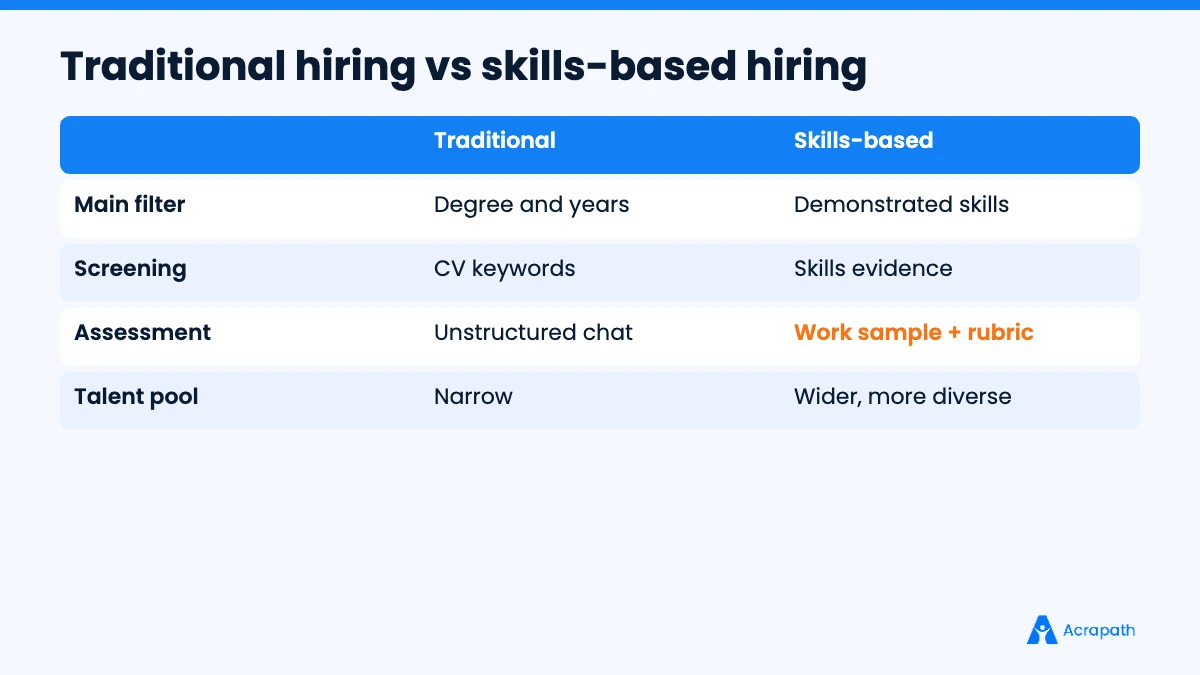
Traditional hiring | Skills-based hiring | |
|---|---|---|
Main filter | Degree, college, years of experience | Demonstrated skills |
Job description | Lists qualifications | Lists skills and outcomes |
Screening | CV keywords | Skills evidence and short tasks |
Interview | Unstructured conversation | Structured, scored questions |
Talent pool | Narrow | Wider and more diverse |
Interest in skills-first hiring has grown sharply in recent years. LinkedIn's Economic Graph research on skills-based hiring found that a skills-first approach can significantly expand the pool of eligible candidates for many roles.
Why Skills-Based Hiring Works
Better prediction: testing the actual work tells you more about future performance than a degree title.
Bigger talent pool: you reach career switchers, self-taught professionals and graduates from less-known colleges.
Fairer decisions: scoring everyone against the same skills reduces bias from names, colleges and backgrounds.
Faster ramp-up: people hired for proven skills usually need less basic training.
Lower cost: removing unnecessary degree requirements can reduce salary inflation for credential-heavy profiles.
How to Implement Skills-Based Hiring (Step-by-Step)
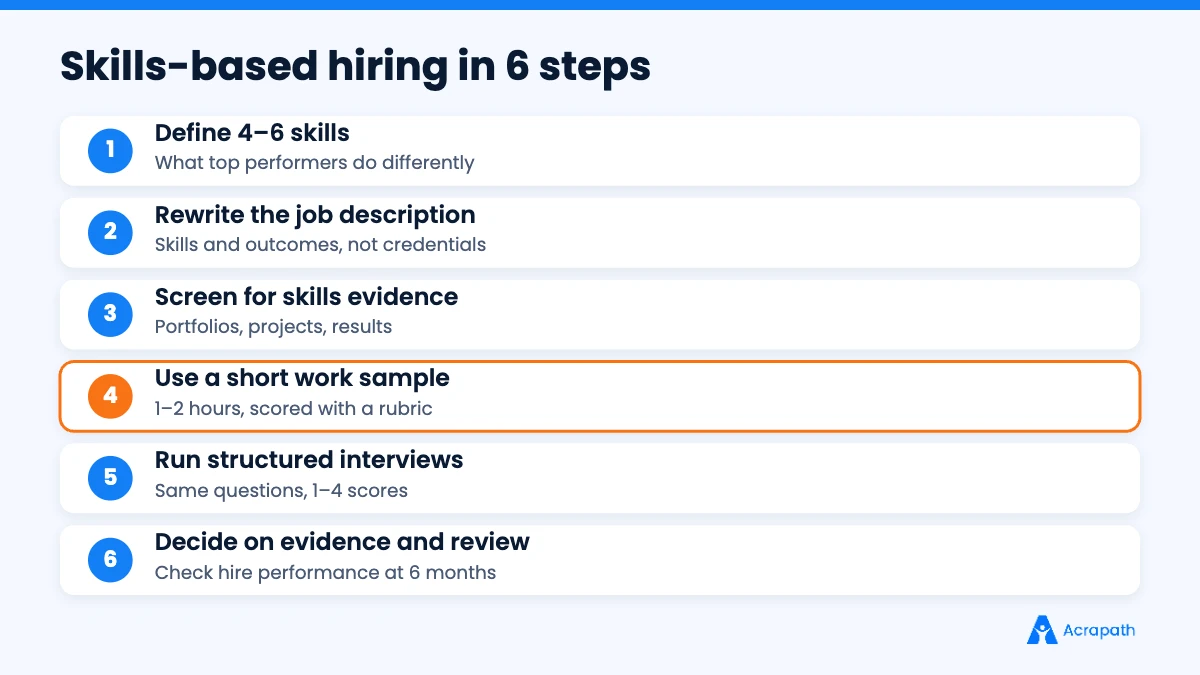
Step 1: Define the skills that predict success
Talk to the hiring manager and one or two strong performers in the role. Ask: what do the best people in this job do differently? Turn the answers into 4–6 skills, split into technical skills (like SQL or Google Ads) and behavioural skills (like prioritisation or stakeholder communication).
Step 2: Rewrite the job description
Lead with outcomes and skills. Replace "B.Tech required, 5+ years" with "You can build and maintain REST APIs and debug production issues independently." Keep a degree requirement only where a licence or law requires it. Our guide on how to write a job description shows the structure.
Step 3: Screen for skills evidence
When reviewing applications, look for proof of skills: portfolios, projects, certifications, measurable results and relevant work in any setting. A short screening question, such as "Describe one campaign you ran and what changed", often beats CV keywords. See our resume screening process for a structured approach.
Step 4: Use a short work sample or skills test
Give candidates a realistic task that reflects the job, keep it to one or two hours, and score it against a clear rubric. For longer tasks, consider paying candidates for their time.
Developer: fix a small bug or build a tiny feature.
Marketer: critique a landing page and suggest three tests.
Accountant: prepare a bank reconciliation.
Sales: a 15-minute role-play call.
Designer: walk through a past project and its decisions.
Step 5: Run structured interviews
Ask every candidate the same skill-focused questions and score answers on a simple 1–4 scale with examples of what good looks like. Our list of interview questions to ask candidates is grouped by role and skill.
Step 6: Decide on evidence and review results
Combine scores from the task and interview, discuss as a panel and decide. After six months, check how your hires are performing and refine the skills list.
Which Roles Suit Skills-Based Hiring?
Most roles benefit, especially where output is easy to observe:
Software development, data analysis and design
Digital marketing, content and SEO
Sales and customer support
Operations and many administrative roles
Regulated roles are different. Doctors, nurses, lawyers, chartered accountants and some engineering roles need specific licences or qualifications by law. For these, keep the credential as a minimum and use skills testing on top of it.
For a real example of this approach, see how a creative agency used skills-first hiring to build its team in our design team hiring case study.
Common Mistakes to Avoid
Removing degrees without defining skills. You'll get more applicants but no better way to choose.
Overlong unpaid tasks. Strong candidates drop out of multi-day assignments.
Testing the wrong things. Puzzles and trick questions rarely reflect the real job.
Inconsistent scoring. Without a rubric, bias creeps back in.
Keeping old filters in your ATS. Check that automatic filters aren't still rejecting candidates without degrees.
Where to Find Skilled Candidates
Skills-based hiring works best when you source beyond traditional channels: portfolios on GitHub or Behance, bootcamp graduates, online communities and candidate databases searchable by skill. Our guide to where to find candidates lists 11 channels.
Conclusion
Skills based hiring replaces guesswork with evidence. Define the skills that predict success, rewrite your job description around them, screen for proof, test with a short work sample and score structured interviews consistently. Keep credentials only where the law requires them.
You'll widen your talent pool and hire people who can do the job from day one.
Want to search candidates by skill? Browse verified professionals on Acrapath and filter candidates in Talbox.
- #skills based hiring
- #skills first hiring
- #skills assessment
- #recruitment
- #hiring process
Frequently asked questions
What is skills based hiring?
Skills based hiring is an approach where employers choose candidates based on proven abilities, using work samples, skills tests and structured interviews, rather than relying mainly on degrees, college names or years of experience. Credentials are kept only where a licence or law requires them.
What are the benefits of skills-based hiring?
It predicts job performance more accurately, widens the talent pool to career switchers and self-taught professionals, reduces bias from names and colleges, helps new hires ramp up faster and can reduce salary inflation linked to credential-heavy profiles.
How do you assess skills during hiring?
Use a short, realistic work sample scored with a clear rubric, ask structured skill-based interview questions, and review evidence such as portfolios, projects and measurable results. Keep tasks to one or two hours and score every candidate the same way.
Should I remove degree requirements from job posts?
Remove them where the degree doesn't map to a real skill the job needs. Keep them where a licence or law requires a qualification, such as medicine, nursing, law or chartered accountancy. Replace removed requirements with clear skills and outcomes.
Does skills-based hiring work for senior roles?
Yes, with adjustments. For senior roles, assess skills through case discussions, deep dives into past decisions and results, and structured leadership questions rather than simple tests. Evidence of judgement and impact matters more than titles held.