How to Hire an Operations Manager Who Fixes Processes

Jatin Kashyap
Growth Lead, Acrapath

Learn how to hire an operations manager who fixes processes: when to hire, how to define the role, skills to look for, interview questions, a case exercise and a 90-day plan.
Key Takeaways
To hire an operations manager who actually fixes processes, define 3–5 outcomes for the first year before you write the job post.
Look for proof of measurable improvements: cycle time cut, cost saved, error rate reduced, team output raised.
Use a short process case study plus a structured interview. Research by Sackett and colleagues (2022) found structured interviews predict job performance far better than unstructured ones.
Most operations manager roles call for about 5–8 years of experience, including 2 or more years leading people.
Plan the first 90 days before the person joins, so they can learn the operation before changing it.
Your business is growing, but the cracks are showing. Orders slip, the same mistakes repeat every week, and your best people spend their days firefighting instead of improving anything. You know you need someone to take charge of how work gets done.
That person is an operations manager. Hire the right one and processes get calmer, cheaper and more predictable. Hire the wrong one and you get a busy manager who adds meetings and reports while the real problems stay put.
This guide shows you how to hire an operations manager step by step: when you need one, how to define the role, the skills to look for, where to find candidates, a fair assessment process with interview questions and a case exercise, and how to set your new hire up to succeed.
What a Great Operations Manager Does
An operations manager is responsible for the day-to-day running of a business process or function: planning work, managing people and resources, tracking performance and improving how things are done. The best ones do more than keep things running. They find the root causes of recurring problems, fix them permanently and leave behind processes that work without them standing over every step.
That last point matters when you hire. You are not just hiring someone to supervise. You are hiring someone to build a system.
When Should You Hire an Operations Manager?
Founders and department heads often wait too long. These are the signs it's time:
You are the bottleneck. Decisions and approvals queue up waiting for you.
Problems repeat. The same delays, errors or customer complaints come back every week or month.
Growth is breaking processes. What worked for 20 orders a day collapses at 200.
No one owns the numbers. You can't quickly say what your turnaround time, error rate or cost per order is.
Team leads are stretched. Supervisors spend their time on escalations instead of coaching their teams.
You're opening a new site, shift or service line and need someone to set it up properly.
If three or more apply, an operations manager will likely pay for themselves quickly through saved time, lower costs and fewer mistakes.
Define the Role Before You Write the Job Post
"Operations manager" covers very different jobs. Decide which one you need before you advertise.
Type of role | Typical setting | What they mainly do |
|---|---|---|
Process or plant operations | Manufacturing, warehouses | Run production or fulfilment, quality and safety |
Service delivery operations | BPO, support, healthcare, banking | Manage teams that deliver a service to SLAs |
Multi-site or regional operations | Retail, logistics, chains | Standardise and run several locations |
Startup or business operations | Growing companies | Build processes across teams from scratch |
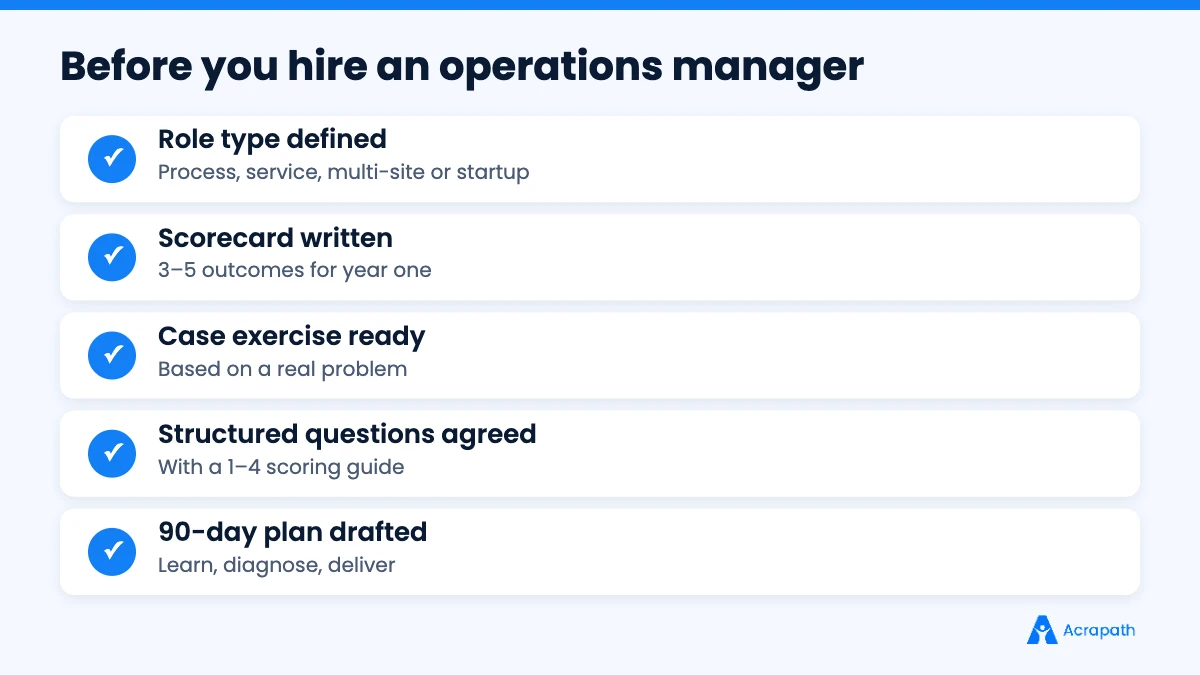
Next, write a simple scorecard. List 3–5 outcomes you expect, with a rough timeline:
First 90 days: map the core process, set baseline KPIs and fix one quick win.
First 6 months: reduce turnaround time by a target amount, introduce clear SOPs, stabilise staffing.
First 12 months: hit cost and quality targets consistently, build a team-lead layer that runs without daily escalation.
The scorecard keeps your job description, interview questions and final decision focused on results rather than personality or polish. Our guide on how to write a job description shows how to turn these outcomes into a job post that attracts the right applicants.
Skills and Experience to Look For
Area | Must-have | Nice to have |
|---|---|---|
Process improvement | Clear examples of fixing a process with numbers | Lean Six Sigma Green or Black Belt |
People leadership | 2+ years managing team leads or staff | Experience scaling a team quickly |
Data | Builds and reads KPI dashboards in Excel or BI tools | SQL or advanced analytics |
Budget and cost | Has owned or tracked a cost centre | P&L ownership |
Industry knowledge | Understands your type of operation | Same industry, same scale |
Communication | Writes clear SOPs and reports | Experience presenting to leadership or boards |
Most operations manager roles ask for roughly 5–8 years of total experience. Treat this as a guide rather than a rule. A candidate with four years who has already run a team of 30 and cut costs measurably may be stronger than one with ten years of maintaining the status quo.
Red flags to watch for:
Every achievement is described as "we" with no clear personal role.
No numbers anywhere, even when asked directly.
Blames previous teams or bosses for every problem.
Talks only about tools and frameworks, never about people.
Wants to change everything in week one without learning first.
Where to Find Operations Manager Candidates
Strong operations managers are often employed and not actively looking. Combine channels:
Job portals and candidate databases for active candidates with the right industry background.
Referrals from your team, investors and industry contacts.
LinkedIn outreach to assistant managers and team leads ready for a step up.
Competitors and adjacent industries, such as logistics for e-commerce or BPO for customer operations.
Internal promotion of a strong team lead, supported with training.
Our list of 11 places to find candidates explains how to get the most from each channel. If the role is urgent or confidential, compare a recruitment agency vs a job portal before you decide.
How to Assess Operations Manager Candidates (Step-by-Step)
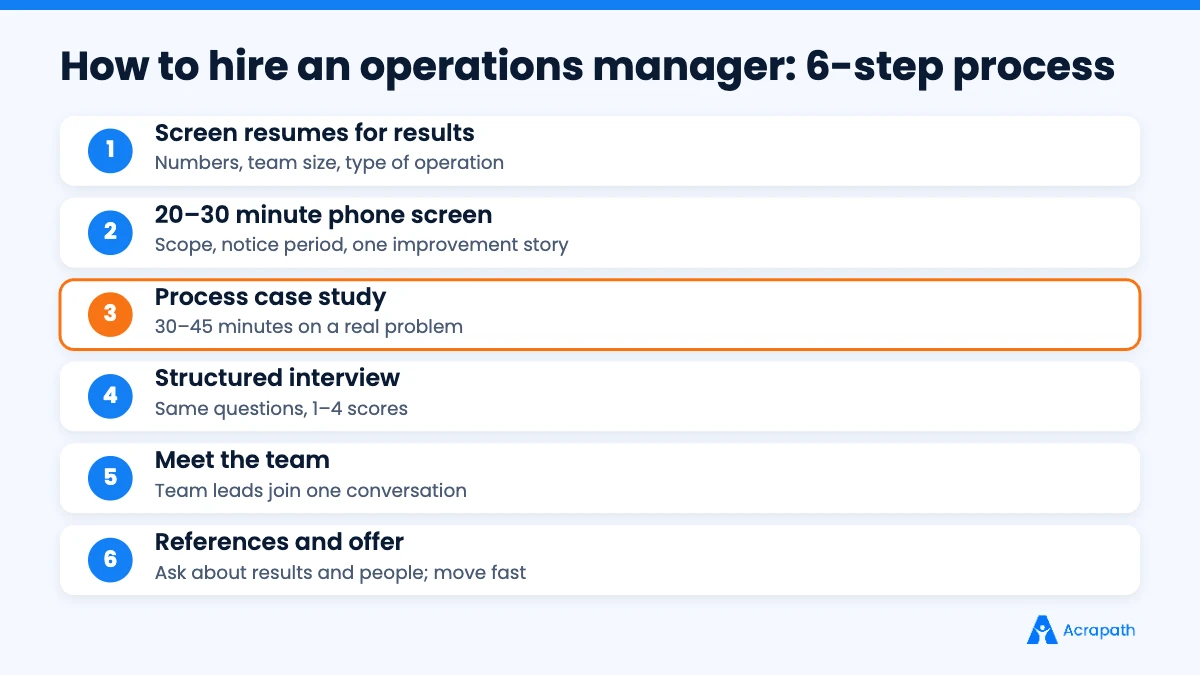
Step 1: Screen resumes for results
Shortlist candidates whose resumes show measurable improvements, team size and the type of operation they ran. Skip resumes that list duties without outcomes. Our resume screening process gives you a seven-step method.
Step 2: Run a 20–30 minute phone screen
Confirm the basics: current scope, team size, reason for moving, notice period and salary expectations. Ask for one improvement story and listen for numbers.
Step 3: Give a short process case study
Give finalists a realistic problem from your business, or the example case below, and ask them to present their approach in 30–45 minutes. You're testing how they diagnose problems, not whether they reach your exact answer.
Step 4: Hold a structured interview
Ask every candidate the same questions and score answers on a simple 1–4 scale against your scorecard. This matters. In a major 2022 re-analysis of selection research, Sackett and colleagues found that structured interviews were the strongest predictor of job performance among common methods, with a validity of about .42, compared with about .19 for unstructured interviews. Our guide to the structured interview includes a scorecard template.
Step 5: Meet the team
Have finalists meet one or two team leads they would manage. Watch how they listen and ask questions. Team leads often spot a poor fit faster than senior leaders.
Step 6: Check references and make the offer
Ask references specifically about results and how the candidate treated their team. Then move quickly. Good operations managers often have more than one offer.
Interview Questions to Ask an Operations Manager
Use these questions in your structured interview. The notes tell you what a strong answer includes.
"Tell me about a process you improved. What was the before and after?" Look for a clear baseline, a root cause, the change they made and a measured result.
"How do you decide which KPIs to track for a team?" Strong answers link KPIs to customer or business outcomes and keep the list short.
"Walk me through a crisis you handled: a missed deadline, outage or big client escalation." Listen for calm prioritisation, communication and a fix that stopped it happening again.
"How have you handled a team lead who consistently underperformed?" Good answers include clear expectations, support, documentation and a decision.
"How would you spend your first 30 days here?" Look for listening, learning and measuring before changing.
"Tell me about a time you reduced cost without hurting quality." Ask how they protected quality and how they measured it.
"How do you write and maintain SOPs?" Strong candidates involve the people doing the work and review SOPs regularly.
"Describe a time you disagreed with a senior leader about an operational decision." Look for data-driven argument and professional handling.
"How do you plan capacity for a peak period?" Expect forecasting, staffing plans, buffers and contingency.
"What's an improvement that failed, and what did you learn?" Honesty here is a good sign.
For a wider bank of questions by role and competency, see our list of interview questions to ask candidates.
A Ready-to-Use Case Exercise
Adapt this case to your business and give it to finalists 24 hours before the interview:
Case: You've joined a company that ships 400 orders a day. Average time from order to dispatch is 48 hours, and the target is 24. Customer complaints about late delivery have doubled in three months. The warehouse has 18 staff across two shifts and two team leads.
Your task (30 minutes to present):
What data would you ask for in your first week?
What are the three most likely causes of the delay?
What would you change in the first 30 days, and how would you measure it?
What would you avoid changing until you understand more?
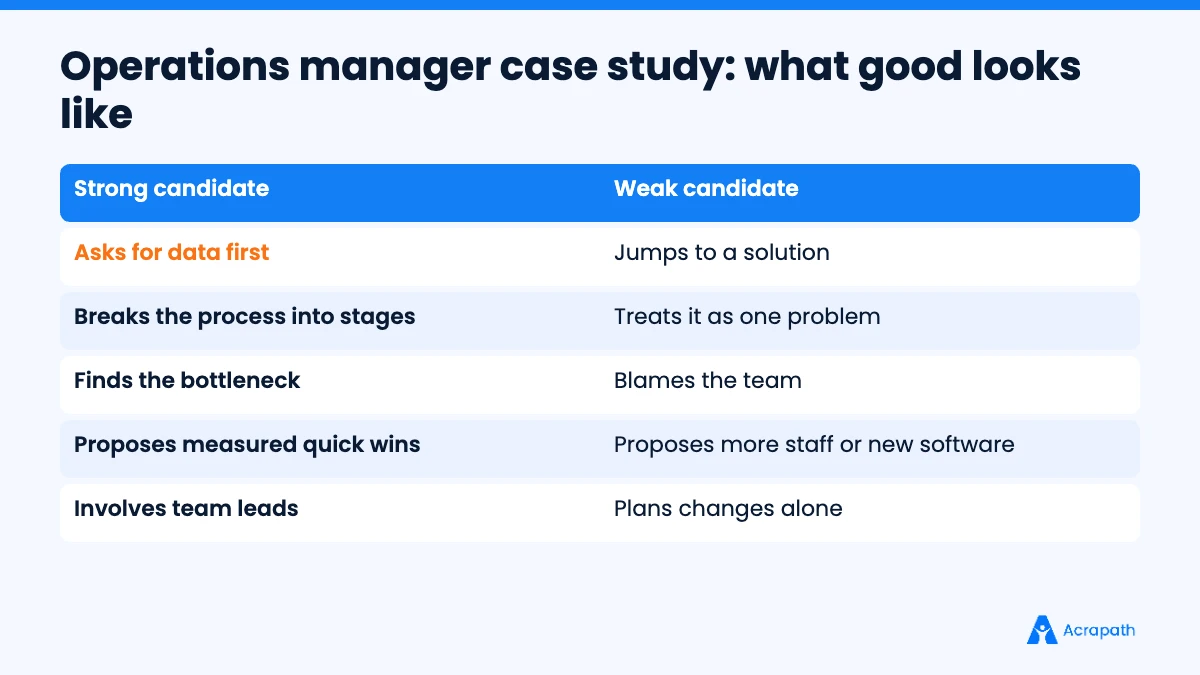
What good looks like: they ask for data before proposing fixes, break the process into stages, find the bottleneck, propose a few targeted changes with measures, and involve the team leads. Be wary of candidates who jump straight to "hire more people" or "buy new software" without diagnosis.
Salary and the Offer
Operations manager pay varies widely by industry, city, team size and scope. Benchmark against current job posts and salary data for the same role and location rather than relying on old figures. When you compare budgets across channels, our guide to cost per hire helps you see the full cost of the hire, including your team's time.
In the offer, be clear about:
Fixed pay and any performance bonus tied to operational KPIs
Team size and reporting line
The scorecard outcomes for the first year
Working hours and expectations during peak periods or shifts
Onboarding Your New Operations Manager: The First 90 Days
Great hires can still fail if they're dropped in without support. A simple 30-60-90 plan helps:
Days 1–30: Learn. Meet every team, walk every process, review the numbers and listen to customers. No major changes yet.
Days 31–60: Diagnose and plan. Agree baseline KPIs, identify the top three problems and present a plan with quick wins.
Days 61–90: Deliver. Implement the first improvements, set up regular reviews and start developing team leads.
Meet weekly with your new operations manager in the first three months to remove blockers and agree priorities.
Common Mistakes When Hiring an Operations Manager
Hiring for industry experience alone. Ten years in your industry doesn't guarantee improvement skills.
No scorecard. Without defined outcomes, you can't judge candidates or performance fairly.
Unstructured interviews. Gut feel favours confident talkers over effective operators.
Skipping the case exercise. It's the closest thing to seeing them do the job.
Expecting instant transformation. Real process change takes months, not weeks.
Overlooking internal talent. A strong team lead with support can grow into the role and already knows the business.
If you're building a skills-first process across roles, our guide to skills-based hiring shows how to apply the same principles everywhere. Want to see the role from the candidate's side? Our jobseeker guide on how to become an operations manager shows what ambitious candidates are building towards.
Conclusion
To hire an operations manager who fixes processes, start with a clear scorecard of outcomes, look for measurable improvements and real people leadership, and assess candidates with a process case study and a structured interview. Then give your new hire a 90-day plan to learn before they change things.
The right operations manager doesn't just keep the lights on. They make your business calmer, faster and cheaper to run.
Need help finding them? Hire verified operations professionals through Acrapath and get a shortlist matched to your industry.
- #hire operations manager
- #operations hiring
- #interview questions
- #case study exercise
- #recruitment
Frequently asked questions
What should I look for when hiring an operations manager?
Look for measurable process improvements, at least two years of people leadership, comfort with KPIs and dashboards, cost or budget ownership and clear communication. Industry knowledge helps, but proof that the candidate has fixed recurring problems and built processes that work without them matters more.
How many years of experience should an operations manager have?
Most operations manager roles ask for about 5–8 years of total experience, including two or more years managing teams or team leads. Treat this as a guide. A candidate with fewer years but strong, measurable results and leadership experience can outperform someone with a longer but less impactful record.
What interview questions should I ask an operations manager?
Ask about a process they improved with before-and-after numbers, how they choose KPIs, a crisis they handled, how they manage an underperforming team lead, their first 30 days, reducing cost without hurting quality and planning for peak periods. Score every answer against the same scorecard.
Should I give operations manager candidates a case study?
Yes. A short, realistic case, such as diagnosing slow order dispatch, shows how a candidate gathers data, finds root causes and plans changes. Keep it to about 30–45 minutes, base it on a real problem, and judge their approach rather than whether they match your exact answer.
When does a small business need an operations manager?
Usually when the founder becomes a bottleneck, the same problems repeat, growth is breaking existing processes, nobody owns key numbers or a new site or service line is opening. If several of these apply, an operations manager can save more in time and errors than they cost.