How to Become an Operations Manager: Skills, Path and Salary

Jatin Kashyap
Growth Lead, Acrapath

Learn how to become an operations manager: what the job involves, the skills and certifications employers want, a step-by-step career path, salary factors and resume tips.
Key Takeaways
To become an operations manager, most people combine a degree in business, commerce, engineering or a related field with 3–7 years of hands-on operations, supply chain or team-lead experience.
The 5 core skills are process improvement, people management, data and Excel, budgeting and clear communication.
A common path runs from operations executive or coordinator, to team lead, to assistant manager, to operations manager.
In the US, the Bureau of Labor Statistics put the median pay for general and operations managers at about $102,950 in May 2024. Pay in other countries depends heavily on industry, city and company size.
Certifications such as Lean Six Sigma, PMP or ASCM's CSCP help you stand out, but measurable results from your own work matter more.
Every business has a version of the same problem. Orders ship late, a team is always firefighting, costs creep up and nobody can quite explain why. The person who fixes that, quietly and permanently, is the operations manager.
If you like solving practical problems, organising people and seeing your work show up in real numbers, this is one of the most versatile careers you can choose. Operations managers work in factories, warehouses, hospitals, e-commerce companies, banks, hotels and startups, and the skills move easily between them.
This guide explains how to become an operations manager from where you are now: what the job involves, the skills and qualifications employers want, a step-by-step career path, what the role pays and how to get your first operations job.
What Does an Operations Manager Do?
An operations manager makes sure a business delivers its products or services efficiently, on time and within budget. They plan and run day-to-day processes, manage teams and resources, track performance with data, fix bottlenecks and keep quality and safety standards high. In short, they turn a company's plans into reliable daily output.
The exact work depends on the industry, but most operations managers spend their week on a mix of these:
Planning: setting daily, weekly and monthly targets for output, staffing and inventory.
Running the floor or the process: making sure work moves from one stage to the next without delays.
Managing people: hiring, scheduling, training and coaching team leads and staff.
Tracking performance: reviewing KPIs such as turnaround time, cost per unit, error rate and on-time delivery.
Improving processes: finding waste, rewriting standard operating procedures (SOPs) and testing better ways of working.
Managing budgets and vendors: controlling costs, negotiating with suppliers and approving spend.
Reporting: explaining results and problems to senior leaders in plain language.
A good operations manager is rarely the loudest person in the room. They are the one who notices that a two-minute delay at one desk is costing the company hours every day, and then fixes it.
Where Operations Managers Work
Operations is one of the few careers that exists in almost every industry. That flexibility is a big reason people choose it. Here is how the role changes across common sectors:
Industry | What operations focuses on | Typical KPIs |
|---|---|---|
Manufacturing | Production lines, quality, maintenance, safety | Output per shift, defect rate, downtime |
E-commerce and logistics | Warehousing, dispatch, last-mile delivery | Order cycle time, on-time delivery, returns |
Services and BPO | Teams handling customer or back-office work | Turnaround time, accuracy, SLA compliance |
Healthcare | Patient flow, staffing, supplies, compliance | Wait times, bed occupancy, cost per patient |
Banking and fintech | Account processing, KYC, payments | Processing time, error rate, compliance |
Startups and tech | Building processes from scratch across teams | Cost per order, response time, team output |
If you already work in one of these industries, the fastest route into operations is usually inside it, because you already understand how the work flows.
Skills You Need to Become an Operations Manager
Employers hire operations managers for results. The skills below are the ones that produce them.
Hard skills
Process improvement: mapping a process, spotting waste and testing fixes. Lean and Six Sigma tools are common here.
Data and Excel: pivot tables, lookups, charts and simple dashboards. Many companies also use tools like Power BI or Google Looker Studio.
Budgeting and cost control: reading a cost report, building a simple budget and explaining variances.
Planning and scheduling: capacity planning, rosters and inventory planning.
Systems: comfort with ERP, CRM or warehouse management systems, depending on the industry.
Soft skills
People leadership: setting clear expectations, giving feedback and keeping a team motivated under pressure.
Problem-solving: staying calm when something breaks and working from the root cause, not the symptom.
Communication: writing clear SOPs, running short daily stand-ups and reporting upwards without jargon.
Negotiation: with vendors, other departments and sometimes your own team.
Decision-making: acting on incomplete information when waiting would cost more.
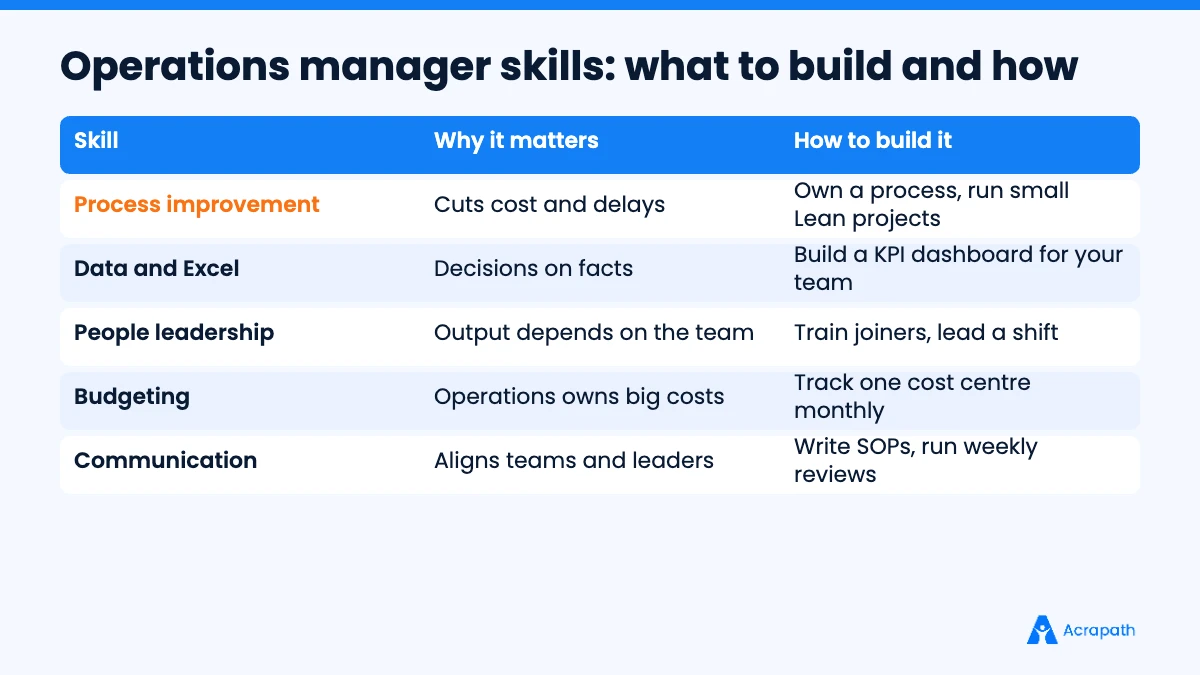
You don't need all of these on day one. Most operations managers build them over several years, one role at a time. What matters is that you can show progress in each area with real examples.
Qualifications and Certifications
There is no single required degree. Employers commonly accept a bachelor's degree in business administration, commerce, engineering, supply chain or a related field. An MBA in operations can speed up progress into management, especially in larger companies, but plenty of operations managers rise through experience alone.
Certifications are useful when they back up real experience:
Certification | Best for | Who offers it |
|---|---|---|
Lean Six Sigma (Green or Black Belt) | Process improvement roles | Various bodies, including ASQ |
Project Management Professional (PMP) | Ops roles with large projects | |
Certified Supply Chain Professional (CSCP) | Supply chain and logistics operations | |
Short courses in Excel, Power BI or SQL | Data-heavy roles | Online learning platforms |
Check eligibility rules and current fees on each provider's website before you enrol. Some, like the PMP, require a minimum amount of project experience first.
How to Become an Operations Manager (Step-by-Step)
There is no fixed timeline, but most people follow a version of this path.
Step 1: Get a relevant foundation
A degree or diploma in business, commerce, engineering or supply chain gives you the vocabulary of operations: costs, processes, inventory and quality. If you are still studying, choose electives or projects that involve real processes, such as a supply chain case study or a college event you helped run.
Pitfall: assuming the degree is enough. Operations is learned by doing, so start building experience early.
Step 2: Start in an entry-level operations role
Good starting titles include operations executive, operations coordinator, MIS executive, process associate, supply chain trainee, warehouse supervisor and customer operations associate. These roles teach you how work actually flows and where it breaks.
If you are a fresher, our guide to a resume with no experience shows how to turn projects, internships and college responsibilities into strong resume lines.
Pitfall: turning down an operations job because the title sounds junior. The learning matters more than the title in your first two years.
Step 3: Own a process and improve it
Ask for ownership of one process, however small: a daily report, a dispatch slot, an onboarding checklist. Measure it, improve it and record the before-and-after numbers. These numbers become your strongest resume and interview material.
Pitfall: improving things without measuring them. "Made the process faster" is weak. "Cut dispatch time from 48 to 30 hours" gets you shortlisted.
Step 4: Learn the data side
Get comfortable with Excel and at least one reporting tool. Build a simple dashboard for your team's KPIs. Operations managers who can find the story in the numbers move up faster than those who wait for someone else's report.
Step 5: Lead people
Volunteer to train new joiners, lead a shift or run a small project team. Team-lead or supervisor roles are the bridge between doing the work and managing it. This is where you learn scheduling, feedback and handling difficult conversations.
Pitfall: trying to do everyone's work yourself. A manager's job is to make the team productive, not to be the busiest person on it.
Step 6: Add a certification or advanced course
Once you have two or three years of experience, a Lean Six Sigma belt, a PMP or a supply chain certification can strengthen your case for promotion. Pick the one that matches your industry and the problems you solve most often.
Step 7: Apply for assistant manager and manager roles
When you can show results across process, people and data, start applying for assistant operations manager and operations manager roles, inside your company and outside it. Tailor your resume to each job description and lead with numbers.
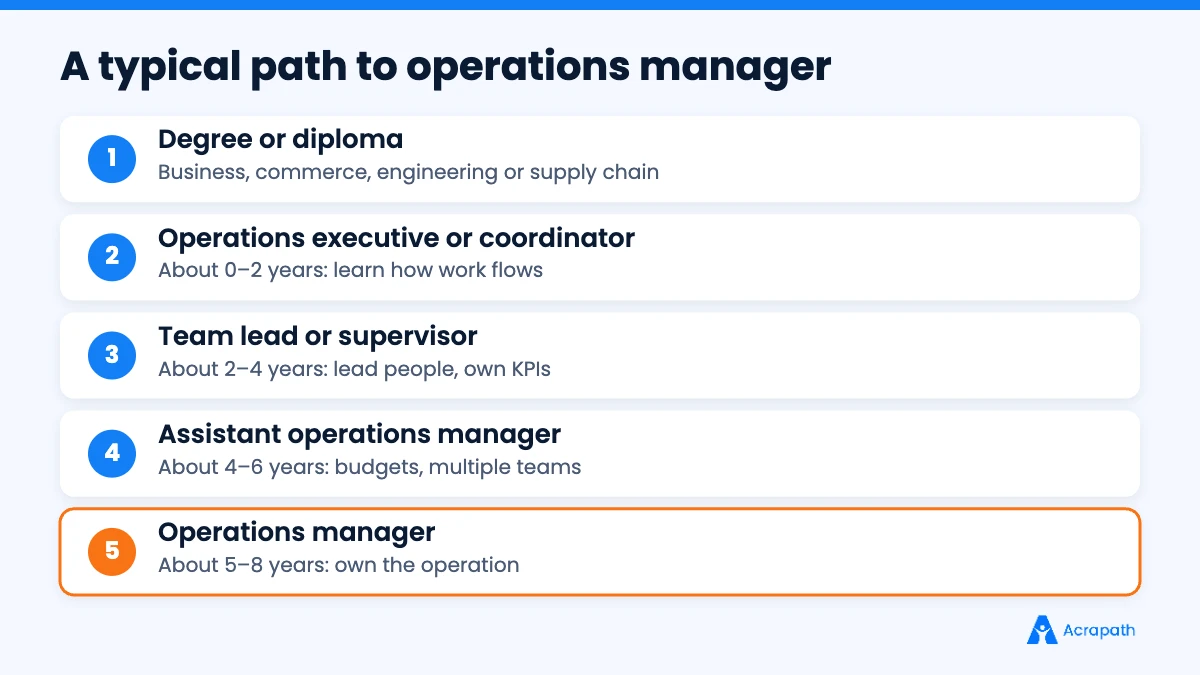
Most people reach their first operations manager title after roughly five to eight years, although strong performers in fast-growing companies sometimes get there sooner.
A Day in the Life of an Operations Manager
No two days are identical, but a typical day in a mid-sized operation might look like this:
Morning stand-up (15 minutes): review yesterday's numbers, today's targets and any staff gaps with team leads.
Floor or process walk: check how work is actually moving, not just what the dashboard says.
Problem-solving block: a delayed shipment, a vendor issue or a recurring error that needs a root-cause fix.
People time: one-to-ones, coaching a new supervisor or handling an escalation from the team.
Planning: next week's rosters, inventory orders or capacity for a big client.
Reporting: a short end-of-day update to leadership on output, costs and risks.
Peak seasons, audits and launches can stretch the day, so the role suits people who stay calm under pressure and enjoy variety.
Operations Manager vs Related Roles
Operations overlaps with several other careers. Knowing the difference helps you choose your path and target the right job titles.
Role | Main focus | How it differs from operations manager |
|---|---|---|
Project manager | Delivering a defined project on time and budget | Projects end; operations run continuously |
Supply chain manager | Sourcing, inventory and logistics | Narrower focus on the flow of goods |
Production manager | Running a manufacturing line or plant | Specific to manufacturing output |
Business analyst | Analysing data and processes to recommend changes | Advises rather than runs teams |
General manager | Overall business unit performance, including sales | Broader scope, often a next step after operations |
Many professionals move between these roles over a career. Experience in any of them can be a stepping stone into operations management.
Operations Manager Salary and Career Growth
Operations managers are well paid in most markets because their decisions directly affect cost and revenue. In the US, the Bureau of Labor Statistics reported a median annual wage of about $102,950 for general and operations managers in May 2024, with wide variation by industry and location.
Outside the US, pay depends on four main factors:
Industry: manufacturing, logistics, banking and tech operations often pay more than smaller service businesses.
City: metro cities and business hubs usually pay more than smaller towns.
Company size: managing a large team or multiple sites raises pay.
Scope: owning a budget, a P&L or several functions moves you into a higher band.
When you compare offers, look at in-hand pay rather than the headline package. Our guide to CTC vs in-hand salary explains the difference, and how to negotiate salary gives you scripts for the offer stage.
A typical growth path after operations manager looks like this:
Senior operations manager
Regional or general manager
Head or director of operations
Vice president of operations
Chief operating officer (COO)
Operations is also a strong base for moving sideways into supply chain, project management, business strategy or consulting.
How to Get Hired: Resume and Interview Tips
Operations hiring managers want proof that you can run things reliably and make them better. Show that clearly.
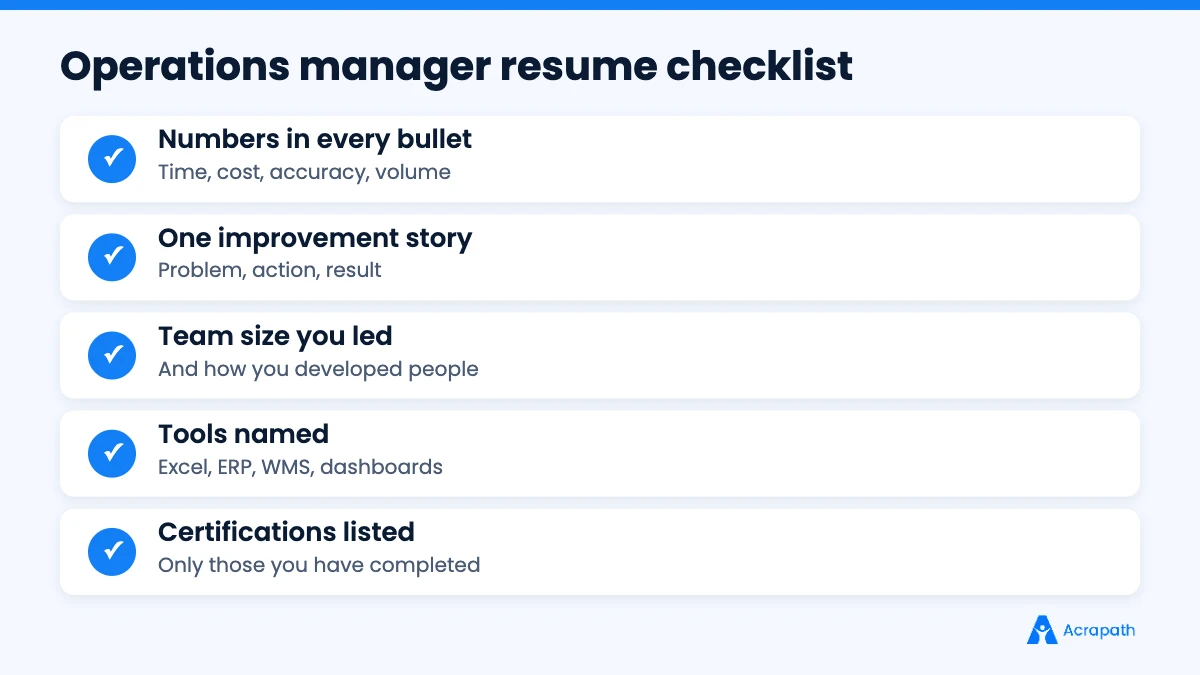
Lead with numbers: turnaround time, cost savings, accuracy, team size, volume handled.
Name your tools: Excel, ERP systems, WMS, CRM, dashboards.
Show leadership: the size of the team you led and how you developed people.
Tell one improvement story from problem to result in your summary or first bullet.
Our complete resume guide walks through each section. In interviews, expect questions on a process you improved, a crisis you handled, how you manage underperformers and how you set KPIs. Open strongly with a clear answer to "tell me about yourself" that mentions one result.
If you're actively searching, follow a structured routine like our 30-day plan to find a job fast, and check your notice period before you accept an offer.
Common Mistakes to Avoid
Chasing the title too early. A manager title without team or budget experience can stall your growth.
Staying in pure execution. If you never own a process or a KPI, it is hard to prove readiness for management.
Ignoring data. Operations decisions increasingly rely on dashboards and analysis.
Collecting certificates without results. A certification supports results; it doesn't replace them.
Neglecting people skills. Most operations problems are people problems at their core.
Conclusion
To become an operations manager, build a foundation in business or engineering, start in an entry-level operations role, own and improve a process, learn the data side and lead people. Add a certification once you have experience, and keep a record of every improvement with numbers.
Do that consistently and the path from executive to operations manager becomes a series of clear, achievable steps rather than a leap.
Ready to start or grow your operations career? See open operations jobs on Acrapath and set up alerts for the roles you want.
- #operations manager
- #operations jobs
- #career guide
- #supply chain
- #process improvement
Frequently asked questions
What qualifications do you need to become an operations manager?
Most employers look for a bachelor's degree in business, commerce, engineering, supply chain or a related field, plus several years of hands-on operations or team-lead experience. An MBA in operations or a certification such as Lean Six Sigma, PMP or CSCP can help, but proven results matter most.
How long does it take to become an operations manager?
Many people reach their first operations manager role after about five to eight years, moving from executive or coordinator to team lead and assistant manager first. Strong performers in fast-growing companies can progress faster, especially if they own processes and lead teams early.
Can a fresher become an operations manager?
Not straight away in most companies. Freshers usually start as operations executives, coordinators, MIS executives or trainees. Within a few years, owning a process, building data skills and leading a small team can prepare you for assistant manager and then operations manager roles.
What skills does an operations manager need?
Key skills include process improvement, people leadership, data analysis and Excel, budgeting and cost control, planning and scheduling, problem-solving and clear communication. Industry-specific knowledge, such as warehouse systems or quality standards, also helps in sectors like logistics and manufacturing.
Is operations manager a good career?
Yes, for people who enjoy solving practical problems and leading teams. Operations managers are needed in almost every industry, pay is generally strong, and the skills transfer well into supply chain, project management, general management and strategy roles. The work can be demanding during peak periods.