How to Negotiate Salary After a Job Offer (Scripts Included)

Jatin Kashyap
Growth Lead, Acrapath
Learn how to negotiate salary after a job offer: find your number, what else to negotiate, mistakes to avoid and 6 copy-ready call and email scripts, including for freshers.
Key Takeaways
To negotiate salary well, wait for a written or verbal offer, research the market rate, then ask for a specific number with 1–2 reasons.
Ask for slightly above your target, usually 10–15% higher than the offer when your research supports it, so there is room to meet in the middle.
Negotiate the total package, not just fixed pay: joining bonus, variable pay, notice buyout, leave and review timing.
Keep it polite and short. One counter, one follow-up, then decide.
Use the 6 scripts below for calls and emails, including what to say as a fresher.
The offer email arrives and the number is lower than you hoped. You want to ask for more, but you worry the company will think you're greedy or, worse, withdraw the offer. So you say "thank you, I accept" and wonder for the next year whether you left money on the table.
It doesn't have to go that way. Learning how to negotiate salary is mostly preparation and a few well-chosen sentences. Most employers expect some negotiation, especially for experienced hires, and a polite, well-reasoned request rarely costs you the offer.
This guide covers when to negotiate, how to find your number, what else you can negotiate and exact scripts for calls and emails.
Should You Negotiate a Job Offer?
Usually, yes. If your research shows the offer is below the market rate for the role, your experience or your location, it is reasonable to ask for more. Employers often build some room into their first offer.
There are a few cases where negotiating has less room: fixed campus packages, government pay scales and some large-company fresher bands where everyone at a level gets the same pay. Even then, you can sometimes ask about joining dates, relocation support or the first review.
How to Negotiate Salary: Step-by-Step
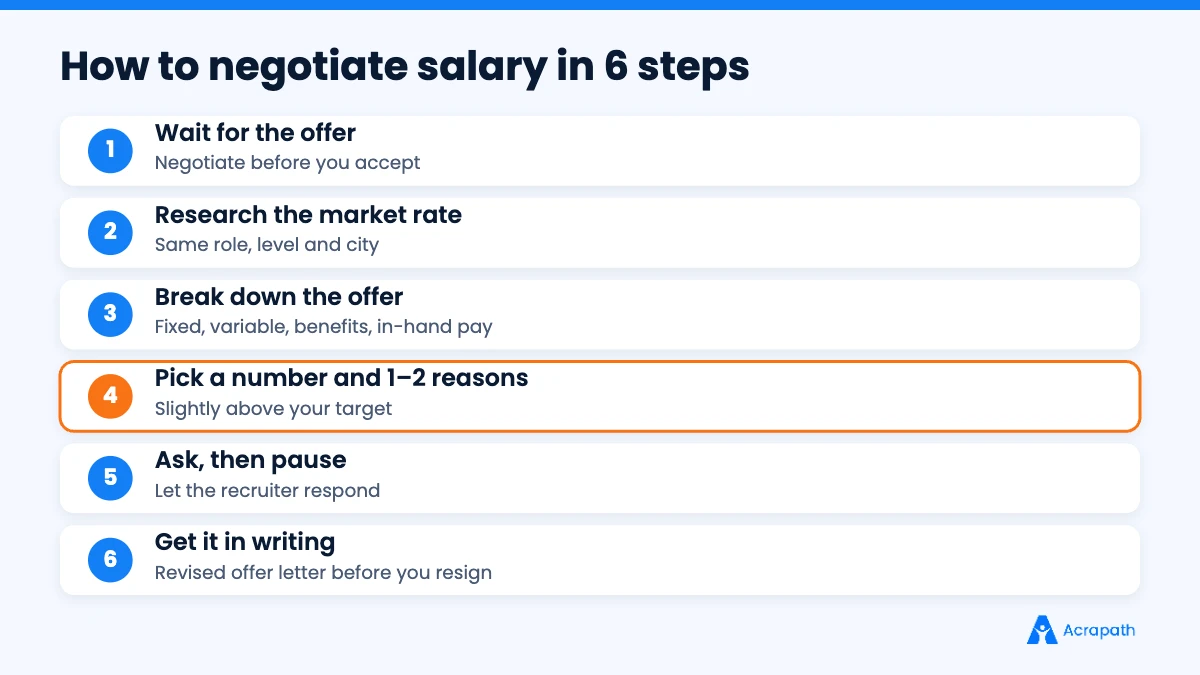
Step 1: Wait for the offer
The strongest time to negotiate is after the company has decided it wants you, but before you accept. If you're asked for expected salary earlier, give a researched range rather than a single low number.
Step 2: Research the market rate
Look at salary data for the same role, experience level and city on salary sites, job posts that list pay, and conversations with people in similar roles. Write down a realistic range and the number you'd be happy with.
Step 3: Understand the offer properly
Break the offer into fixed pay, variable pay, bonuses and benefits. In India, compare in-hand salary, not just CTC. Our guide to CTC vs in-hand salary shows what gets deducted. A higher CTC with a large variable component may pay less than a lower, mostly fixed offer.
Step 4: Choose your number and reasons
Ask for a specific figure, slightly above your target, and back it with one or two reasons: market data, a competing offer, specialised skills or the scope of the role.
Step 5: Ask, then stop talking
Make your request clearly and pause. Let the recruiter respond. Silence feels uncomfortable, but it gives them space to say yes or explain what's possible.
Step 6: Get the final offer in writing
Once you agree, ask for a revised offer letter that reflects every change before you resign from your current job.
Salary Negotiation Scripts
Script 1: The phone counter-offer
"Thank you, I'm really excited about this role and the team. Based on my research for similar roles in this city and the experience I bring in [skill], I was expecting something closer to [number]. Is there any flexibility to get nearer to that?"
Script 2: The email counter-offer
"Subject: [Role] offer – thank you
Hi [Name],
Thank you for the offer for the [Role] position. I'm excited about joining [Company] and contributing to [team or goal].
Before I confirm, I wanted to discuss the fixed salary. Considering my [X years] in [area] and the market range for similar roles, I would be glad to accept at [number]. I'm confident I can [specific contribution].
Would that be possible? Happy to discuss on a call.
Best regards,
[Your name]"
Script 3: When you have another offer
"I want to be transparent. I have another offer at [number], but [Company] is my first choice because of [reason]. If you can get closer to that figure, I'd be happy to accept today."
Only mention a competing offer if it's real. Recruiters may ask for proof.
Script 4: As a fresher
"Thank you for the offer. I'm very keen to join. I noticed similar entry-level roles in [city] are offering around [range]. Given my internship in [area] and project in [skill], is there any room to revise the fixed component slightly?"
Script 5: When salary can't move
"I understand the base salary is fixed. Could we look at a joining bonus, a salary review after six months, or support with my notice period buyout instead?"
Script 6: Accepting gracefully
"Thank you for working with me on this. I'm happy to accept the revised offer of [number]. Could you please share the updated offer letter?"
What Else Can You Negotiate?
Item | When to ask |
|---|---|
Joining or sign-on bonus | When base pay is fixed or you lose a bonus by leaving |
Variable pay share | When too much of the CTC depends on targets |
Notice period buyout | When your notice is longer than their joining date |
Early salary review | When they can't pay more now |
Job title | When the role is bigger than the title suggests |
Remote or hybrid days | When commuting cost or time matters |
Learning budget or certifications | When growth matters as much as pay |
Relocation support | When you're moving cities or countries |
Common Salary Negotiation Mistakes
Accepting on the spot. It's fine to say, "Thank you, could I have a day to review the full offer?"
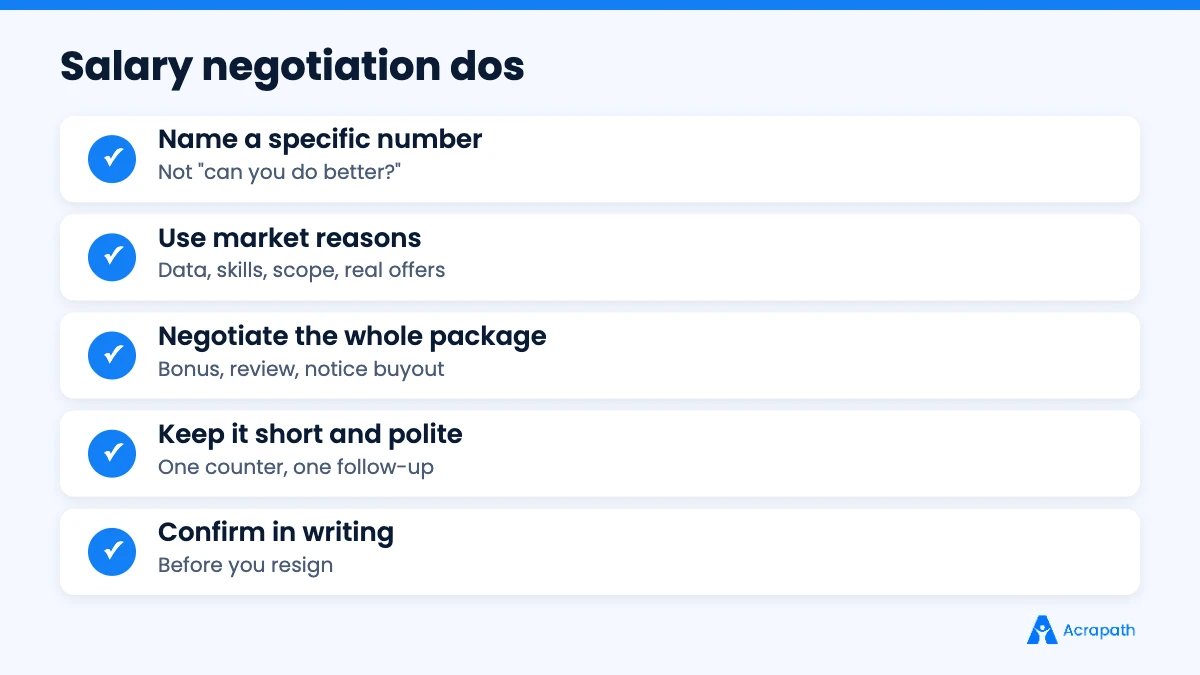
Giving a vague ask. "Can you do better?" invites a tiny increase. Name a number.
Using personal reasons. Rent or EMIs matter to you, but market value and skills persuade employers.
Bluffing about offers. If it's discovered, trust is gone.
Negotiating forever. One counter and one follow-up is usually enough.
Being rude or ultimatum-driven. Your future manager may hear how you behaved.
Set Yourself Up Before the Offer
Strong negotiation starts in the interview. When you explain your impact clearly, from your "tell me about yourself" answer onward, the employer already sees your value before money comes up. A short, professional thank-you email after the interview also keeps you top of mind while they decide.
Conclusion
To negotiate salary with confidence, wait for the offer, research the market, understand the full package and ask for a specific number with clear reasons. Look beyond base pay, use a short script and get the final terms in writing.
A respectful, well-prepared request rarely costs you an offer, and it can shape your earnings for years.
Looking for your next offer to negotiate? Find your next role with Acrapath.
- #salary negotiation
- #job offer
- #counter offer
- #freshers
- #career tips
Frequently asked questions
How much should I ask for when negotiating salary?
Ask for a specific number slightly above your target, often around 10–15% above the offer when your market research supports it. That leaves room to meet in the middle. If the offer is already at or above market, focus on other parts of the package instead.
Can a company withdraw an offer if I negotiate?
It is uncommon when you negotiate politely and with reasons. Most employers expect some negotiation. Offers are more at risk when candidates make ultimatums, bluff about competing offers or keep negotiating for weeks. Keep it short, respectful and backed by market data.
Can freshers negotiate salary?
Sometimes. Fixed campus packages and standard fresher bands often have little room, but off-campus and startup offers may be flexible. Freshers can point to internships, projects or relevant skills, or ask about joining bonuses, early reviews or relocation support if base pay is fixed.
Should I negotiate over email or phone?
Either works. A phone call feels more personal and lets you hear the recruiter's reaction, while email gives you time to phrase things carefully and leaves a record. Many people start with a short call and confirm the agreed figures by email.
What if they say the salary is final?
Thank them, then ask about the rest of the package: a joining bonus, a salary review after six months, notice period buyout, more leave or hybrid days. If nothing changes and the offer still works for you, accept graciously. If it doesn't, it is fine to decline politely.