How to Answer "Tell Me About Yourself" (With Sample Answers)

Jatin Kashyap
Growth Lead, Acrapath

Learn how to answer "tell me about yourself" in 60–90 seconds with a simple formula, sample answers for freshers and experienced pros, and mistakes to avoid.
Key Takeaways
The best tell me about yourself answer is a 60–90 second career story: who you are now, what you have done, and why this role is your next step.
Use the 3-part present–past–future formula and add a one-line close that links you to the job.
Freshers can swap work experience for 2–3 projects, internships or responsibilities from college.
Skip your full life story, family details and a recital of your resume. The interviewer already has your CV.
Practise out loud 5–6 times, record yourself once, and tailor 1–2 lines for every company.
The interviewer smiles, glances at your resume and says, "So, tell me about yourself." It sounds like small talk. It isn't. This is the question that sets the tone for the next 30 minutes, and many candidates waste it by reading out their CV or rambling for five minutes.
A strong tell me about yourself answer is short, structured and pointed at the job in front of you. It shows you can communicate clearly and that you understand why you are in the room.
This guide gives you a simple formula, sample answers for freshers and experienced professionals, a checklist of mistakes to avoid and a practice routine you can finish in one evening.
Why Interviewers Ask "Tell Me About Yourself"
Interviewers ask "tell me about yourself" to hear your career story in your own words and to judge how you communicate. It is rarely about your personal life. They want to know what you do, what you are good at and why you applied.
The question also does three quieter jobs for the interviewer:
It warms up the conversation. An open question gets you talking before harder ones arrive.
It tests structure. Can you summarise yourself in about a minute, or do you wander?
It sets the agenda. Whatever you mention, they will often ask about next. That gives you some control over the rest of the interview.
It usually opens the HR interview round, but technical and managerial interviewers ask it too. The same answer, lightly tailored, works in all of them.
How Long Should Your Answer Be?
Aim for 60–90 seconds, which is roughly 150–220 spoken words. In a video or phone screen, keep it nearer 60 seconds. In a senior-level interview, you can stretch to about two minutes if every line earns its place.
If you notice the interviewer's attention drifting, wrap up. A short answer that invites a follow-up question is always better than a long one that answers everything.
The Present–Past–Future Formula (Step-by-Step)
The simplest way to build your tell me about yourself answer is to move through three time frames and finish with a close. It keeps you on track and sounds natural rather than memorised.
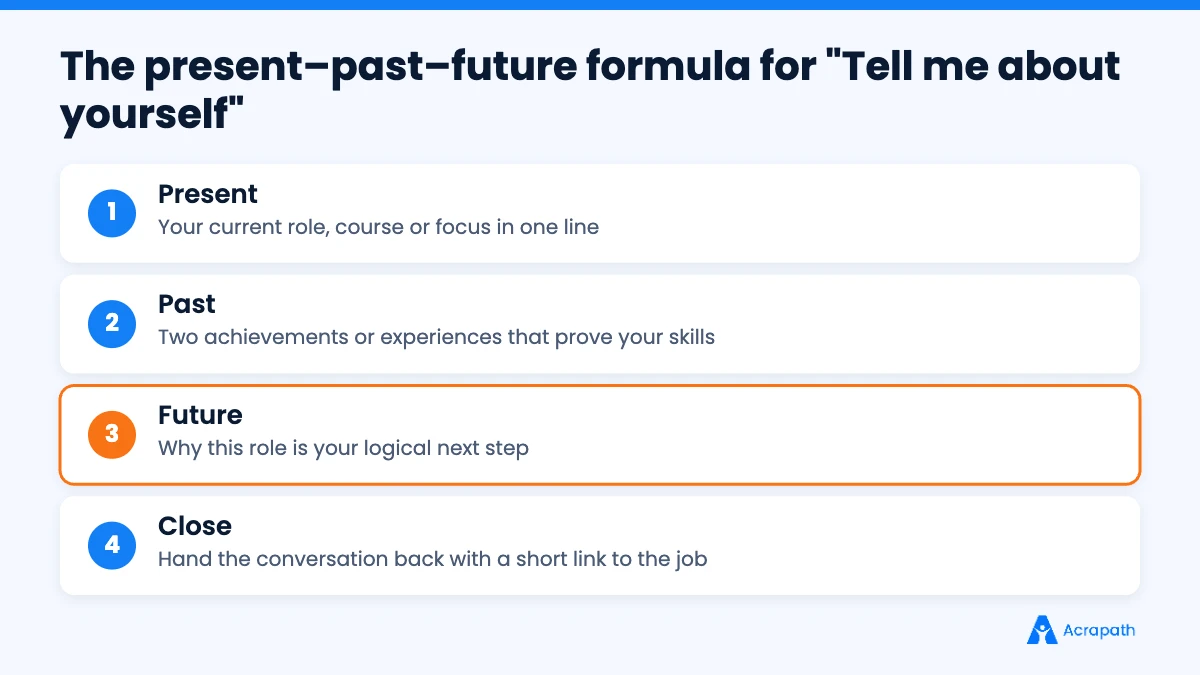
Step 1: Present – Who You Are Now
Start with your current role, course or focus in one or two sentences. Mention your title, the type of work you do and one area you are strongest in.
Example: "I'm a final-year B.Com student specialising in finance, and I've spent the last six months doing an accounts internship at a mid-sized logistics company."
Pitfall: opening with your name and hometown. They have your name. Lead with something relevant to the job.
Step 2: Past – How You Got Here
Pick two experiences or achievements that prove the skills the job asks for. Use numbers wherever you honestly can: customers handled, reports built, sales closed, time saved.
Example: "During the internship I reconciled vendor accounts for over 200 suppliers and built a simple Excel tracker that cut month-end follow-ups for my team."
Pitfall: listing every job or course. Choose the two that match the job description best and leave the rest for later questions.
Step 3: Future – Why This Role, Why Now
Explain what you want to do next and why this company and role fit that goal. This is where you show you researched the employer.
Example: "I'd like to grow into financial analysis, and this analyst role combines the reconciliation work I enjoy with forecasting, which I'm keen to learn."
Pitfall: a generic goal like "I want to grow in a reputed company". Name something specific about the role.
Step 4: Close – Hand the Conversation Back
End with one line that connects you to the role and signals you are finished. "That's why I was excited to apply" or "I'd be happy to talk more about the tracker I built" both work.
A clean close stops you rambling and often steers the next question towards your strongest example.
Tell Me About Yourself: Sample Answers
Use these as models, not scripts. Change the details to match your own background and the job you are applying for.
Sample Answer for Freshers
"I recently completed my B.Tech in Computer Science, where I focused on web development. In my final year I built a placement-tracking web app with two classmates, using React and Node.js, and around 300 students in our college used it during placement season. Before that, I did a two-month internship where I fixed front-end bugs and wrote test cases for a small SaaS team. I enjoy building things people actually use, and this junior developer role fits well because your team works on customer-facing products and pairs freshers with senior engineers. I'd love to bring that same energy here."
If you are still building your experience, our guide to a resume with no experience shows which projects and activities to highlight. The same ones make strong material for this answer.
Sample Answer for Experienced Professionals
"I'm a sales executive with four years of B2B experience, currently selling software to small manufacturers. Over the last year I've consistently hit my quarterly targets and grew my territory's revenue by about a third by focusing on renewals and upsells. Before this I spent two years in inside sales, which taught me how to qualify leads quickly. I'm now looking to move into a larger-account role, and this key account position interests me because it's focused on long-term client relationships rather than one-off deals."
Sample Answer for Career Switchers
"For the last three years I've worked as a school teacher, and in that time I designed digital lesson plans that other teachers in my school started using. That's what pulled me towards instructional design. I've since completed a certification, built a small portfolio of e-learning modules, and freelanced on two corporate training projects. This role is a natural next step because it combines what I know about how people learn with the tools I've been building skills in."
Sample Answer for a Short Phone or Video Screen
"I'm a digital marketing executive with two years' experience in SEO and paid search for e-commerce brands. My biggest win was improving organic traffic for a client's category pages through content and technical fixes. I'm looking for a role where I can own SEO end to end, which is why this position caught my eye."
How to Tailor Your Answer for Each Job
Your core story stays the same, but the examples you choose should change with the job description. Spend ten minutes on this before every interview.
Highlight the top three skills in the job post. These are usually listed first or repeated.
Match one example to each skill. Pick the achievement that proves it best.
Rewrite your "future" line. Mention something specific about the company: its customers, products or the team you would join.
Check your resume lines up. Interviewers often follow up on what you mention, so make sure those points appear on your CV. The complete resume guide shows how to frame them.
Common Mistakes to Avoid
Most weak answers fail for the same few reasons. Check yours against this list.
Mistake | Why it hurts | Do this instead |
|---|---|---|
Reciting your resume | The interviewer has already read it | Tell the story behind 2 highlights |
Personal life story | Family, hobbies and hometown rarely help | Keep it professional unless asked |
Talking for 4–5 minutes | Shows weak structure | Stay within 60–90 seconds |
Sounding memorised | Feels rehearsed, not genuine | Memorise points, not sentences |
No link to the job | Leaves "why you?" unanswered | End with why this role fits |
Negativity about past employers | Raises red flags early | Focus on what you want next |
How to Practise Your Answer
You don't need hours. One focused evening is enough to sound confident.
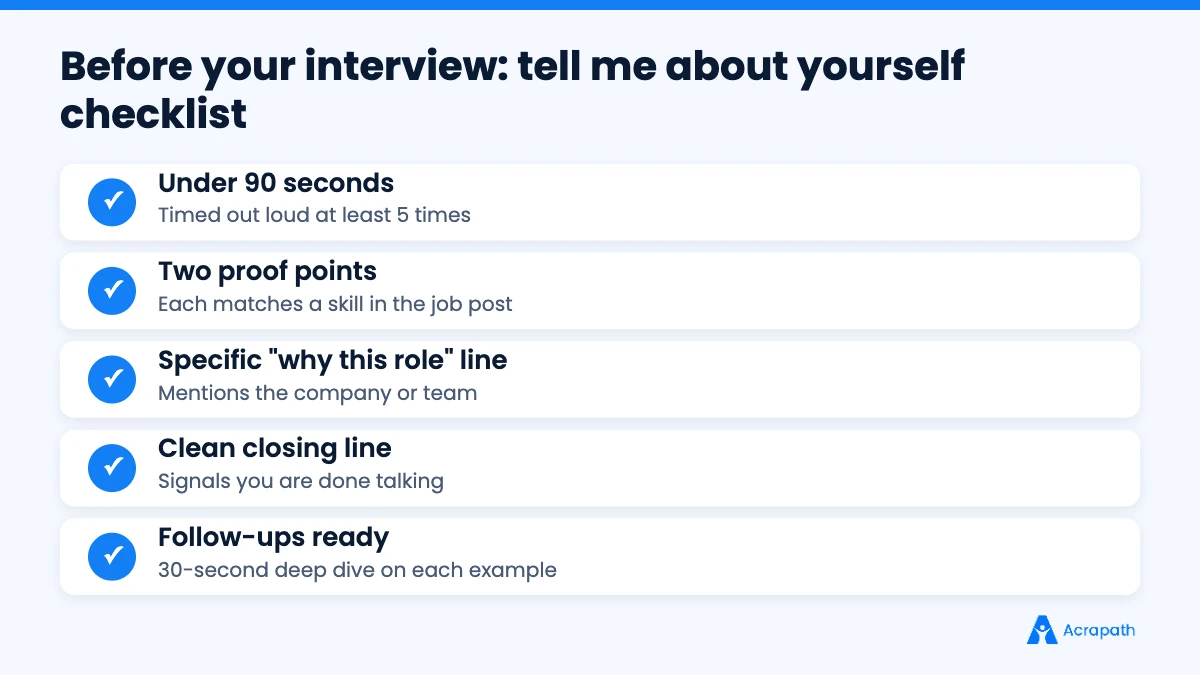
Write bullet points, not a script. Note one line for present, two for past, one for future and one close.
Say it out loud 5–6 times. Time yourself. Cut anything that pushes you past 90 seconds.
Record one take. Watch for filler words, speed and eye contact, especially before a video interview.
Practise follow-ups. For every example you mention, prepare a 30-second deeper explanation.
Do a mock run. Ask a friend or mentor to start the interview with this question cold.
If your interview includes a technical round, pair this with our plan for preparing for a technical interview so your story and your skills tell the same message.
Variations of the Question
Interviewers often phrase it differently. The same formula works for all of these:
"Walk me through your resume."
"Introduce yourself."
"Tell me something about yourself that isn't on your CV."
"Why don't you start by telling us a bit about your background?"
For "something not on your CV", add one short line about a relevant interest or habit, such as a side project or a sport that taught you discipline, then bring it back to the job.
Conclusion
A good tell me about yourself answer is a short career story, not a biography. Lead with who you are now, prove it with two strong examples, explain why this role is your next step and close cleanly.
Write your bullet points tonight, practise them out loud a few times and tailor the examples for each company. After the interview, follow up with a thank-you email that echoes the same story.
Ready to put it to work? Browse jobs on Acrapath and set up alerts for the roles you want.
- #interview tips
- #tell me about yourself
- #freshers
- #self introduction
- #HR interview
Frequently asked questions
How do I answer "tell me about yourself" as a fresher?
Use the present–past–future formula. Start with your degree and focus area, then describe two projects, internships or responsibilities that match the job, and finish with why this role is your next step. Keep it to about 60 seconds and point to skills, not marks or family background.
How long should my tell me about yourself answer be?
Aim for 60–90 seconds, or roughly 150–220 spoken words. Keep it closer to 60 seconds in phone and video screens. If you are interviewing for a senior role, up to two minutes is fine, provided every line connects to the job.
Should I talk about my family or hobbies?
Usually not. Interviewers want your professional story. Mention a hobby only if it shows a skill the role needs, such as a coding side project or a sport that built teamwork, or if the interviewer specifically asks about life outside work.
Is it okay to memorise my answer?
Memorise the structure and key points, not every sentence. Word-for-word answers often sound robotic and are easy to forget under pressure. Practise from bullet points so the answer sounds natural and you can adjust it to the conversation.
What is the difference between "introduce yourself" and "tell me about yourself"?
They are effectively the same question and you can use the same answer. "Introduce yourself" is slightly more common in Indian campus interviews, while "walk me through your resume" invites a little more chronological detail. The present–past–future formula works for all three.