Nursing Jobs Abroad: How to Work as a Nurse in the UAE, UK and US

Jatin Kashyap
Growth Lead, Acrapath
Explore nursing jobs abroad: licences, exams, documents and timelines to work as a nurse in the UAE (DHA), UK (NMC) and US (NCLEX-RN), plus scam warning signs.
General information, checked November 2026. Licensing rules change, so always confirm the current requirements with the official regulator before you apply or pay any fees.
Key Takeaways
Nursing jobs abroad in the UAE, UK and US all need a local licence: DHA (or DOH/MOHAP) in the UAE, NMC registration in the UK, and a state RN licence via the NCLEX-RN in the US.
Every route starts with document verification: degree, nursing registration, experience letters and a good-standing certificate.
The UK asks for IELTS Academic 7.0 or OET grade B, then a CBT before you travel and an OSCE after you arrive.
Dubai uses DataFlow verification and a Prometric exam, and you can sit the exam in your home country.
Plan for roughly 6–12 months for the UK or UAE and often longer for the US, and never pay a "recruiter" who promises a job without a licence.
You've built solid clinical experience, and you keep seeing posts about nurses earning more, gaining international exposure and building careers in Dubai, London or Texas. The question is where to start, because every country has its own regulator, exams and paperwork.
This guide breaks down nursing jobs abroad in the three destinations nurses ask about most: the UAE, the UK and the US. For each, you'll see the licence you need, the exams, the documents and a realistic timeline, plus how to spot recruitment scams.
Why Nurses Look for Jobs Abroad
Nurses move abroad for higher pay, structured career progression, exposure to advanced hospital systems and, in some countries, a route to long-term residence. Demand for internationally educated nurses remains strong in many health systems, which is why hospitals actively recruit overseas.
Every destination, though, protects patients the same way: you can only work as a registered nurse after the local regulator licenses you. Getting that licence is the real project. The job offer usually follows.
UAE vs UK vs US: Quick Comparison
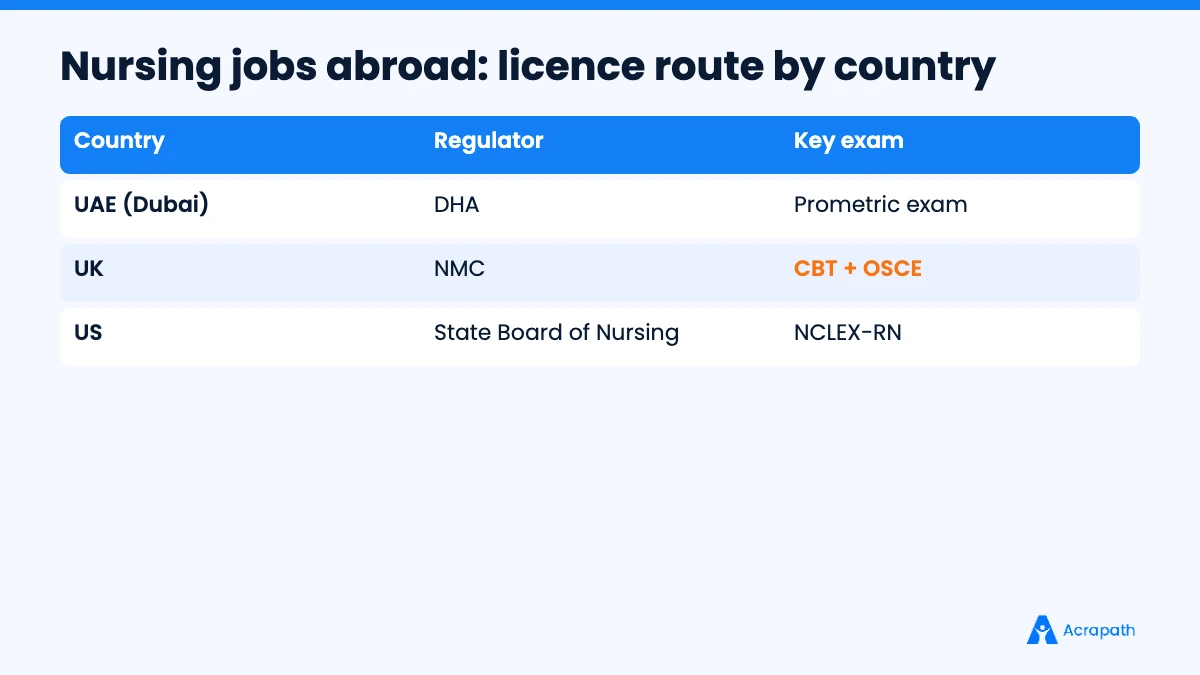
UAE (Dubai) | UK | US | |
|---|---|---|---|
Regulator | Dubai Health Authority (DHA); DOH in Abu Dhabi; MOHAP for other emirates | Nursing and Midwifery Council (NMC) | State Boards of Nursing |
Main exam | Prometric licensing exam | CBT, then OSCE in the UK | NCLEX-RN |
English test | Depends on the authority and your profile | IELTS Academic 7.0 or OET grade B (with a writing allowance) | Required for most applicants (IELTS, TOEFL or OET, depending on the service) |
Verification | DataFlow primary source verification | NMC document checks | CGFNS/TruMerit credentials evaluation and VisaScreen |
Typical timeline | About 4–9 months | About 9–14 months | Often 1–2 years or more |
Timelines are rough estimates and depend on how quickly you gather documents and pass each test.
How to Work as a Nurse in the UAE
Dubai is licensed by the Dubai Health Authority. Abu Dhabi uses the Department of Health (DOH), and most other emirates use the Ministry of Health and Prevention (MOHAP). A licence from one authority does not automatically let you work under another, so decide where you want to work first.
Step 1: Check eligibility
Requirements are set out in the UAE's Unified Professional Qualification Requirements (PQR). You'll typically need a recognised nursing degree or diploma, active registration in your home country and a good-standing certificate. Experience rules vary by title and have been updated recently, so check the current PQR for your category.
Step 2: Apply and complete DataFlow verification
You open an application through the DHA licensing system. Your degree, registration and experience letters are then verified at source by DataFlow. Mismatched names or dates between documents are the most common cause of delays.
Step 3: Pass the Prometric exam
Once eligible, you book the computer-based licensing exam with Prometric. You can usually sit it at a Prometric centre in your own country, so you don't need to travel to Dubai first.
Step 4: Get a job offer and activate the licence
After passing, you receive eligibility. A DHA-licensed employer then hires you and activates your licence, and the hospital handles your work visa.
How to Work as a Nurse in the UK
To work as a registered nurse in the UK, you must join the register of the Nursing and Midwifery Council (NMC). Internationally educated nurses go through the NMC's Test of Competence, which has two parts.
Step 1: Meet the English requirement
Most applicants take IELTS Academic (7.0 overall and in each skill) or OET (grade B), with a small allowance in writing. Some nurses qualify through other routes, such as training taught in English or recent practice in an English-speaking country. Check the NMC's current English language guidance before booking a test.
Step 2: Pass the CBT
The computer-based test (CBT) is part one of the Test of Competence. You take it in your home country before you travel.
Step 3: Submit documents and get a decision letter
After the CBT, you upload your qualifications, registration, identity and character evidence to the NMC. Once the NMC is satisfied, you receive a decision letter and can accept a job offer with visa sponsorship.
Step 4: Take the OSCE in the UK
The Objective Structured Clinical Examination is a practical exam. According to NHS Employers, most nurses sit it soon after arriving, often within their first few months, with the employer's support. After passing, you join the NMC register as a registered nurse.
How to Work as a Nurse in the US
In the US, nurses are licensed by each state's Board of Nursing, so requirements differ from state to state. Every state requires the NCLEX-RN, the same licensing exam US-trained nurses take.
Step 1: Credentials evaluation
Most state boards ask for a credentials evaluation, commonly from TruMerit (formerly CGFNS), to confirm your education is comparable to US standards.
Step 2: Apply to a state board and pass the NCLEX-RN
You apply to the board of the state where you want to work, register for the NCLEX-RN and sit it at a Pearson VUE centre. The exam is offered in a number of countries outside the US. Some states also have extra requirements, so read your chosen state's rules carefully.
Step 3: English test and VisaScreen
For a work visa or green card, most foreign-educated nurses need a VisaScreen certificate. It verifies your education and licence, your English test results and a passed NCLEX-RN or qualifying exam.
Step 4: Employer sponsorship
Most international nurses enter the US through an employer-sponsored immigrant visa (green card) route. This is often the slowest step, so many nurses work with established healthcare employers or licensed agencies.
Documents to Prepare for Every Country
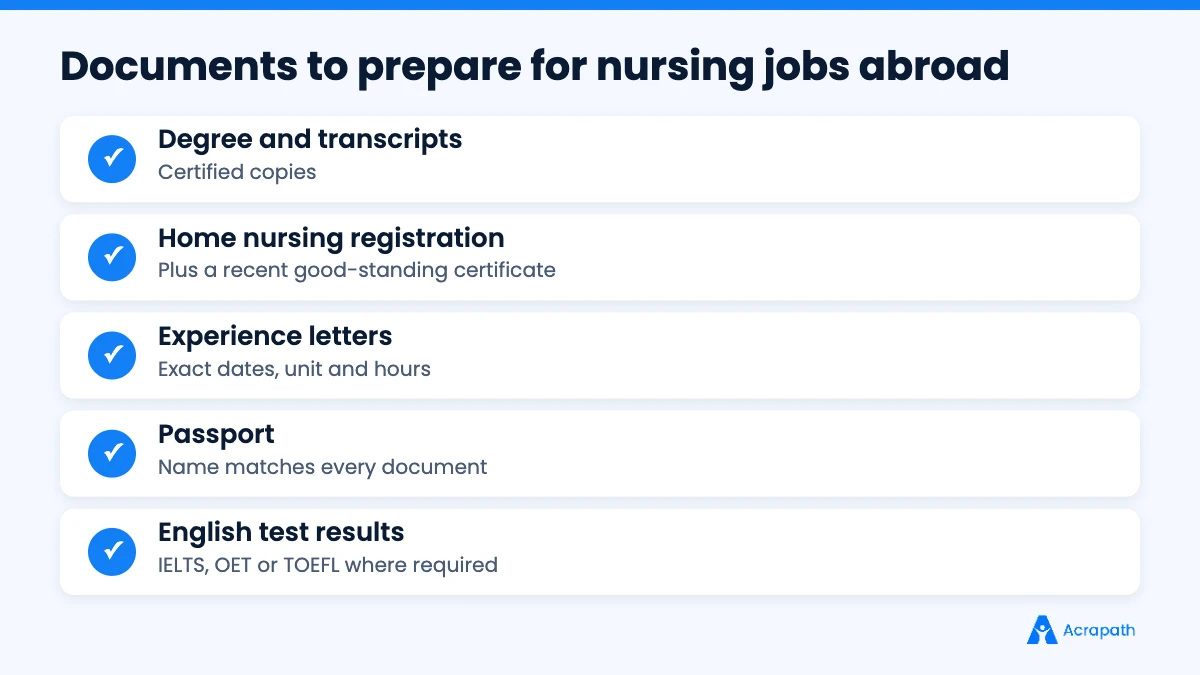
Start collecting these now. Getting them right early saves months later.
Degree or diploma certificate and full transcripts
Home-country nursing registration certificate
Good-standing certificate from your nursing council (usually recent)
Experience letters with exact dates, unit and hours
Passport, with your name matching every other document
English test results (where required)
Basic Life Support certificate (often requested in the UAE)
How to Avoid Nursing Job Scams
Overseas nursing recruitment attracts fraud. Protect yourself with these checks:
No licence, no job. A genuine offer comes after or alongside licensing, not instead of it.
Be wary of large upfront fees. In the UK, the ethical recruitment code says candidates should not be charged recruitment fees. Treat demands for "placement fees" with caution anywhere.
Verify the employer. Check the hospital's official website and contact HR directly.
Use official portals only. Pay regulator and exam fees through official websites, never through an agent's personal account.
Get Your Profile Ready
International employers screen hundreds of nursing CVs. Make yours easy to shortlist with our staff nurse resume guide, and prepare for clinical and behavioural rounds with our nursing interview questions and answers. Most interviews, including video calls with overseas hospitals, open with an introduction, so practise answering "tell me about yourself".
Conclusion
Nursing jobs abroad are within reach if you treat licensing as the main project. Choose your destination, check the regulator's current rules, get your documents verified early and pass the required exams: Prometric for the UAE, the CBT and OSCE for the UK, or the NCLEX-RN for the US.
Start with one country, plan for several months and don't let anyone rush you into paying for a job that skips the licence.
Looking for your next nursing role? Browse medical and nursing jobs on Acrapath and set up alerts for openings that match your experience.
- #nursing jobs abroad
- #nurses
- #DHA exam
- #NMC registration
- #NCLEX-RN
Frequently asked questions
Which country is easiest for nursing jobs abroad?
There is no single easiest country. The UAE route is often quickest, since you can sit the Prometric exam at home. The UK route is well structured with employer support for the OSCE. The US usually takes longest because of credential checks, the NCLEX-RN and immigration steps.
Do I need IELTS to work as a nurse abroad?
For the UK, most applicants need IELTS Academic 7.0 or OET grade B unless they qualify through another approved route. The US usually needs an English test for VisaScreen. UAE requirements depend on the authority and your background, so check the current rules for your category.
Can I take the DHA exam in India?
Yes. The DHA licensing exam is run by Prometric and can usually be taken at a Prometric test centre in India or other countries. You first need to complete your application and DataFlow verification and receive eligibility before you can book.
How long does it take to become a nurse in the UK from abroad?
Many nurses take roughly 9–14 months from starting English test preparation to joining the NMC register. The steps are the English test, the CBT, document checks and decision letter, a job offer and visa, and then the OSCE after arriving in the UK.
Should I pay an agent to get a nursing job abroad?
Be careful. Genuine hospitals and ethical recruiters generally do not charge nurses large placement fees, and the UK's ethical recruitment code says candidates should not pay recruitment fees. Pay regulator and exam fees only through official websites, and verify any employer directly.


