Sales Interview Questions and Answers for Freshers and Pros

Jatin Kashyap
Growth Lead, Acrapath
Prepare for sales interview questions with sample answers for freshers and experienced candidates, objection handling, a "sell me this pen" walkthrough and a prep plan.
Key Takeaways
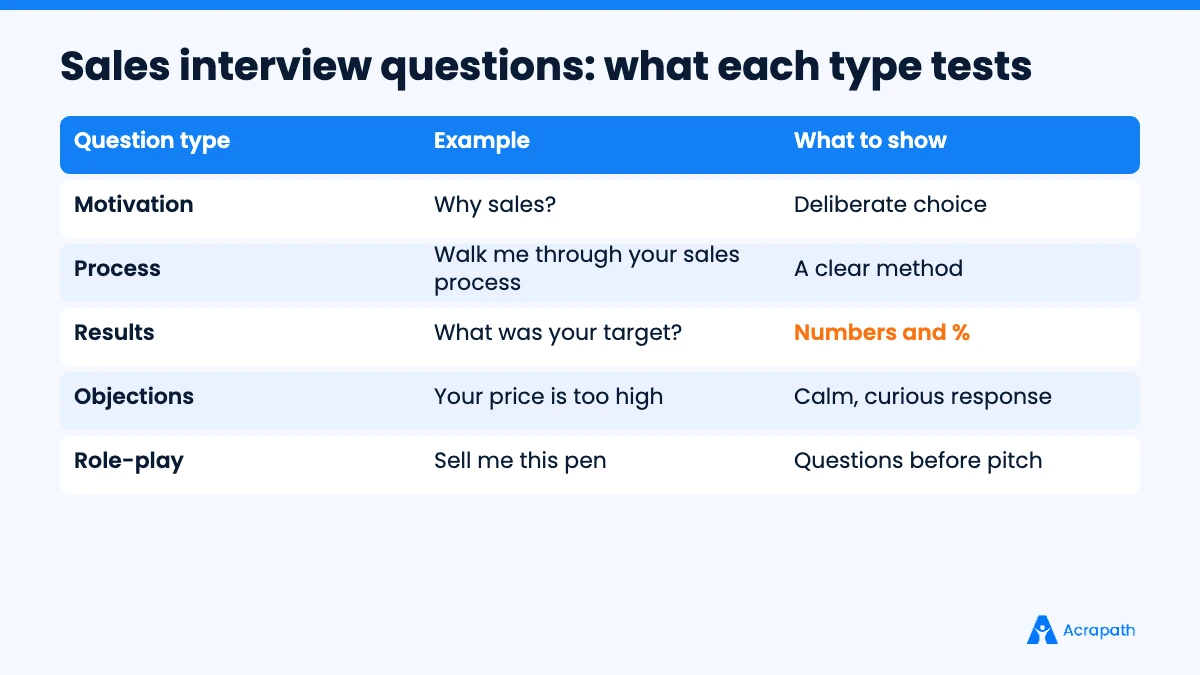
Most sales interview questions test 4 things: motivation for sales, how you sell, how you handle rejection, and whether you hit numbers.
Expect at least 1 role-play, such as "sell me this pen". Ask questions before you pitch.
Use the STAR method and end every story with a number: revenue, deals, conversion rate or target percentage.
Freshers can use college events, internships, fundraising or part-time jobs as sales proof.
Research the company's product, customer and price point before the interview. Interviewers notice.
Sales interviews are different from most job interviews. The interviewer isn't only listening to your answers. They're watching how you sell yourself, how you handle pushback and whether you'd be comfortable in front of their customers.
That makes preparation more important, not less. The good news: sales interview questions follow a clear pattern, and once you know what each question is really testing, you can answer with confidence.
This guide covers the most common questions for freshers and experienced candidates, with sample answers, a role-play walkthrough and a short preparation plan.
What Sales Interviewers Look For
Sales interviewers look for people who can start conversations, understand customer needs, handle objections and close, while staying motivated through rejection. They also check whether you'll be disciplined about follow-ups and CRM updates.
Trait | How they test it |
|---|---|
Motivation | "Why sales?" and "What drives you?" |
Communication | Your introduction and how clearly you answer |
Selling skill | Role-plays and "how would you sell our product?" |
Resilience | Questions about rejection and missed targets |
Results | Your numbers: targets, deals, revenue |
Coachability | How you respond to feedback during the role-play |
The interview usually opens with an introduction. Prepare it using our guide on how to answer "tell me about yourself", and make sure it mentions at least one result.
Sales Interview Questions for Freshers
1. Why do you want a career in sales?
Why they ask: To check you chose sales deliberately, not as a fallback.
Sample answer: "I enjoy talking to people and understanding what they need, and I like work where effort shows up in results. In college I ran sponsorship for our fest and raised more than our target by calling over 60 local businesses. Seeing a clear link between my effort and the outcome is exactly why I want to start in sales."
2. Have you ever sold anything?
Why they ask: To find any real sales experience, however small.
Sample answer: "Yes. During my internship I helped an ed-tech company convert enquiries into course sign-ups. I called leads, asked about their goals and explained which course fit. I converted 14 enquiries in six weeks, and I learned that listening first made people far more likely to buy."
3. How do you handle rejection?
Why they ask: Sales involves a lot of "no".
Sample answer: "I treat a "no" as feedback. After a rejection, I note why the person said no, and if I see a pattern I change my approach. When I was calling sponsors, the first ten said no because I led with our needs. When I started leading with what their brand would get, more people agreed to meet."
4. What do you know about our product and customers?
Why they ask: To check you prepared and can think like a seller.
Sample answer: "From your website and reviews, you sell accounting software to small businesses, mostly owners who want GST-ready invoicing without hiring an accountant. Your main selling point seems to be ease of use. I would expect common objections to be price and switching effort from existing tools."
5. Where do you see yourself in three years?
Why they ask: To check ambition and fit with the sales ladder.
Sample answer: "I want to be a consistent top performer, then move into handling larger accounts or a team lead role. I want to learn your sales process properly first and build a record of hitting targets."
Being new to sales doesn't mean having nothing to show. Our guide to a resume with no experience explains how to present college and internship work, and the same examples power your interview answers.
Sales Interview Questions for Experienced Candidates
6. Walk me through your sales process.
Why they ask: To see whether you sell with a method.
Sample answer: "I start by researching the account and finding the right person. On the first call I focus on discovery: their current process, problems and budget. If there's a fit, I run a tailored demo, send a proposal within 24 hours, and agree a next step at every meeting. I log everything in the CRM so nothing slips."
7. What was your target last year, and how did you perform?
Why they ask: Numbers are the most important part of a sales interview.
Sample answer: "My annual target was ₹60 lakh in new revenue and I closed ₹66 lakh, about 110% of target. I hit target in three of four quarters. The quarter I missed, I had two large deals slip, so I started building more pipeline earlier to protect against that."
8. Tell me about your biggest deal.
Why they ask: To understand deal size, complexity and your role.
Sample answer: "My biggest deal was a 12-month contract with a hospital group. It took four months and involved the operations head, finance and IT. I mapped every stakeholder, ran a pilot in one branch, and used the pilot results to answer finance's concerns. It closed at nearly three times my average deal size."
9. Tell me about a deal you lost.
Why they ask: To test honesty and learning.
Sample answer: "I lost a mid-sized deal because I focused on the champion and never met the finance head. When budget was reviewed, we were cut. Since then I ask early who signs off on spend and make sure I speak to them before the proposal stage."
10. How do you manage your pipeline?
Why they ask: To check planning and discipline.
Sample answer: "I review my pipeline every Monday. I keep roughly three times my monthly target in qualified pipeline, move stale deals out, and set a clear next step for every open opportunity. That weekly review is how I avoid end-of-month surprises."
11. How do you prospect for new customers?
Why they ask: Outbound skill matters for many roles.
Sample answer: "I build a list from LinkedIn and industry directories, then use a sequence of a personalised email, a call and a LinkedIn message over two weeks. I personalise the first line using something specific about their business. Referrals from existing customers are my highest-converting source."
Objection-Handling Questions
12. A customer says "Your price is too high." What do you do?
Why they ask: Price is the most common objection.
Sample answer: "I would first ask what they are comparing us with, because "too high" is always relative. Then I would go back to the problem they told me about and show the cost of not solving it. If budget is truly the issue, I would look at a smaller starting package rather than discount straight away."
13. A customer says "Send me an email and I'll think about it." How do you respond?
Why they ask: This is often a polite brush-off.
Sample answer: "I would agree, then ask one question: "So I send you the right information, what would you need to see to make a decision?" That turns a vague delay into a specific next step, and I would book a follow-up call before ending the conversation."
14. The customer says they are happy with a competitor. What now?
Why they ask: To see whether you can create interest without pushing.
Sample answer: "I would respect that and ask what they like most about their current provider and what they would improve. If there is a gap we fill well, I would focus on that one point. If not, I would stay in touch, because needs change."
Role-Play: "Sell Me This Pen"
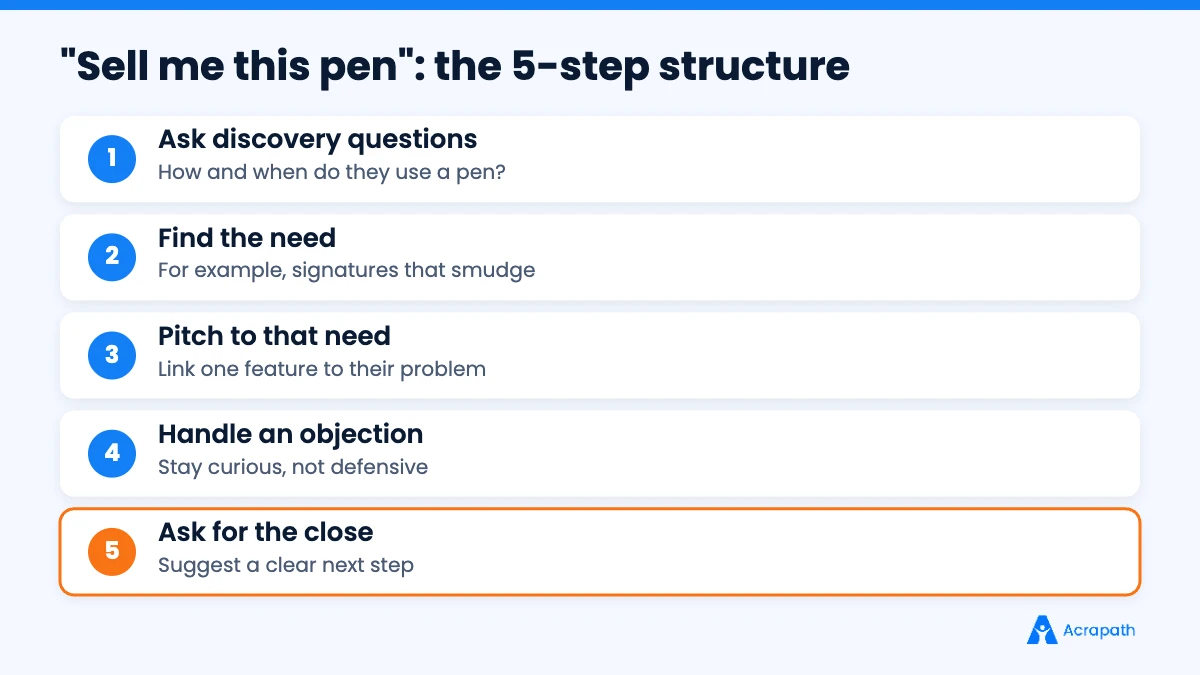
This classic test isn't really about the pen. The interviewer wants to see whether you ask questions before pitching. Here's a strong structure:
Ask discovery questions. "When did you last use a pen? What do you use it for? What do you like or dislike about the pen you have now?"
Find the need. Suppose they sign contracts and hate pens that smudge.
Pitch to that need. "This pen uses quick-dry ink, so your signatures won't smudge on important documents."
Handle an objection. If they say they have plenty of pens, ask how many of them are reliable when it matters.
Ask for the close. "Shall I add two to your order so you have one at your desk and one in your bag?"
The same structure works for any role-play, including "sell me our product". Interviewers using a scorecard will usually be checking for these steps. You can see what employers are told to look for in our employer guide to sales interview questions to ask.
Behavioural Sales Interview Questions
15. Tell me about a time you missed a target.
Why they ask: Everyone misses sometimes. They want to see ownership.
Sample answer: "In my second quarter I hit 82% of target because I relied too much on one large deal. I took responsibility, broke my target into weekly pipeline goals and spread my effort across more mid-sized accounts. I hit 104% the next quarter."
16. How do you stay motivated in slow months?
Why they ask: Resilience predicts long-term performance.
Sample answer: "I focus on what I control: calls, meetings and pipeline. I set weekly activity goals, track them, and celebrate small wins like a new meeting booked. Slow months are usually when I build the pipeline that pays off later."
17. How do you work with marketing and product teams?
Why they ask: Sales roles increasingly involve collaboration.
Sample answer: "I share customer feedback every month: the objections I hear most and features customers ask for. With marketing, I give feedback on lead quality so they can improve targeting."
18. Why should we hire you?
Why they ask: Your closing pitch.
Sample answer: "You need someone who can bring in new business in this segment quickly. I have two years selling to similar customers, I consistently hit target, and I've shown I can learn a new product fast. I'm confident I can build pipeline in my first 60 days."
How to Prepare in 5 Steps
Know your numbers. Targets, achievement percentage, deal sizes and sales cycle. Freshers: amounts raised, sign-ups, participants.
Research the product. Customer type, price range, main competitors and likely objections.
Prepare four STAR stories. A big win, a lost deal, a missed target and an objection you overcame.
Practise one role-play. Ask a friend to play a difficult customer.
Prepare your questions. Ask about targets, lead sources, ramp-up time and incentive structure.
Make sure your CV backs up your numbers. Our sales executive resume guide shows how to present achievements, and the sales executive career guide covers skills and salary. After the interview, send a thank-you email within 24 hours. It's a small sales skill in itself.
Conclusion
Sales interview questions are designed to see you sell. Show motivation, prove results with numbers, ask questions before pitching in role-plays and handle objections calmly. Prepare your stories, know the product and practise out loud.
Treat the interview like a sales meeting where the product is you, and you'll stand out.
Ready to land your next sales role? See open sales jobs on Acrapath and set up alerts for your target roles.
- #sales interview
- #interview questions
- #sell me this pen
- #sales jobs
- #freshers
Frequently asked questions
What are the most common sales interview questions?
Common questions include "Why sales?", "Walk me through your sales process", "What was your target and how did you perform?", "Tell me about a deal you lost", "How do you handle rejection?" and role-plays like "sell me this pen". Most aim to test motivation, method, resilience and results.
How do I answer "sell me this pen"?
Ask questions before you pitch. Find out how the interviewer uses pens and what frustrates them, then sell the pen as the solution to that need, handle one objection and ask for the close. The interviewer is testing your process more than your pitch.
How can a fresher prepare for a sales interview?
Use any experience where you persuaded people: fest sponsorships, fundraising, internships, part-time jobs or student clubs. Put numbers on it, research the company's product and customers, and practise a role-play. Show energy, curiosity and resilience, since interviewers know freshers have limited sales history.
What numbers should I mention in a sales interview?
Mention your target, your achievement as a percentage, deals closed, average deal size, sales cycle length and conversion rate. Freshers can use sign-ups, amounts raised or participants recruited. Specific numbers make your claims believable and are what sales managers listen for most.
What questions should I ask at the end of a sales interview?
Ask about targets and how many of the team hit them, where leads come from, how long ramp-up takes, how incentives are calculated and paid, and what top performers do differently. These questions show you think like a salesperson and help you judge the role.


