Financial Analyst Interview Questions and Answers (2026)

Jatin Kashyap
Growth Lead, Acrapath

Prepare for financial analyst interview questions on accounting, modelling, valuation, Excel and behavioural rounds, with sample answers and a one-week plan.
Key Takeaways
Most financial analyst interview questions fall into 5 groups: accounting basics, financial modelling, valuation, Excel, and behavioural or case questions.
Know how the 3 financial statements link. It is the single most common technical question.
Expect a timed Excel or modelling test in many hiring processes, often 60–120 minutes.
Answer behavioural questions with a short STAR story that ends in a number.
Prepare 2–3 questions of your own about the team's reporting cycle, tools and stakeholders.
You've cleared the resume screen for a financial analyst role. Now comes the part most candidates under-prepare for: a mix of accounting theory, live Excel work and "walk me through" questions that test whether you really understand the numbers.
The good news is that financial analyst interview questions are predictable. The same core topics come up again and again, whether you're interviewing for FP&A at a company, an equity research desk or a finance role at a startup.
This guide groups the most common questions by type, explains why each is asked and gives sample answers you can adapt. It works for freshers and for analysts with a few years' experience.
What Financial Analyst Interviews Test
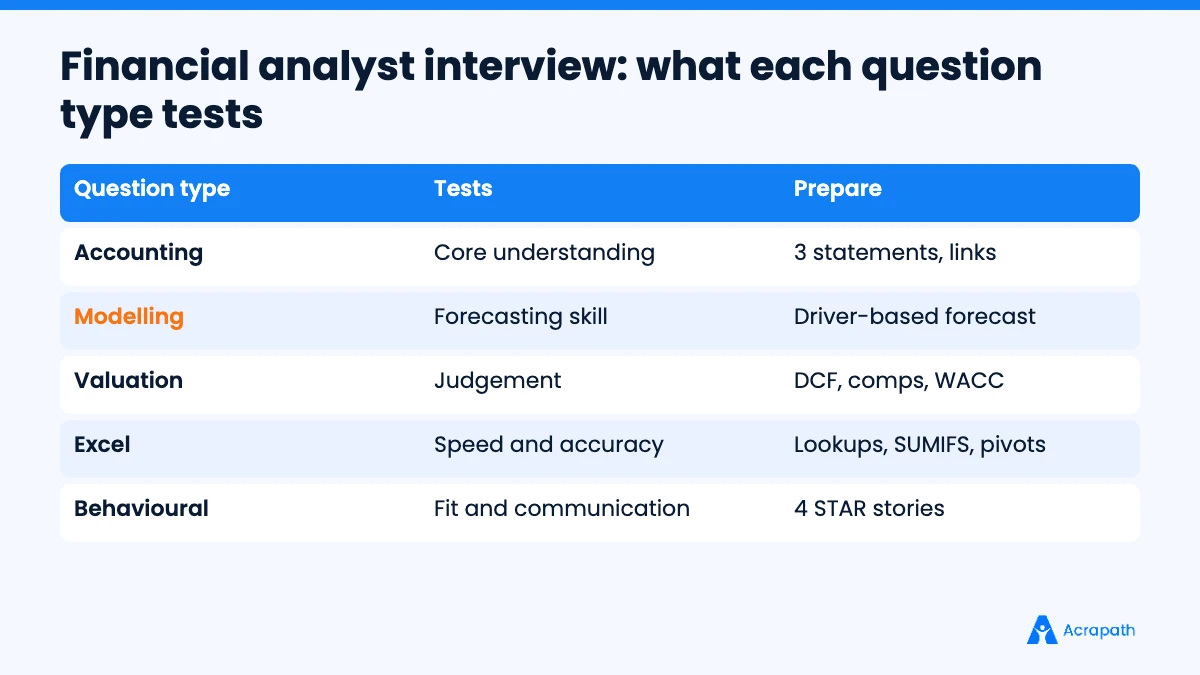
Financial analyst interviews test whether you can turn financial data into decisions. Interviewers check four things: your accounting foundation, your modelling and Excel skills, your judgement on valuation and business drivers, and how clearly you explain numbers to non-finance people.
A typical process looks like this:
Round | What happens | What to prepare |
|---|---|---|
HR or recruiter screen | Background, motivation, salary expectations | A 60–90 second introduction |
Technical interview | Accounting, valuation and finance concepts | The questions in this guide |
Excel or modelling test | Build or fix a model under time pressure | Shortcuts, lookups, a 3-statement model |
Case or presentation | Analyse a business problem and recommend | A clear structure and a recommendation |
Manager or final round | Fit, judgement, stakeholder handling | STAR stories with numbers |
Your first answer in most rounds will be your introduction, so prepare it well. Our guide on answering "tell me about yourself" gives you a simple structure.
Accounting and Financial Statement Questions
1. Walk me through the three financial statements.
Why they ask: It checks your core understanding of how a business is reported.
How to answer: Describe each statement in one line, then explain what each shows.
Sample answer: "The income statement shows revenue, expenses and profit over a period. The balance sheet shows assets, liabilities and equity at a point in time, and must balance. The cash flow statement shows how cash moved through operating, investing and financing activities. Together they tell you whether a business is profitable, what it owns and owes, and whether it generates cash."
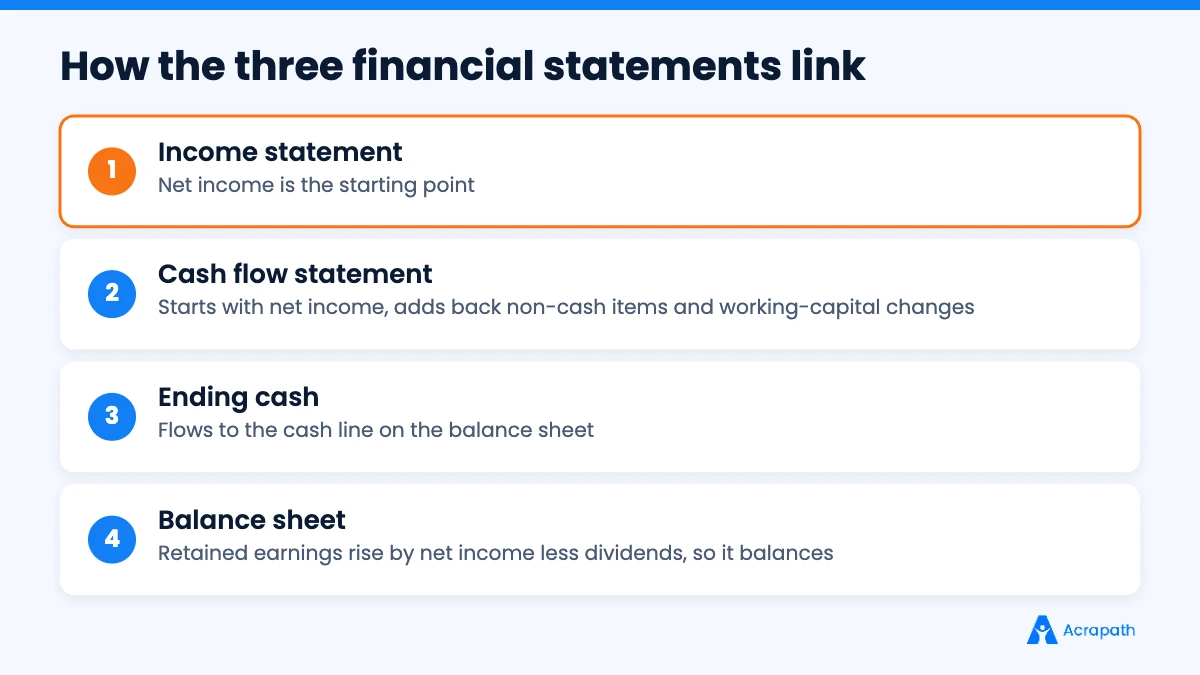
2. How do the three statements link together?
Why they ask: This is the most common technical question, because it shows whether you can build a model.
How to answer: Start with net income and trace it through.
Sample answer: "Net income from the income statement is the starting point of the cash flow statement and also flows into retained earnings on the balance sheet. The cash flow statement adjusts for non-cash items like depreciation and for working-capital changes, and its ending cash becomes the cash line on the balance sheet. Capex appears in investing cash flow and increases PP&E on the balance sheet."
3. If depreciation goes up by 10, how do the statements change?
Why they ask: It tests whether you can follow one change through all three statements.
How to answer: Assume a tax rate and walk through each statement in order.
Sample answer: "Assuming a 25% tax rate, operating income falls by 10 and net income by 7.5. On the cash flow statement, net income is down 7.5 but we add back the 10 of depreciation, so cash rises by 2.5 because of the tax saving. On the balance sheet, cash is up 2.5, PP&E is down 10, so assets fall 7.5, and retained earnings fall 7.5, so it balances."
4. What is working capital and why does it matter?
Why they ask: Working capital drives short-term cash, which matters in forecasting.
How to answer: Give the definition and a practical implication.
Sample answer: "Working capital is current assets minus current liabilities. Operating working capital usually focuses on receivables, inventory and payables. If a company grows sales but customers pay slowly, receivables rise and cash is tied up, so a profitable company can still run short of cash."
5. What is the difference between EBITDA and net income?
Why they ask: It checks you understand profit measures and their limits.
How to answer: Explain what EBITDA removes and when it is useful.
Sample answer: "EBITDA is earnings before interest, tax, depreciation and amortisation. It strips out financing, tax and non-cash charges, so it is useful for comparing operating performance across companies. Net income is what is left after all of those. EBITDA can flatter capital-heavy businesses because it ignores the cost of replacing assets."
Financial Modelling and Forecasting Questions
6. How would you build a revenue forecast?
Why they ask: Forecasting is the daily work of most FP&A analysts.
How to answer: Show you would break revenue into drivers rather than just apply a growth rate.
Sample answer: "I would break revenue into its drivers, for example customers multiplied by average order value multiplied by purchase frequency, or units multiplied by price. I would base each driver on historical trends and management input, check it against market growth and capacity, and build a base, upside and downside case."
7. What is a three-statement model?
Why they ask: It tests your modelling vocabulary and process.
How to answer: Describe the build order and what makes it balance.
Sample answer: "It is a linked model of the income statement, balance sheet and cash flow statement. You start with assumptions, build the income statement, then supporting schedules for working capital, capex and debt, then the cash flow statement, and finally the balance sheet. If it is linked correctly, the balance sheet balances every period."
8. What is variance analysis?
Why they ask: It is core to FP&A reporting.
How to answer: Define it, then explain how you would present findings.
Sample answer: "Variance analysis compares actual results with budget or forecast and explains the gap. I would split the variance into volume, price and cost effects, focus on the few biggest drivers, and present them with a clear explanation and an action, rather than listing every line."
9. How do you check a model for errors?
Why they ask: Accuracy matters more than speed in finance.
How to answer: List practical checks.
Sample answer: "I check that the balance sheet balances, cash ties out, and totals match their components. I trace key formulas, look for hard-coded numbers inside formulas, test extreme inputs to see if outputs make sense, and compare key ratios with history and peers."
Valuation Questions
10. What are the main valuation methods?
Why they ask: It checks breadth across valuation approaches.
How to answer: Name the three main approaches and when each fits.
Sample answer: "The main methods are discounted cash flow, comparable companies and precedent transactions. DCF values a business on its own projected cash flows. Comparables use multiples of similar listed companies, and precedents use multiples paid in past acquisitions. In practice you use more than one and compare the ranges."
11. Walk me through a DCF.
Why they ask: DCF is the most common valuation question.
How to answer: Go step by step and keep it short.
Sample answer: "Project unlevered free cash flow for five to ten years. Calculate a terminal value using a perpetual growth rate or an exit multiple. Discount both to today using the weighted average cost of capital. That gives enterprise value. Subtract net debt to get equity value, and divide by diluted shares for a per-share value."
12. What is WACC?
Why they ask: It tests understanding of the discount rate.
How to answer: Define it and name its parts.
Sample answer: "WACC is the weighted average cost of capital: the blended return required by debt and equity holders, weighted by their share of the capital structure. The cost of debt is taken after tax because interest is tax-deductible, and the cost of equity is usually estimated with CAPM."
13. What is the difference between enterprise value and equity value?
Why they ask: It tests a concept candidates often mix up.
How to answer: Give the bridge between the two.
Sample answer: "Equity value is what belongs to shareholders. Enterprise value is the value of the whole operating business to all capital providers. Roughly, enterprise value equals equity value plus debt, preferred stock and minority interest, minus cash."
Excel and Technical Skills Questions
Many employers include a timed Excel test. Expect to clean data, build a small model or summarise results. Practise these functions and skills until they feel automatic:
Lookups: XLOOKUP, INDEX-MATCH, and when to use each
Conditional maths: SUMIFS, COUNTIFS, AVERAGEIFS
Logic and errors: IF, IFS, IFERROR
Summaries: pivot tables and charts
Finance functions: NPV, XNPV, IRR, XIRR, PMT
Scenario tools: data tables and goal seek
Speed: keyboard shortcuts for navigation and formatting
14. What is the difference between VLOOKUP and INDEX-MATCH?
Why they ask: It shows whether you build robust models.
How to answer: Explain the practical advantage.
Sample answer: "VLOOKUP only looks to the right and breaks if columns are inserted, because it uses a fixed column number. INDEX-MATCH can look in any direction and is more robust. In newer Excel versions, XLOOKUP does both jobs more simply."
15. What is the difference between NPV and IRR?
Why they ask: It checks capital budgeting basics.
How to answer: Define both and note when they disagree.
Sample answer: "NPV is the present value of future cash flows minus the investment, at a chosen discount rate. IRR is the discount rate at which NPV equals zero. They can rank projects differently when projects differ in size or timing, and in that case NPV is usually the better guide."
If you are moving into finance from another field, our financial analyst career guide lists the skills to build first.
Behavioural and Case Questions
Answer behavioural questions with the STAR method: situation, task, action, result. Keep each answer under two minutes and end with a measurable result.
16. Tell me about a time you found an error in data or a report.
Why they ask: Accuracy and ownership are essential in finance.
How to answer: Show how you found it, fixed it and stopped it happening again.
Sample answer: "In my internship I noticed that our monthly expense report double-counted some vendor invoices because two teams uploaded the same file. I traced the duplicates, corrected the report before it went to the finance head, and set up a simple check on invoice numbers. The next month the report went out with no corrections needed."
17. How would you explain a complex analysis to a non-finance manager?
Why they ask: Analysts spend much of their time explaining numbers.
How to answer: Show that you lead with the conclusion.
Sample answer: "I start with the one-line answer, for example "costs are 8% over budget, mostly because of freight". Then I show two or three supporting numbers, avoid jargon, and finish with what we should do next."
18. A company's revenue is growing but cash is falling. Why might that be?
Why they ask: It is a classic short case question.
How to answer: List likely causes and how you would check each.
Sample answer: "Possible causes are rising receivables because customers pay slowly, inventory build-up, heavy capex, debt repayments, or lower margins on new sales. I would check the cash flow statement first to see whether the drop comes from operating, investing or financing activities, then look at working-capital days."
19. Why do you want to be a financial analyst?
Why they ask: It tests motivation and fit.
How to answer: Link your interest to specific work the role involves.
Sample answer: "I enjoy finding the story behind numbers and helping people make better decisions with them. During my internship, building the monthly variance report and seeing managers use it to cut costs showed me that this is the work I want to do every day."
20. Where do you see yourself in five years?
Why they ask: It checks ambition and whether you'll stay.
How to answer: Be realistic and link growth to the role.
Sample answer: "I want to become a strong senior analyst who owns a business unit's forecasting end to end, and to build towards a finance manager role. I want to deepen my modelling and business-partnering skills, which this role offers."
Questions to Ask the Interviewer
End every round with one or two thoughtful questions. They show you understand the job. Good options include:
"What does the monthly reporting cycle look like for this team?"
"Which tools and systems do you use for planning and reporting?"
"Who are the main stakeholders this role works with?"
"What would a great first six months look like in this role?"
How to Prepare in One Week
Days 1–2: revise the three statements and practise the linking and depreciation questions out loud.
Days 3–4: build a simple three-statement model from a listed company's annual report, then run a basic DCF on it.
Day 5: do two timed Excel practice tests and drill the functions listed above.
Day 6: write four STAR stories with numbers: an error you caught, a deadline, a disagreement and an analysis you're proud of.
Day 7: research the company's latest results and prepare your questions.
Accounting-heavy roles overlap a lot with this list. If you're also applying for accounts positions, review our accountant interview questions. Before you accept an offer, read CTC vs in-hand salary so you know what you will actually take home.
Conclusion
Most financial analyst interview questions test the same foundations: how the statements link, how you forecast and value a business, how quickly you work in Excel and how clearly you explain your findings. Practise the answers out loud, build one model from scratch and prepare a few STAR stories with numbers.
Do that and the technical rounds feel familiar rather than frightening.
Ready for your next finance role? See open finance jobs on Acrapath and set up alerts for analyst roles.
- #financial analyst
- #interview questions
- #finance jobs
- #financial modelling
- #FP&A
Frequently asked questions
What are the most common financial analyst interview questions?
The most common questions ask you to walk through the three financial statements, explain how they link, follow a change such as higher depreciation through each statement, walk through a DCF, define WACC and explain variance analysis. Expect behavioural questions about accuracy, deadlines and explaining numbers too.
Is there an Excel test in financial analyst interviews?
Many employers include one, often lasting 60–120 minutes. You may need to clean data, build a pivot table, use lookups and SUMIFS, or build a small forecast or three-statement model. Practise under time pressure and keep your formulas simple and easy to audit.
How should a fresher prepare for a financial analyst interview?
Focus on accounting fundamentals, the three-statement links, basic valuation and Excel. Build one simple model from a listed company's annual report, practise a DCF, and prepare STAR stories from internships, projects or college roles that show accuracy and analysis.
What skills do interviewers look for in a financial analyst?
Interviewers look for strong accounting knowledge, financial modelling and forecasting, Excel skills, attention to detail, business understanding and clear communication. The ability to explain what the numbers mean, and what to do about them, often separates good candidates from great ones.
How long does a financial analyst interview process take?
Most processes have three to five rounds: a recruiter screen, a technical interview, an Excel or modelling test, sometimes a case presentation, and a final manager round. Depending on the company, this usually takes two to five weeks from first call to offer.

