UI/UX Designer Interview Questions and Answers (With Portfolio Tips)

Jatin Kashyap
Growth Lead, Acrapath

Prepare for UI UX designer interview questions on process, portfolio, research, visual design and collaboration, with sample answers and design challenge tips.
Key Takeaways
Most UI UX designer interview questions cover 5 areas: your design process, portfolio, user research, visual and interaction design, and collaboration.
Prepare 2–3 portfolio case studies you can present in 10–15 minutes each: problem, research, decisions, outcome.
Expect a design challenge, either take-home (often 3–6 hours) or live whiteboard (usually 45–60 minutes).
Talk about trade-offs and results, not just tools. "Why" matters more than "Figma".
Freshers can use college projects, redesigns and internship work, if they explain the reasoning behind each decision.
Design interviews feel different from other job interviews. You aren't just answering questions. You're presenting your work, defending your decisions and sometimes designing live while someone watches. It can be nerve-racking if you haven't seen the format before.
The good news is that UI UX designer interview questions follow clear patterns. Interviewers want to understand how you think, how you work with users and teammates, and whether your designs solve real problems.
This guide covers the most common questions, with sample answers, plus how to present your portfolio and tackle design challenges. It works for freshers, junior designers and experienced UI/UX designers.
What UI/UX Interviewers Look For
UI/UX interviewers look for designers who can understand a user problem, explore solutions, make reasoned decisions, communicate them clearly and work well with product managers and developers. Visual polish matters, but process and reasoning matter more.
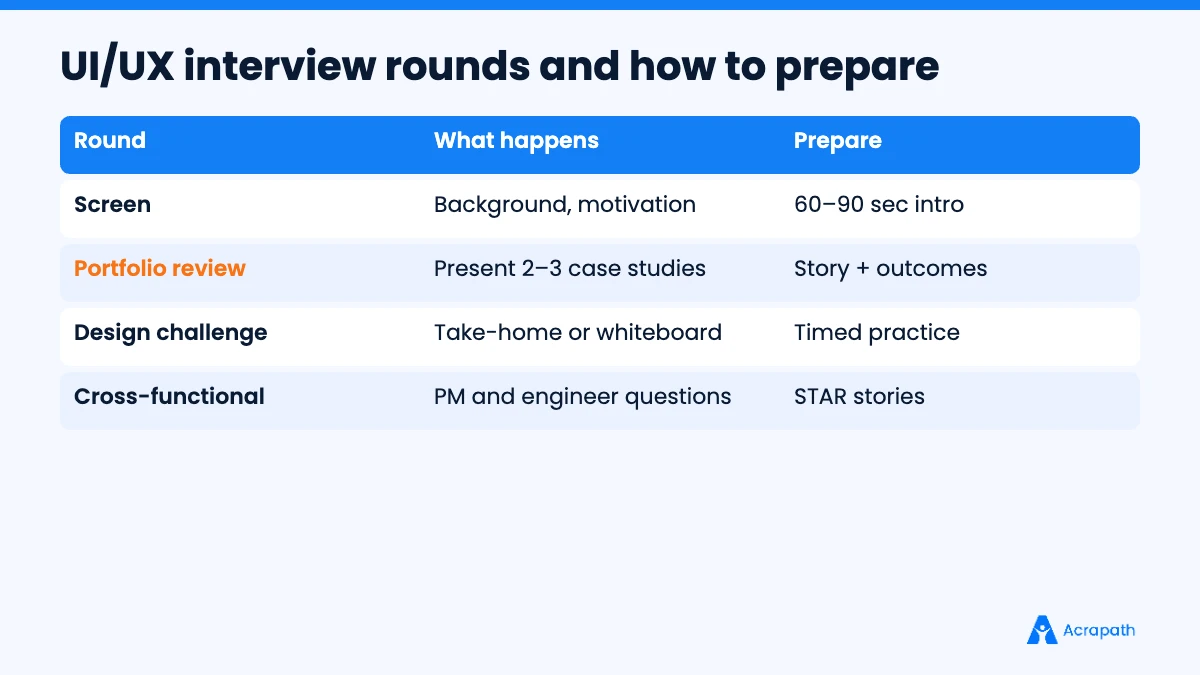
Round | What happens | How to prepare |
|---|---|---|
Recruiter screen | Background, motivation, salary, availability | A clear 60–90 second introduction |
Portfolio review | You present 2–3 case studies | Story-led case studies with outcomes |
Design challenge | Take-home or live whiteboard exercise | Practise a process under time limits |
Cross-functional interview | PM and engineer ask about collaboration | STAR stories about teamwork and conflict |
Culture or leadership round | Values, growth, working style | Honest examples and good questions |
Your introduction opens almost every round, so prepare it using our guide on how to answer "tell me about yourself".
Design Process Questions
1. Walk me through your design process.
Why they ask: To see whether you follow a structured, user-centred approach.
Sample answer: "I start by understanding the problem and the business goal, usually by talking to stakeholders and looking at data. Then I research users through interviews, support tickets or analytics. I map the journey, sketch several options, test low-fidelity versions quickly, and move to high fidelity once the direction is clear. After launch, I look at metrics and feedback to decide what to improve. I adjust the depth of each step to the project's time and risk."
2. How do you start a project when the brief is vague?
Why they ask: Real briefs are often unclear.
Sample answer: "I ask questions before I design: who the users are, what problem we're solving, how we'll measure success and what constraints exist. I write a one-page problem statement and get the PM and stakeholders to agree on it. That stops us designing the wrong thing."
3. What is the difference between UI and UX?
Why they ask: To check your fundamentals.
Sample answer: "UX is about how the whole experience works: whether users can achieve their goal easily, from structure and flows to content. UI is the visual and interactive layer: layout, typography, colour, components and states. Good products need both. Great UI on a confusing flow still fails."
4. How do you prioritise what to design first?
Why they ask: To test product thinking.
Sample answer: "I look at user impact and business value against effort. Problems that block many users from completing a key task come first. I agree priorities with the PM and engineering, because effort estimates often change the order."
Portfolio Questions
Your portfolio review is usually the most important round. Our UX design portfolio guide shows how to structure case studies so they're easy to present.
5. Walk me through one project in your portfolio.
Why they ask: To see how you think, not just what you made.
Sample answer: "Structure your answer as: context and goal, your role, research and insights, options you explored, the decision and why, the final design, and the outcome. Example: "Our checkout had a high drop-off on mobile. I ran five usability sessions and found users didn't trust the payment step. We redesigned it with clearer pricing and security cues, and drop-off fell noticeably in the next release.""
6. What would you do differently on that project?
Why they ask: To check self-awareness and growth.
Sample answer: "I'd involve developers earlier. We designed a custom date picker that took much longer to build than expected. Now I share early sketches with engineering to catch effort issues before I polish anything."
7. Which project are you proudest of, and why?
Why they ask: To see what you value as a designer.
Sample answer: "Pick a project where you made a measurable difference or overcame a real constraint, and explain why it mattered to users."
8. How did you measure the success of your design?
Why they ask: To test outcome thinking.
Sample answer: "We tracked task completion rate and time on task in usability tests before and after, and conversion in analytics after launch. We also watched support tickets on that flow. If I can't share exact numbers, I explain the metric and the direction of change."
User Research Questions
9. How do you conduct user research with a small budget?
Why they ask: Most teams have limited time and money.
Sample answer: "I use quick methods: five short user interviews, guerrilla testing with a clickable prototype, reviewing support tickets and sales call notes, and analytics. Even five users usually reveal the biggest usability problems."
10. How do you handle feedback that conflicts with research?
Why they ask: To see how you balance opinions and evidence.
Sample answer: "I listen first, because stakeholders often know constraints I don't. Then I share the research evidence clearly. If we still disagree, I suggest a quick test or an A/B experiment so data decides rather than seniority."
11. What is usability testing and how do you run it?
Why they ask: To check practical research skills.
Sample answer: "It's watching real users try to complete tasks with a design. I write realistic tasks, recruit five or so participants, ask them to think aloud, avoid leading questions, and note where they struggle. Then I group issues by severity and fix the biggest ones first."
Visual and Interaction Design Questions
12. How do you approach accessibility?
Why they ask: Accessibility is a must, not a nice-to-have.
Sample answer: "I check colour contrast, use text sizes that scale, make tap targets large enough, never rely on colour alone, write clear labels and design focus states for keyboard and screen-reader users. I follow WCAG guidelines and test with accessibility tools."
13. Have you worked with a design system?
Why they ask: Most product teams use one.
Sample answer: "Yes. I used our component library in Figma and contributed new components when patterns repeated. I document usage, states and spacing so developers build consistently, and I avoid one-off components unless there's a strong reason."
14. How do you design for both mobile and desktop?
Why they ask: To test responsive thinking.
Sample answer: "I usually start mobile-first because it forces me to prioritise content. Then I adapt layouts for larger screens using a grid, and check interactions like hover, which doesn't exist on touch screens."
15. Which tools do you use and why?
Why they ask: To see tool fluency, but also judgement.
Sample answer: "Figma for design, prototyping and handoff; FigJam or Miro for workshops; Maze or simple video calls for testing. Tools matter less than process, and I can pick up new ones quickly."
Collaboration and Behavioural Questions
16. Tell me about a time a developer said your design couldn't be built.
Why they ask: Designer–developer collaboration is critical.
Sample answer: "A developer told me an animation I'd designed would hurt performance on older phones. We sat together, agreed what the animation needed to communicate, and found a simpler version that still worked. Since then, I review motion and complex interactions with engineering early."
17. How do you handle a stakeholder who keeps changing requirements?
Why they ask: To test communication under pressure.
Sample answer: "I document decisions and the reasons behind them, show the impact of each change on timeline and scope, and ask the PM to help prioritise. Most changes calm down once the trade-offs are visible."
18. Why do you want to work here?
Why they ask: Motivation and research.
Sample answer: "Mention the product, its users and a specific design opportunity you noticed, then connect it to your experience."
How to Handle the Design Challenge
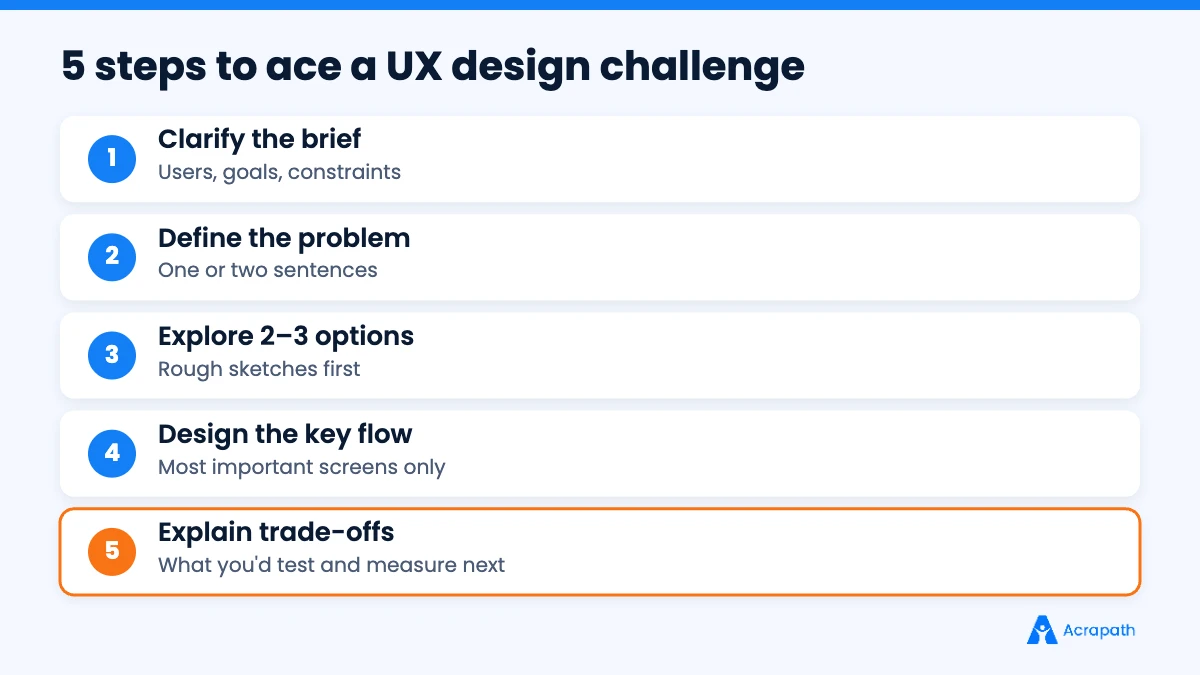
Many companies set a design challenge. Treat it as a chance to show your process, not just a final screen.
Clarify the brief. Ask about users, goals and constraints, even in a take-home (write your assumptions down).
Define the problem. Write one or two sentences about who you're designing for and what they need.
Explore options. Show two or three rough directions before choosing one.
Design the key flow. Focus on the most important screens, not every screen.
Explain trade-offs and next steps. What would you test? What would you measure?
For a live whiteboard round, talk through your thinking out loud. Silence makes it hard for interviewers to follow your process. For take-homes, respect the suggested time. Interviewers can tell when someone spent three days on a four-hour task, and it isn't always a positive signal.
Questions to Ask the Interviewer
"How do designers work with product and engineering here?"
"Do you have a design system, and who maintains it?"
"How often do designers talk to users?"
"How is design success measured?"
How to Prepare in One Week
Day 1–2: choose 2–3 portfolio projects and rehearse a 10–15 minute story for each.
Day 3: practise one timed whiteboard challenge, such as designing a parking app or a library booking flow.
Day 4: prepare STAR stories about conflict, feedback and a mistake.
Day 5: study the company's product and note two improvements you'd suggest.
Day 6–7: do a mock portfolio review with a friend and refine your answers.
Applying for visual or brand roles too? Review our graphic designer interview questions. After the final round, send a short thank-you email, and when an offer arrives, read how to negotiate salary. You can also see what hiring managers are told to look for in our employer guide on how to hire a UI/UX designer.
Conclusion
UI UX designer interview questions test your process, your reasoning and how you work with people, as much as your visual skills. Prepare a few strong case studies with clear outcomes, practise a design challenge under time pressure, and have honest stories about collaboration and mistakes ready.
Show interviewers how you think, and your portfolio will do the rest.
Ready for your next design role? See open design jobs on Acrapath and set alerts for UI/UX roles.
- #UI UX designer
- #interview questions
- #design interview
- #portfolio review
- #design jobs
Frequently asked questions
What are common UI UX designer interview questions?
Common questions include "Walk me through your design process", "Walk me through a portfolio project", "How do you conduct user research?", "How do you approach accessibility?", "How do you handle conflicting feedback?" and questions about working with developers. Expect a portfolio review and often a design challenge.
How should I present my portfolio in a design interview?
Choose two or three case studies and tell each as a story: context and goal, your role, research and insights, options explored, the decision and why, the final design and the outcome. Keep each to about 10–15 minutes and leave time for questions.
What is a whiteboard design challenge?
It is a live exercise, usually 45–60 minutes, where you design a solution to a short brief while explaining your thinking. Interviewers look at how you clarify the problem, explore options and make trade-offs, not at polished visuals.
How can a fresher prepare for a UI UX interview?
Build two or three solid case studies from college projects, internships or self-initiated redesigns, focusing on research and reasoning. Practise presenting them, do timed design challenges, learn accessibility basics and be ready to explain why you made each decision.
How long should a UX take-home assignment take?
Most companies suggest around 3–6 hours. Respect the stated time, document your assumptions, focus on the key flow rather than every screen, and explain what you would test or improve next. Ask the recruiter if the brief or timeline is unclear.