How to Find a Job Fast: A 30-Day Job Search Plan

Jatin Kashyap
Growth Lead, Acrapath
Want to find a job fast? Follow this 30-day job search plan with weekly steps, a daily routine, tracking tips and tactics that get you interviews sooner.
Key Takeaways
To find a job fast, treat the search like a project: a clear target role, a tailored resume and a daily routine for 30 days.
Week 1 is setup: target roles, resume, LinkedIn and job alerts. Weeks 2–4 are applying, networking and interviewing.
Aim for 5–10 tailored applications a week plus 3–5 networking messages, rather than 100 generic applications.
Referrals and direct messages to hiring managers usually move faster than cold applications alone.
Track every application in one sheet and follow up after 5–7 working days.
Job searching can drag on for months when it has no structure. You apply to whatever appears, wait, refresh your inbox and wonder why nothing is happening.
If you need to find a job fast, the answer isn't applying to more jobs. It's applying to the right ones, with a better resume, through better channels, every single day. A focused 30-day plan does exactly that.
Below is a week-by-week plan you can start today, with daily targets, a tracking template and tips to speed up each stage.
Why Most Job Searches Take Too Long
No clear target: applying to every role makes your resume generic.
One resume for everything: it fails keyword screens and doesn't speak to any one hiring manager.
Only cold applications: no referrals, no outreach, no follow-ups.
Weak interview preparation: interviews arrive, but offers don't.
No tracking: you can't see what's working.
The 30-day plan fixes each of these in order.
The 30-Day Job Search Plan
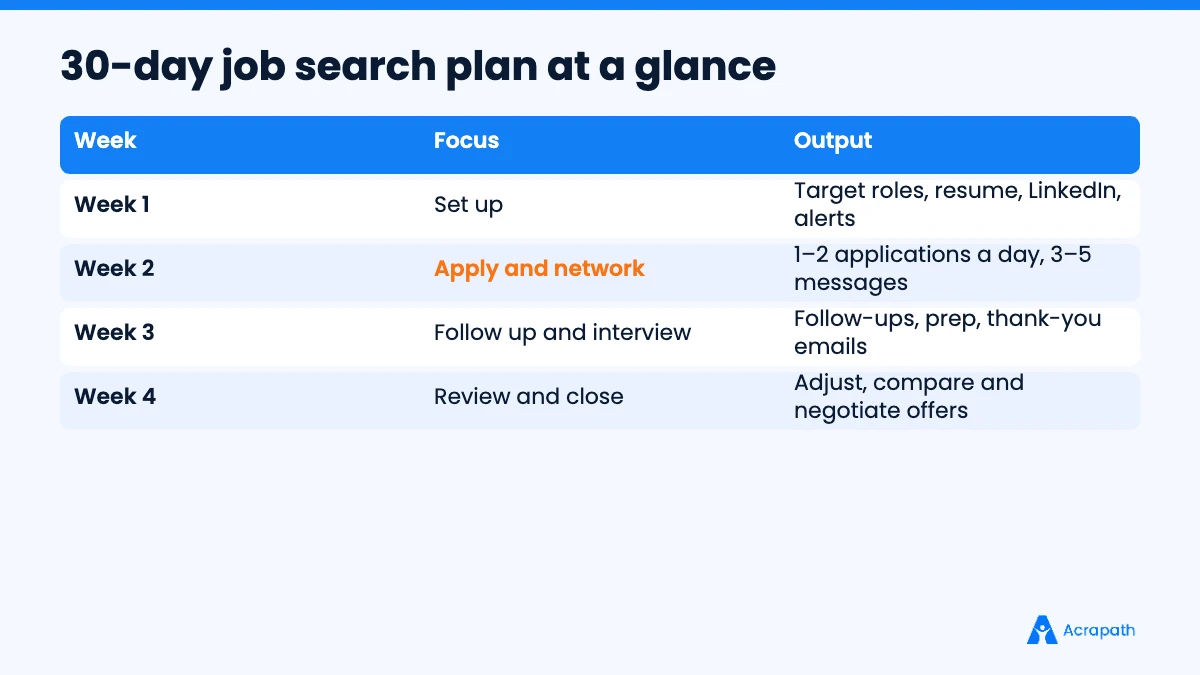
Week 1 (Days 1–7): Set up for speed
Pick 1–2 target roles. For example, "junior data analyst" and "MIS executive". Write down the industries and cities you're open to.
Collect 10 job descriptions for those roles and highlight the skills that repeat. These are your keywords.
Rewrite your resume around those skills and your best results. Follow our complete resume guide. If you're a fresher, use the resume with no experience format.
Update LinkedIn: headline with your target role, an "About" section, skills and a professional photo. Turn on "open to work" for recruiters.
Set up job alerts on two or three job portals for your exact roles and locations.
Build your tracker: a sheet with company, role, date applied, channel, contact, status and follow-up date.
Prepare your introduction using our guide on answering "tell me about yourself".
Week 2 (Days 8–14): Apply and network
Send 1–2 tailored applications a day. Adjust your resume summary and top bullets for each one.
Message 3–5 people a week in your target companies or roles: alumni, former colleagues, friends of friends. Ask for advice or a referral, not just a job.
Apply within the first few days of a job being posted when you can. Early applications are more likely to be seen.
Spend 20 minutes a day practising common interview questions.
Week 3 (Days 15–21): Follow up and interview
Follow up on applications older than 5–7 working days with a short, polite email or LinkedIn message.
Prepare for each interview: research the company, prepare two STAR stories with numbers and three questions to ask.
Send a thank-you email after each interview within 24 hours.
Keep applying. Don't pause your search because one interview went well.
Week 4 (Days 22–30): Review, adjust and close
Check your tracker. Which channels got responses? Which resume version worked? Do more of that.
If you have applications but no interviews, your resume needs work. If you have interviews but no offers, focus on interview practice.
Handle offers well: compare in-hand pay, ask questions and, if needed, use our guide on how to negotiate salary.
If you're currently employed, check your notice period so you can give an honest joining date.
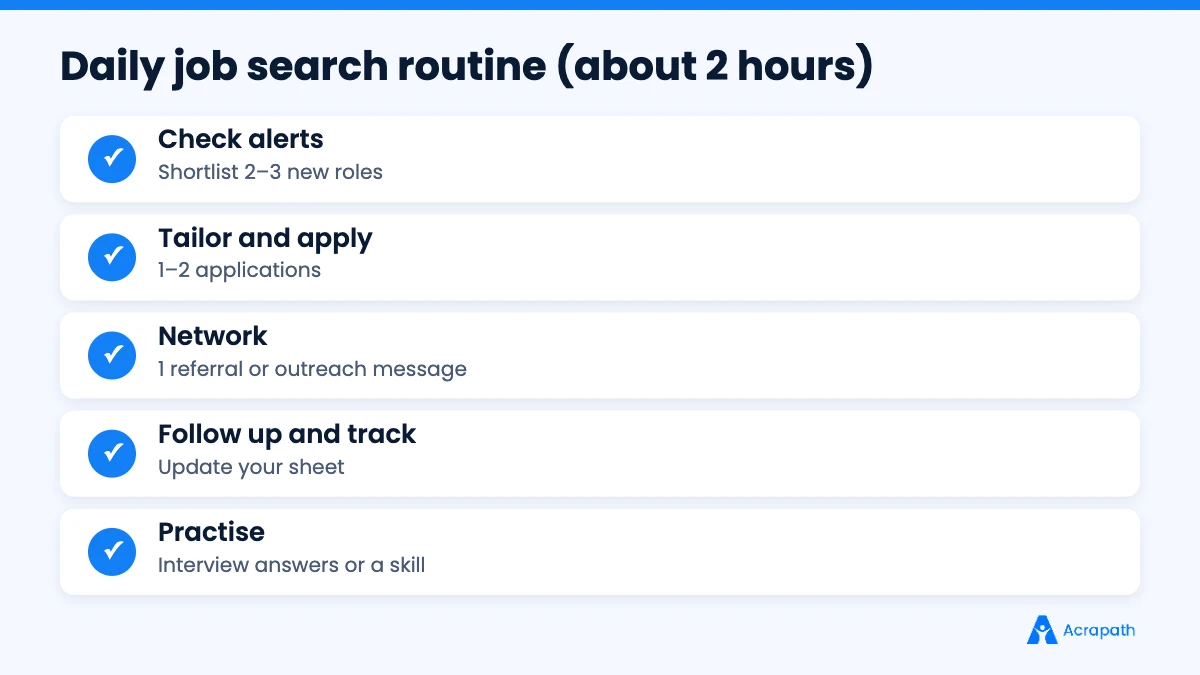
Your Daily Job Search Routine
Time | Task |
|---|---|
20 minutes | Check alerts and shortlist 2–3 new roles |
45 minutes | Tailor and send 1–2 applications |
20 minutes | Send 1 networking or referral message |
15 minutes | Follow-ups and tracker updates |
20 minutes | Interview practice or skill-building |
That's about two hours a day, which is manageable alongside a job or studies.
Tactics That Speed Things Up
Referrals: a referral puts your application in front of a person, not just a system.
Message the hiring manager: a two-line note after you apply can get your CV read.
Be flexible where you can: nearby cities, hybrid roles or contract-to-hire positions can open doors faster.
Show proof: a portfolio, GitHub, campaign results or sample work makes shortlisting easy.
Prepare for role-specific rounds: for example, our sales interview questions or financial analyst interview questions.
Common Mistakes That Slow You Down
Applying to roles where you match less than half the requirements.
Sending the same resume and cover note to every company.
Waiting for replies instead of applying in parallel.
Ignoring red flags in "too good to be true" offers that ask for fees.
Skipping follow-ups because they feel awkward.
Conclusion
To find a job fast, narrow your target, fix your resume and LinkedIn in week one, then apply, network and follow up every day for the next three weeks. Track everything, adjust based on results and prepare properly for every interview.
Thirty focused days beat three unfocused months.
Start today: browse jobs on Acrapath and set alerts for your target roles.
- #job search
- #find a job fast
- #job search plan
- #freshers
- #career tips
Frequently asked questions
How can I find a job fast?
Pick one or two target roles, tailor your resume to their job descriptions, update LinkedIn and set job alerts. Then send one or two tailored applications a day, ask for referrals, follow up after 5–7 working days and prepare well for every interview. Track results and adjust weekly.
How many jobs should I apply to per week?
Aim for around 5–10 tailored applications a week, plus 3–5 networking or referral messages. Fewer, well-targeted applications usually get more interviews than dozens of generic ones, because your resume matches each role more closely.
How long does a job search usually take?
It varies widely by role, level, location and market conditions. A structured search with tailored applications, referrals and follow-ups often produces interviews within the first few weeks. Senior and specialist roles usually take longer than entry-level ones.
Why am I not getting interview calls?
The most common reasons are applying to roles that don't match your skills, a generic resume that misses keywords, applying late to postings and relying only on cold applications. Tailor your resume, apply early, add referrals and follow up to improve response rates.
Should I follow up after applying for a job?
Yes. If you haven't heard back in 5–7 working days, send a short, polite message to the recruiter or hiring manager restating your interest and one reason you fit. One or two follow-ups are fine. Avoid sending repeated messages.