How to Run a Structured Interview (With a Scorecard Template)

Jatin Kashyap
Growth Lead, Acrapath

Learn how to run a structured interview in 6 steps, with question types, scoring anchors, sample questions by competency and a copy-ready interview scorecard template.
Key Takeaways
A structured interview asks every candidate for a role the same job-related questions, in the same order, and scores answers against a pre-agreed rating scale.
It is one of the most reliable ways to compare candidates fairly and reduce "gut feel" bias.
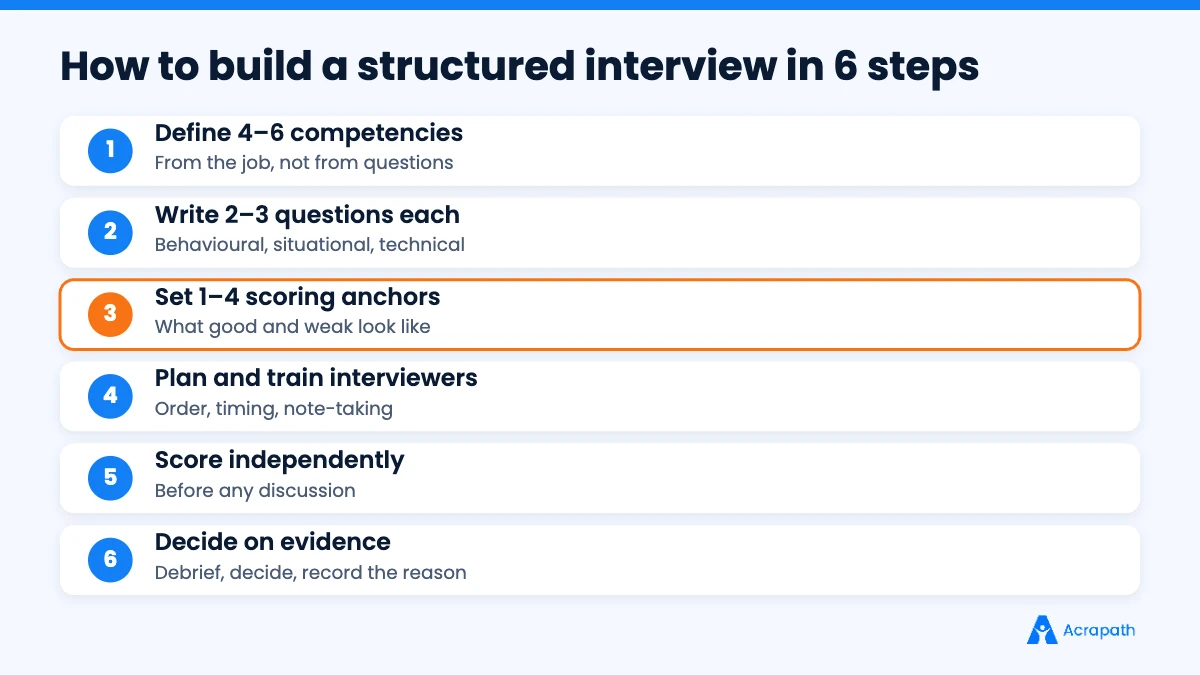
Build one in 6 steps: define 4–6 competencies, write 2–3 questions per competency, define what 1–4 answers look like, train interviewers, score independently, then decide together.
Use a scorecard: each interviewer rates every competency before seeing anyone else's scores.
Keep 5–10 minutes at the end for candidate questions. Structure doesn't mean robotic.
Two interviewers meet the same candidate. One says "brilliant, hire". The other says "not convinced". When you ask why, the answers are "great energy" and "something felt off". Neither tells you whether the person can do the job.
That's what happens with unstructured interviews. Every interviewer asks different questions, remembers different moments and judges on different criteria. A structured interview fixes this by making interviews consistent, job-related and scored the same way for everyone.
This guide explains what structured interviews are, why they work, how to build one step by step, and gives you a scorecard template you can copy today.
What Is a Structured Interview?
A structured interview is an interview format where every candidate for a role is asked the same set of job-related questions, in a consistent order, and their answers are rated against a predefined scoring guide. Interviewers know in advance what a strong, average and weak answer looks like, so decisions are based on evidence rather than impressions.
The US Office of Personnel Management's guidance on structured interviews describes the same core elements: questions based on a job analysis, consistent administration and a rating scale with clear benchmarks.
Unstructured interview | Structured interview | |
|---|---|---|
Questions | Different for each candidate | Same for every candidate |
Basis | Interviewer's preferences | Job competencies |
Scoring | Overall impression | Rating scale per competency |
Comparison | Hard and subjective | Side by side on the same criteria |
Bias risk | High | Lower |
Why Structured Interviews Work
Better prediction: research on hiring methods has consistently found that structured interviews predict job performance better than unstructured ones.
Fairer comparisons: every candidate gets the same chance to show the same skills.
Less bias: scoring against criteria reduces the pull of first impressions, similarity and halo effects.
Better candidate experience: candidates see a professional, organised process.
Easier defence of decisions: you can explain why someone was or wasn't selected.
Faster debriefs: panels compare scores and evidence instead of arguing about feelings.
Types of Structured Interview Questions
Behavioural questions
These ask about past behaviour, because how someone handled a situation before is a good guide to how they'll handle it again. They usually start with "Tell me about a time when…" and are best answered with the STAR method: situation, task, action, result.
Example: "Tell me about a time you had to deliver a project with an unrealistic deadline. What did you do?"
Situational questions
These present a realistic scenario from the job and ask what the candidate would do. They're useful for freshers with less experience to draw on.
Example: "A customer emails you angrily about a delayed order, and you don't yet know the cause. How do you respond?"
Technical or job-knowledge questions
These check specific knowledge the job needs, such as accounting entries, SQL, design principles or safety rules.
Example: "How would you reconcile a bank statement that doesn't match the ledger?"
A good structured interview usually mixes all three, mapped to the competencies the job needs.
How to Build a Structured Interview (Step-by-Step)
Step 1: Define 4–6 competencies
Start with the job, not with questions. Ask the hiring manager and a top performer what separates great from average in this role. Turn that into four to six competencies, such as problem solving, communication, ownership, customer focus and one or two technical skills.
Step 2: Write 2–3 questions per competency
For each competency, write behavioural or situational questions that make candidates show it. Avoid hypothetical questions with obvious "right" answers, and avoid anything unrelated to the job, especially personal questions about family, religion, age or health. Our list of interview questions to ask candidates is a good starting bank.
Step 3: Define what good looks like
This is the step most teams skip, and it's the one that makes structure work. For each question, write short examples of a 1, 2, 3 and 4 answer. These are called behavioural anchors.
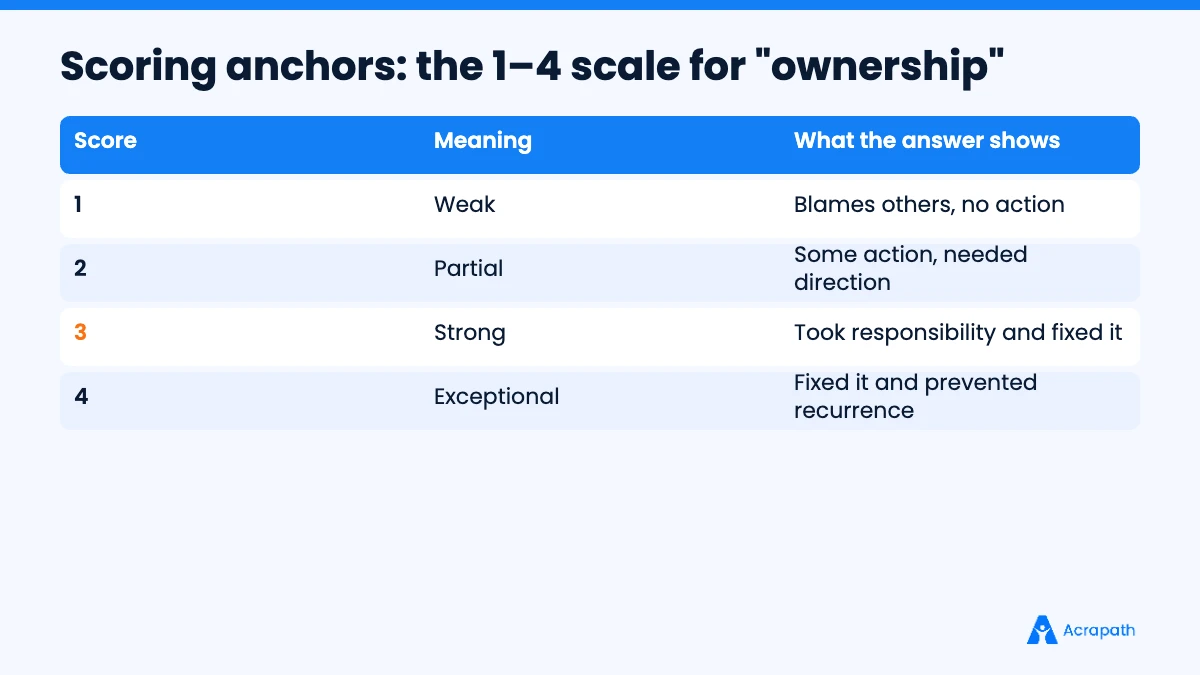
Score | Meaning | Example for "ownership" |
|---|---|---|
1 | Weak | Blames others, no clear action taken |
2 | Partial | Took some action but needed heavy direction |
3 | Strong | Took responsibility, acted and fixed the issue |
4 | Exceptional | Fixed it and changed the process so it didn't recur |
Step 4: Plan the interview and train interviewers
Decide who asks which questions, the order and the timing. A 45-minute interview might be 5 minutes of introduction, 30 minutes of questions, 5 minutes of candidate questions and 5 minutes buffer. Brief interviewers on the anchors and on note-taking: record what the candidate said, not what you think of them.
Step 5: Run the interview and score independently
Ask each question as written. You can use neutral follow-up prompts such as "What did you do next?" or "What was the result?", but don't lead the candidate. Score each competency right after the interview, before talking to other interviewers.
Step 6: Decide together using the evidence
In the debrief, each interviewer shares their scores and evidence. Discuss big gaps between scores, then make a decision based on the overall picture and any must-have competencies. Write down the reason for the decision.
Structured Interview Scorecard Template
Copy this into a document or spreadsheet and complete one per interviewer per candidate.
Candidate: [Name] · Role: [Role] · Interviewer: [Name] · Date: [Date]
Scale: 1 = weak · 2 = partial · 3 = strong · 4 = exceptional
Competency 1: [e.g. Problem solving]
Question: [Question text]
Evidence (what the candidate said and did): __________
Score: __ / 4Competency 2: [e.g. Communication]
Question: [Question text]
Evidence: __________
Score: __ / 4Competency 3: [e.g. Ownership]
Question: [Question text]
Evidence: __________
Score: __ / 4Competency 4: [e.g. Technical skill]
Question: [Question text]
Evidence: __________
Score: __ / 4Must-have met? Yes / No · Total: __ / 16
Recommendation: Strong hire / Hire / No hire / Strong no hire
Summary (2–3 lines of evidence): __________
Keep scorecards with your hiring records so you can review which scores actually predicted performance after six months.
Sample Structured Interview Questions by Competency
Problem solving: "Tell me about a complex problem you solved recently. How did you approach it?"
Communication: "Describe a time you had to explain something technical to someone without that background."
Ownership: "Tell me about a mistake you made at work. What happened next?"
Teamwork: "Describe a disagreement with a colleague and how you resolved it."
Customer focus: "Tell me about a time you went beyond the usual process to help a customer."
Prioritisation: "You have three urgent tasks due today and can only finish two. What do you do?"
Learning: "Tell me about a skill you had to learn quickly for a job. How did you do it?"
Common Mistakes to Avoid
Structure on paper only. Writing questions but letting interviewers improvise defeats the purpose.
No scoring anchors. Without examples of good and bad answers, a "3" means different things to different people.
Group scoring. Discussing before scoring lets the loudest voice win.
Too many competencies. More than six makes interviews rushed and shallow.
Robotic delivery. Be warm. Explain the format at the start so candidates know what to expect.
Illegal or irrelevant questions. Stick to the job. Personal questions about family plans, religion, age or health create legal and ethical risk.
Where Structured Interviews Fit in Your Hiring Process
Structured interviews work best as part of a consistent process: a clear job description, fair CV screening, a skills test or work sample where relevant, then structured interviews and references. Our guides on screening resumes and skills-based hiring cover the earlier stages, and our guide on hiring a React Native developer shows the full process in action for a technical role.
Want to see it from the other side? Our jobseeker guide to HR interview questions and answers shows how candidates prepare for behavioural questions.
Conclusion
A structured interview turns hiring from a conversation into a fair, evidence-based assessment. Define the competencies the job needs, write consistent questions, agree what good answers look like, score independently and decide together using the evidence.
Start with your next role: pick four competencies, copy the scorecard and run every interview the same way. You'll make better hires and spend far less time debating gut feelings.
Want help running a structured hiring process end to end? Acrapath's hiring desk can manage shortlisting and interviews for you.
- #structured interview
- #interview scorecard
- #competency based interview
- #hiring process
- #recruitment
Frequently asked questions
What is a structured interview?
A structured interview asks every candidate for a role the same job-related questions in a consistent order and scores their answers against a predefined rating scale. Interviewers know in advance what strong and weak answers look like, so decisions rest on evidence rather than impressions.
What are the advantages of a structured interview?
Structured interviews predict job performance better than unstructured ones, make comparisons between candidates fairer, reduce bias from first impressions, give candidates a more professional experience and make hiring decisions easier to explain and review later.
What is an interview scorecard?
An interview scorecard is a form each interviewer fills in for each candidate. It lists the competencies being assessed, the question for each, space for evidence, a score on a fixed scale and an overall recommendation. It keeps evaluation consistent and evidence-based.
How many questions should a structured interview have?
Most structured interviews cover four to six competencies with one to three questions each, which usually fits into 30–45 minutes of questioning. Fewer, deeper questions with follow-up prompts work better than many rushed ones.
Can I ask follow-up questions in a structured interview?
Yes. Neutral probing prompts such as "What did you do next?" or "What was the result?" are fine and help candidates give complete answers. Avoid leading follow-ups that hint at the right answer, and use similar prompts for every candidate.