
Copy this graphic designer job description template with responsibilities, skills by level, tools and portfolio tips, plus how to customise it for your brand in 10 minutes.
Key Takeaways
A clear graphic designer job description names the type of design work (brand, social, print, packaging, presentations or motion), the tools used and who the designer will work with.
List 7–9 responsibilities tied to real outputs, such as social creatives per week, campaign assets or brand guidelines.
Ask for a portfolio, not a degree. A strong portfolio is the best evidence of design skill.
Most roles fall into 3 levels: junior (0–2 years), mid-level (2–5 years) and senior or lead (5+ years).
Copy the template below and customise it in about 10 minutes.
Good design shows up everywhere in a business: your social posts, website, ads, product packaging, pitch decks and even your job posts. When it's done well, people trust your brand faster. When it isn't, everything looks a little less credible.
Yet many companies write graphic designer job posts that list ten software tools and say nothing about the actual work. The result is a flood of applications that don't match what you need.
A sharp graphic designer job description tells candidates exactly what they'll design, for whom, with which tools and how their work will be judged. Below you'll find a copy-ready template, guidance by seniority, the skills to look for and the mistakes to avoid.
What Does a Graphic Designer Do?
A graphic designer creates visual content that communicates a message: logos, social media graphics, ads, brochures, packaging, presentations, website visuals and more. They turn briefs into designs, apply brand guidelines consistently, work with marketing and product teams, and prepare files for print or digital use.
The role varies by company, so be specific about which type you need:
Design focus | Typical outputs | Key tools |
|---|---|---|
Social and digital marketing | Social posts, ads, banners, email graphics | Photoshop, Illustrator, Figma, Canva |
Brand design | Logos, brand guidelines, stationery | Illustrator, InDesign |
Print and packaging | Brochures, packaging, signage | InDesign, Illustrator, print specs |
Presentation and content | Pitch decks, reports, infographics | PowerPoint, Keynote, Figma |
Motion graphics | Animated ads, video graphics, reels | After Effects, Premiere Pro |
If you need someone to design app screens or website flows, you're probably hiring a UI/UX designer instead. Our guide to hiring a UI/UX designer explains the difference.
Graphic Designer Job Description Template
Copy this into your job post and replace the square brackets. It follows the structure in our guide on how to write a job description.
Job title: Graphic Designer [Junior / Senior / Social Media / Brand]
Location: [City / Hybrid / Remote with time zone]
Employment type: [Full-time / Part-time / Contract]
Reports to: [Marketing Manager / Creative Lead / Founder]
About us: [Two or three sentences on your company, your audience and your brand personality.]
About the role: We're looking for a Graphic Designer to create [social media, campaign, brand and print] designs that help [audience] understand and trust [brand]. You'll turn briefs into polished visuals, keep our brand consistent across every channel and work closely with [marketing, content and product] teams. A typical week includes [e.g. 10–15 social creatives, ad variations and one larger campaign or deck].
What you'll do:
Design social media posts, ads, banners and email graphics to brief and on time
Create campaign assets across [digital and print] formats
Apply and help evolve our brand guidelines, including colours, typography and layouts
Design presentations, reports and infographics that make complex information clear
Prepare print-ready and web-ready files in the right formats and sizes
Work with copywriters and marketers to turn ideas into visual concepts
Present design options, explain your choices and act on feedback
Keep our design files and asset library organised
[Create simple motion graphics or short video edits]
What you'll bring:
A portfolio showing [social, brand, print or campaign] work
[1–3 / 3–5 / 5+] years of graphic design experience
Strong skills in [Adobe Photoshop, Illustrator, InDesign / Figma]
A good eye for typography, layout, colour and hierarchy
The ability to manage several briefs and meet deadlines
Nice to have:
Motion design skills in [After Effects]
Experience in [your industry]
Basic understanding of marketing metrics such as click-through rate
What we offer:
Salary: [range]
[Benefits, learning budget, design tool subscriptions]
[Work setup, equipment]
Creative ownership of [brand, channel or campaign]
How to apply: [Steps and timeline. For example: "Share your CV and portfolio link. Shortlisted designers complete a short paid design task and a portfolio review."]
Responsibilities to Include (and Why)
Describe outputs, not just tools. "Design 10–15 social creatives a week" tells a designer far more than "proficient in Photoshop". It shows the pace, the type of work and what a normal week feels like.
A few details make a big difference to applicants:
Volume and pace: how many creatives or projects a week.
Channels: social, ads, print, packaging, presentations or motion.
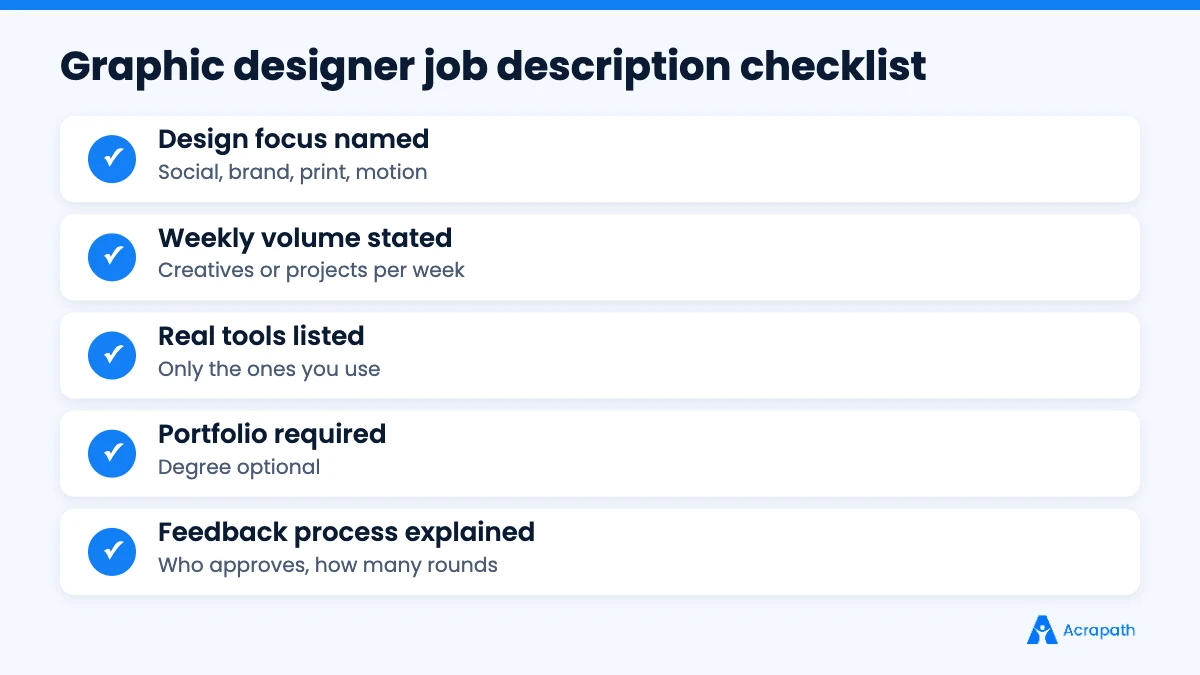
Collaboration: who writes the copy, who approves designs and how feedback works.
Brand maturity: whether guidelines already exist or the designer will help build them.
Skills and Experience by Level
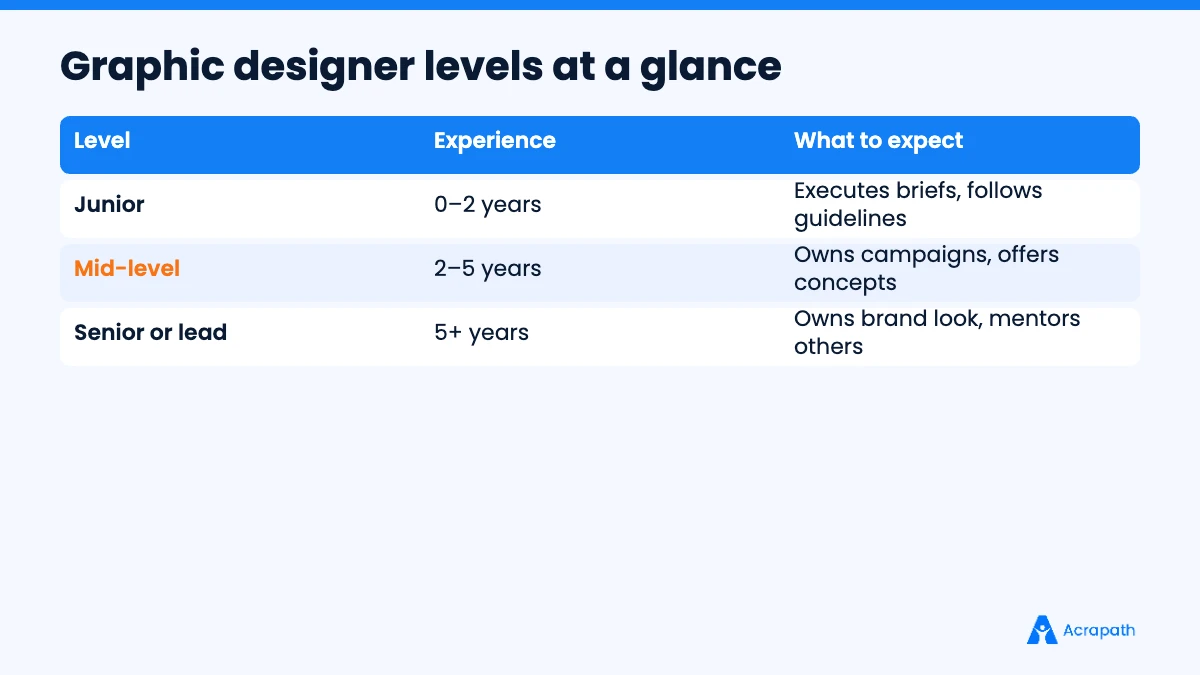
Level | Typical experience | What to expect |
|---|---|---|
Junior designer | 0–2 years | Executes briefs well, follows brand guidelines, learning speed and polish |
Mid-level designer | 2–5 years | Handles campaigns end to end, gives concept options, needs light direction |
Senior or lead designer | 5+ years | Owns brand look and feel, mentors others, works directly with leadership |
Look beyond tools at these core skills:
Visual fundamentals: typography, layout, colour, hierarchy and spacing.
Concept thinking: turning a brief into a clear idea, not just a nice-looking image.
Brand consistency: applying guidelines without making everything look the same.
Communication: explaining design choices and taking feedback well.
Speed and organisation: delivering on time and managing files properly.
A degree in design can help, but many excellent designers are self-taught. Judge the portfolio first. Our guide to skills-based hiring explains how to hire on ability rather than credentials.
How to Customise the Template
Name the design focus. Social, brand, print, packaging, presentations or motion.
Show the volume. A rough number of creatives or projects per week.
Name the tools you actually use. Not every tool you've ever heard of.
Describe your brand. Link to your website or social pages so designers can see your style.
Be clear about the task. Keep it short and paid if it's substantial.
Add pay and benefits. Designers compare offers closely.
Common Mistakes to Avoid
The tool dump. Listing 15 programmes says nothing about the job.
Unicorn roles. Asking one person to be an expert in branding, UI, illustration, video and 3D attracts generalists who can't go deep.
Requiring a degree over a portfolio. You'll miss strong self-taught designers.
Long unpaid "tests" that look like real client work. Good designers will decline.
No information about feedback. Designers want to know how many approval layers there are.
After You Post: Reviewing Portfolios and Candidates
Shortlist on portfolio quality and relevance first. Look for work similar to what you need, clear thinking behind each project and consistent polish. Then ask finalists to walk you through two projects: the brief, their process, the options they explored and the result.
A short paid design task can help, as our overview of pre-employment assessments explains. Score portfolio reviews and tasks with a consistent rubric, as in a structured interview. See how one agency built its team on skills rather than credentials in our creative agency hiring case study.
Want to understand what designers prepare for? Our jobseeker guide to graphic designer interview questions shows the questions candidates expect. If you're also hiring marketing roles, our digital marketing manager job description uses the same format.
Conclusion
A strong graphic designer job description names the type of design work, the weekly volume, the tools you use and how designs are reviewed. Copy the template, add your brand context and pay range, and ask for a portfolio rather than a degree.
You'll attract designers whose work already looks like what you need.
Need design talent fast? Hire verified design professionals through Acrapath.
- #graphic designer job description
- #design hiring
- #JD template
- #portfolio review
- #creative hiring
Frequently asked questions
What should a graphic designer job description include?
Include a company and brand intro, the type of design work, typical weekly volume, 7–9 responsibilities tied to outputs, the tools you actually use, required experience, a portfolio requirement, pay and benefits, how feedback and approvals work and the hiring steps, including any paid design task.
Should a graphic designer have a degree?
Not necessarily. A design degree can help, but many strong graphic designers are self-taught or trained through short courses. A portfolio showing relevant, polished work and clear thinking is the best evidence of skill. Make a degree preferred rather than required for most roles.
What skills should a graphic designer have?
Key skills include typography, layout, colour and visual hierarchy, concept development, brand consistency, proficiency in tools such as Photoshop, Illustrator, InDesign or Figma, clear communication about design choices, handling feedback and managing several briefs to deadline.
What is the difference between a graphic designer and a UI/UX designer?
A graphic designer creates visual communication such as social posts, ads, branding, print and presentations. A UI/UX designer designs digital products, focusing on how apps and websites work and feel, including user research, flows, wireframes and interface design. The skills overlap but the focus differs.
Should I give graphic designers a design test?
A short, relevant task can help, especially to compare finalists. Keep it brief, base it on a realistic but not live brief, and pay for anything substantial. Many companies combine a portfolio walkthrough with a small task rather than relying on a test alone.