How to Hire Freshers: Campus and Off-Campus Hiring Guide

Jatin Kashyap
Growth Lead, Acrapath
A complete guide to hiring freshers: campus vs off-campus hiring, fresher-friendly job posts, sourcing, assessing at scale, reducing offer reneges and onboarding graduates.
Key Takeaways
To hire freshers well, plan headcount and training capacity first, then choose between campus hiring, off-campus hiring or a mix.
Write fresher-friendly job descriptions that list skills and potential, not years of experience.
Assess at scale with a short online test, then use a work sample, group exercise or structured interview to choose.
Make offers quickly and stay in touch until joining day. Engagement between offer and joining is the best defence against offer reneges.
Plan a 30–90 day onboarding and training programme. Freshers become productive faster with structure, a buddy and real work early.
Freshers bring energy, fresh ideas and a willingness to learn your way of working. For growing companies, they're also one of the most cost-effective ways to build a strong team. Many of today's best managers started as someone's graduate hire.
But hiring freshers is different from hiring experienced professionals. There's no track record to check, applications come in by the hundreds and the best graduates often get several offers at once. Without a plan, you end up with long screening days, offers that are declined at the last minute and new joiners who struggle without training.
This guide shows you how to hire freshers step by step, through campus and off-campus routes: how to plan, write the job post, source and assess candidates at scale, reduce dropouts, and onboard graduates so they become productive quickly.
Why Hire Freshers?
Fresher hiring is not just about saving money. Done well, it builds a pipeline of loyal, well-trained talent.
Build talent your way. Freshers learn your processes and culture without unlearning old habits.
Grow future leaders. A strong graduate intake today becomes your team leads in three to five years.
Bring new skills. Recent graduates often know the latest tools, platforms and techniques.
Hire at scale. Fresher programmes let you fill several similar roles at once.
Control costs. Entry-level salaries are lower, and well-trained freshers often stay longer.
Strengthen your employer brand. Good graduate programmes build a reputation on campus that brings better applicants every year.
The trade-off is time. Freshers need training, supervision and patience in the first few months. Hire them when you can genuinely support them.
Which Roles Suit Fresher Hiring?
Freshers work best in roles where skills can be taught and supervised, and where there's a clear path to grow. Common examples include:
Software developers, QA engineers and data analysts
Sales, inside sales and customer success executives
Operations, supply chain and MIS executives
Marketing, content and social media executives
Accounts and finance executives
HR and recruitment coordinators
Management trainees and graduate analyst programmes
Roles that need deep specialist judgement from day one, such as senior engineering, legal counsel or critical-care nursing, usually need experienced hires.
Campus Hiring vs Off-Campus Hiring
There are two main routes to hiring freshers. Most growing companies use both.
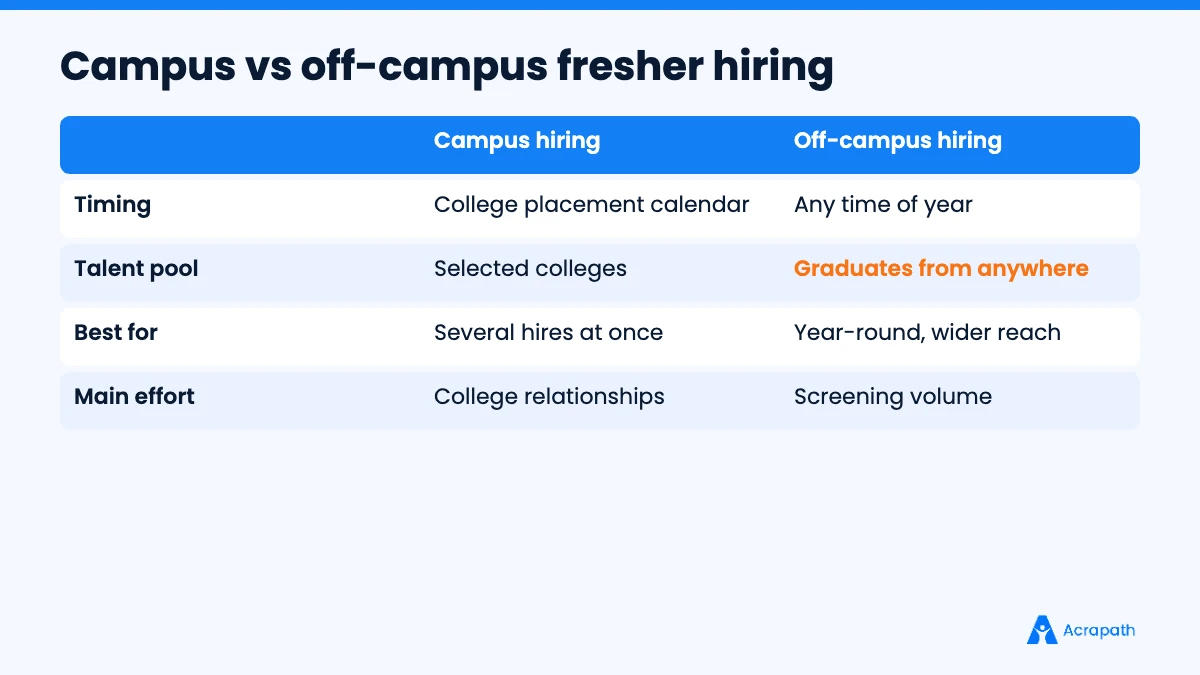
Campus hiring | Off-campus hiring | |
|---|---|---|
How it works | You recruit through a college's placement cell, often on campus | You advertise openly and graduates apply directly |
Best for | Hiring several freshers at once from known colleges | Year-round hiring and wider talent pools |
Timing | Follows each college's placement calendar | Any time of year |
Talent pool | Students from selected colleges | Graduates from any college or background |
Effort | Relationship-building, travel or virtual drives | Screening larger volumes of applications |
Competition | Strong employers compete on the same day | Less direct competition, but more applicant variety |
Campus hiring gives you access to a concentrated pool of graduates and builds long-term relationships with colleges. Off-campus hiring widens your reach to talented graduates from colleges you don't visit, including career switchers and self-taught candidates. Read how one consulting firm used campus hiring for analysts in our campus analyst hiring case study, and how a fresher landed a developer job without campus placement in our off-campus case study.
How to Hire Freshers (Step-by-Step)
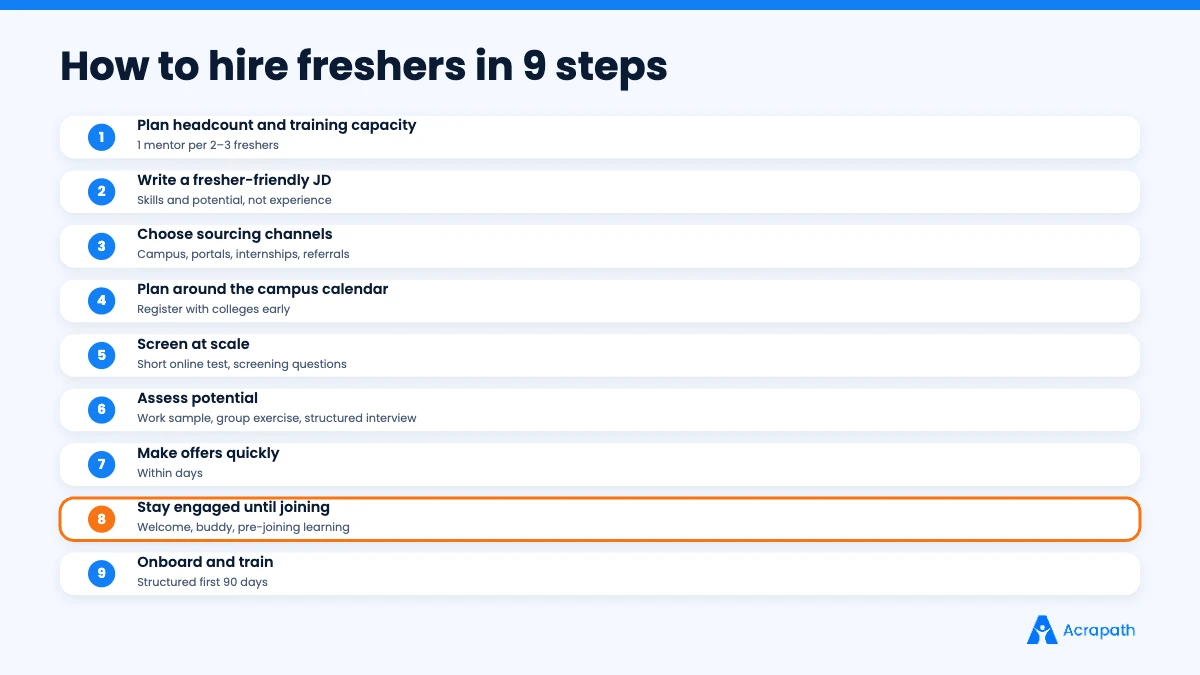
Step 1: Plan headcount and training capacity
Decide how many freshers you need, in which roles and by when. Then check how many you can realistically train. A useful rule is to have at least one experienced team member available to mentor every two or three freshers in their first months.
Also decide your timeline. If you plan to hire from campuses, you'll need to register with colleges well before their placement season begins.
Step 2: Write a fresher-friendly job description
Freshers can't show years of experience, so don't ask for it. Describe the role, the training you offer and the skills or potential you're looking for. Our guide on how to write a job description explains the structure. For fresher roles, include:
What they'll learn in the first three to six months
Skills that matter, such as communication, problem-solving, basic Excel or a programming language
Eligible degrees and graduation years, kept as broad as the role allows
Training and support: induction, mentors and certifications
Salary, location and joining timeline
Any service agreement, stated clearly upfront if you use one
Avoid unnecessary filters such as very high mark cut-offs or a short list of "top" colleges. They narrow your pool without predicting performance well. Our guide to skills-based hiring explains why.
Step 3: Choose your sourcing channels
Combine several channels to reach both campus and off-campus talent:
College placement cells: build relationships with a manageable number of colleges and come back each year.
Job portals: post fresher roles and search candidate databases by skill.
Internships: convert strong interns into full-time hires through pre-placement offers (PPOs).
Hackathons, competitions and case challenges: find talent by watching people solve problems.
Referrals: your recent fresher hires know talented classmates.
Social media and communities: student clubs, coding communities and LinkedIn.
Training institutes and bootcamps: graduates with practical, job-ready skills.
Our list of places to find candidates covers each channel in more detail.
Step 4: Plan around the campus calendar
Colleges run placement seasons on their own schedules, and many strong students accept offers early. Contact placement cells well in advance, share your job descriptions and salary details on time, and confirm drive dates, eligibility rules and the college's policies on multiple offers. For off-campus hiring, align your drives with graduation months, when many students actively look for roles.
Step 5: Screen at scale, fairly
Fresher roles can attract hundreds of applications. Use a simple, consistent first filter rather than reading every resume in detail:
A short online test covering aptitude, communication and core role skills
Two or three screening questions in the application form
A quick resume check for must-have requirements only
Our resume screening process helps keep shortlisting consistent when volumes are high.
Step 6: Assess potential with the right mix
Freshers have little work history, so assess what predicts success: learning ability, core skills, communication and attitude. Use two or three of these:
Aptitude and core skills test for reasoning and job basics
Work sample or short assignment, such as a coding task, a short case or a sample email
Group discussion or group exercise for communication and teamwork
Structured interview with the same questions for every candidate
Our guide to pre-employment assessments compares these methods, and our structured interview guide includes a scorecard.
Step 7: Make offers quickly
Strong graduates often have competing offers. Aim to share results and offers within days, not weeks. Keep the offer clear: salary breakdown, location, joining date, training period, probation and any service agreement.
Step 8: Stay engaged until joining day
The gap between offer and joining can be weeks or months, especially for campus hires. This is when many freshers accept other offers. Stay in touch:
Send a welcome email and a short joining guide
Invite them to a virtual meet-the-team session
Share pre-joining learning resources or a small online course
Assign a buddy who checks in once or twice before joining
Confirm the joining date and documents well in advance
Step 9: Onboard and train
A structured first 90 days turns freshers into productive team members:
Week 1: induction, tools, policies and meeting the team
Weeks 2–4: role training or bootcamp, with small real tasks
Months 2–3: gradually increasing responsibility with regular feedback from a mentor
Building Campus Relationships That Last
The companies that win the best graduates usually aren't the ones with the flashiest stalls on placement day. They're the ones colleges and students already know and trust. Building that takes a little effort all year round, not just during placement season.
Start small and stay consistent. Choose a manageable number of colleges whose courses match your roles, and return every year.
Know the placement officer. Share your hiring plans early, respect the college's rules and give clear feedback after each drive.
Show up outside placement season. Guest lectures, workshops, live projects, industry visits and judging student competitions help students see what your work is really like.
Involve your recent hires. Alumni who joined you are your most credible ambassadors on campus.
Close the loop. Tell colleges how their graduates are doing after joining. It strengthens the relationship for next year.
Running a Virtual Campus Drive
Virtual drives let you reach colleges in other cities and countries without travel, which is especially useful for smaller teams. A simple format works well:
Pre-placement talk (30–45 minutes): introduce your company, the roles, the training programme and pay. Leave time for student questions.
Online test (45–60 minutes): aptitude plus role basics, with clear instructions and a technical help contact.
Second-round exercise: a short case, coding task or virtual group discussion for shortlisted students.
Structured interviews by video: the same questions and scoring guide for every candidate.
Same-day or next-day results: share outcomes with the placement cell quickly.
Test your video platform and online test in advance, and keep a backup plan for students with poor connectivity, such as a rescheduled slot.
Designing a Fresher Training Programme
Training is what turns a promising graduate into a productive team member. It doesn't need to be elaborate, but it does need to be planned.
Period | Focus | Output |
|---|---|---|
Week 1 | Induction: company, culture, tools, policies | Accounts set up, buddy assigned |
Weeks 2–4 | Role bootcamp: core skills and processes | First small real tasks completed |
Months 2–3 | Supervised work on live projects | Regular feedback, growing ownership |
Months 4–6 | Increasing independence | Probation review against clear goals |
Assign each fresher a mentor and a buddy, and schedule short weekly check-ins for the first three months. Freshers who know what's expected, and get regular feedback, settle in faster and stay longer.
A Simple Annual Fresher Hiring Calendar
Several months before campus season: finalise headcount, budgets and job descriptions; contact placement cells.
During placement season: run drives, assess quickly and make offers within days.
After offers: run pre-joining engagement and confirm joining dates.
Around graduation: run off-campus drives for graduates who are still looking.
Through the year: run internships and live projects to build next year's pipeline.
Internships: Your Best Fresher Pipeline
Internships let you see candidates do real work before you commit to a full-time offer. Interns who perform well can be offered a pre-placement offer, and those who join already know your tools and team.
To make internships work as a hiring pipeline:
Give interns real projects with clear goals, not just support tasks
Assign each intern a mentor and hold a mid-point and final review
Decide early what a PPO-worthy performance looks like
Pay interns fairly; it widens your talent pool and builds your reputation
What to Look for in Fresher Candidates
Quality | What it looks like | How to test it |
|---|---|---|
Learning ability | Picks up new ideas quickly | Aptitude test, learning-based task |
Core skills | Basics of the role are in place | Skills test or work sample |
Communication | Explains ideas clearly, listens well | Group discussion, interview |
Ownership | Has taken responsibility for something | Questions about projects and activities |
Attitude and curiosity | Asks good questions, accepts feedback | Interview, response to task feedback |
Projects, internships, competitions, part-time work and student leadership are all valid evidence. Our jobseeker guide to a resume with no experience shows what strong fresher resumes contain, which helps you know what to look for.
Interview Questions to Ask Freshers
"Tell me about a project you're proud of. What was your role?"
"Describe a time you had to learn something new quickly."
"Tell me about a time you worked in a team that disagreed. What did you do?"
"What did you do when something you were responsible for went wrong?"
"Why are you interested in this role and our company?"
"Walk me through how you would approach [simple role-related problem]."
"What feedback have you received from a teacher or mentor, and what did you change?"
"What do you want to learn in your first year at work?"
For more, see our list of interview questions to ask candidates. Candidates prepare for these too: our interview preparation guide shows how they approach them.
Pay, Offers and Service Agreements
Benchmark fresher salaries against current job posts for similar roles, cities and company sizes. A clear, fair offer reduces renegotiation and reneging.
Some employers use service agreements or training bonds for freshers who receive expensive training. If you use one, explain it clearly before the offer, keep terms reasonable and take legal advice on enforceability in your country. This is general information, not legal advice. Many companies now prefer retention bonuses or career paths over bonds because they attract more candidates.
How to Reduce Offer Reneges and Early Attrition
Move fast: shorter processes leave less time for competing offers.
Be transparent: share real details about the role, pay, location and training.
Engage before joining: regular, friendly contact keeps candidates committed.
Keep joining dates realistic: long gaps increase dropouts.
Support new joiners: a buddy, regular feedback and visible learning keep freshers motivated.
Measuring the Success of Fresher Hiring
Track a few simple metrics each hiring season:
Offer acceptance rate: offers accepted ÷ offers made
Renege rate: accepted offers that didn't join
Time to productivity: how long until new hires work independently
Six- and twelve-month retention
Cost per hire across campus and off-campus channels; see our guide to cost per hire
Hiring manager satisfaction with the quality of hires
Compare results by college and channel to decide where to invest next season.
Common Mistakes When Hiring Freshers
Hiring more freshers than you can train. Without support, good hires leave.
Filtering by marks and college name alone. You miss talented candidates and reduce diversity.
Long, slow processes. Strong graduates accept faster offers elsewhere.
Vague offers. Unclear pay or hidden bonds lead to reneges and distrust.
No contact between offer and joining. Silence invites competing offers.
No structured onboarding. Freshers need training and feedback to succeed.
Conclusion
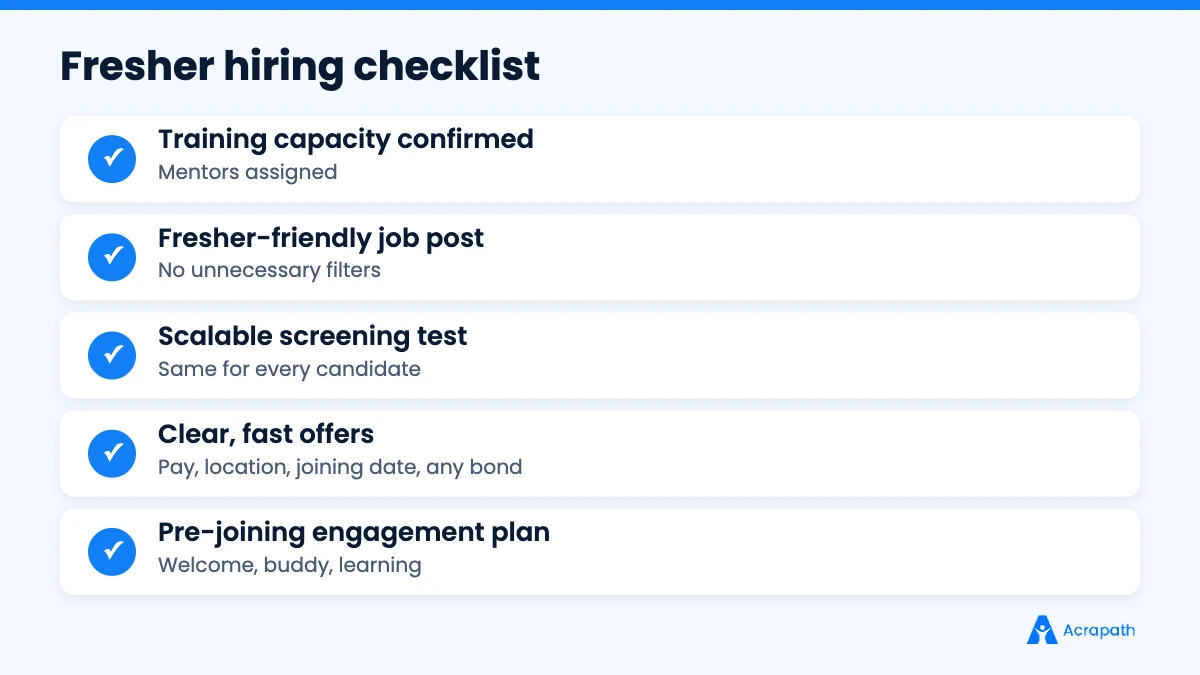
To hire freshers successfully, plan headcount around your ability to train, write job descriptions that focus on skills and potential, and use both campus and off-campus channels. Screen consistently at scale, assess with a short test plus a work sample or structured interview, make offers quickly and stay in touch until joining. Then invest in a structured first 90 days.
Do this every season and your fresher programme becomes one of your strongest sources of long-term talent.
Want to reach more graduates faster? Browse verified professionals and freshers by function on Acrapath and search candidates in Talbox.
- #hire freshers
- #campus hiring
- #off campus hiring
- #graduate recruitment
- #fresher training
Frequently asked questions
How do companies hire freshers?
Companies hire freshers through campus placement drives at colleges and through off-campus hiring via job portals, internships, referrals, hackathons and social media. Most use a short online test to screen at scale, then a work sample, group exercise or structured interview, followed by quick offers and structured onboarding.
What is the difference between campus and off-campus hiring?
Campus hiring happens through a college's placement cell, usually on the college's schedule and with its students. Off-campus hiring is open to graduates from any college and can run all year through job portals, referrals and other channels. Many employers use both to widen their talent pool.
How do you assess freshers with no experience?
Focus on what predicts success: learning ability, core skills, communication and attitude. Use an aptitude or skills test, a short work sample such as a coding task or case, a group exercise and a structured interview. Projects, internships and student leadership are valid evidence.
How can I reduce offer reneges from freshers?
Make offers quickly, keep terms clear and transparent, set realistic joining dates and stay in touch between offer and joining with welcome emails, team introductions, pre-joining learning and a buddy. Regular, friendly contact makes candidates far less likely to accept another offer.
Is it a good idea to use a training bond for freshers?
It depends. Bonds can protect expensive training investments, but they may put off strong candidates and enforceability varies by country. If you use one, explain it before the offer and take legal advice. Many employers prefer retention bonuses, clear growth paths and good training instead.