Interview Preparation: The Complete Guide From Research to Offer

Jatin Kashyap
Growth Lead, Acrapath
The complete guide to interview preparation: what each round tests, how to research, build STAR stories, answer common and technical questions, handle tough questions and follow up.
Key Takeaways
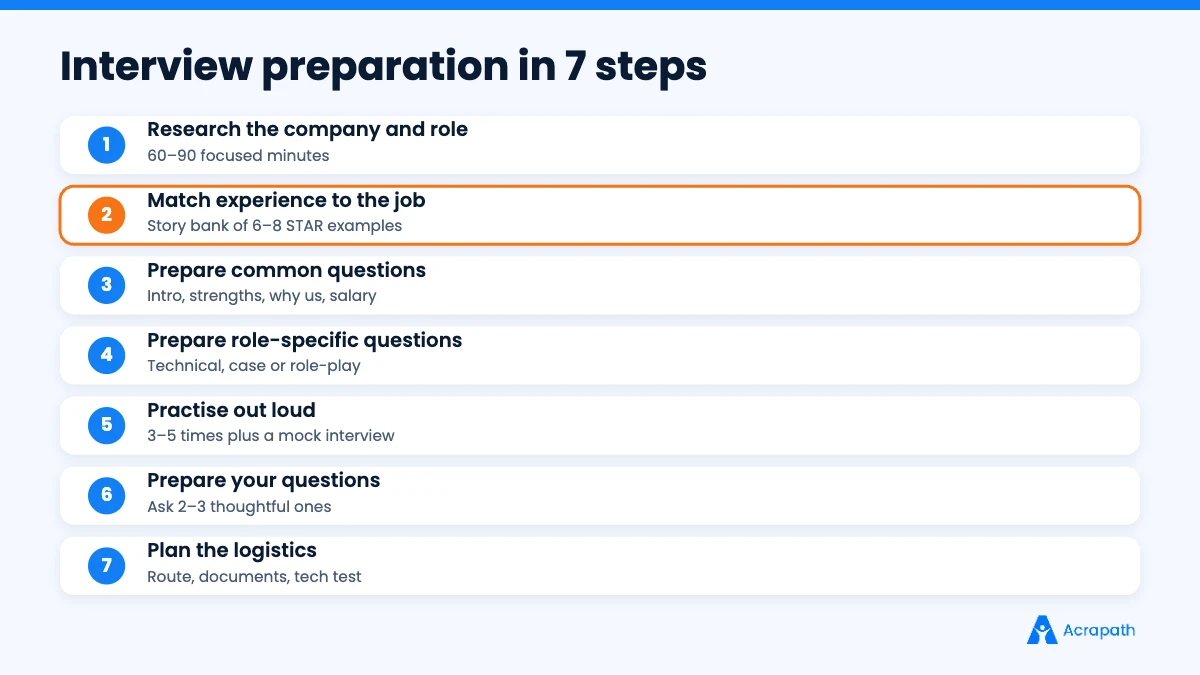
Good interview preparation follows 7 steps: research the company, match your experience to the job, prepare common questions, prepare role-specific questions, practise out loud, prepare your own questions and plan the logistics.
Build a "story bank" of 6–8 STAR examples with numbers. They answer most behavioural questions.
Keep answers to roughly 1–2 minutes, and your opening "tell me about yourself" to 60–90 seconds.
Practise out loud at least 3–5 times and do one mock interview. Reading answers silently is not enough.
Send a thank-you email within 24 hours and follow up after 5–7 working days if you haven't heard back.
An interview invitation is exciting for about ten minutes. Then the questions start. What will they ask? How much should I research? What if I freeze on a technical question? What do I say about salary?
The candidates who get offers aren't always the most experienced. They're usually the best prepared. They know the company, they've matched their experience to the job, they've practised their stories out loud, and they walk in with good questions of their own.
This complete guide to interview preparation takes you from the moment you get the call to the moment you get the offer. You'll learn what each interview round tests, how to research efficiently, how to build answers that stick, how to handle difficult questions, what to do on the day and how to follow up. Each section links to our detailed guides when you want to go deeper.
What Is Interview Preparation?
Interview preparation is the work you do before an interview to show an employer, clearly and confidently, why you're right for the job. It includes researching the company and role, matching your experience to what they need, preparing and practising answers, planning questions to ask and getting the practical details right, from your outfit to your internet connection.
Good preparation does two things. It improves your answers, and it reduces nerves, because you've already done the hard thinking before you walk in.
The Interview Process: Rounds to Expect
Most hiring processes have several stages. Knowing what each one tests helps you prepare the right way.
Round | What happens | What it tests | How to prepare |
|---|---|---|---|
Screening call | 15–30 minute call with a recruiter | Basic fit, availability, salary expectations | Your introduction, notice period, salary range |
HR round | Behavioural and motivation questions | Communication, attitude, culture fit | STAR stories, "why this company" |
Technical or functional round | Role-specific questions or tests | Skills and knowledge | Core concepts, practice problems |
Assignment or case | Take-home task, case study or role-play | Applied ability | Practise similar tasks, structure your approach |
Manager round | Deeper discussion with your future boss | Judgement, ownership, fit with the team | Examples of decisions and results |
Final round | Senior leader or founder conversation | Motivation, long-term fit | Big-picture answers, smart questions |
Not every company uses every round. Ask the recruiter what to expect. It's a normal question and shows you're organised.
What Interviewers Are Really Looking For
Behind every question, most interviewers are trying to answer five simple questions about you. Keep them in mind and your answers will stay focused.
What they want to know | How to show it |
|---|---|
Can you do the job? | Specific examples, numbers and technical answers |
Will you do the job well? | Ownership, reliability and results under pressure |
Will you fit with the team? | Collaboration stories and respectful tone |
Do you really want this job? | Research, enthusiasm and thoughtful questions |
Will you grow here? | Learning habits and realistic goals |
If an answer doesn't help with at least one of these, it's probably too long or off track.
Step 1: Research the Company and Role
Research shows interest and helps you tailor every answer. You don't need hours. Sixty to ninety focused minutes is enough for most interviews.
Research checklist:
What the company does: products or services, main customers and how it makes money.
Recent news: launches, funding, expansions, awards or leadership changes from the last 6–12 months.
Competitors: two or three similar companies, and what makes this one different.
Culture and values: the careers page, employee posts on LinkedIn and how the company describes itself.
The team: who you'll work with, and what the team is responsible for.
Your interviewers: if you have their names, glance at their LinkedIn profiles to understand their roles.
Decode the job description. Highlight every skill, tool and responsibility in the job post. Mark the ones repeated or listed first. These are the priorities, and your answers should prove you can deliver them.
Write a half-page research note with three things you admire about the company, three problems you could help solve and three questions you want answered. You'll use all of it in the interview.
Step 2: Match Your Experience to the Job
This is the step most candidates skip, and it's the one that makes the biggest difference. Take each priority from the job description and match it to evidence from your experience.
What the job needs | Your evidence | Result or number |
|---|---|---|
Example: Manage client relationships | Handled 25 key accounts at my current company | Renewal rate above team average |
Example: Data analysis in Excel | Built the weekly sales dashboard | Cut reporting time from 4 hours to 1 |
Example: Work under deadlines | Delivered quarterly close during an audit | Zero late filings |
Build a story bank with the STAR method
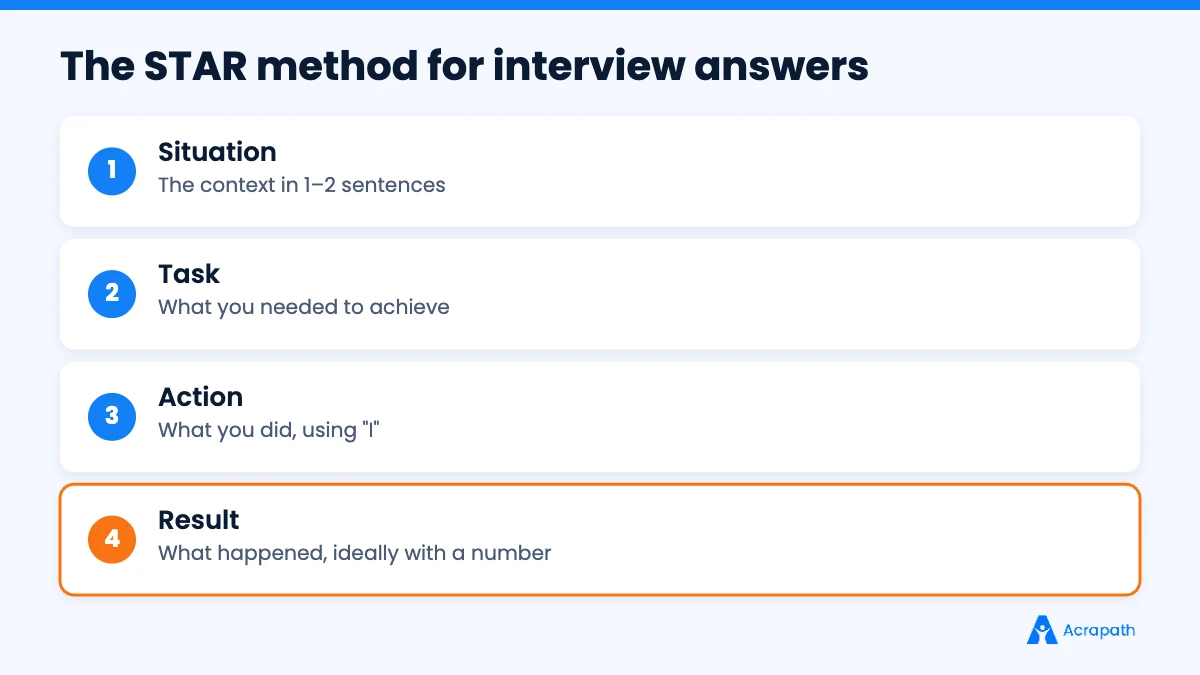
Most behavioural questions, such as "tell me about a time when...", can be answered with a short story in the STAR format:
Situation: the context, in one or two sentences.
Task: what you needed to achieve.
Action: what you did. Use "I", not just "we".
Result: what happened, ideally with a number.
Prepare 6–8 stories that cover common themes: a success you're proud of, a problem you solved, a conflict with a colleague, a mistake you learned from, a time you led others, a tight deadline, a time you went beyond your role and a time you handled change. One good story can often answer several different questions.
Step 3: Prepare for Common Interview Questions
Some questions appear in almost every interview. Prepare short, honest answers to each:
"Tell me about yourself." A 60–90 second career story: present, past, future. Our guide on how to answer "tell me about yourself" gives you a formula and sample answers.
"Why do you want to work here?" Use your research: one thing about the company, one about the role, one about your goals.
"Why are you leaving your current job?" Stay positive. Focus on what you're moving towards.
"What are your strengths?" Pick two relevant to the job, each with a short example.
"What is your greatest weakness?" Name a real but manageable weakness and what you're doing to improve it.
"Tell me about a challenge you faced." Use a STAR story with a clear result.
"Where do you see yourself in five years?" Show ambition that fits the path this role offers.
"Why should we hire you?" Summarise your top three matches to the job in 30–45 seconds.
"Tell me about a time you failed." Be honest, take ownership and show what you learned.
"How do you handle pressure or tight deadlines?" Give a specific example, not a general claim.
"Describe a conflict with a colleague." Show how you listened, found common ground and solved the problem.
"What are your salary expectations?" Give a researched range, ideally after understanding the role fully.
"What is your notice period?" Know your contract. Our guide to the notice period explains buyouts and early release.
"Do you have any questions for us?" Always say yes. See Step 6.
For a full list with sample answers, see our HR interview questions and answers.
Step 4: Prepare Role-Specific and Technical Questions
The technical or functional round is where many candidates are won or lost. Prepare for the questions your specific role is known for. Our role guides cover the most common ones:
If you're interviewing for | Read this guide |
|---|---|
Software or technical roles | |
Sales roles | |
Finance and analyst roles | |
Accounting roles | |
Design roles | UI/UX designer interview questions and graphic designer interview questions |
Marketing roles | |
Consulting roles | |
Nursing roles | |
Teaching roles | |
Legal roles |
General tips for technical rounds:
Revise the fundamentals listed in the job description, not everything you've ever studied.
Think out loud. Interviewers often care more about your approach than a perfect answer.
Ask clarifying questions before solving a problem.
If you don't know, say so, then explain how you'd find the answer.
Practise under time pressure if there's a test, assignment or live exercise.
Step 5: Practise Out Loud
Knowing an answer and saying it clearly are two different skills. Practise until your answers sound natural, not memorised.
Speak each key answer out loud 3–5 times. Time yourself. Most answers should take 1–2 minutes.
Record one practice session on your phone. Watch for filler words, speed, posture and eye contact.
Do a mock interview with a friend, mentor or colleague. Ask them to include one question you haven't prepared.
Memorise points, not scripts. Use three or four bullet points per answer so you can adapt naturally.
Practise your opening and closing. First and last impressions stay with interviewers.
If you get nervous, practise more, not less. Familiarity is the best cure for interview nerves.
Step 6: Prepare Your Questions for the Interviewer
At the end, interviewers almost always ask if you have questions. Saying "no" can look like a lack of interest. Prepare five and ask two or three:
"What would success look like in this role in the first six months?"
"What are the biggest challenges the team is facing right now?"
"How does the team measure performance?"
"What do you enjoy most about working here?"
"What does the onboarding process look like?"
"What are the next steps in the hiring process, and when can I expect to hear back?"
Avoid asking about salary, leave or perks in the first conversation unless the interviewer raises them. Those questions are better for the HR or offer stage.
Step 7: Plan the Logistics
Small practical problems can throw you off before you say a word. Sort them out the day before.
For in-person interviews:
Confirm the address, building, floor and contact person.
Plan to arrive 10–15 minutes early, allowing for traffic.
Carry printed copies of your resume, ID and any documents requested.
Choose clean, comfortable clothes that match the company's dress style, leaning slightly formal.
For video interviews:
Test your internet, camera, microphone and the meeting link in advance.
Choose a quiet room with a plain background and light on your face.
Close other apps and silence notifications.
Keep your resume and notes nearby, but don't read from them.
Look at the camera when you speak, not at your own video.
How to Calm Interview Nerves
Almost everyone feels nervous before an interview. A little adrenaline helps you stay sharp. Too much makes you rush. These habits help:
Prepare thoroughly. Most nerves come from uncertainty. The steps above remove much of it.
Arrive or log in early so you aren't stressed by the clock.
Breathe slowly for a minute before you start: in for four counts, out for six.
Reframe the interview as a conversation. You're also deciding whether this job is right for you.
Pause before answering. A two-second pause looks thoughtful, not unprepared.
Bring a glass of water or keep one nearby on video calls, so you can take a moment if needed.
Accept small mistakes. If you stumble, say "Let me rephrase that" and continue. Interviewers expect it.
After a few interviews, your nerves will drop naturally. Every interview is practice for the next one, whatever the result.
On the Day: How to Perform at Your Best
Start strong. Greet everyone politely, smile and thank them for their time.
Listen to the whole question. Pause for a second before answering. It's fine to take a moment.
Answer the question asked. Then stop. Long answers lose attention.
Use your stories. Match a STAR example to the question and finish with the result.
Be honest. If you don't know something, say so and explain how you'd learn it.
Show enthusiasm. Interest and energy matter, especially for freshers.
Watch your body language. Sit upright, keep your hands relaxed and maintain natural eye contact.
Close confidently. Thank them, restate your interest in one line and ask about next steps.
Interview Formats and How to Adapt
The same preparation works across formats, but each one needs a slightly different approach.
Phone interviews
Without body language, your voice does all the work. Stand or sit upright, smile while you speak and keep your notes in front of you. Pause briefly after each answer so the interviewer knows you've finished.
Video interviews
Treat a video call like an in-person meeting. Dress fully, look at the camera, and keep answers slightly shorter than you would face to face, because attention drops faster on screen. If the connection breaks, rejoin quickly and calmly pick up where you left off.
One-way recorded video interviews
Some employers send questions that you answer on camera without a live interviewer. You may get a short time to think and a fixed time to answer. Practise with a timer, keep each answer structured, and use any practice question the platform offers to check your lighting and sound.
Panel interviews
When several people interview you together, find out their roles in advance if possible. Answer the person who asked the question, but make eye contact with everyone. Each panellist may be listening for something different: skills, teamwork or leadership.
Group discussions
Common in campus hiring, a group discussion tests communication, reasoning and teamwork. Speak early but don't dominate, build on others' points, bring in facts or examples, and help the group reach a conclusion. Summarising the discussion at the end is a strong move if no one else does.
Assessment centres
Larger employers sometimes run a half-day or full-day assessment centre with several exercises, such as presentations, case studies, role-plays and interviews. Pace yourself, treat every exercise as fresh even if one went badly, and stay professional during breaks, since assessors often notice behaviour throughout the day.
Two Example STAR Answers
Here's what strong STAR answers sound like in practice.
Question: "Tell me about a time you solved a difficult problem."
Answer: "In my last role, our customer support team was taking almost three days to resolve billing complaints, and customers were cancelling (situation). I was asked to bring the time down without adding staff (task). I reviewed 100 recent tickets and found that most delays came from tickets being passed between two teams. I proposed a single owner for billing issues, wrote a short checklist and trained four colleagues (action). Within six weeks, average resolution time fell to just over one day, and billing-related cancellations dropped noticeably (result)."
Question: "Describe a time you worked under a tight deadline."
Answer: "During my final-year project, our team lost a member two weeks before submission (situation). We still had to deliver a working app and a report (task). I reorganised the remaining work into daily goals, took over the testing myself and set up a quick 15-minute check-in each evening (action). We submitted on time, and our project received one of the highest grades in our batch (result)."
Notice that both answers are specific, focus on what the candidate personally did and end with a clear outcome.
Interview Preparation for Experienced Professionals
If you have several years of experience, interviewers expect more than good answers. They want evidence of judgement, ownership and impact.
Lead with impact. Revenue, savings, growth, team size, quality improvements.
Show decisions, not just tasks. Explain trade-offs you made and why.
Prepare a leadership story, even if you haven't managed people formally: mentoring, leading a project or influencing a decision.
Know your market value before the salary conversation.
Prepare to discuss your notice period and joining date clearly and honestly.
Last-Minute Interview Preparation: A 24-Hour Plan
If you've only got a day, focus on what matters most:
Hour 1: read the job description and highlight the top five requirements.
Hour 2: scan the company website, recent news and the interviewer's LinkedIn profile.
Hours 3–4: write three STAR stories that match the top requirements, plus your 60–90 second introduction.
Hour 5: practise your introduction and stories out loud, with a timer.
Hour 6: revise the core technical topics for the role.
Evening: prepare three questions to ask, plan your route or test your tech, and get a good night's sleep.
Last-minute preparation won't make you an expert, but it will make you clear, relevant and confident, which is what most interviewers notice first.
How to Handle Difficult Questions
Some questions feel risky. Here's how to approach them calmly:
Employment gaps: be brief and honest, then focus on what you did to stay current. "I took a year off for family reasons. During that time I completed a data analytics course and freelanced on two small projects."
Why you're leaving: focus on growth, not grievances. "I've learned a lot, and I'm looking for a role with more ownership of client accounts."
Being fired or let go: state facts without blame and show what you learned.
Salary expectations: research the market, then give a range. If you're unsure, ask about the full role and benefits first. When the offer arrives, use our guide on how to negotiate salary.
Questions you can't answer: "I haven't worked with that directly, but here's how I'd approach it" is far better than guessing.
Inappropriate personal questions: you can politely steer back to your skills and experience.
Interview Preparation for Freshers
If this is your first job interview, you may worry that you have nothing to talk about. You do. You just need to frame it.
Use college projects, internships and part-time work as your STAR stories.
Highlight responsibilities: clubs, events, volunteering, competitions and team projects all show skills.
Know your resume inside out. Interviewers often pick any line and ask you to explain it.
Revise core subjects related to the role, especially for technical interviews.
Show learning speed and attitude. Employers hiring freshers are betting on potential.
Our guide to a resume with no experience shows how to present these experiences, and the same examples become strong interview answers. If you're changing fields rather than starting out, see how to switch careers for how to explain your move.
After the Interview: Follow Up and Next Steps
Send a thank-you email within 24 hours
A short email thanking the interviewer, mentioning one thing you discussed and restating your interest keeps you top of mind. Use one of our thank-you email templates.
Follow up if you don't hear back
If the timeline passes or you hear nothing after 5–7 working days, send a polite follow-up asking about next steps. One or two follow-ups are fine.
Reflect and improve
Note the questions you were asked, what went well and what you'd answer differently. This list makes every future interview easier.
Handle the outcome well
If you're rejected, thank them and ask for brief feedback. Many people are reconsidered for future roles. If you get an offer, read it carefully, compare in-hand pay, negotiate if appropriate and confirm your joining date around your notice period.
Interview Preparation Checklist
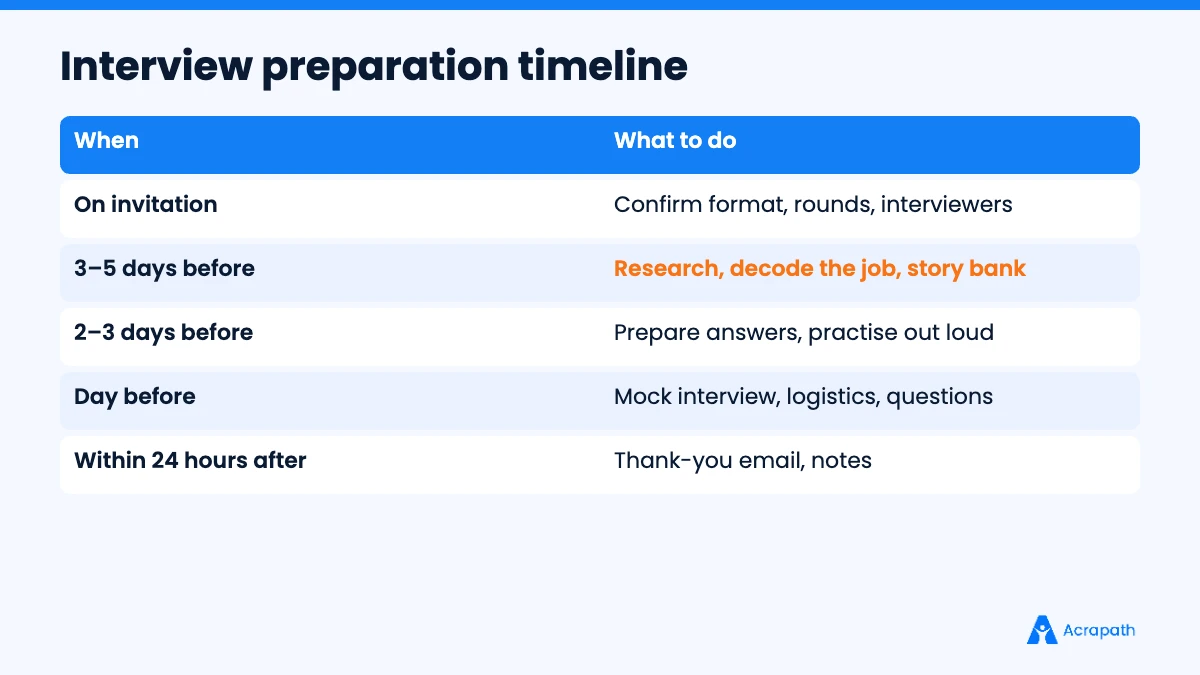
When | What to do |
|---|---|
As soon as you're invited | Confirm date, time, format, rounds and interviewer names |
3–5 days before | Research the company, decode the job description, build your story bank |
2–3 days before | Prepare common and role-specific answers, practise out loud |
The day before | Mock interview, plan logistics, test tech, prepare questions to ask |
On the day | Arrive or log in early, stay calm, listen, use your stories, close strong |
Within 24 hours after | Send a thank-you email and note what you learned |
Common Interview Preparation Mistakes
Researching the company but not the role. Your answers must match the job's priorities.
Memorising scripts. You'll sound robotic and struggle with follow-up questions.
No numbers. "I improved sales" is weak; "I grew renewals by 15%" is memorable.
Ignoring the technical round. Behavioural answers can't make up for weak fundamentals.
Not preparing questions. It can look like a lack of interest.
Badmouthing past employers. It raises red flags immediately.
Skipping the follow-up. A thank-you email is easy and many candidates forget it.
Conclusion
Strong interview preparation turns a nervous conversation into a confident one. Research the company and decode the job, match your experience with a story bank of STAR examples, prepare common and role-specific questions, practise out loud, plan good questions of your own and get the logistics right. Then follow up within 24 hours.
Most candidates prepare a little. If you prepare properly, you'll stand out before you've finished your first answer.
Before you start, make sure your resume matches your stories with our complete resume guide, and keep your search moving with our 30-day job search plan. Ready to get more interviews? Browse jobs on Acrapath and set up alerts for your target roles.
- #interview preparation
- #interview tips
- #interview questions
- #job interview
- #freshers
Frequently asked questions
How do I prepare for an interview?
Research the company and role, match your experience to the job description, build 6–8 STAR stories with numbers, prepare answers to common and role-specific questions, practise out loud, prepare questions to ask and plan the logistics. Then send a thank-you email within 24 hours.
How long should I prepare for an interview?
For most interviews, plan about four to eight hours spread over a few days: one to two hours of research, two to three hours building and practising answers, and time for a mock interview and logistics. Technical or case interviews usually need more practice time.
What are the most common interview questions?
Common questions include "Tell me about yourself", "Why do you want to work here?", "Why are you leaving?", "What are your strengths and weaknesses?", "Tell me about a challenge you faced", "Why should we hire you?" and "Do you have any questions for us?"
What is the STAR method in interviews?
STAR stands for Situation, Task, Action and Result. It is a simple structure for answering behavioural questions: briefly describe the context, explain what you needed to achieve, focus on the actions you personally took and finish with the outcome, ideally including a number.
What should I do after an interview?
Send a short thank-you email within 24 hours that mentions something you discussed and restates your interest. Note the questions you were asked for future practice. If you hear nothing after the promised timeline or 5–7 working days, send one polite follow-up.