Resignation Letter Format: 8 Samples for Every Situation

Jatin Kashyap
Growth Lead, Acrapath
Get the right resignation letter format with what to include, what to leave out and 8 copy-ready samples, including short, immediate, probation and early-release letters.
Key Takeaways
A good resignation letter format has 6 parts: date, addressee, a clear statement that you're resigning, your last working day, a short thank-you and an offer to help with handover.
Keep it to 3–4 short paragraphs. A resignation letter is a formal record, not the place for complaints.
Check your notice period in your contract before you write, and state your last working day based on it.
Send it by email to your manager (and HR if your company requires), then follow up with a conversation.
Use the 8 copy-ready samples below for standard, short, immediate, probation, higher-studies, personal-reasons and early-release situations.
You've made the decision, maybe even accepted a new offer. Now comes the part that feels surprisingly awkward: putting it in writing. What do you say? How formal should it be? Do you need to give a reason?
A resignation letter is simpler than it looks. Its job is to confirm, clearly and politely, that you're leaving and when. Get the format right and you leave on good terms, protect your relieving letter and final settlement, and keep a positive reference for the future.
Below you'll find the standard resignation letter format, what to include and avoid, and eight samples you can copy for different situations.
What Is a Resignation Letter?
A resignation letter is a formal written notice that you are leaving your job. It states your intention to resign, your last working day and, usually, a brief thank-you. Most employers need it in writing to start the exit process: handover, clearance, full and final settlement and your relieving or experience letter.
Today, most resignation letters are sent by email. Some companies also ask you to submit it through an HR system or sign a printed copy. Check your company's policy.
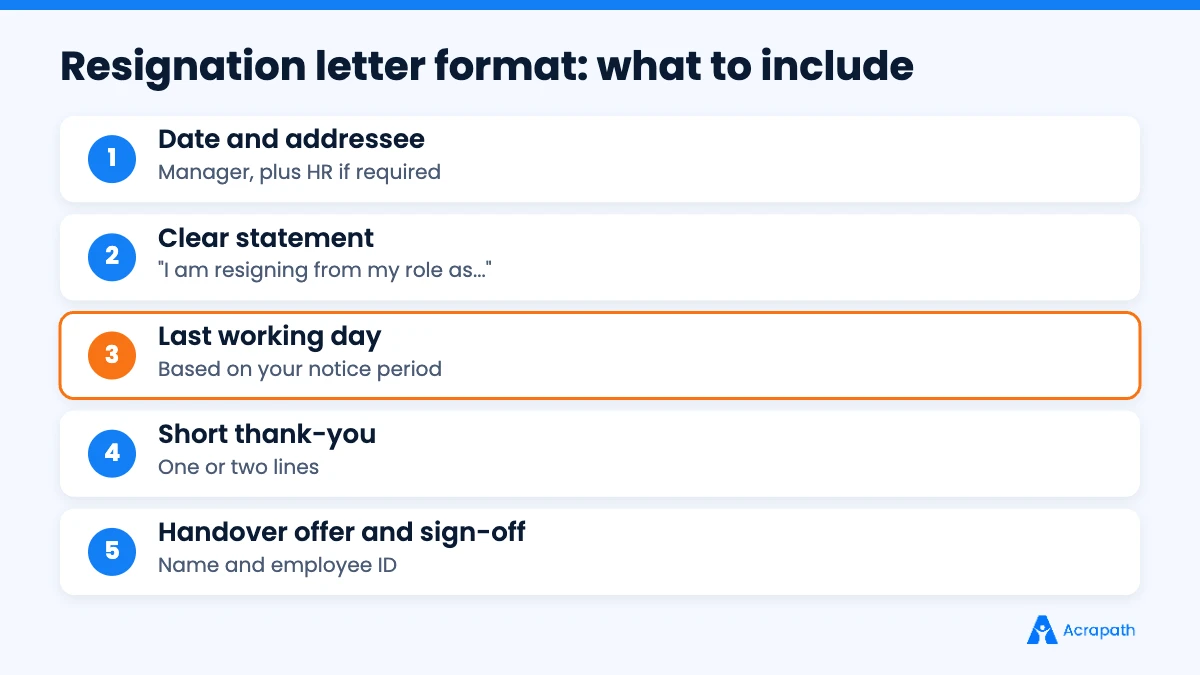
Resignation Letter Format: What to Include
Date: the day you submit the letter. Your notice period usually starts from here.
Addressee: your reporting manager, and HR if your company requires it.
Subject line (for email): "Resignation – [Your Name]".
Statement of resignation: one clear sentence, such as "I am writing to formally resign from my position as [Job Title]."
Last working day: calculated from your notice period, or a requested date if you're asking for early release.
Thank-you: one or two lines appreciating the opportunity.
Handover offer: a commitment to help with a smooth transition.
Sign-off: your name, and employee ID if your company uses one.
Before you calculate your last day, read our guide to the notice period. It explains how notice works, how buyouts are calculated and how to ask for early release.
What to Leave Out
Complaints and criticism. Raise genuine issues in an exit interview or with HR, not in a permanent letter.
Long explanations. You don't have to give a detailed reason.
Details of your new job or salary. Keep these private until you've left.
Emotional language. Stay polite, brief and professional, even if you're leaving for difficult reasons.
8 Resignation Letter Samples
Copy the sample that fits your situation and replace everything in square brackets.
Sample 1: Standard formal resignation letter
Subject: Resignation – [Your Name]
Dear [Manager's Name],
Please accept this letter as formal notice of my resignation from the position of [Job Title] at [Company Name], effective today, [Date]. In line with my [30/60/90]-day notice period, my last working day will be [Last Working Day].
I'm grateful for the opportunities I've had here, especially [one specific project, skill or experience]. Working with you and the team has helped me grow professionally.
I'll do everything I can to ensure a smooth handover before I leave, including documenting my ongoing work and training [colleague or replacement].
Thank you again for your support.
Sincerely,
[Your Name]
[Employee ID]
Sample 2: Short and simple resignation email
Subject: Resignation – [Your Name]
Hi [Manager's Name],
I'm writing to let you know that I'm resigning from my role as [Job Title]. My last working day will be [Last Working Day], in line with my notice period.
Thank you for everything over the past [time period]. I'll make sure my work is handed over properly.
Best regards,
[Your Name]
Sample 3: Resignation letter requesting early release or notice buyout
Subject: Resignation and Request for Early Release – [Your Name]
Dear [Manager's Name],
Please accept this as formal notice of my resignation from my position as [Job Title], effective [Date]. My contractual notice period is [number] days, which would make my last working day [Contractual Last Day].
I'd like to request an early release, with a last working day of [Requested Date]. I'm happy to complete a full handover before then, including [specific tasks], and I'm open to adjusting my leave balance or a notice period buyout as per company policy.
I appreciate everything I've learned here and want to make this transition as smooth as possible for the team.
Kind regards,
[Your Name]
Sample 4: Immediate resignation letter
Subject: Immediate Resignation – [Your Name]
Dear [Manager's Name],
I'm writing to inform you that I must resign from my position as [Job Title], effective immediately, due to [brief reason, e.g. unforeseen personal circumstances].
I understand this is short notice and I apologise for the inconvenience. I'm willing to settle any notice period obligations as per my contract and company policy, and I'll share a handover note covering my current work by [date].
Thank you for your understanding and for the opportunities I've had here.
Sincerely,
[Your Name]
Leaving without serving notice can affect your final settlement and relieving letter, so use this only when you genuinely have no alternative, and settle notice obligations properly.
Sample 5: Resignation letter for higher studies
Subject: Resignation – [Your Name]
Dear [Manager's Name],
I am writing to formally resign from my role as [Job Title], as I will be pursuing [course name] at [institution] starting [month and year]. My last working day will be [Last Working Day].
This was not an easy decision. I've learned a great deal here, especially about [specific area], and that experience shaped my decision to study further.
I'll make sure all my responsibilities are handed over before I leave. I hope to stay in touch.
Warm regards,
[Your Name]
Sample 6: Resignation letter for personal or health reasons
Subject: Resignation – [Your Name]
Dear [Manager's Name],
Due to personal reasons, I have decided to resign from my position as [Job Title]. My last working day will be [Last Working Day].
Thank you for your support during my time at [Company Name]. I'll do my best to complete a thorough handover before I leave.
Sincerely,
[Your Name]
You don't need to share details about personal or health matters. "Personal reasons" is enough.
Sample 7: Resignation letter for a new opportunity
Subject: Resignation – [Your Name]
Dear [Manager's Name],
I'm writing to inform you that I have accepted a new opportunity and will be resigning from my position as [Job Title]. As per my notice period, my last working day will be [Last Working Day].
I'm thankful for the support and guidance you've given me, and for the chance to work on [project or achievement]. I'll always value my time here.
Over the coming weeks, I'll prepare detailed handover notes and help train [colleague or replacement].
Best wishes,
[Your Name]
Sample 8: Resignation letter during probation
Subject: Resignation During Probation – [Your Name]
Dear [Manager's Name],
I am writing to resign from my position as [Job Title]. As I am currently on probation, my notice period is [number] days, so my last working day will be [Last Working Day].
After careful thought, I've realised this role isn't the right long-term fit for me. I'm grateful for the welcome and support I've received, and I'll ensure my work is handed over properly.
Kind regards,
[Your Name]
How to Submit Your Resignation (Step-by-Step)
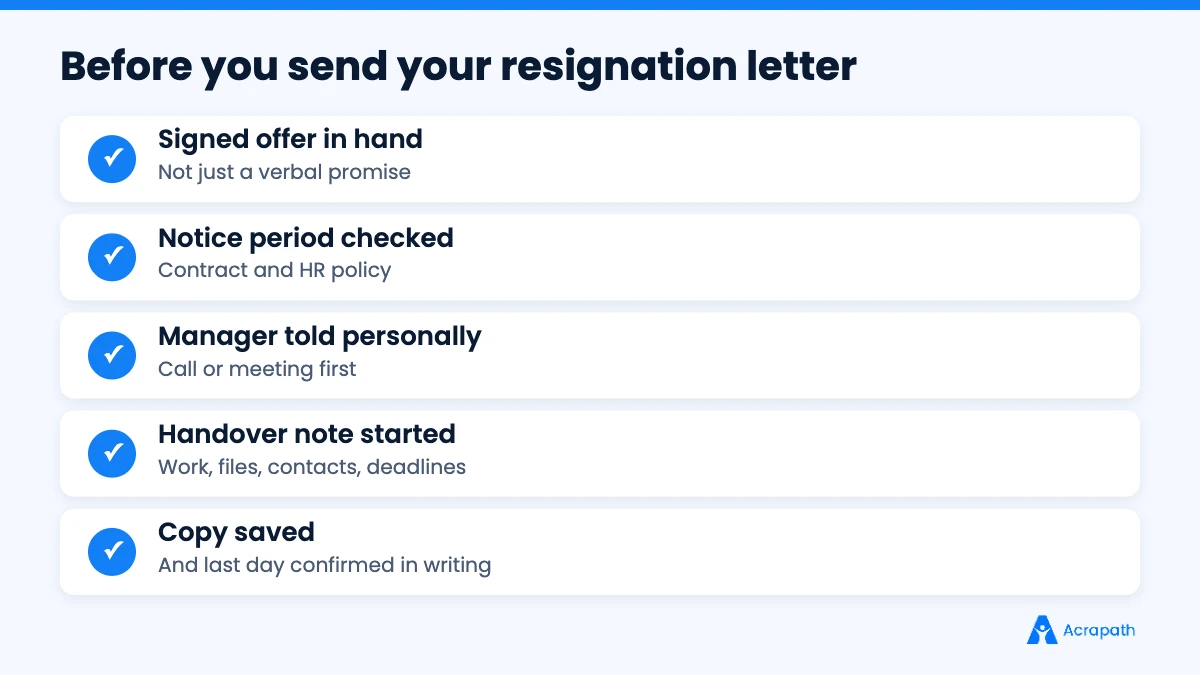
Check your contract for notice period, buyout rules and leave adjustment.
Secure your next step first. Ideally, have a signed offer letter before resigning.
Tell your manager in person or on a call before or alongside the email. It's more respectful than a surprise email.
Send the letter to your manager and HR, and keep a copy.
Confirm your last working day in writing once your manager or HR replies.
Prepare a handover note listing ongoing work, contacts, files and deadlines.
Complete clearance and collect your relieving letter, experience letter and final settlement details.
Handling a Counter-Offer
Your manager may offer a raise or promotion to keep you. Think carefully before accepting. Ask yourself whether money was the real reason you were leaving, and whether the issues that made you look elsewhere will actually change. If you do consider it, compare total in-hand pay using our guide to CTC vs in-hand salary, and decide quickly so you don't leave your new employer waiting.
Common Resignation Mistakes
Resigning before you have a written offer. Verbal promises can change.
Getting your notice period wrong. It can delay your joining date or lead to deductions.
Using the letter to vent. It stays on your file permanently.
Leaving without a handover. It damages references and relationships.
Forgetting documents. Collect your relieving letter, experience letter and salary slips before you go.
Conclusion
The right resignation letter format is short, polite and clear: who you are, that you're resigning, your last working day, a thank-you and an offer to help with handover. Pick the sample that matches your situation, check your notice period, talk to your manager and get your last day confirmed in writing.
Leave well, and your old company becomes part of your network rather than a closed door.
Planning your next move? Our guide on how to switch careers helps if you're changing fields, and our 30-day plan to find a job fast helps if you're still searching. When you're ready, find your next role with Acrapath.
- #resignation letter format
- #resignation letter sample
- #resignation email
- #notice period
- #job switch
Frequently asked questions
What is the correct resignation letter format?
Include the date, addressee, a subject line for email, one clear sentence stating you are resigning, your last working day based on your notice period, a short thank-you, an offer to help with handover and your name. Keep it to three or four short, polite paragraphs.
Do I have to give a reason in my resignation letter?
No. A reason is optional. You can mention a new opportunity, higher studies or simply "personal reasons" if you prefer to keep it private. Avoid criticising your manager or company in the letter; raise genuine concerns in an exit interview or with HR instead.
Can I resign by email?
Yes. Most companies accept resignation by email, sent to your reporting manager and HR if required. Some also ask you to submit it through an HR system. It is still respectful to tell your manager in person or on a call before or alongside the email.
How do I calculate my last working day?
Start from the date you submit your resignation and add the notice period in your contract, for example 30, 60 or 90 days. Check whether your company counts calendar or working days, whether leave can be adjusted and whether early release or a buyout is allowed.
Can I withdraw my resignation?
You can ask, but your employer does not have to accept. Once a resignation is accepted, withdrawing it usually depends on your manager and company policy. Make sure your decision is final, ideally with a signed offer in hand, before you submit your letter.