How to Switch Careers Without Starting From Zero

Jatin Kashyap
Growth Lead, Acrapath

Learn how to switch careers without starting from zero: a 9-step plan to use transferable skills, close gaps, build proof, rewrite your resume and explain your move in interviews.
Key Takeaways
To switch careers without starting from zero, build on transferable skills you already have and target a "bridge role" that uses them.
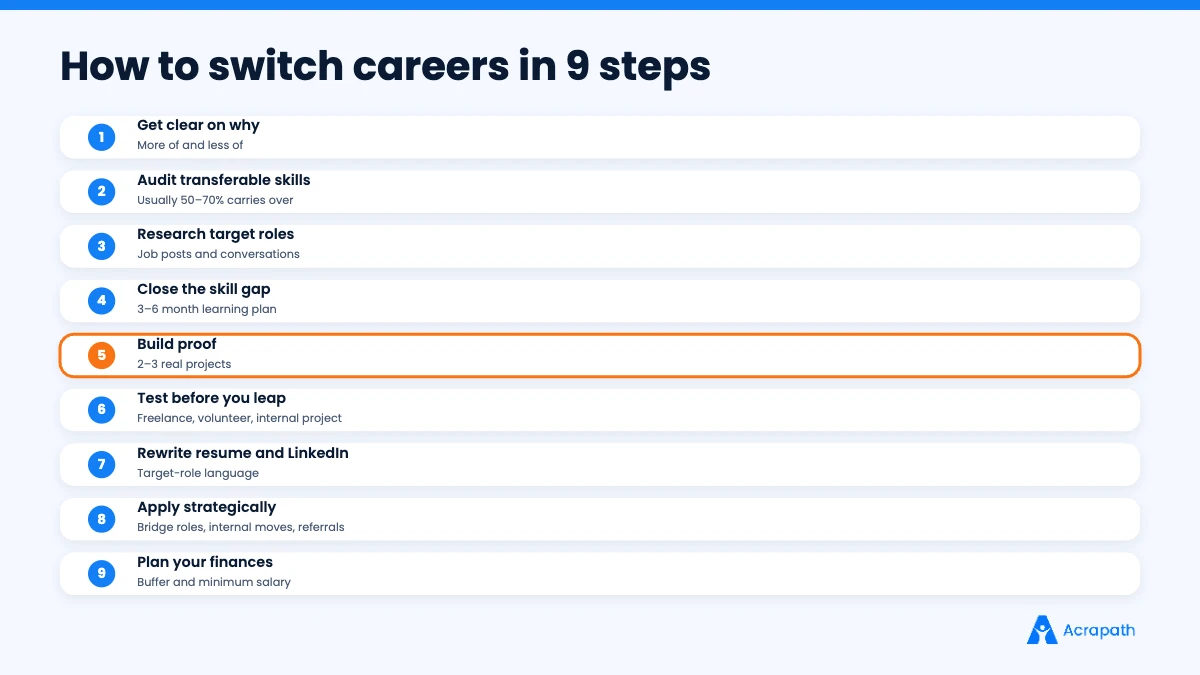
Most successful switches follow 9 steps: clarify why, audit skills, research roles, close gaps, build proof, test first, rewrite your resume, apply strategically and plan your finances.
The World Economic Forum's Future of Jobs Report 2025 expects 39% of workers' core skills to change by 2030, so learning new skills mid-career is becoming normal, not unusual.
Proof beats certificates: 2–3 real projects in your new field often matter more to employers than another course.
Expect a switch to take roughly 6–18 months, depending on how far the new field is from your current one.
You're good at your job, but something feels off. Maybe the work no longer interests you, the industry is shrinking, or you've watched friends move into fields that seem more meaningful or better paid. You keep thinking about a change, then stop, because it feels like starting over at the bottom.
Here's the good news: very few career changes really start from zero. Most people carry years of useful skills into a new field: communication, problem-solving, managing people, understanding customers, handling data. The trick is knowing how to package those skills and fill the specific gaps that matter.
This guide shows you how to switch careers step by step, with practical ways to test a new field before you leap, real examples of common switches, how to rewrite your resume and how to explain your move in interviews.
Signs It's Time to Switch Careers
A bad month isn't a reason to change careers. A consistent pattern might be. Watch for these signs:
You've lost interest in the work itself, not just your current employer or manager.
Your skills are becoming less valued, and your industry is shrinking or automating.
You keep drifting towards another field in your reading, side projects or conversations.
Your growth has stalled and the next steps up don't appeal to you.
Your values have changed. You want more impact, flexibility or stability than your field can offer.
You feel drained by the work, even after a break or a change of team.
If several of these have held true for six months or more, it's worth exploring a change seriously. If the problem is a specific manager, company or role, a job change within your field may solve it with far less risk.
Career Change vs Job Change
Before you commit, be clear about which one you need.
Job change | Career change | |
|---|---|---|
What changes | Employer, team or role level | Field, function or industry |
Example | Accountant moves to a bigger company | Accountant becomes a data analyst |
Skills needed | Mostly the same | Some new skills required |
Typical timeline | 1–3 months | About 6–18 months |
Pay impact | Often an increase | Can dip at first, then recover |
Many successful switchers use a "half-step": they change either the function or the industry first, not both at once. A sales executive in banking might move to sales in fintech, then into product marketing a year later. Each step reuses most of what they know.
How to Switch Careers (Step-by-Step)
Step 1: Get clear on why you want to switch
Write down what you want more of and less of: the type of work, the people you work with, the pace, the pay, the flexibility, the impact. Be specific. "I want to do something creative" is vague. "I want to spend most of my day designing things people use" points you towards product design, UX or content.
Pitfall: running away from a bad situation without a clear picture of what you're running towards.
Step 2: Audit your transferable skills
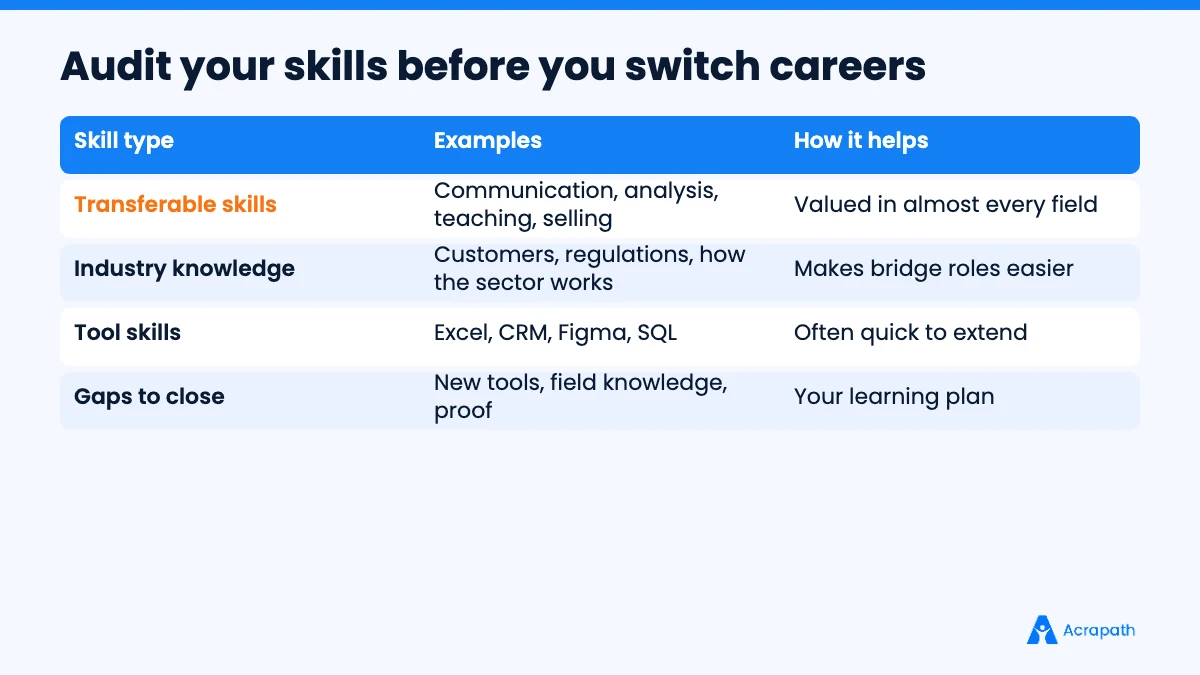
List what you do well, with evidence. Then sort your skills into three groups:
Transferable skills: communication, stakeholder management, analysis, teaching, selling, project coordination.
Industry knowledge: how your current sector works, its customers, regulations and problems.
Tool skills: Excel, CRM, design software, coding languages, data tools.
You'll usually find that 50–70% of what a new role needs is already in your toolkit. That's your starting advantage.
Step 3: Research target roles properly
Read 15–20 job descriptions for the role you want. Highlight the skills and tools that appear again and again. Then talk to people who already do the job. Ask them what a normal week looks like, what they wish they'd known, and which skills matter most in practice.
On Acrapath, you can use Circle to connect with professionals in the field you're exploring and ask for a short conversation. Most people are happy to share 15 minutes of advice when you ask a focused question.
Step 4: Close the skill gap with a learning plan
Compare the skills employers ask for with what you have. Then choose the quickest credible way to close each gap:
Gap | Fastest credible option |
|---|---|
A tool (Excel, SQL, Figma, Google Ads) | Short online course plus practice projects |
Core knowledge of the field | Structured course or certification |
Practical experience | Freelance work, volunteering or an internal project |
A licence or regulated qualification | Formal programme (plan for longer timelines) |
Network in the new field | Communities, events and informational interviews |
Keep your plan to three to six months of focused learning at a time. It's easier to stay consistent alongside a job.
Step 5: Build proof, not just certificates
Employers hiring career switchers want to see that you can do the work. Create two or three projects that look like real tasks in your target role:
Aspiring data analyst: analyse a public dataset and publish a dashboard with insights.
Aspiring UX designer: redesign a common app flow and document your research and decisions.
Aspiring SEO specialist: grow traffic on a small blog and show the before-and-after numbers.
Aspiring HR professional: create an onboarding checklist and policy for a small team.
Projects give you something concrete to show and talk about, which is far more persuasive than another certificate.
Step 6: Test the new career before you leap
Before resigning, try the work in a low-risk way: freelance on a small paid project, volunteer for a nonprofit, take on a side project or ask to help another team at your current company. If you enjoy it and get good feedback, you'll switch with confidence. If you don't, you've saved yourself a costly mistake.
Step 7: Rewrite your resume and LinkedIn for the new role
Lead with a summary that explains your move in one or two lines, then highlight transferable skills and your new projects. Use the language of your target role's job descriptions. A hybrid resume format, which combines a skills section with your work history, often works well for switchers. Our complete resume guide explains the structure, and if your new-field experience is thin, our guide to a resume with no experience shows how to present projects.
Update your LinkedIn headline to your target role, such as "Operations professional moving into supply chain analytics", so recruiters searching for that role can find you.
Step 8: Apply strategically
Career switchers rarely succeed by applying cold to hundreds of jobs. Focus on routes where your background is an advantage:
Internal moves: your current employer already trusts you, which lowers the risk for them.
Bridge roles: roles that combine your old and new fields, such as a nurse moving into healthcare operations or a teacher moving into corporate training.
Referrals: people you met during your research can introduce you to hiring managers.
Industries you know: a finance professional moving into data analysis is more credible at a bank or fintech than anywhere else.
Follow a structured weekly routine like our 30-day plan to find a job fast.
Step 9: Plan your finances
A switch can mean a short-term pay cut, unpaid learning time or a gap between jobs. Build a buffer of several months' expenses before you resign, and decide in advance the lowest salary you could accept. When offers arrive, compare in-hand pay rather than headline packages, and use our guide on how to negotiate salary to make your case.
A Sample 12-Month Career Switch Timeline
Every switch is different, but a realistic plan alongside a full-time job might look like this:
Months | Focus | Output |
|---|---|---|
1–2 | Research and skills audit | Target role chosen, 5 conversations with people in the field |
3–5 | Core learning | One course or certification completed, tools practised weekly |
6–8 | Build proof | 2–3 portfolio projects, one small freelance or internal project |
9–10 | Reposition | Resume, LinkedIn and portfolio rewritten for the new role |
11–12 | Apply and interview | Referrals, bridge roles and internal moves pursued |
Treat the timeline as a guide. If you already have strong transferable skills, you might move faster. If the new field needs a formal qualification, plan for longer.
Two habits make the biggest difference. First, block regular time in your calendar, even five hours a week, and protect it. Second, share your progress publicly, for example by posting your projects on LinkedIn. It builds credibility and often brings opportunities to you.
Common Career Switches That Build on Existing Skills
Some switches are especially natural because so many skills carry over. Here are examples, with real stories from our case studies:
From | To | What carries over |
|---|---|---|
Content writer | SEO specialist | Writing, research, understanding readers |
Teacher | Instructional designer or corporate trainer | Lesson design, explaining complex ideas |
Engineer | Management consultant or product manager | Problem-solving, structured thinking, data |
Graphic designer | Product or UX designer | Visual design, tools, feedback cycles |
Commerce graduate or accountant | Financial analyst | Accounting, Excel, attention to detail |
Customer support | Operations or customer success | Process knowledge, customer empathy |
Sales executive | Account management or product marketing | Customer insight, communication, persuasion |
Read how others made these moves: content writer to SEO specialist, teacher to instructional designer, engineer to management consultant, graphic designer to product designer and B.Com graduate to financial analyst.
If one of these paths interests you, our role guides go deeper, including how to become an SEO specialist, how to become a financial analyst, how to become an operations manager and supply chain jobs.
How to Explain Your Career Change in Interviews
Interviewers will ask why you're switching. A clear, confident answer turns your background into a strength. Use this simple structure:
What you did: one line about your previous career and a result you're proud of.
Why you're moving: what drew you to the new field, framed positively.
What you've done about it: courses, projects, freelance work or internal moves.
Why it makes you a strong fit: how your previous experience gives you an edge.
Example: "I spent five years as a school teacher, where I designed digital lessons that other teachers started using. That's what drew me to instructional design. Over the last year I completed a certification, built a portfolio of four e-learning modules and freelanced on two corporate projects. My classroom experience means I understand how people actually learn, which I think is the hardest part of this job."
Build this into your answer to "tell me about yourself", so your story is clear from the first minute. Avoid criticising your old field or employer. Focus on what you're moving towards.
Switching Careers at 30, 40 or Later
Changing careers mid-life is common and increasingly expected. According to the World Economic Forum's Future of Jobs Report 2025, employers expect 39% of workers' core skills to change by 2030. Constant reskilling is becoming part of every career, not a sign that something went wrong.
Experienced switchers have real advantages: professional maturity, a network, industry knowledge and a track record of delivering results. To make the most of them:
Target roles that value your experience, rather than competing with freshers on entry-level jobs.
Use your network first. Former colleagues and clients are often your best route into a new field.
Be realistic about timing and money, especially if you have family commitments.
Show that you learn quickly, with recent projects and courses.
Common Career Change Mistakes to Avoid
Quitting before testing. Try the work first through projects or freelancing.
Collecting certificates without projects. Employers want evidence you can do the job.
Starting completely from scratch. Look for paths that reuse your existing skills.
Hiding your background. Your previous career is part of your value; explain how it helps.
Applying everywhere. Focus on bridge roles, internal moves and referrals.
Ignoring finances. A buffer gives you time to find the right role rather than the first one.
Conclusion
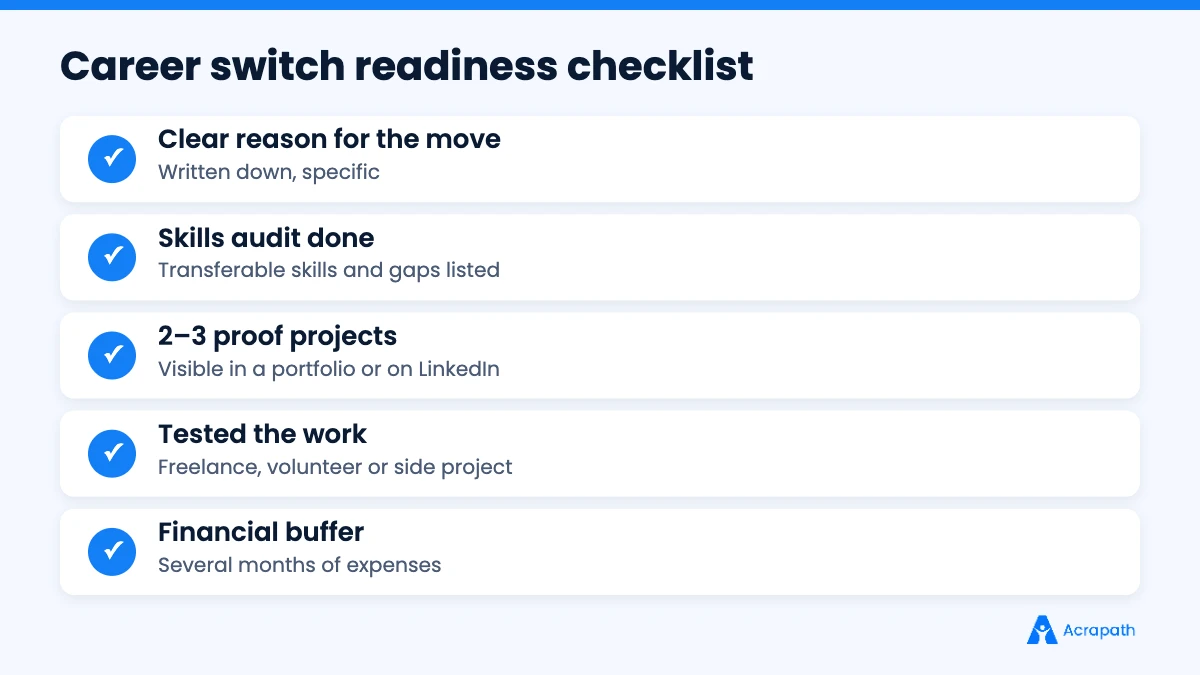
You can switch careers without starting from zero. Be clear about why you want the change, map your transferable skills, research your target role, close the specific gaps and build real proof through projects. Test the new field before you leap, then rewrite your resume, apply through bridge roles and referrals, and plan your finances.
A career change is a project, not a gamble. Take it one step at a time and your past experience becomes your biggest advantage.
Ready for your next move? Find your next role with Acrapath and connect with professionals in your target field through Circle.
- #career change
- #switch careers
- #transferable skills
- #career growth
- #upskilling
Frequently asked questions
How do I switch careers with no experience in the new field?
Start with your transferable skills, then close the specific gaps with short courses and two or three real projects that resemble the new job. Test the work through freelancing, volunteering or an internal project, and target bridge roles where your previous background is an advantage.
Is 30 too late to switch careers?
No. Many people change careers in their thirties, forties and later. Experienced switchers bring professional maturity, networks and industry knowledge. Focus on roles that value your experience, build proof of new skills and use your network to find opportunities rather than competing only on entry-level roles.
How long does it take to switch careers?
It often takes about 6–18 months, depending on how far the new field is from your current one. Switches that reuse most of your skills, such as content writing to SEO, are faster. Regulated fields that need formal qualifications or licences usually take longer.
Will I have to take a pay cut to change careers?
Sometimes, especially at first. Moving into a bridge role, an internal transfer or an industry you already know can limit the drop. Build a financial buffer, decide your minimum acceptable salary in advance and compare offers on in-hand pay before accepting.
How do I explain a career change in an interview?
Briefly describe your previous career and a result you are proud of, explain positively what drew you to the new field, show what you have done to prepare, such as projects and courses, and finish with how your past experience makes you a stronger candidate.