Supply Chain Jobs: Roles, Skills and How to Get Hired

Jatin Kashyap
Growth Lead, Acrapath
Explore supply chain jobs: the main roles in planning, procurement, logistics and management, the skills and certifications employers want, pay and demand, and how to get hired.
Key Takeaways
Supply chain jobs cover 4 broad areas: planning, sourcing and procurement, logistics and warehousing, and supply chain management.
Popular entry points include supply chain analyst, demand planner, purchase executive, logistics coordinator and inventory controller.
Employers value Excel and data skills, ERP experience, negotiation, problem-solving and clear communication under pressure.
In the US, the Bureau of Labor Statistics reported a median wage of $80,880 for logisticians in May 2024 and projects 17% job growth from 2024 to 2034.
Certifications such as ASCM's CSCP, CPIM or CLTD, or CIPS for procurement, can help once you have some experience.
Every product you buy, from a phone to a packet of biscuits, reaches you through a chain of people who planned it, sourced it, moved it and stored it. When that chain works, nobody notices. When it breaks, shelves go empty and deliveries slip.
That's why companies across manufacturing, e-commerce, retail, pharma and logistics keep hiring for supply chain jobs. The field rewards people who like numbers, enjoy solving practical problems and can stay calm when a shipment is stuck at a port.
This guide explains the main supply chain roles, what each one does, the skills and certifications employers look for, how pay and demand look, and a step-by-step plan to get hired, whether you're a fresher or switching from another field.
What Is Supply Chain Management?
Supply chain management is the coordination of everything needed to get a product from raw materials to the customer: forecasting demand, buying materials, producing goods, storing inventory, transporting orders and handling returns. The goal is to deliver the right product, in the right quantity, at the right time, at the lowest sensible cost.
Most supply chain work falls into five stages:
Plan: forecast demand and plan supply, production and inventory.
Source: choose suppliers, negotiate prices and buy materials or goods.
Make: produce or assemble products, or prepare services.
Deliver: store, pick, pack and transport orders to customers.
Return: manage returns, repairs, recycling and replacements.
Supply chain jobs sit at every one of these stages, which is why the field has so many entry points.
Types of Supply Chain Jobs
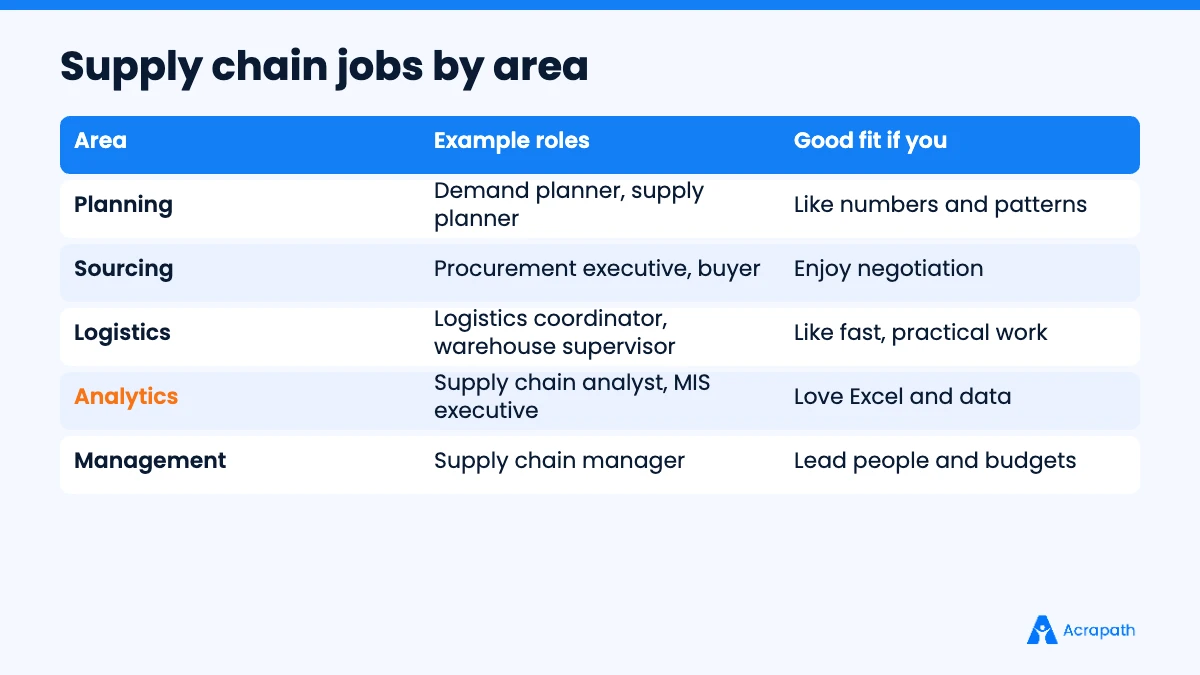
Here are the most common roles, grouped by area, with what each one involves.
Role | What you do | Typical entry background |
|---|---|---|
Supply chain analyst | Analyse data on costs, inventory and delivery to find improvements | Graduate with strong Excel or analytics |
Demand planner | Forecast sales and plan stock levels | Commerce, statistics, business or engineering |
Purchase or procurement executive | Raise purchase orders, compare quotes, manage suppliers | Commerce, business or engineering |
Buyer or category executive | Negotiate prices and terms for a product category | Procurement or retail experience |
Inventory controller | Track stock accuracy, run cycle counts, prevent shortages | Graduate, often from warehouse roles |
Logistics coordinator | Plan shipments, book carriers, track deliveries | Graduate or diploma |
Warehouse supervisor | Run receiving, storage, picking and dispatch | Diploma or graduate, floor experience |
EXIM or import-export executive | Handle documentation, customs and freight | Commerce or international business |
Transport or fleet manager | Manage vehicles, routes, drivers and costs | Several years in logistics |
Supply chain manager | Own the end-to-end flow, team and budget | 5–10 years across functions |
Planning roles
Demand planners and supply planners decide how much to make or buy, and when. They spend much of their time in spreadsheets and planning systems, comparing forecasts with actual sales and adjusting. If you enjoy numbers and patterns, this is a strong place to start.
Sourcing and procurement roles
Procurement teams find suppliers, negotiate contracts and make sure materials arrive on time and at the right quality. The work mixes negotiation, relationship-building and cost analysis. Good procurement professionals save companies large amounts of money, which makes these roles visible and valued.
Logistics and warehousing roles
Logistics coordinators, warehouse supervisors and transport managers keep goods moving. These roles are fast-paced and practical. You'll deal with real-time problems: a late truck, a damaged consignment, a picking backlog before a big sale. Many senior supply chain leaders started here.
Management roles
Supply chain managers and heads of supply chain own the whole flow. They balance cost, speed and service across planning, sourcing and logistics, manage teams and report to leadership. Many also move into broader operations roles. Our guide on how to become an operations manager shows how closely the two paths overlap.
Skills Employers Look For
Hard skills
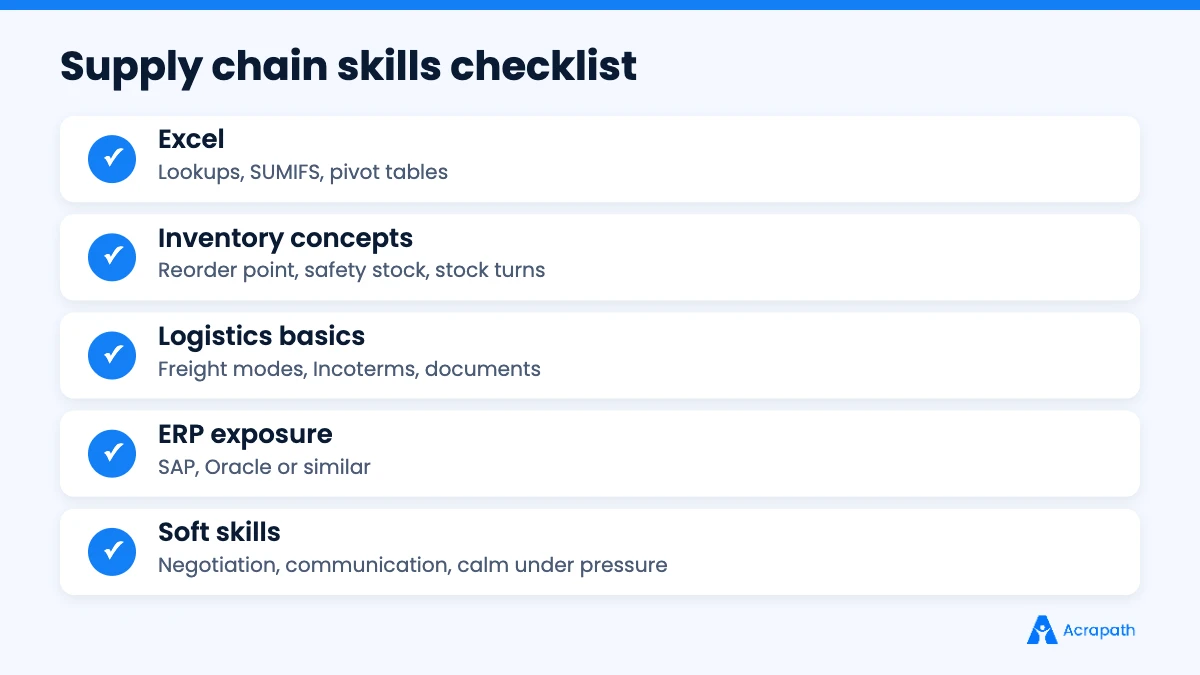
Excel and data analysis: lookups, pivot tables, charts and basic forecasting. This is the single most requested skill in entry-level postings.
ERP and planning systems: experience with systems such as SAP, Oracle or similar tools, even at a basic level, helps your application stand out.
Inventory concepts: reorder points, safety stock, stock turns, FIFO and cycle counting.
Logistics basics: freight modes, Incoterms, shipping documents and carrier management.
Cost analysis: understanding landed cost, total cost of ownership and simple budgets.
Soft skills
Problem-solving: finding a workaround fast when a supplier fails or a shipment is delayed.
Negotiation: with suppliers, transporters and internal teams.
Communication: clear updates to sales, finance and customers when plans change.
Attention to detail: small errors in quantities or documents can be expensive.
Working under pressure: peak seasons, sales events and disruptions are part of the job.
Education and Certifications
Most supply chain employers ask for a bachelor's degree. Common backgrounds include commerce, business administration, engineering, economics and dedicated logistics or supply chain programmes. An MBA in operations or supply chain can help later for management roles, but it isn't required to start.
Certifications are most useful after you have some experience:
Certification | Focus | Offered by |
|---|---|---|
CSCP (Certified Supply Chain Professional) | End-to-end supply chain | |
CPIM (Certified in Planning and Inventory Management) | Planning and inventory | ASCM |
CLTD (Certified in Logistics, Transportation and Distribution) | Logistics and distribution | ASCM |
CIPS qualifications | Procurement and supply | |
Lean Six Sigma Green Belt | Process improvement | Various accredited bodies |
Check each provider's eligibility rules, exam format and current fees before enrolling. Many people start with a short Excel or data course, which pays off immediately in almost any supply chain role.
Industries That Hire Supply Chain Talent
Supply chain skills travel well, so it pays to know which industries hire most and what each one values.
Industry | What the supply chain focuses on | What employers value |
|---|---|---|
E-commerce and retail | Fast delivery, returns, peak-sale planning | Speed, data, last-mile logistics |
FMCG and consumer goods | Distribution to thousands of stores, demand planning | Forecasting, distributor management |
Manufacturing | Raw materials, production planning, plant logistics | ERP, inventory control, vendor management |
Pharma and healthcare | Cold chain, compliance, batch tracking | Accuracy, documentation, quality |
Third-party logistics (3PL) | Running warehouses and transport for clients | Operations discipline, SLAs, cost control |
Automotive and electronics | Global sourcing, just-in-time supply | Supplier management, import-export knowledge |
If you already know an industry from college projects, internships or family business, start there. Industry knowledge shortens your learning curve and makes your interviews stronger.
What a Typical Day Looks Like
A day in a junior supply chain role is usually a mix of routine checks and unexpected problems. A logistics coordinator, for example, might:
Check overnight dispatches and flag any delayed shipments
Book transport for the day's orders and confirm pickup times
Update tracking and inventory reports for the sales team
Chase a supplier about a late delivery and find a backup option
Join a short evening call to plan tomorrow's volumes
Planners spend more time on forecasts and spreadsheets, while procurement executives spend more time on supplier calls and purchase orders. All of them share one habit: checking the numbers before making a decision.
Supply Chain Salary and Job Outlook
Demand for supply chain skills has stayed strong as companies try to make their operations more resilient after recent disruptions. In the US, the Bureau of Labor Statistics reported that logisticians earned a median annual wage of $80,880 in May 2024, and projected employment growth of 17% from 2024 to 2034, much faster than the average for all occupations.
Pay in other countries varies widely. It depends on:
Industry: pharma, FMCG, manufacturing and large e-commerce firms often pay more than small distributors.
Role: planning, procurement and analytics roles usually pay more at entry level than floor-level warehouse roles, while senior logistics roles can pay very well.
City: business and logistics hubs generally pay more.
Skills: ERP experience, analytics and certifications raise your value.
When comparing offers, look at what you'll actually take home. Our guide to CTC vs in-hand salary explains the difference, and how to negotiate salary helps at the offer stage.
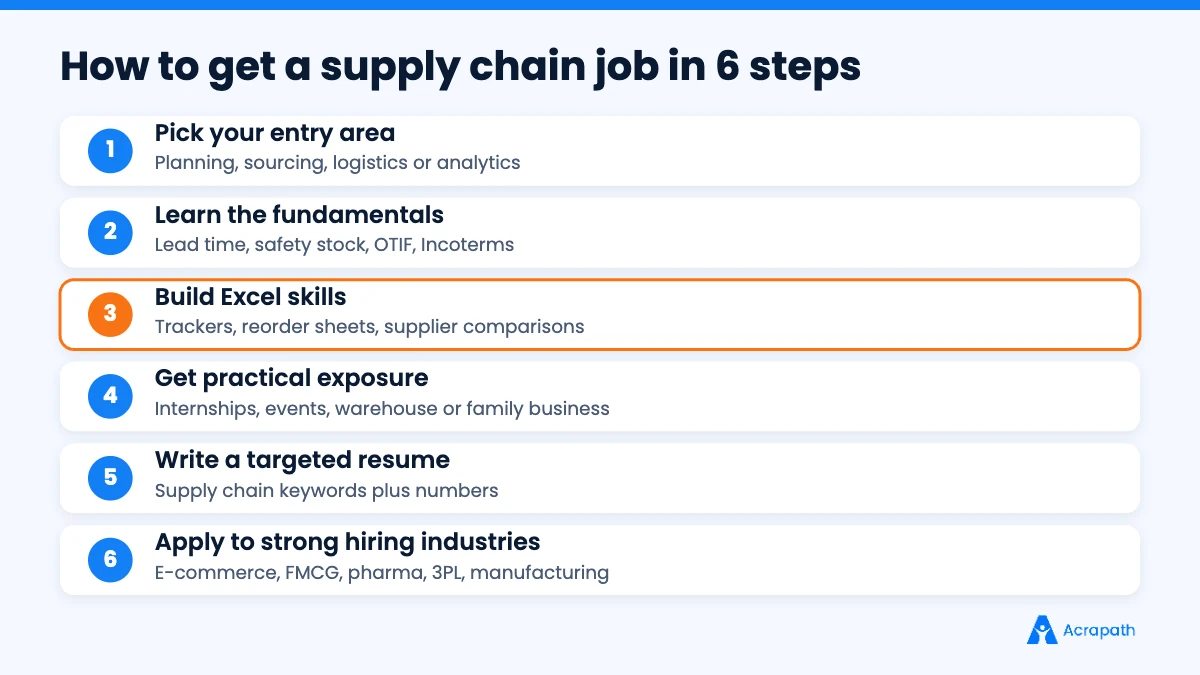
How to Get a Supply Chain Job (Step-by-Step)
Step 1: Pick your entry area
Choose one area to target first: planning, procurement, logistics or analytics. Your choice should match your strengths. Numbers-minded people often start in planning or analytics; people who enjoy negotiation suit procurement; practical, hands-on people thrive in logistics.
Step 2: Learn the fundamentals
Learn the core terms: lead time, safety stock, reorder point, Incoterms, freight modes, OTIF (on time in full) and inventory turnover. Free courses, textbooks and company case studies are enough to start.
Step 3: Build your Excel and data skills
Practise with real-looking data: build a simple inventory tracker, a reorder calculation or a supplier comparison sheet. Mention these projects on your resume and in interviews.
Step 4: Get practical exposure
Internships, part-time warehouse work, family business operations, college fests and procurement for events all count. If you're a fresher, our guide to a resume with no experience shows how to present them.
Step 5: Write a targeted resume
Use the language of supply chain job descriptions and show results with numbers: stock accuracy improved, cost saved, delivery time reduced. Our complete resume guide covers the format and structure.
Step 6: Apply strategically and prepare for interviews
Target industries with strong supply chain hiring, such as e-commerce, FMCG, retail, pharma, manufacturing and third-party logistics (3PL) companies. Follow a daily routine like our 30-day plan to find a job fast, and prepare a strong opening using our guide to "tell me about yourself".
How Supply Chain Careers Grow
Supply chain offers a clear ladder and plenty of side doors. A common progression looks like this:
Executive or analyst (0–3 years): learn processes, systems and data.
Senior executive or specialist (2–5 years): own a category, region or process.
Assistant manager or manager (5–8 years): lead a team and a budget.
Senior manager or head of supply chain (8–15 years): own end-to-end performance.
Director or VP of supply chain, or COO: set strategy across the business.
You can also move sideways into operations management, procurement leadership, supply chain consulting or analytics. Many people find that a few years in logistics or warehousing makes them far more effective later in planning or management roles, because they understand what happens on the ground.
Entry-Level Supply Chain Jobs for Freshers
If you're just starting out, these titles are commonly open to freshers or candidates with up to two years of experience:
Supply chain trainee or management trainee (operations)
Junior supply chain analyst or MIS executive
Purchase assistant or procurement executive
Logistics coordinator or dispatch executive
Inventory executive or stock controller
Customer operations or order management executive
EXIM documentation executive
Many large companies also run graduate programmes that rotate trainees through planning, procurement and logistics. They're competitive but give you a broad foundation.
Supply Chain Interview Questions You May Face
Prepare short, specific answers to these common questions:
"What is the difference between logistics and supply chain management?" Logistics is the movement and storage of goods; supply chain management covers the full flow from planning and sourcing to delivery and returns.
"How would you decide when to reorder an item?" Explain reorder points using average demand, lead time and safety stock.
"A key supplier misses a delivery. What do you do?" Show prioritisation: check stock cover, inform stakeholders, find alternatives and fix the root cause.
"How do you measure supply chain performance?" Mention metrics such as OTIF, inventory turnover, fill rate, lead time and cost per order.
"Tell me about a time you saved cost or time." Use a STAR story with a number at the end.
"Which Excel functions do you use most?" Be ready to name and explain lookups, SUMIFS and pivot tables, and possibly to demonstrate them.
Common Mistakes to Avoid
Applying to every role in operations. Target one area first so your resume stays focused.
Ignoring Excel. Weak spreadsheet skills rule out many candidates early.
Listing duties without results. Show what changed because of your work.
Dismissing floor roles. Warehouse and logistics experience builds credibility that senior leaders respect.
Collecting certificates too early. Get practical exposure first, then certify.
Conclusion
Supply chain jobs offer a wide choice of roles, steady demand and strong career growth for people who like numbers, problem-solving and coordination. Pick an entry area, learn the fundamentals, build your Excel skills, get practical exposure and target industries that hire heavily for supply chain talent.
Start with one role, prove your value with numbers, and you'll find the paths into planning, procurement, logistics and management open up quickly.
Ready to apply? See open operations and supply chain jobs on Acrapath and set up alerts for the roles you want.
- #supply chain jobs
- #logistics jobs
- #procurement
- #supply chain analyst
- #career guide
Frequently asked questions
What jobs are there in supply chain?
Common supply chain jobs include supply chain analyst, demand planner, procurement or purchase executive, buyer, inventory controller, logistics coordinator, warehouse supervisor, import-export executive, transport manager and supply chain manager. They fall into planning, sourcing, logistics and management roles.
Can freshers get supply chain jobs?
Yes. Freshers often start as supply chain trainees, junior analysts, purchase assistants, logistics coordinators or inventory executives. Strong Excel skills, a relevant degree and any practical exposure, such as internships or event procurement, make your application stand out.
What qualifications do I need for a supply chain job?
Most roles ask for a bachelor's degree in commerce, business, engineering, economics or supply chain. Excel and ERP skills are highly valued. Certifications such as ASCM's CSCP, CPIM or CLTD, or CIPS for procurement, help once you have some experience.
Is supply chain a good career?
For people who enjoy data, problem-solving and coordination, yes. Demand is strong across industries, and in the US the Bureau of Labor Statistics projects 17% growth for logisticians from 2024 to 2034. Careers can progress into supply chain management, operations and general management.
What is the difference between logistics and supply chain?
Logistics focuses on moving and storing goods: transport, warehousing and delivery. Supply chain management is broader and includes logistics plus demand planning, sourcing, production planning, inventory and returns. Logistics is one important part of the wider supply chain.