How to Hire a Financial Analyst: Modelling Test and Interview Plan

Jatin Kashyap
Growth Lead, Acrapath

A practical process to hire a financial analyst: define the role, write the JD, run a 90-minute modelling test with a rubric, ask the right interview questions and make a strong offer.
Key Takeaways
To hire a financial analyst, define the exact type of analyst you need, test real modelling skills with a short task and run a structured interview with a shared scorecard.
The US Bureau of Labor Statistics reports a median wage of $101,350 for financial and investment analysts (May 2024) and 6% projected job growth for 2024-34.
A 60-90 minute modelling test predicts on-the-job skill far better than a CV alone.
Score every candidate with one rubric of 5 criteria: accuracy, structure, assumptions, insight and communication.
Make the offer within 48 hours of the final round, because good analysts get other offers quickly.
You need someone who can build a forecast your CFO trusts, explain why margins dropped last quarter and help leadership decide whether to launch in a new city.
Many CVs list "advanced Excel" and "financial modelling". Far fewer candidates can actually build a clean model, question their own assumptions and turn the numbers into a clear recommendation.
That's why hiring a financial analyst needs a process that tests real work, not just credentials.
This guide shows you how to define the role, write a job description that attracts the right people, run a modelling test with a scoring rubric, ask interview questions that reveal judgement and close the offer before a competitor does.
What Does a Financial Analyst Do?
A financial analyst collects and analyses financial data to help a business make decisions. They build forecasts and budgets, value projects or companies, track performance against plan and explain the results to managers.
The US Bureau of Labor Statistics notes that financial analysts typically need a bachelor's degree. It reports a median annual wage of $101,350 for financial and investment analysts in May 2024 and projects employment to grow 6% from 2024 to 2034, faster than the average for all jobs.
Step 1: Define the Type of Analyst You Need
"Financial analyst" covers very different jobs. Decide which one you're hiring for before you write a single line of the job post.
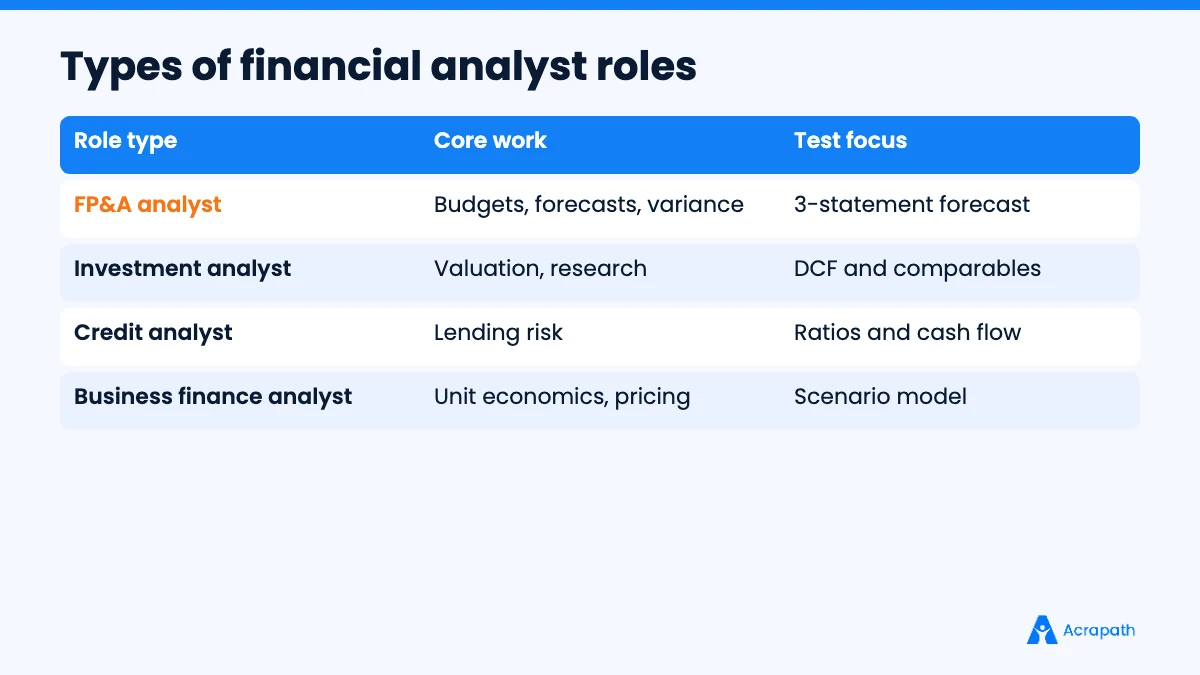
Ask yourself:
What decisions will this person support? Budgets, investments, lending or pricing?
Who will they work with most? The CFO, business heads, investors or credit committees?
What will they own in their first 90 days? A monthly forecast, a board pack or a valuation model?
What level do you need? A fresher who builds under guidance, or an experienced analyst who owns models end to end?
Your answers decide the skills you test and the salary you offer.
Step 2: Write a Clear Job Description
A focused job description saves you hours of screening. Include:
The team and reporting line: "Reports to the Finance Manager, supports the sales and operations heads."
Three to six key responsibilities: monthly forecasting, variance analysis, business cases, board reporting.
Must-have skills: accounting basics, Excel modelling, clear writing.
Nice-to-have skills: SQL, Power BI or Tableau, industry experience, CFA or CA progress.
Location, work setup and salary range where you can share it.
Our accountant job description template shows the format, and our older guide on how to hire an accountant covers the sister role if you need both.
Step 3: Source Candidates in the Right Places
Strong financial analysts come from several pools:
Commerce, economics and MBA graduates for junior roles.
CA articleship completers and CFA candidates with strong technical grounding.
Analysts at audit firms, banks and consultancies looking for in-house roles.
Referrals from your finance team, who know who's good.
Verified candidate directories such as Acrapath's Talbox, where you can filter by skills and experience.
For more channels, see our list of where to find candidates.
Step 4: Screen CVs Quickly and Fairly
Screen for evidence, not buzzwords. Look for:
Models or analyses the candidate built, with scope ("built a 3-year forecast for a ₹200 crore business").
Exposure to the type of work you need (FP&A, valuation, credit).
Tools named in context, not just listed.
Clear, error-free writing on the CV itself.
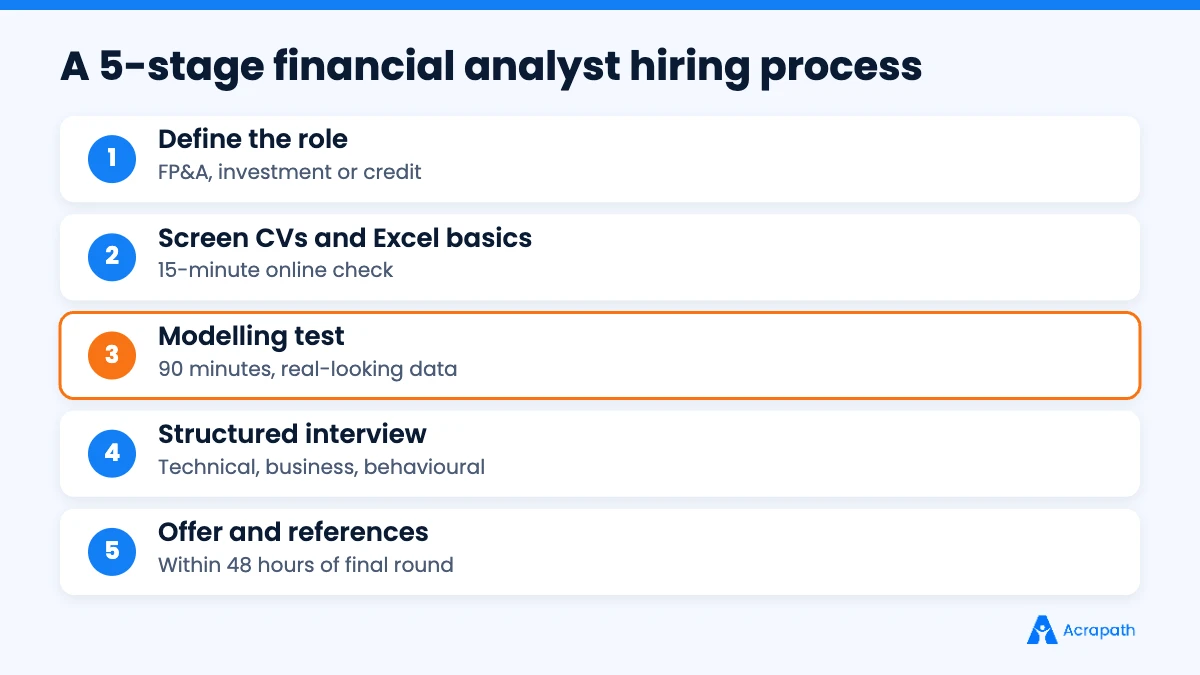
A short online Excel check, 15 minutes on lookups, pivots and basic formulas, can filter a large applicant pool before anyone spends time on calls. Our resume screening guide has a full checklist.
Step 5: Run a Financial Modelling Test
A work-sample test is the single most useful step in hiring an analyst. Research on selection methods, summarised by Sackett, Zhang, Berry and Lievens (2022), found work samples and structured interviews among the stronger predictors of job performance, ahead of unstructured interviews.
Design the Test
Keep it realistic and short:
Format: 60-90 minutes live, or a take-home task of about three hours.
Data: a simple, anonymised dataset that looks like your business, such as three years of revenue, costs and headcount.
Task: build a 12-month forecast, flag the two biggest risks and recommend one action.
Output: the model plus a five-line summary a non-finance manager could read.
Sample Test Brief
You are joining the finance team of a 200-person subscription software company. Using the attached three years of monthly revenue, churn and cost data, build a 12-month forecast. Clearly separate your inputs, calculations and outputs. Then write a five-line summary: what the forecast shows, the two biggest risks and one action you'd recommend to the CEO. You have 90 minutes. Use Excel or Google Sheets.
Score It With a Rubric
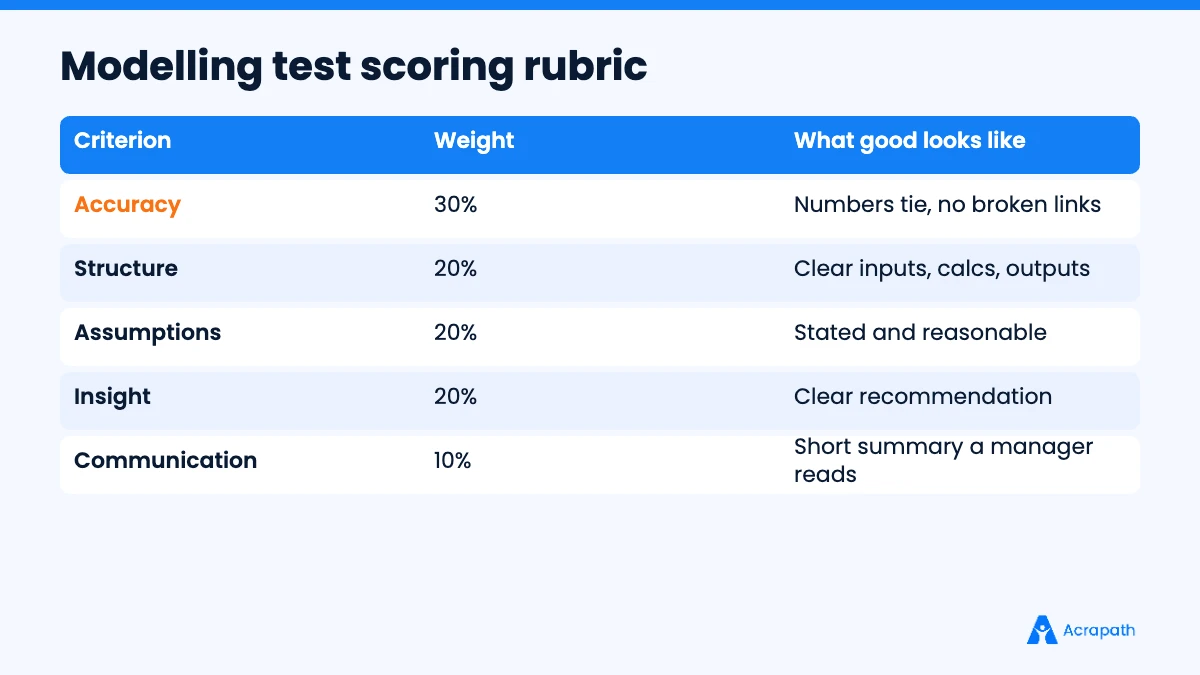
Ask two reviewers to score each test independently, then compare. Rubrics reduce bias and stop the loudest interviewer from deciding alone.
Pitfall to avoid: don't ask candidates to solve a real, live business problem for free. Use sample data and keep the scope tight.
Step 6: Hold a Structured Interview
Use a structured interview: the same questions for every candidate, scored on the same scale. Split the hour into three parts.
Technical Questions
"Walk me through how the three financial statements link."
"How would you build a revenue forecast for a business with seasonal sales?"
"When would you use a DCF valuation, and when would comparables be more useful?"
"Talk me through your modelling test. What would you change with more time?"
Business Judgement Questions
"Margins fell 3 points last quarter. How would you find out why?"
"A sales head says your forecast is too low. How do you respond?"
"Which metric would you watch most closely in our business, and why?"
Behavioural Questions
"Tell me about a time you found an error in a report. What did you do?"
"Describe a time you explained a complex analysis to a non-finance colleague."
"Tell me about a deadline you nearly missed. What happened?"
For more examples across roles, see our list of interview questions to ask candidates.
What Good Answers Sound Like
Question area | Strong answer | Weak answer |
|---|---|---|
Statement links | Explains how net profit flows to cash and the balance sheet clearly | Recites definitions without links |
Forecasting | Starts with drivers (customers, price, churn) and states assumptions | Applies one growth rate to everything |
Margin drop | Breaks it into price, mix, volume and cost and checks data first | Guesses a cause immediately |
Pushback | Listens, rechecks assumptions, explains the logic calmly | Gives in at once, or refuses to engage |
Errors | Owns it, fixes it, adds a check to prevent repeats | Blames others |
Red Flags to Watch For
Can't explain the logic behind their own model.
Hard-codes numbers inside formulas with no clear inputs.
No sense check: accepts a forecast that makes no business sense.
Struggles to summarise findings in plain language.
Claims advanced skills that the test doesn't show.
Step 7: Check References and Make the Offer
Ask referees specific questions: "How accurate were their forecasts?", "Did managers trust their numbers?", "How did they handle tight month-end deadlines?"
Then move fast. Agree the salary band before the final round so you can make a verbal offer within 24-48 hours, followed by a written letter. Our offer letter template helps you send it the same day, and our guide to cutting time to hire shows where else you can save days.
What Your New Analyst Needs on Day One
A smooth start helps your analyst add value faster:
Access to the accounting system, data sources and shared drives.
The current budget, last few months' management reports and key models.
A short glossary of company-specific terms and metrics.
A named buddy in the finance team.
A clear 30-60-90 day plan, for example: learn the monthly close in month one, own the forecast in month two, present a business case in month three.
Setting the Salary Range
Pay for financial analysts varies widely by country, city, industry and level, so build your range from local data rather than a global average.
Use three inputs:
Current job postings for similar roles in your city or remote market.
Recruiter and agency feedback on what shortlisted candidates expect.
Your internal pay structure, so a new analyst isn't paid far above colleagues doing similar work.
As one reference point, the BLS reported a US median of $101,350 for financial and investment analysts in May 2024. Investment and risk roles in major financial centres typically pay more; FP&A roles in smaller companies often pay less.
Share the range in your job post where you can. Clear pay ranges attract better-matched applicants and remove a common reason offers fall through at the last step.
In-House Analyst vs Outsourced Support
Before you hire, check that a full-time analyst is the right answer.
Option | Best when | Watch out for |
|---|---|---|
Full-time in-house analyst | You need ongoing forecasting, reporting and business partnering | Higher fixed cost; needs onboarding and management |
Part-time or contract analyst | You have a defined project, such as a fundraising model | Knowledge leaves when the contract ends |
Outsourced finance firm | You need monthly reporting but not daily business support | Less context on your business; slower answers |
Upskilling an existing team member | Someone in accounts already shows strong analytical skill | They may need time and training to step up |
Many growing companies start with a contractor for a fundraising or budget project, then hire full-time once the monthly workload is clear.
Interview Scorecard Template
Give every interviewer the same scorecard, scored 1-5 for each area:
Area | What to look for | Score (1-5) |
|---|---|---|
Accounting foundations | Explains statement links accurately | |
Modelling skill | Clean, logical, error-checked model | |
Business judgement | Asks why before answering, uses drivers | |
Communication | Plain-language summary of findings | |
Ownership | Owns mistakes, meets deadlines |
Add a short written note for each score. The notes matter more than the numbers when you debrief, because they show why each interviewer reached their view.
Mistakes to Avoid When Hiring a Financial Analyst
Hiring on credentials alone. A strong certification doesn't guarantee strong modelling.
Running a test that takes a weekend. Good, employed candidates will drop out.
Letting each interviewer ask whatever they like. You'll compare impressions, not evidence.
Ignoring communication. An analyst whose numbers nobody understands won't change decisions.
Waiting a week to decide. Analysts with modelling skill rarely stay available for long.
Questions Strong Candidates Will Ask You
Good analysts interview you too. Prepare clear answers to these, because vague replies are a common reason top candidates decline:
"Who will use my analysis, and how?" Strong analysts want their work to change decisions, not sit in a folder.
"What data and tools will I have?" Be honest if data is messy; many analysts enjoy fixing it if they know upfront.
"How is the month-end and budget workload spread?" Share realistic hours during close and budget season.
"What does growth look like here?" Explain the path to senior analyst, finance manager or business partner roles.
"How will my performance be measured?" Name the outputs that matter, such as forecast accuracy and on-time reporting.
Candidates who ask these questions are usually the ones worth hiring. Treat the conversation as part of your pitch, and make sure every interviewer gives consistent answers.
How Acrapath Can Help
Acrapath helps you find and hire verified finance professionals. You can post a role, search verified candidates in Talbox, and move shortlisted analysts through a simple hiring pipeline. If your team is stretched, Acrapath's hiring desk can run sourcing, screening and the modelling test for you.
Our case study on how a fintech built its finance team shows this process in action.
Conclusion
Hiring a great financial analyst comes down to testing the real work. Define the type of analyst you need, write a focused job description, run a short modelling test with a five-part rubric and use a structured interview to judge business sense and communication.
Your next step: write the one-paragraph brief for your modelling test this week, so it's ready the moment applications arrive.
When you're ready to start, hire verified finance professionals through Acrapath.
- #hire financial analyst
- #FP&A hiring
- #financial modelling test
- #finance interview questions
- #hiring guide
Frequently asked questions
What skills should a financial analyst have?
A strong financial analyst combines accounting knowledge, advanced Excel and financial modelling, clear business judgement and the ability to explain numbers to non-finance colleagues. For many roles, experience with forecasting, valuation, data tools such as SQL or Power BI, and presenting to managers also matters.
How do you test a financial analyst candidate?
Use a short, realistic modelling test. Give the candidate a small dataset and ask them to build a forecast or valuation, state assumptions and write a short recommendation. Score it with a rubric covering accuracy, structure, assumptions, insight and communication, so every interviewer judges the same things.
How long should a financial modelling test take?
Keep it to 60-90 minutes for a live test or about three hours for a take-home task. Longer tests put off strong candidates who are already employed. A focused task with clear instructions shows modelling skill and judgement without asking for unpaid project work.
What should be in a financial analyst job description?
Include the team the analyst supports, key responsibilities such as forecasting or valuation, must-have skills, tools used, the reporting line, location or remote setup and a salary range where possible. Separate must-have skills from nice-to-have ones so qualified candidates aren't put off.
How much does it cost to hire a financial analyst?
Costs include salary, job advertising, recruiter or agency fees, interview time and onboarding. Pay varies widely by country and level; in the US, the Bureau of Labor Statistics reported a median wage of $101,350 for financial and investment analysts in May 2024.