Product Manager Resume: Examples and Bullet Points That Work

Jatin Kashyap
Growth Lead, Acrapath

How to write a product manager resume that gets interviews: the right format, a strong summary, outcome-focused bullet points, skills to list, a full sample and versions for APM and career-switch candidates.
Key Takeaways
A strong product manager resume leads with outcomes: what you shipped, why it mattered and the measurable result, not a list of duties.
Most PM bullets should follow 1 pattern: action + what you built or changed + measurable result + timeframe.
Keep it to 1 page for under about 8 years of experience and 2 pages at most for senior roles.
Your summary needs just 3 lines: level, domain and your single best outcome.
APM and career-switch candidates should add 1-2 product case studies to show product thinking.
You've shipped features, run experiments, talked to dozens of customers and kept engineers, designers and sales aligned. Then you open your resume and it says: "Responsible for product roadmap. Worked with cross-functional teams."
That's the most common problem with product manager resumes. They describe the job, not the impact. And product hiring managers are looking for impact above everything else.
The fix is straightforward once you know the pattern.
This guide shows you the best format for a product manager resume, how to write a summary, how to turn duties into outcome-driven bullet points, which skills to list, a full sample resume and how to adapt it if you're applying for associate PM roles or switching into product.
What Hiring Managers Look for in a Product Manager Resume
Product leaders scan a resume for a few signals:
Outcomes: Did your work move a metric that mattered?
Ownership: Did you lead decisions, or just attend meetings?
Product sense: Do you understand users and problems, not only features?
Collaboration: Can you align engineers, designers and business teams?
Context: What kind of products, users and scale have you worked with?
Every line on your resume should support one or more of these signals.
The Best Product Manager Resume Format
Use a clean, single-column, reverse-chronological format. It's easiest for recruiters to read and for applicant tracking systems to parse. Our ATS-friendly resume guide explains which layouts and fonts pass these systems safely.
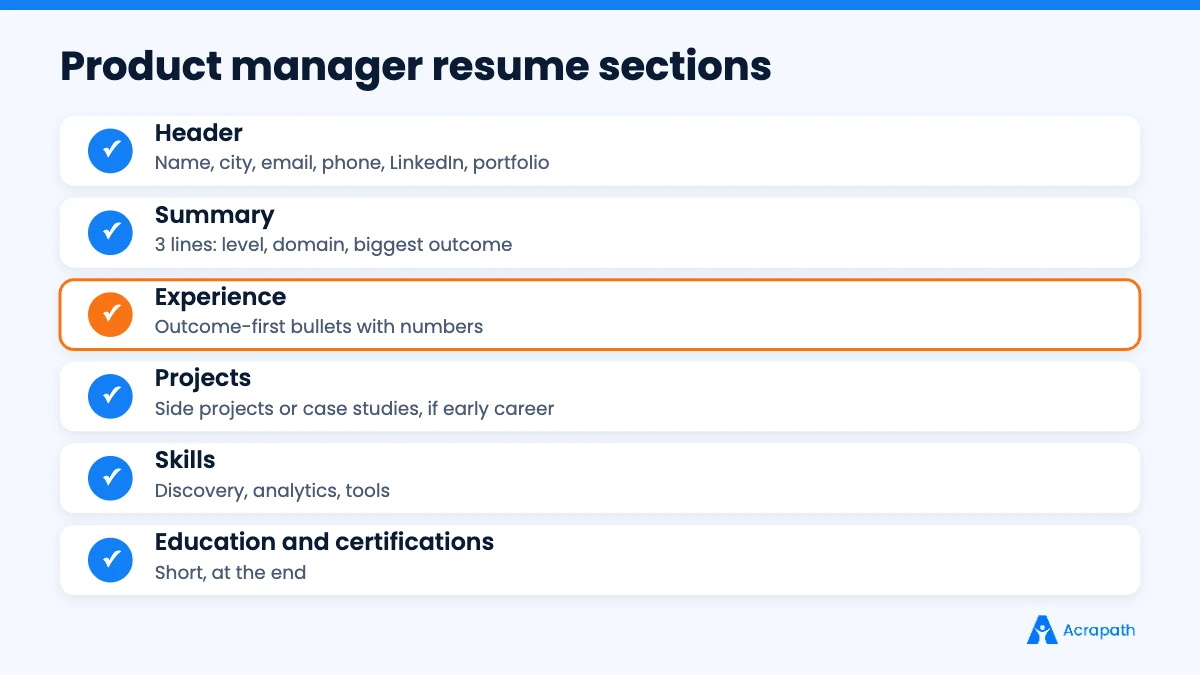
Avoid heavy graphics, skill bars and multi-column templates. They look modern but often break in applicant tracking systems and hide your content.
For the fundamentals of any strong resume, see our complete guide on how to write a resume.
How to Write a Product Manager Resume Summary
Your summary is a three-line pitch. Include your level, domain and best outcome.
Mid-level PM example
Product manager with 4 years in B2B SaaS, focused on onboarding and activation. Led discovery and experiments that raised trial-to-paid conversion by 18%. Comfortable with SQL and close collaboration with engineering and design.
Senior PM example
Senior product manager with 9 years in consumer fintech, leading teams of up to 12 engineers. Owned payments and lending products used by 2M+ customers; launched credit features that grew revenue 35% year on year.
APM example
Engineering graduate targeting associate product manager roles. Built and launched two student apps with 3,000+ combined users; ran user interviews and A/B tests to improve retention by 22%.
How to Write Product Manager Bullet Points That Work
Use this pattern for most bullets:
Action verb + what you built or changed + measurable result + timeframe
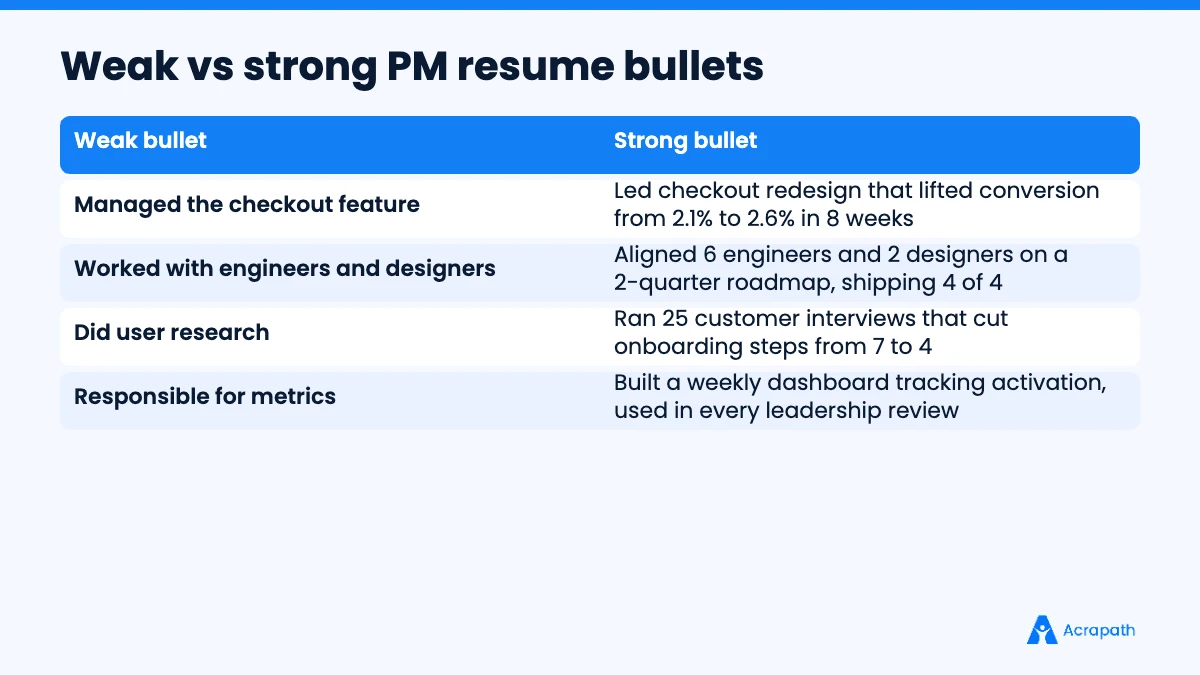
Good action verbs for PMs include: led, launched, prioritised, defined, discovered, validated, reduced, increased, aligned, scaled and retired.
Product Manager Resume Bullet Examples by Area
Discovery and research
Ran 30 customer interviews and 4 usability tests, identifying 3 onboarding blockers that informed the next quarter's roadmap.
Validated a new pricing tier with a 2-week fake-door test before engineering investment, avoiding an estimated 6 weeks of wasted build time.
Delivery and execution
Led a team of 7 engineers and 2 designers to launch a mobile app redesign in 10 weeks, on time and within scope.
Cut release cycle from monthly to weekly by introducing feature flags and a simple release checklist with engineering.
Growth and metrics
Increased 30-day retention from 34% to 41% by redesigning the first-week user journey.
Raised average order value 12% through a bundling feature tested with 20% of traffic before full rollout.
Strategy and stakeholders
Defined a 12-month product strategy for the merchant platform, approved by leadership and used to plan headcount.
Aligned sales, support and engineering on a shared prioritisation framework, reducing ad-hoc feature requests by about half.
Data and analytics
Built a weekly activation dashboard in SQL and a product analytics tool, adopted in every leadership review.
Identified a drop-off in KYC verification through funnel analysis; fix improved completion by 9 percentage points.
Skills to List on a Product Manager Resume
Skill area | Examples to list |
|---|---|
Discovery | Customer interviews, usability testing, jobs-to-be-done |
Prioritisation and planning | Roadmapping, RICE or similar frameworks, OKRs |
Execution | Writing PRDs and user stories, agile delivery, release planning |
Data | SQL, A/B testing, product analytics, dashboards |
Collaboration | Stakeholder management, presenting to leadership |
Tools | Jira, Figma, Notion, analytics platforms |
Domain | Payments, B2B SaaS, marketplaces, healthtech, etc. |
List only skills you can discuss with a real example. Interviewers often pick a skill from your resume and ask you to walk through when you used it.
Sample Product Manager Resume
Aditi Verma
Bengaluru · aditi.verma@email.com · +91 98xxx xxxxx · linkedin.com/in/aditiverma
Summary
Product manager with 5 years in B2B SaaS and marketplaces, focused on activation and monetisation. Led launches that grew paid conversion by 18% and cut onboarding time in half.
Experience
Product Manager, Onboarding and Growth · B2B SaaS company · 2023-present
Led redesign of self-serve onboarding with 6 engineers and 1 designer; trial-to-paid conversion rose 18% in two quarters.
Ran 40 customer interviews and 6 experiments, cutting time-to-first-value from 3 days to 1 day.
Defined activation metrics and a weekly dashboard used by leadership and sales.
Introduced a prioritisation framework that reduced unplanned work from roughly 30% to 15% of sprint capacity.
Associate Product Manager · Online marketplace · 2021-2023
Launched seller analytics dashboard used by 8,000+ sellers within three months.
Wrote PRDs and user stories for 12 features, working with 2 squads.
Improved listing completion by 11 percentage points through form simplification tested on 25% of traffic.
Business Analyst · Consulting firm · 2019-2021
Built pricing and market-sizing models for 6 clients in retail and logistics.
Skills
Customer discovery, A/B testing, SQL, product analytics, roadmapping, PRDs, Jira, Figma, stakeholder management
Education
B.Tech, Computer Science · 2019
Product Manager Resume for APM and Freshers
If you're applying for associate product manager roles, you won't have PM job titles yet. Show product thinking through:
Projects: an app, website or tool you built or helped build, with users and results.
Product case studies: a short write-up on improving a real product, with problem, research, solution and success metrics.
Internships: any role where you worked with users, data or engineers.
Clubs and competitions: product challenges, hackathons and case competitions.
Pair this with the advice in our guide to a resume with no experience.
Product Manager Resume for Career Switchers
Engineers, analysts, consultants, designers and marketers often move into product. Reframe your experience around product work:
Engineers: highlight technical decisions, scoping and working with users or product managers.
Analysts and consultants: emphasise problem framing, data insights and recommendations that were adopted.
Designers: show research, problem definition and business outcomes, not only visuals.
Marketers: focus on experiments, funnels and customer insight.
Add a clear summary line, such as "Data analyst transitioning to product management", so recruiters understand your goal. Our guide to switching careers without starting from zero explains how to position transferable skills.
Product Manager Resume by Level
What a hiring manager expects to see changes as you grow. Adjust your emphasis:
Level | What to emphasise | Example signal |
|---|---|---|
APM / fresher | Product thinking, projects, learning speed | Side project with real users and results |
Product manager | Owning features end to end, metrics moved | Launch that lifted a core metric |
Senior PM | Strategy, complex trade-offs, cross-team influence | Multi-quarter roadmap tied to business goals |
Group PM / lead | Leading PMs, portfolio decisions, hiring | Grew a product team and its outcomes |
If you're applying one level up, include one or two bullets that show you already work at that level, such as setting strategy or mentoring a junior PM.
How to Show Impact Without Exact Numbers
Many companies don't allow you to share exact revenue or user counts. You can still show impact:
Use percentages: "increased activation by 15%" instead of raw numbers.
Use ranges: "a feature used by 50,000-100,000 monthly users".
Use relative change: "halved support tickets for billing".
Use time saved: "cut weekly reporting from 6 hours to 1".
Use adoption: "rolled out to all 4 regional teams within a quarter".
Never invent numbers. If an interviewer asks how you measured a result, you should be able to explain the source and method clearly.
How to Tailor Your PM Resume to Each Job
Product roles vary widely, so a quick tailoring pass for each application pays off:
Read the job post for the product area and stage. A growth PM at a startup needs different proof than a platform PM at a large company.
Mirror the key terms. If the post says "experimentation" and "activation", use those words where they truthfully describe your work.
Reorder your bullets. Put the two most relevant outcomes at the top of each role.
Adjust your summary. Name the domain or user type the company serves, if you have experience with it.
Check length. Cut older bullets rather than shrinking the font to fit.
Tailoring usually takes 15-20 minutes per application, and it's often the difference between a generic rejection and an interview call.
Should You Add a Portfolio Link?
A short product portfolio can make your resume far more convincing, especially if you're early in your career or switching into product. It doesn't need to be fancy. A simple page or document with two or three case studies works well.
For each case study, cover:
The problem: who the users were and what wasn't working.
Your process: research, options considered and why you chose one.
The solution: what was built, with a screenshot or sketch if you can share it.
The result: the metric that moved, or what you learned if it didn't.
Remove confidential details and get permission where needed. Add the link to your resume header so recruiters can find it in one click.
Common Product Manager Resume Mistakes
Listing responsibilities instead of outcomes. "Owned the roadmap" says little.
Taking credit for team results alone. Use "led", "partnered with" or "drove" honestly.
Too much jargon. Recruiters outside your company won't know internal project names.
No numbers at all. Even rough percentages or ranges help.
One resume for every job. Tailor your summary and top bullets to each company's product and stage.
Ignoring formatting. Typos and broken layouts suggest weak attention to detail, a key PM trait.
After Your Resume Gets You the Interview
Your resume will shape your interviews. Expect interviewers to ask you to go deeper into each bullet: why you chose that solution, what trade-offs you made and how you measured success.
Prepare with our list of product manager interview questions and answers and our interview preparation guide.
Conclusion
A product manager resume that works shows outcomes, ownership and product sense. Use a clean single-column format, a three-line summary, and bullet points that combine action, what you built and a measurable result. Tailor your top bullets to each role, and add projects or case studies if you're new to product.
Your next step: rewrite your three most important bullets using the action-plus-result pattern today.
When your resume is ready, explore product jobs on Acrapath and set up alerts for PM and APM roles.
- #product manager resume
- #PM resume examples
- #APM resume
- #resume bullet points
- #product jobs
Frequently asked questions
How long should a product manager resume be?
Keep it to one page if you have less than about eight years of experience, and two pages at most for senior roles. Recruiters skim quickly, so prioritise your most relevant outcomes and cut older or unrelated roles to one line each.
What should a product manager resume summary say?
In two to three lines, state your level, the type of products or industry you know, and one strong outcome. For example: Product manager with 4 years in B2B SaaS, focused on onboarding and activation; led changes that raised trial-to-paid conversion by 18%.
How do I write a PM resume with no product manager experience?
Highlight product-like work from your current role, such as running experiments, writing requirements, analysing data or working with engineers. Add one or two product case studies or side projects with clear problems, decisions and results. Use a summary that names the PM role you're targeting.
What skills should I list on a product manager resume?
List skills you can back up with examples: customer discovery, prioritisation, roadmapping, writing requirements, experimentation, analytics with SQL or product analytics tools, stakeholder management and communication. Mention tools like Jira, Figma or Amplitude only if you've used them in real work.
Should a product manager resume include metrics?
Yes. Product management is judged on outcomes, so most bullets should show a measurable result, such as conversion, retention, revenue, time saved or adoption. If you can't share exact numbers, use percentages, ranges or relative changes approved by your employer.