Product Manager Interview Questions and Answers

Jatin Kashyap
Growth Lead, Acrapath
Prepare for product manager interview questions on product sense, metrics, estimation, technical, behavioural and strategy rounds, with frameworks, sample answers and a 2-week plan.
Key Takeaways
Most product manager interview questions fall into 6 groups: product sense, analytical and metrics, estimation, technical, behavioural and strategy.
Product sense questions ("design a product for…", "improve this app") test whether you start with users and problems, not features.
For metrics questions, define the goal first, then pick 1 north-star metric and 2–4 supporting and guardrail metrics.
Prepare 6–8 STAR stories about shipping, prioritising, handling conflict and learning from failure, each with a number.
Many companies add a take-home case or presentation round, so practise structuring and presenting a recommendation in 20–30 minutes.
Product manager interviews have a reputation for being unpredictable. One interviewer asks you to design an alarm clock for blind users, the next asks why daily active users dropped 8% last Tuesday, and a third wants to hear about the time you disagreed with an engineering lead.
The good news is that underneath the variety, the same few skills are being tested again and again: understanding users, using data to make decisions, working with engineers and designers, and communicating a clear recommendation.
This guide breaks down the most common product manager interview questions by type, explains what each one is really testing, gives you simple frameworks and sample answers, and finishes with a two-week preparation plan. It works for associate PM, PM and senior PM roles.
What Product Manager Interviews Test
A product manager decides what a team should build and why, then works with engineering, design, data and business teams to deliver it. Interviews test whether you can do that well under realistic conditions.
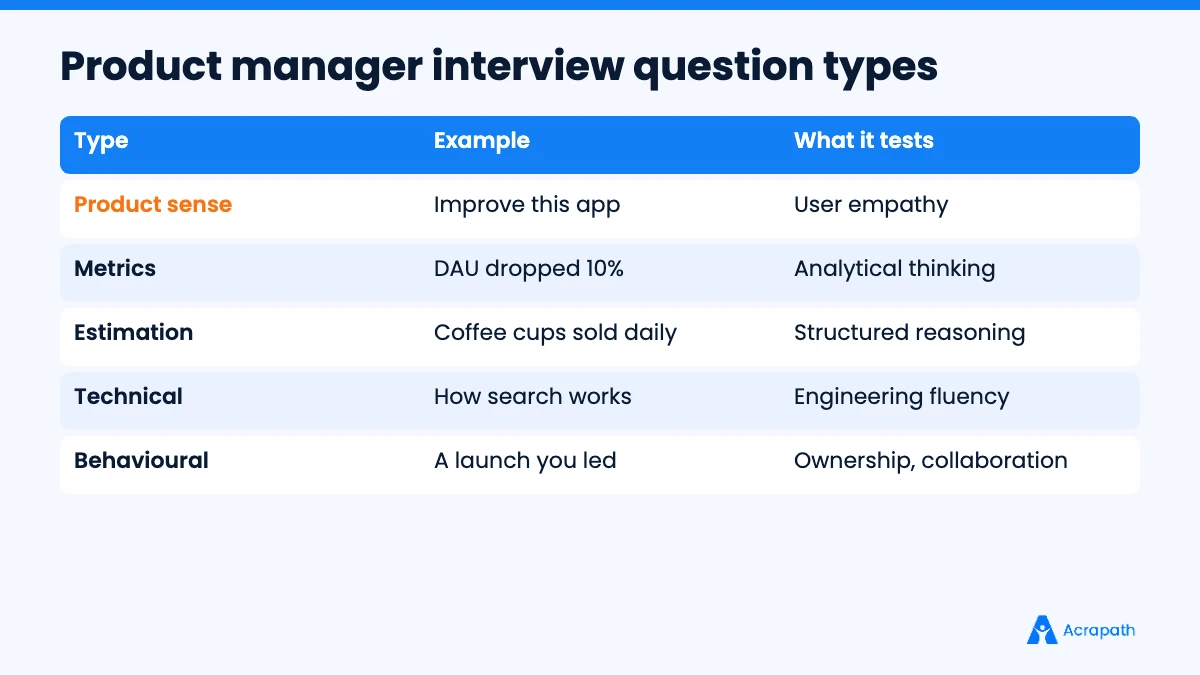
Skill | What interviewers look for | Typical question |
|---|---|---|
Product sense | User empathy, clear problem framing, creative but practical ideas | "How would you improve Google Maps?" |
Analytical thinking | Choosing the right metrics, diagnosing problems with data | "Sign-ups dropped 15% this week. What do you do?" |
Estimation | Structured reasoning with reasonable assumptions | "How many food delivery orders happen in Mumbai each day?" |
Technical understanding | Enough to work well with engineers and judge trade-offs | "How does a search feature work behind the scenes?" |
Execution and leadership | Prioritising, shipping, influencing without authority | "Tell me about a time you had to say no to a stakeholder." |
Strategy | Market, competition and long-term thinking | "Should we enter the B2B market?" |
The Typical PM Interview Process
Round | What happens | How to prepare |
|---|---|---|
Recruiter screen | Background, motivation, salary expectations | A 60–90 second introduction |
Hiring manager round | Your experience and how you work | STAR stories with numbers |
Product sense round | Design or improve a product | Practise a framework out loud |
Analytical or metrics round | Metrics, root-cause analysis, estimation | Practise defining goals and metrics |
Technical round (some companies) | System basics, APIs, trade-offs | Revise how common products work |
Case or take-home | Written or presented product case | Practise structuring a 20–30 minute presentation |
Final or leadership round | Strategy, values, fit | Big-picture answers and good questions |
Your first answer in most rounds will be your introduction. Our guide to answering "tell me about yourself" shows how to keep it to 60–90 seconds and point it at the role.
Product Sense Questions
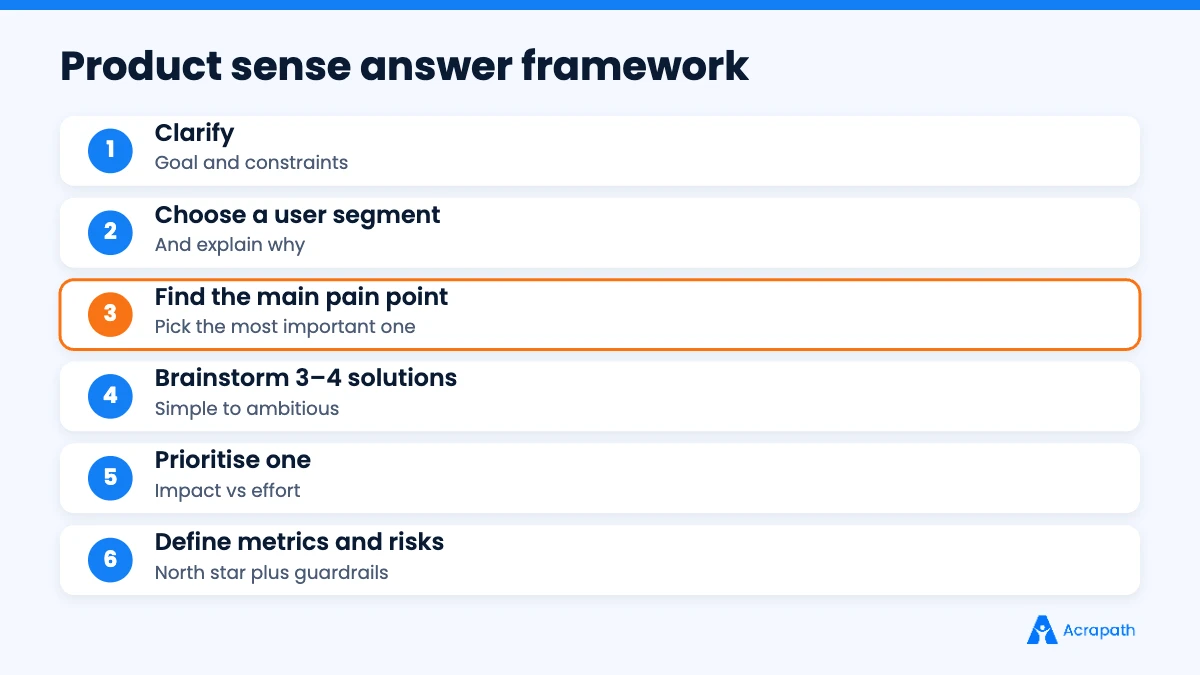
Product sense questions ask you to design a new product or improve an existing one. Use a simple structure so you don't jump straight to features:
Clarify the goal and constraints. Ask one or two questions.
Choose a user segment and explain why.
List their main pain points and pick the most important one.
Brainstorm 3–4 solutions, from simple to ambitious.
Prioritise one, based on impact and effort.
Define success metrics and mention risks.
1. How would you improve [a popular app you use]?
Why they ask: To see whether you start with users and problems rather than a wish list of features.
How to answer: Pick one user segment, find a real pain point, propose a focused solution and explain how you would measure it.
Sample answer: "Let's take a food delivery app and focus on families ordering dinner for four or more people. Their biggest pain point is coordinating different orders, so one person ends up collecting choices on WhatsApp. I'd build a group order link where each person adds their own items to a shared cart that the host pays for. I'd measure success through group orders per week, average order value and repeat usage among families, while watching delivery times as a guardrail."
2. Design a product for elderly people who live alone.
Why they ask: It tests empathy, segmentation and creativity in an unfamiliar space.
How to answer: Narrow the segment, focus on one strong need such as safety or loneliness, and keep the solution simple to use.
Sample answer: "I'd focus on people over 70 who live alone and whose children live in other cities. Their families worry most about emergencies and missed medicines. I'd design a simple daily check-in device with one large button: pressing it each morning tells family members all is well, and missing it triggers a call. Success would be daily check-in rate and how quickly families respond to alerts."
3. What is your favourite product, and why?
Why they ask: It shows how you think about products and users.
How to answer: Choose something you know well, explain who it serves and why it works, and add one improvement.
Sample answer: "My favourite is a UPI payments app. It turned a multi-step bank transfer into scanning a QR code, which works for both a street vendor and a large retailer. The design hides complexity behind one action. If I could improve one thing, I'd make failed payment reasons clearer, because uncertainty is the main anxiety users feel."
4. How would you prioritise features for the next quarter?
Why they ask: Prioritisation is a core PM responsibility.
How to answer: Link priorities to goals, use a simple scoring method and explain trade-offs.
Sample answer: "I'd start from the quarter's goal, for example improving activation. I'd list candidate features and score each on expected impact on that goal, confidence and effort, using a method like RICE. Then I'd review the top items with engineering and design, check dependencies and agree what we are explicitly not doing this quarter."
Analytical and Metrics Questions
For metrics questions, always define the goal before naming metrics. Then choose a north-star metric that captures value for users, plus a few supporting and guardrail metrics.
5. What metrics would you track for a new feature?
Why they ask: It tests whether you can connect features to outcomes.
How to answer: State the goal, pick a north-star metric, then adoption, engagement and guardrail metrics.
Sample answer: "For a "save for later" feature in a shopping app, the goal is to recover purchases users aren't ready to make yet. My north star would be purchases from saved items. Supporting metrics: share of active users who save an item, items saved per user and time from save to purchase. Guardrails: overall conversion rate and cart abandonment, to make sure saving doesn't simply delay purchases that would have happened anyway."
6. Daily active users dropped 10% last week. How would you investigate?
Why they ask: Root-cause analysis is a daily PM task.
How to answer: Check data quality first, then segment by time, platform, geography and user type, then look for internal and external causes.
Sample answer: "First I'd confirm the drop is real and not a tracking issue. Then I'd check whether it was sudden or gradual and segment it by platform, app version, country, new versus returning users and acquisition channel. If it's limited to one app version, I'd check recent releases. If it's across everything, I'd look at external factors like holidays, outages or a competitor launch. Then I'd confirm the cause and agree a fix."
7. How would you measure the success of a search feature?
Why they ask: It tests your understanding of user intent and quality metrics.
How to answer: Combine usage, quality and outcome metrics.
Sample answer: "I'd track search usage rate, click-through rate on results, the share of searches with no results, how often users refine or repeat a search, and conversion from search to the key action such as a purchase or booking. Time to first relevant click is a useful quality signal too."
Estimation Questions
Estimation questions test structured thinking, not the exact number. State your assumptions clearly, break the problem into steps and sanity-check your answer.
8. How many cups of coffee are sold in Bengaluru each day?
Why they ask: It tests whether you can reason step by step under uncertainty.
How to answer: Pick a sensible starting population, segment it and multiply by realistic rates.
Sample answer: "I'll assume about 13 million people in Bengaluru. Say around 30% drink coffee outside the home on a typical day, that is roughly 4 million people, averaging about 1.5 cups. That gives around 6 million cups a day. I'd sanity-check it by estimating the number of cafes and stalls and their daily sales, and adjust if the two numbers are far apart."
Say your assumptions out loud, round numbers so the maths is easy, and finish with a quick sanity check. Interviewers care far more about your reasoning than your final figure.
Technical Questions
PMs don't need to code in most roles, but they need enough technical understanding to discuss trade-offs with engineers.
9. What happens when you type a website address into a browser?
Why they ask: A classic test of basic technical understanding.
How to answer: Explain the main steps simply.
Sample answer: "The browser looks up the domain's IP address through DNS, opens a connection to the server, usually over HTTPS, and sends a request. The server processes it, often calling databases and other services, and sends back HTML, CSS and JavaScript, which the browser renders. Caching and CDNs can speed up many of these steps."
10. How would you work with engineers on a technical trade-off?
Why they ask: It tests collaboration and judgement.
How to answer: Show that you clarify the user and business impact, then let engineers lead on solutions.
Sample answer: "I'd explain the user problem and what success looks like, then ask the engineers for options with their trade-offs in time, risk and maintainability. If one option ships faster but adds technical debt, I'd agree a plan to address that debt rather than ignore it."
If your target role is technical, such as a platform or API product, revise system basics with our guide on how to prepare for a technical interview.
Behavioural Questions
Use the STAR method: situation, task, action, result. Keep each story under two minutes and end with a number where possible.
11. Tell me about a product you launched.
Why they ask: It shows your end-to-end ownership.
How to answer: Cover the problem, your role, key decisions, the launch and results.
Sample answer: "I led the launch of a self-serve onboarding flow for small business customers who previously needed a sales call to get started. I ran user interviews, wrote the requirements, worked with design on three prototypes and phased the rollout. Self-serve sign-ups grew steadily over the next quarter, and the sales team could focus on larger accounts."
12. Tell me about a time you said no to a stakeholder.
Why they ask: PMs must protect focus.
How to answer: Show respect, use data and offer an alternative.
Sample answer: "A sales leader wanted a custom feature for one large prospect. I showed that it would delay a roadmap item affecting most of our customers. Instead, I suggested a lighter workaround the prospect could use immediately and added the request to our backlog with evidence for later prioritisation. The deal closed, and the roadmap stayed on track."
13. Tell me about a product decision that failed.
Why they ask: Honesty and learning matter more than a perfect record.
How to answer: Own the decision, explain what you learned and what you changed.
Sample answer: "We launched a referral programme without testing the reward size first, and uptake was far lower than expected. I learned to test key assumptions with a small experiment before a full launch. In the next quarter we tested three reward levels with small user groups first, and the winning version performed much better."
14. How do you handle disagreement with a designer or engineer?
Why they ask: Collaboration is central to the role.
How to answer: Show that you go back to users and data, not hierarchy.
Sample answer: "I start by making sure we agree on the user problem and the goal. Then I ask what each of us is worried about. Often a quick prototype or user test settles the disagreement better than debate. If we still disagree, I make a decision, explain my reasoning and stay open to revisiting it if the data says otherwise."
Use our interview preparation guide to build your full story bank.
Strategy Questions
15. Should our company build or buy a new capability?
Why they ask: It tests business judgement.
How to answer: Compare cost, time to market, strategic importance and risk.
Sample answer: "If the capability is core to our differentiation, I'd lean towards building it so we control the experience and can improve it over time. If it's a commodity, such as payments or email delivery, buying or partnering usually gets us to market faster and lets the team focus on what makes us unique."
16. How would you enter a new market?
Why they ask: It tests strategic structure.
How to answer: Cover the customer, the size of the opportunity, competition, your right to win and a small first step.
Sample answer: "I'd first define the target customer and their unmet need, estimate the market size and look at competitors' strengths and gaps. Then I'd ask what gives us an advantage, such as existing customers, technology or distribution. I'd recommend a small, measurable pilot before a full launch."
Many strategy questions overlap with consulting-style cases. Our case interview preparation guide explains frameworks you can borrow.
Take-Home Assignments and Presentation Rounds
Some companies give a take-home product case, such as "propose how to improve retention for our app" or "write a short product requirements document for feature X". To do well:
Clarify the brief and the time expected. Don't spend days on a two-hour task.
Structure your answer: problem, users, insights, options, recommendation, metrics, risks and next steps.
Use evidence: app reviews, public data or a few quick user conversations.
Keep it short: 6–10 slides or 2–3 pages is usually enough.
Practise presenting in 15–20 minutes and leave time for questions.
Questions to Ask Your Interviewer
"How does the team decide what to build next?"
"How do product, design and engineering work together day to day?"
"Which metrics matter most for this product right now?"
"What would success look like for this role in six months?"
"What's the biggest challenge facing the product this year?"
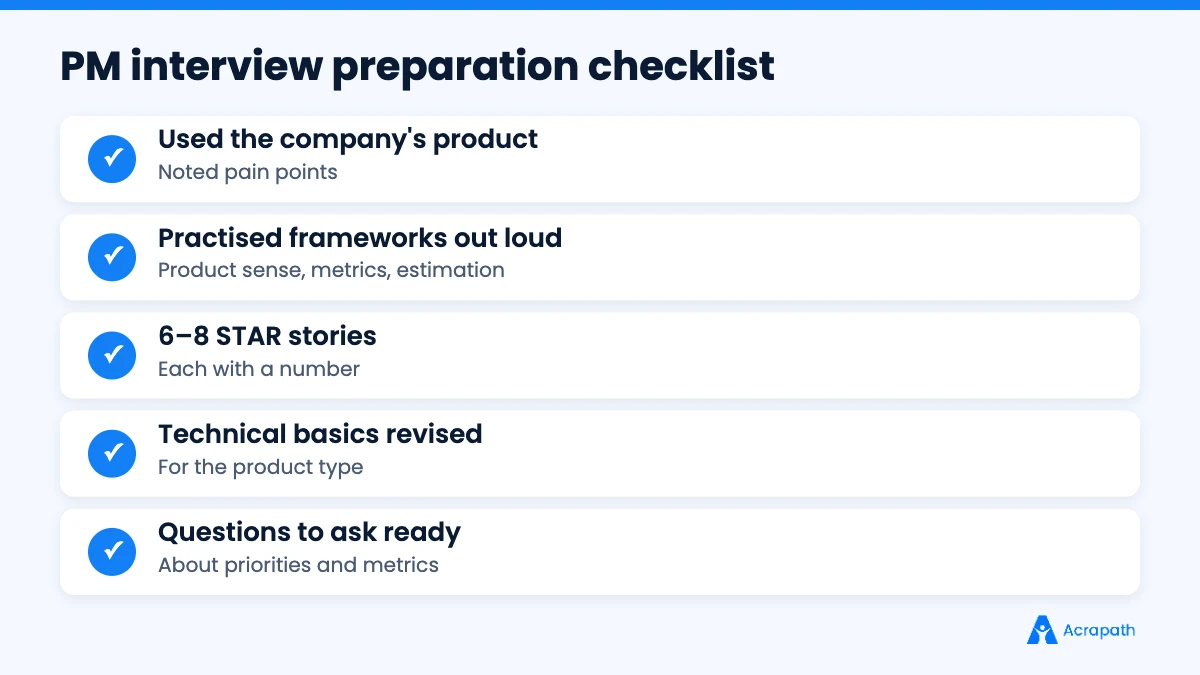
How to Prepare in Two Weeks
Days | Focus |
|---|---|
1–2 | Research the company and its products; use them as a user and note pain points |
3–5 | Practise product sense questions out loud, one a day, using the framework |
6–7 | Practise metrics and root-cause questions; write down metric trees |
8 | Practise 3–4 estimation questions with a timer |
9–10 | Build 6–8 STAR stories with numbers |
11 | Revise technical basics for the product type |
12 | Do a full mock interview with a friend or mentor |
13–14 | Prepare questions to ask, refine weak answers and rest |
If you're moving into product from another field, such as engineering, design, sales or consulting, our guide on how to switch careers shows how to frame your experience. Make sure your CV gets past screening software with our ATS-friendly resume guide, and when the offer arrives, use our salary negotiation scripts. Designers moving into product may also find our UI/UX designer interview questions useful for portfolio-style rounds.
Common Mistakes in PM Interviews
Jumping to features before defining the user and the problem
Listing too many metrics without a clear north star
Ignoring trade-offs, such as cost, effort or risk
Talking about "we" without explaining your own role
Rambling: long answers without structure lose interviewers quickly
Not using the company's product before the interview
Conclusion
Most product manager interview questions test the same core skills: understanding users, using data to make decisions, working with technical teams and communicating a clear recommendation. Learn a simple structure for product sense, metrics and estimation questions, prepare STAR stories with numbers, and practise everything out loud.
Do that, and even unfamiliar questions become a chance to show how you think.
Ready for your next product role? See open product jobs on Acrapath and set up alerts for PM and associate PM roles.
- #product manager interview questions
- #PM interview
- #product sense
- #estimation questions
- #product jobs
Frequently asked questions
What are the most common product manager interview questions?
Common questions include improving or designing a product, choosing metrics for a feature, investigating a drop in usage, estimation questions, explaining basic technical concepts, and behavioural questions about launches, prioritisation, conflict and failure. Strategy questions about new markets or build-versus-buy decisions are common for senior roles.
How do I answer product sense questions?
Clarify the goal, choose a specific user segment, identify their main pain point, brainstorm a few solutions, prioritise one based on impact and effort, then define success metrics and risks. Starting with users and problems, rather than features, is what interviewers look for most.
How should I approach PM estimation questions?
State your assumptions clearly, break the problem into simple steps such as population, share of users and frequency, use round numbers and finish with a sanity check. Interviewers care far more about structured reasoning than whether your final number is exactly right.
Do product managers need technical skills?
Most PM roles don't require coding, but you need enough technical understanding to discuss trade-offs with engineers, such as how APIs, databases and front ends work together. Technical, platform and API product roles may test this more deeply.
How long should I prepare for a product manager interview?
Around two weeks of focused practice works well for most candidates: research the company, practise product sense, metrics and estimation questions out loud, build STAR stories with numbers, revise technical basics and do at least one full mock interview.