How to Become a Recruiter: Skills, Salary and Your First Role

Jatin Kashyap
Growth Lead, Acrapath
Learn how to become a recruiter: what recruiters do, types of recruiting roles, key skills and certifications, a step-by-step path to your first role, pay and career growth.
Key Takeaways
To become a recruiter, you typically need a graduate degree (HR, business, psychology or any field), strong communication skills and an entry role such as recruitment coordinator, sourcer, HR executive or agency associate.
Recruiters find, screen and interview candidates, manage hiring pipelines and help close offers. The job mixes HR, sales and project management.
Key skills include sourcing and Boolean search, screening, interviewing, ATS use, persuasion, organisation and resilience.
In the US, the Bureau of Labor Statistics groups recruiters with human resources specialists, whose median pay was $72,910 in May 2024, with 6% projected growth from 2024 to 2034.
Most recruiters specialise over time, for example in tech, healthcare, sales or executive hiring, which raises both impact and earning potential.
Every company needs people, and someone has to find them. Recruiters sit right at that point: they understand what a team needs, search for people who fit, persuade the right ones to apply and guide both sides to an offer. When it works, a recruiter changes a candidate's career and a company's future in the same week.
If you enjoy talking to people, like a fast pace and get a buzz from closing a deal, recruitment can be a rewarding career with clear growth and strong earning potential, especially once you specialise.
This guide explains how to become a recruiter: what the job really involves, the main types of recruiting roles, the skills and qualifications employers want, a step-by-step path to your first role, pay and career growth, and how to prepare for recruiter interviews.
What Does a Recruiter Do?
A recruiter finds, screens and helps hire candidates for job openings. They work with hiring managers to understand each role, write and post job ads, search databases and networks for candidates, screen resumes, conduct interviews, coordinate the interview process, share feedback, negotiate offers and support candidates through to joining.
A typical week might include:
Intake meetings with hiring managers to understand new roles and must-have skills
Sourcing candidates through job portals, LinkedIn, referrals and databases
Screening calls to check experience, motivation, notice period and salary expectations
Shortlisting and presenting candidates to hiring managers
Scheduling interviews and collecting feedback
Closing: negotiating offers, handling counter-offers and keeping candidates engaged until joining
Reporting on pipelines, time to hire and hiring progress
Types of Recruiters
Recruiting roles vary a lot depending on who you work for and what you hire.
Type | Who they work for | What's different |
|---|---|---|
In-house or corporate recruiter | One company | Deep knowledge of the business and culture; steady salary |
Agency or staffing recruiter | Many client companies | Fast-paced, target-driven, often commission-based |
Executive search recruiter | Clients hiring senior leaders | Long searches, discreet outreach, high-value placements |
RPO recruiter | An outsourcing firm embedded in a client | Volume hiring for one client using the firm's processes |
Technical or IT recruiter | Tech companies or agencies | Needs understanding of tech roles and skills |
Campus recruiter | Employers hiring graduates | College relationships and fresher programmes |
Healthcare recruiter | Hospitals or healthcare agencies | Licensing and registration checks are central |
Many recruiters start in agency or RPO roles because they offer intensive training and fast learning, then move in-house or into specialist recruiting later.
Skills You Need to Become a Recruiter
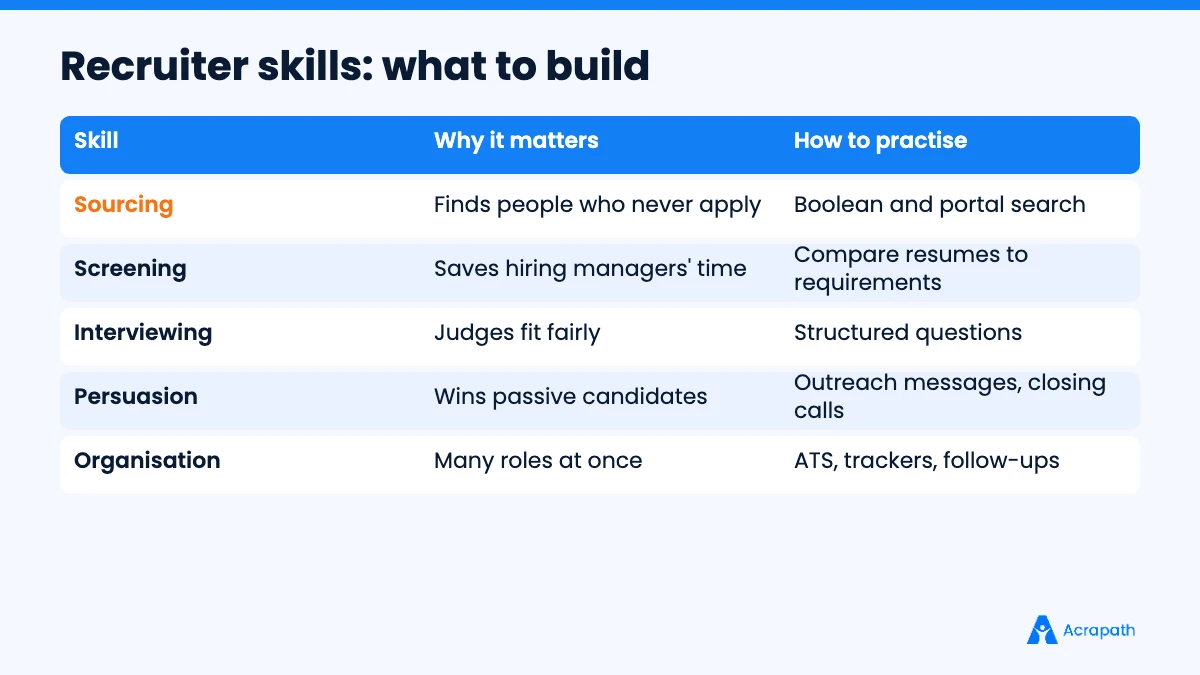
Hard skills
Sourcing: finding candidates on job portals, LinkedIn and databases, including Boolean search, for example: (“Java” OR “Spring Boot”) AND developer AND Pune.
Resume screening: quickly judging fit against role requirements.
Interviewing: asking structured, job-related questions and probing answers.
ATS and HR tools: managing pipelines and records in applicant tracking systems.
Employment basics: offer components, notice periods, background checks and fair hiring practices.
Data and reporting: tracking pipelines, conversion rates and time to hire in spreadsheets or dashboards.
Soft skills
Communication: clear, friendly and professional on calls, email and messages.
Persuasion and negotiation: selling a role to passive candidates and closing offers.
Resilience: candidates decline, offers fall through and roles get put on hold.
Empathy: treating candidates with respect, even when the answer is no.
Organisation: juggling many roles, candidates and deadlines at once.
Business understanding: learning what different roles actually do and need.
Education and Certifications
There's no single required degree. Many recruiters have degrees in HR, business, psychology or communication, but graduates from any field can succeed, especially with strong communication skills. Technical recruiters with a background in engineering or IT often have an edge in tech hiring.
Certifications can strengthen your profile once you have some experience:
Certification | Who it suits | Offered by |
|---|---|---|
SHRM-CP | HR and recruiting professionals | |
CIPD qualifications | HR professionals, especially in the UK | |
Short sourcing or talent acquisition courses | New and junior recruiters | Online learning platforms and recruiting communities |
MBA or PG diploma in HR | Those aiming for HR leadership | Universities and business schools |
Check each provider's eligibility rules and current costs. For your first role, practical sourcing and interviewing skills matter more than certificates.
How to Become a Recruiter (Step-by-Step)
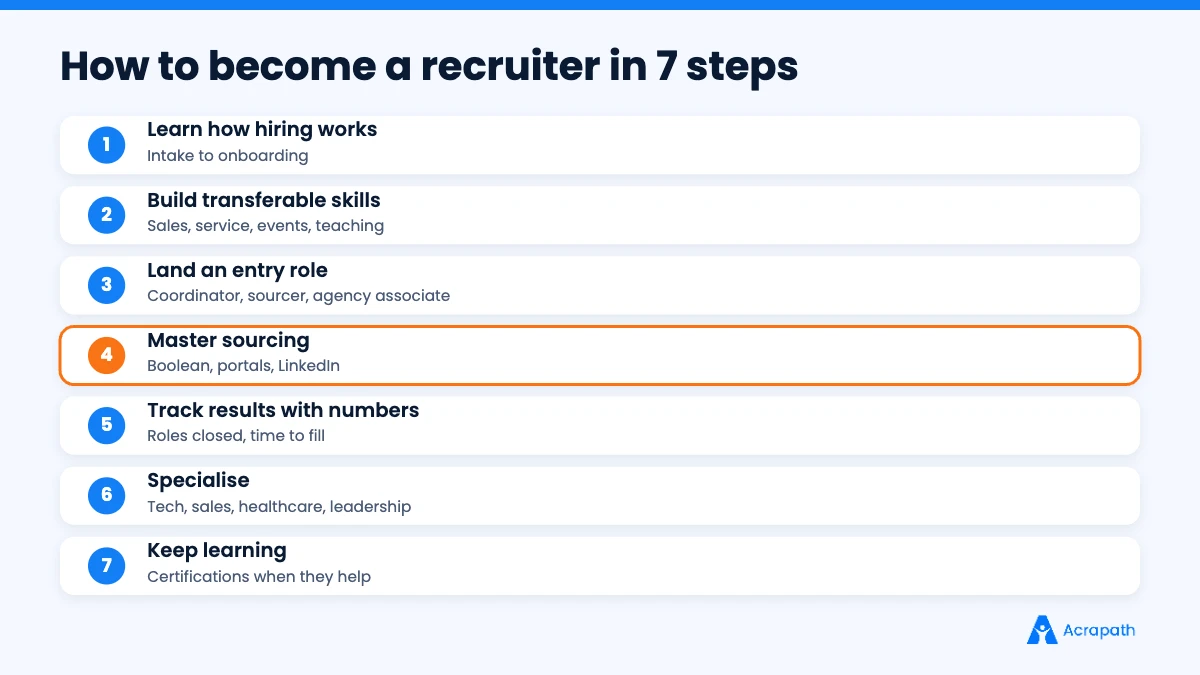
Step 1: Learn how hiring works
Understand the full recruitment cycle: intake, job description, sourcing, screening, interviews, offers and onboarding. Reading how employers approach hiring helps. Our employer guides to screening resumes and running a structured interview show the process from the hiring side.
Step 2: Build transferable skills
Customer service, sales, teaching, event management and campus placement committee work all build recruiter skills: talking to strangers, handling objections, organising and following up. Highlight these on your resume.
Step 3: Land an entry-level role
Common starting points include:
Recruitment coordinator or talent acquisition coordinator
Sourcer or sourcing associate
Agency recruitment associate or consultant
HR executive with recruitment responsibilities
Recruitment intern
If you're new to the workforce, our guide to a resume with no experience shows how to present college projects and responsibilities. Read how one recruitment intern grew into an HR business partner in our career case study.
Step 4: Master sourcing
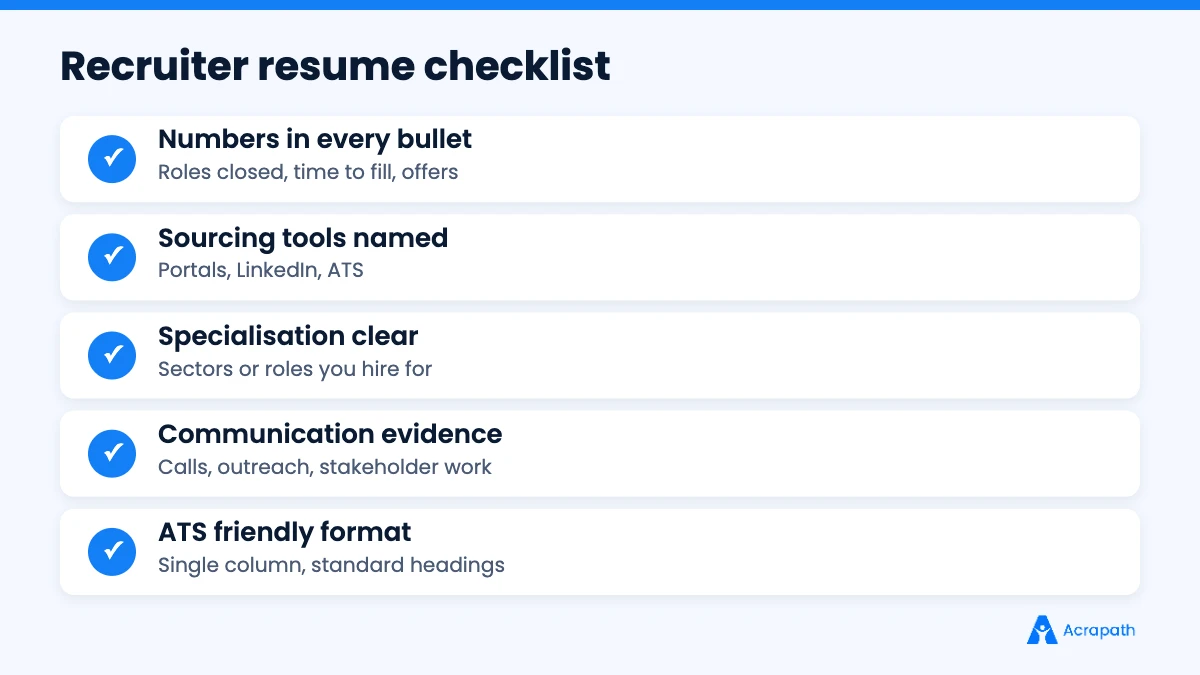
Learn Boolean search, portal search filters and LinkedIn search. Practise writing short, personalised outreach messages. Sourcing is the skill that most separates average recruiters from strong ones.
Step 5: Build a track record with numbers
Track your results from day one: roles closed, time to fill, candidates submitted versus interviewed, offer acceptance rate and hiring manager feedback. These numbers become your strongest resume and interview material.
Step 6: Choose a specialisation
After a year or two, focus on a sector or role type: tech, sales, finance, healthcare, campus or leadership hiring. Specialists build deeper networks, understand roles better and usually earn more.
Step 7: Keep learning and consider certification
Learn employment basics for your market, new sourcing tools and data skills. Add a certification when it supports your next step, such as moving into an in-house team or a talent acquisition lead role.
A Day in the Life of a Recruiter
No two days are the same, but a typical day for a recruiter handling several open roles might look like this:
9:30 am: check overnight applications, messages and interview feedback.
10:00 am: a 20-minute intake call with a hiring manager about a new sales role.
10:30 am – 12:30 pm: sourcing: running searches, reviewing profiles and sending personalised messages to potential candidates.
2:00 – 4:00 pm: screening calls with shortlisted candidates to check experience, interest, notice period and salary expectations.
4:00 pm: sending a shortlist to a hiring manager with a short note on each candidate.
4:30 pm: scheduling interviews, chasing feedback and updating the applicant tracking system.
5:30 pm: an offer call with a candidate, answering questions and discussing joining dates.
Agency recruiters often spend more time on business development and client calls, while in-house recruiters spend more time with internal hiring teams. Both spend a large part of the day on the phone.
Recruiting Metrics You'll Be Measured On
Recruiters are judged on results. Knowing the common metrics helps you track your own performance and talk about it in interviews.
Metric | What it measures |
|---|---|
Time to fill | Days from a role opening to an accepted offer |
Submittal-to-interview ratio | How many shortlisted candidates the hiring manager chooses to interview |
Offer acceptance rate | Offers accepted out of offers made |
Quality of hire | How new hires perform and how long they stay |
Candidate experience | Feedback from candidates, including those not hired |
Placements or roles closed | The number of successful hires in a period |
Tools Recruiters Use
You don't need to master every tool before your first job, but knowing the main categories helps:
Job portals and candidate databases for posting roles and searching profiles
LinkedIn for sourcing, outreach and employer branding
Applicant tracking systems for managing pipelines and candidate records
Spreadsheets for trackers, reports and simple dashboards
Scheduling and video tools for interviews
Email and messaging templates for consistent, quick communication
Pick up the tools your employer uses quickly, and focus on the skills behind them: searching well, communicating clearly and keeping every candidate updated.
Recruiter Salary and Career Growth
Recruiter pay depends on the type of recruiting, the industry you hire for, your city and your results. In the US, the Bureau of Labor Statistics includes recruiters in the human resources specialists group, which had a median annual wage of $72,910 in May 2024 and is projected to grow 6% from 2024 to 2034.
A few factors shape earnings everywhere:
Agency recruiters often earn a base salary plus commission or incentives linked to placements.
In-house recruiters usually have a higher fixed salary and more predictable hours.
Specialists in tech, leadership or niche roles generally earn more than generalists.
Results such as roles filled, quality of hire and client feedback drive increments.
When an offer arrives, compare in-hand pay and the incentive structure carefully. Our guide on how to negotiate salary can help.
A common career path looks like this:
Recruitment coordinator or associate
Recruiter or recruitment consultant
Senior recruiter or principal consultant
Talent acquisition lead or recruitment manager
Head of talent acquisition or HR leadership
Recruiters also move into HR business partnering, employer branding, people operations or starting their own recruitment business.
Pros and Cons of Being a Recruiter
Pros | Cons |
|---|---|
You help people change their careers | Rejection and dropped offers are common |
Fast learning about many roles and industries | Targets can create pressure, especially in agencies |
Strong earning potential with results | Busy periods can mean long days |
Clear progression and specialisation paths | You depend on hiring managers' availability |
Skills transfer into HR, sales and consulting | Hiring slows down in tough economies |
How to Get Hired as a Recruiter
Recruiting interviews often feel like sales interviews, because the job is partly about persuasion. Expect questions such as:
"Why do you want to be a recruiter?"
"How would you find candidates for a hard-to-fill role?"
"Write a Boolean search for [role]."
"A candidate accepts an offer, then gets a counter-offer. What do you do?"
"How do you handle a hiring manager who keeps changing requirements?"
"Tell me about a time you persuaded someone to change their mind."
Prepare STAR stories with numbers, and use our interview preparation guide and HR interview questions and answers to practise. Make sure your resume gets past screening software too: recruiters will judge your own resume closely, so follow our ATS-friendly resume tips. If you're coming from another field, our guide on how to switch careers shows how to frame your move, and how to start a career in HR covers the wider HR path.
Common Mistakes New Recruiters Make
Posting and waiting. Strong recruiters source actively instead of relying only on applications.
Skipping the intake meeting. Unclear requirements lead to wasted searches.
Overselling roles. Misleading candidates causes dropouts and damages trust.
Poor follow-up. Candidates and hiring managers both expect regular updates.
Ignoring data. Tracking your pipeline shows where hiring gets stuck.
Treating candidates as numbers. Your reputation with candidates is your long-term network.
Conclusion
To become a recruiter, learn how hiring works, build communication and organisation skills, and start in an entry role such as recruitment coordinator, sourcer or agency associate. Master sourcing, track your results with numbers, then specialise in a sector you enjoy and add certifications as you grow.
Recruitment rewards people who are curious, persistent and genuinely interested in others. Do it well, and you'll help hundreds of people find their next role while building a strong career of your own.
Ready to start? Browse HR and recruitment jobs on Acrapath and set up alerts for recruiter roles.
- #how to become a recruiter
- #recruiter skills
- #talent acquisition
- #HR careers
- #recruitment jobs
Frequently asked questions
What qualifications do you need to become a recruiter?
Most recruiters have a graduate degree, often in HR, business, psychology or communication, though any field can work. Employers value strong communication, organisation and persuasion skills most. Certifications such as SHRM-CP or CIPD qualifications can help later, but practical sourcing and interviewing skills matter more for a first role.
Can a fresher become a recruiter?
Yes. Many recruiters start straight after graduation as recruitment coordinators, sourcing associates, agency recruitment associates or recruitment interns. Agency and outsourcing firms often train freshers intensively. Highlight communication, customer-facing experience, organisation and any campus placement or event work on your resume.
What is the difference between an in-house recruiter and an agency recruiter?
An in-house recruiter works for one company and hires only for its roles, usually with a fixed salary and deep knowledge of the business. An agency recruiter works for a recruitment firm, filling roles for many clients, often with targets and commission linked to placements.
How much do recruiters earn?
Pay depends on the type of recruiting, industry, city and results. In the US, recruiters fall under human resources specialists, whose median pay was $72,910 in May 2024 according to the Bureau of Labor Statistics. Agency recruiters may earn commission on top of base pay, and specialists often earn more.
What skills make a good recruiter?
Good recruiters combine sourcing and Boolean search, resume screening, structured interviewing and ATS use with communication, persuasion, negotiation, empathy, organisation and resilience. Understanding the roles you hire for, and tracking your pipeline with data, helps you fill roles faster and with better candidates.