How to Become an Online Tutor: Skills, Platforms and Pay

Jatin Kashyap
Growth Lead, Acrapath

A practical guide to becoming an online tutor: choosing a subject, the skills and setup you need, where to find students, how to set your rates and how to grow into a full-time teaching career.
Key Takeaways
To become an online tutor, pick one subject and level you know well, set up a quiet space with a good headset and whiteboard, choose a work model and run your first trial lessons.
The US BLS reported a median of $40,090 a year ($19.27 an hour) for tutors in May 2024, and noted that most tutors work part time.
There are 4 main ways to tutor online: an edtech job, a tutoring marketplace, your own private students, or online classes for a school or institute.
Specialists earn more: exam prep, advanced maths, coding and languages usually pay above general homework help.
Most new tutors can be ready to teach within 2-4 weeks of deciding to start.
You explain a maths concept to your cousin, and for the first time it clicks for them. You realise you're good at this. Could you do it for students you've never met, from home, and get paid for it?
Online tutoring is one of the most flexible ways to earn from what you know. College students, teachers, working professionals and parents returning to work all tutor online, part time or full time.
The basics are simple, but the tutors who build steady income do a few things differently: they specialise, they set up properly and they treat tutoring like a small business.
This guide walks you through the skills you need, how to set up, where to find students, how to set your rates and how to grow online tutoring into a long-term career.
What Is an Online Tutor?
An online tutor teaches students one-on-one or in small groups over video. Tutors help with school subjects, exam preparation, languages, coding, music and professional skills.
Unlike a classroom teacher, an online tutor usually focuses on one student's specific needs: closing gaps, building confidence or preparing for a particular test.
The US Bureau of Labor Statistics describes tutors as working in a range of settings and notes that most work part time, often in the evenings and on weekends, with busier periods before exams.
Types of Online Tutoring
Type | Typical students | What you need |
|---|---|---|
School subject tutoring | Students in Classes 1-12 or equivalent | Strong subject knowledge for the board or curriculum |
Exam preparation | Students preparing for entrance or language tests | Deep knowledge of the exam pattern |
Language tutoring | Adults and children learning a new language | Fluency, conversation practice skills |
Coding and tech skills | Students and working professionals | Practical skills and project examples |
College-level tutoring | Undergraduates | Degree-level subject expertise |
Hobby and creative skills | Learners of music, art, writing | Portfolio and teaching examples |
Choose one type to start. A clear niche makes it easier for students to find and trust you.
Is Online Tutoring Right for You?
Online tutoring suits you if you:
Enjoy explaining ideas and seeing someone improve.
Are patient when a student doesn't understand the first time.
Can stay organised with schedules, notes and payments.
Are comfortable on camera and with basic technology.
Want flexible hours or extra income alongside study or work.
It may be harder if you need a fixed monthly salary from day one. Income from private students grows over time, so many tutors combine an edtech job with a few private students at first.
Skills Every Online Tutor Needs
Subject mastery: you must know your subject well beyond the level you teach.
Clear explanation: breaking a big idea into small, simple steps.
Questioning: asking questions that show what the student really understands.
Patience and encouragement: many students come to tutors after struggling.
Online engagement: using screen sharing, whiteboards and quick quizzes to keep attention.
Planning: structuring each session and tracking progress over weeks.
Professional communication: clear updates for parents and adult learners.
How to Become an Online Tutor (Step-by-Step)
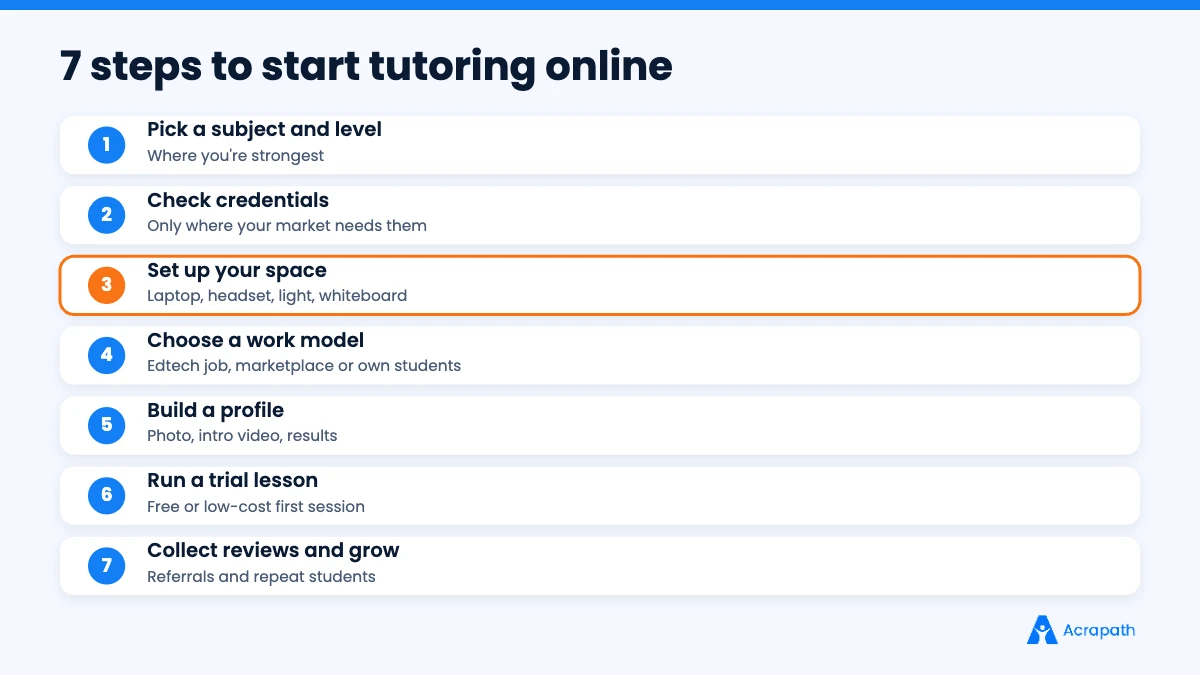
Step 1: Pick Your Subject and Level
Start with your strongest subject and a specific level. "Physics for Class 11-12" or "Spoken English for working professionals" is easier to market than "all subjects".
Check demand: look at what parents ask for in local groups, what edtech companies hire for, and what students search for in your area.
Step 2: Check Whether You Need Credentials
Many private students and marketplaces don't require a teaching qualification. Edtech companies, schools and some exam-prep roles may prefer or require a relevant degree, a teaching credential or a language certificate. Requirements vary by country and employer, so check before you apply.
Even when credentials aren't required, a relevant certificate or strong academic record builds trust quickly.
Step 3: Set Up Your Teaching Space
You don't need a studio, but you do need to look and sound clear.
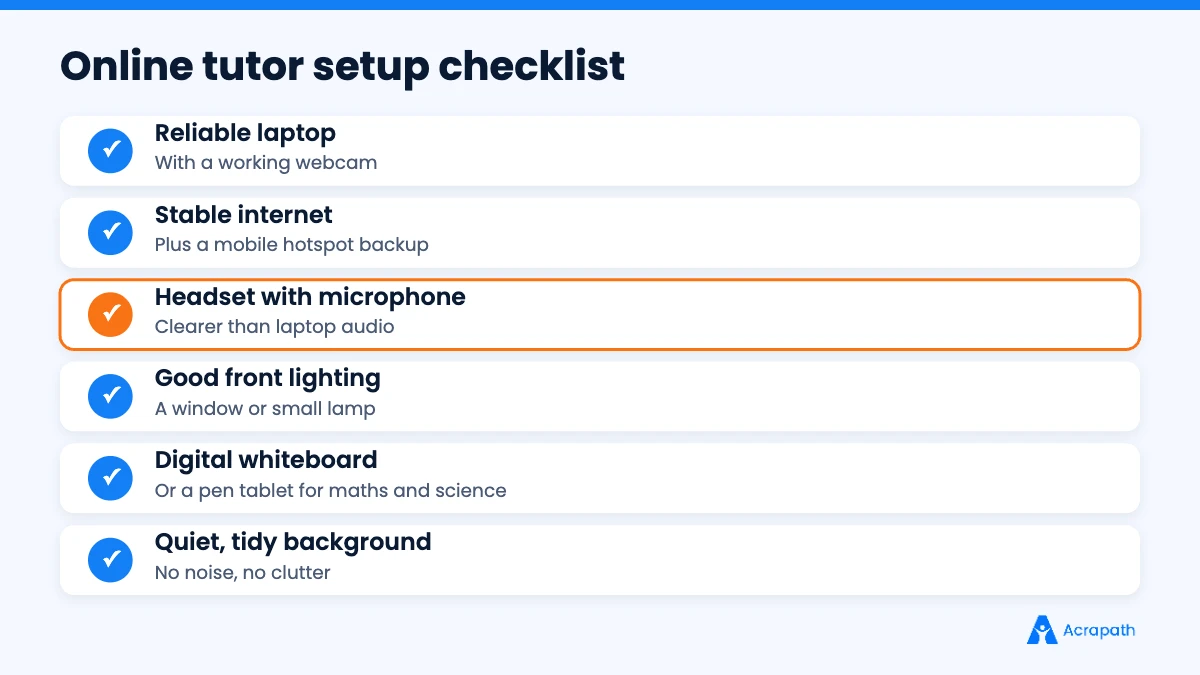
Pitfall to avoid: don't rely on laptop speakers and a built-in microphone. A basic headset is the cheapest, biggest upgrade you can make.
Step 4: Choose How You'll Work
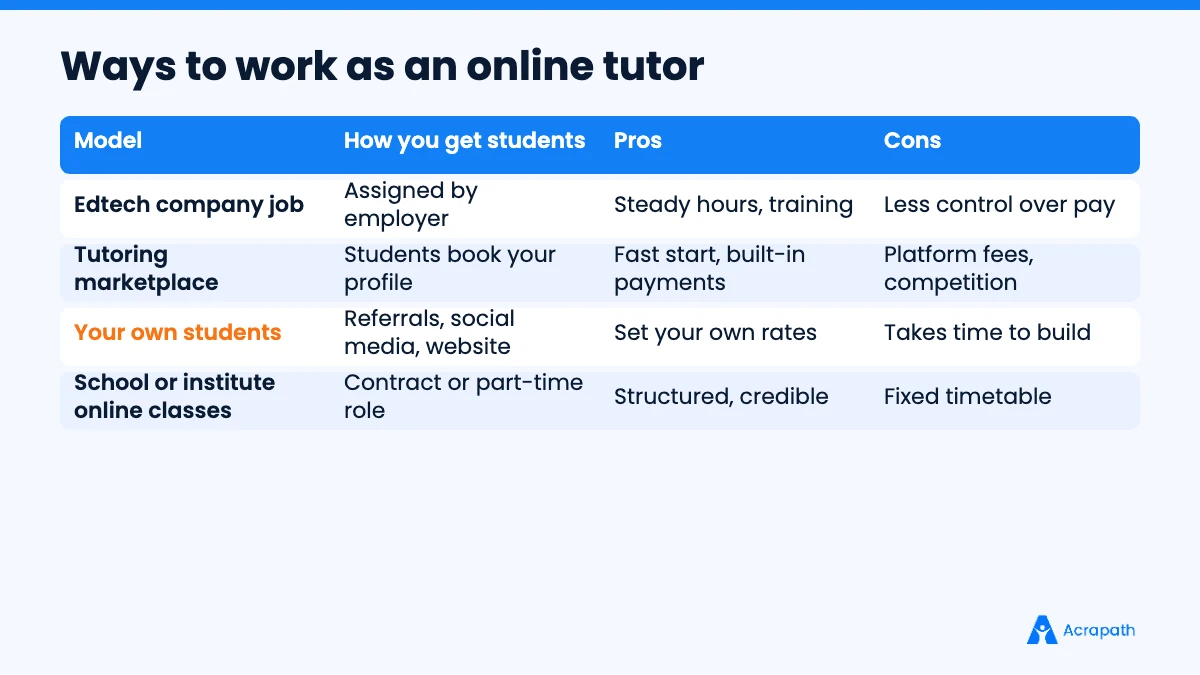
Most new tutors start with an edtech job or a tutoring marketplace to get experience and reviews, then add private students over time. Our case study on scaling tutor hiring at an edtech company shows what these companies look for when they hire tutors in bulk.
Step 5: Build a Strong Tutor Profile
Whether on a marketplace, an application or your own page, your profile should include:
A clear, friendly photo.
A one-line headline: "IIT-qualified physics tutor for JEE and Class 11-12".
A short intro video of 60-90 seconds explaining one concept.
Your qualifications and teaching experience.
Results, such as "helped 12 students improve their board maths scores by 15+ marks".
Your availability and time zone.
Step 6: Run Trial Lessons
Offer a short trial lesson so parents and students can see how you teach. Use it to assess the student's level and agree goals. Many tutors find a trial converts better than any profile description.
Step 7: Collect Reviews and Grow
After a few weeks, ask happy students and parents for a short review. Referrals from satisfied families are the cheapest and most reliable source of new students.
How to Prepare for Edtech Tutor Interviews
Edtech companies usually test you with a short demo class. Prepare:
A 10-15 minute lesson on a topic they choose or one you're strong in.
A way to check understanding, such as two or three quick questions.
An example of how you'd handle a student who is distracted or stuck.
Our teacher interview questions and answers cover the questions most education employers ask, and our interview preparation guide helps with research and follow-up.
How to Set Your Tutoring Rates
Pricing depends on your subject, level, experience, market and the student's location.
Research local and online rates for your subject and level.
Start slightly below established tutors while you build reviews, but not so low that you undervalue your work.
Charge more for specialist work such as exam prep, advanced maths, coding or teaching students abroad.
Offer packages, for example 8 or 12 sessions paid upfront, to keep students committed.
Review your rates every 6-12 months as your results and reviews grow.
Write a simple policy for cancellations and late arrivals, and share it before the first paid session.
How Much Do Online Tutors Earn?
Earnings vary more for tutors than for most jobs. In the US, the BLS reported a median annual wage of $40,090 for tutors in May 2024, or about $19.27 an hour. The lowest-paid 10% earned under $28,430, and the top 10% earned more than $78,810.
Your income depends on how many hours you fill and your hourly rate. A tutor with 20 regular hours a week at a strong specialist rate can earn far more than one who teaches general homework help for a few hours.
BLS projects employment of tutors to grow 1% from 2024 to 2034, so specialising and building a reputation matters more than waiting for demand to rise.
How to Structure Your First Lesson
A clear structure helps new students trust you quickly:
Time | What to do |
|---|---|
0-5 minutes | Introductions, goals and how the student feels about the subject |
5-15 minutes | A short diagnostic: a few questions to find gaps |
15-40 minutes | Teach one focused concept with examples and practice |
40-50 minutes | Student explains it back or solves problems alone |
50-60 minutes | Summary, homework and plan for the next session |
Send a short message to the parent or adult learner after the session with what you covered and what comes next.
Ways to Find Your First Students
Your network: friends, family, former teachers and school groups.
Local parent communities on messaging apps and social media.
Short teaching clips on social media that solve one common problem.
Tutoring marketplaces and edtech job listings.
Schools and coaching centres that need online or substitute faculty.
A Day in the Life of an Online Tutor
Here's how a part-time maths tutor who also works a day job might spend a weekday:
Time | Activity |
|---|---|
7:00-7:30 AM | Review notes and homework from yesterday's students |
6:00-7:00 PM | One-on-one session: Class 10 algebra revision |
7:15-8:15 PM | Small group session: three students preparing for a unit test |
8:30-9:00 PM | Mark submitted work, send short updates to parents |
Weekend | Plan next week's lessons, record one short teaching clip |
Full-time tutors often teach five to seven hours a day, spread across mornings for adult learners or students abroad, and evenings for school students. Planning, marking and messages add one to two hours more.
Tools Online Tutors Use
You can start with free tools and add paid ones as you grow:
Video calling software with screen sharing and recording.
Digital whiteboards for writing equations, drawing diagrams and saving board notes for students.
A pen tablet if you teach maths, science or anything with diagrams.
Shared documents and folders for notes, worksheets and homework.
Quiz tools for quick checks at the start or end of a session.
A simple calendar and booking link so students can choose slots.
A spreadsheet to track students, sessions, payments and progress.
Learn one tool well before adding another. Students care far more about clear explanations than fancy software.
Online Tutor vs Classroom Teacher
Online tutor | Classroom teacher | |
|---|---|---|
Group size | One student or a small group | Full class |
Schedule | Flexible, often evenings and weekends | Fixed school hours |
Credentials | Often optional | Usually required by law |
Income | Varies with hours and rates | Fixed salary scale |
Focus | Individual gaps and goals | Whole curriculum for many students |
Many people do both: they teach in a school or coaching centre and tutor a few students online.
Teaching Students in Other Countries
Online tutoring lets you teach students anywhere, which can raise your income. A few practical points:
Time zones: list your availability in the student's time zone to avoid confusion.
Curriculum differences: learn the exam boards and terms your students use, such as GCSE, IB or SAT.
Payments: use a reliable method that handles currency conversion, and agree fees and refund rules in writing.
Taxes: income from overseas students is usually taxable in your country. Keep clear records and check with a tax adviser.
Language and accent: speak clearly and check understanding often.
How to Keep Students Engaged Online
Attention drops faster on a screen than in a classroom. These habits keep students involved:
Ask a question every few minutes. Even "What do you think comes next?" keeps the student thinking.
Let the student drive the whiteboard. Ask them to solve or draw while you guide.
Use short bursts. Teach for five to seven minutes, then switch to practice.
Show progress. Keep a simple tracker of topics mastered and scores over time, and share it every few weeks.
Turn cameras on. Seeing faces helps you spot confusion early. Agree this with parents for younger students.
End with a small win. Finish on a problem the student can solve confidently.
Engaged students improve faster, renew packages and recommend you to friends, so engagement is good teaching and good business.
Growing Beyond Tutoring
Online tutoring builds skills that open other doors:
Classroom or school teaching, with the right credentials.
Coaching centre faculty for exam preparation.
Instructional design and curriculum writing. See our case study on a teacher who became an instructional designer.
Corporate training. Our guide on how to become a corporate trainer explains the path.
Running your own tutoring business with other tutors.
Common Mistakes New Online Tutors Make
Teaching every subject and level. Specialise to stand out.
Skipping the diagnostic. You can't fix gaps you haven't found.
Talking for the whole session. Students learn by doing; aim for them to work at least half the time.
No written policies. Clear rules on payments and cancellations prevent awkward conversations.
Ignoring safety and privacy. Use professional platforms, keep records of sessions with minors where required, and never share students' details.
Conclusion
Becoming an online tutor starts with one subject you know well, a simple but professional setup and a clear way to find students. Choose your work model, run trial lessons, collect reviews and keep improving your rates as your results grow.
Your next step: record a 60-second clip explaining one concept from your subject. It becomes your intro video and your first piece of marketing.
If you'd prefer a structured role, explore education and training jobs on Acrapath, including online teaching and tutoring positions.
- #online tutor
- #online tutoring jobs
- #teaching from home
- #edtech jobs
- #career guide
Frequently asked questions
Do I need a degree to become an online tutor?
Not always. Many tutoring marketplaces and private students care more about subject knowledge and teaching skill than a specific degree. Edtech companies and schools often prefer or require a degree in the subject, and some test-prep and school roles may need teaching credentials. Requirements vary by country and employer.
How much do online tutors earn?
Earnings vary widely by subject, level, country and experience. In the US, the Bureau of Labor Statistics reported a median of $19.27 an hour for tutors in May 2024. Exam preparation, advanced maths, coding and language tutoring for international students usually pay more than general homework help.
What subjects are most in demand for online tutoring?
Maths, science, English, coding and exam preparation are consistently in demand, along with spoken languages for adults. Tutors who specialise in a specific exam, board or skill level, such as Class 10 CBSE maths or IELTS speaking, usually find students faster than generalists.
What equipment do I need to tutor online?
You need a reliable laptop with a webcam, a stable internet connection with a backup, a headset with a microphone, good lighting, a quiet background and a digital whiteboard or pen tablet. Most tutors start with what they already own and upgrade the headset and lighting first.
Can online tutoring become a full-time career?
Yes. Many tutors build a full schedule through an edtech job or a base of repeat private students. Others use tutoring as a step into teaching, instructional design, corporate training or curriculum writing. Treat it like a business: track hours, students, reviews and earnings.