How to Become a Compliance Officer: Path, Skills and Salary

Jatin Kashyap
Growth Lead, Acrapath
A step-by-step guide to becoming a compliance officer: degrees, certifications like CAMS and CS, skills, first roles, salary data and a 12-month plan.
This is general career information, checked in November 2026. Licensing and qualification rules differ by country and change over time, so confirm them with the official body in your market.
Key Takeaways
To become a compliance officer, earn a degree in law, commerce, finance or business, pick a compliance area, add one recognised credential and start in an entry role such as KYC analyst.
The US Bureau of Labor Statistics puts the median compliance officer wage at $78,420 (May 2024), with 3% job growth projected for 2024-34.
Most people take 2-5 years to move from a first analyst job to the officer title.
5 credentials cover most paths: CAMS, ICA certificates, CCEP, Company Secretary (India) and CIPP for privacy.
Employers hire for attention to detail, clear writing and judgement as much as for degrees.
You read a news story about a bank fined for weak anti-money laundering checks and think: someone should have caught that. That someone is a compliance officer.
Compliance is one of the steadiest careers in law and finance. Every regulated business, from banks and fintechs to hospitals and listed companies, needs people who know the rules and make sure the business follows them.
The path is clearer than most people think. You don't need to be a litigator, and you don't need ten years of experience to start.
This guide walks you through what compliance officers do, the qualifications that matter, the skills employers test, how to land your first role, and what you can expect to earn.
What Is a Compliance Officer?
A compliance officer makes sure an organisation follows the laws, regulations and internal policies that apply to it. They write policies, monitor activity, train staff, investigate problems and report to management or regulators when something goes wrong.
The job is preventive. A good compliance officer spots risk early, so the business never ends up in front of a regulator or a court.
Compliance work usually falls into one of these areas:
Financial crime (AML and KYC): checking customers, monitoring transactions, reporting suspicious activity.
Corporate and securities compliance: board filings, disclosures, insider-trading rules and company law.
Regulatory compliance in financial services: banking, insurance and investment rules.
Data privacy: how the company collects, stores and shares personal data.
Healthcare and industry-specific compliance: patient data, product safety or environmental rules.
If you're still weighing legal paths, our guide to legal careers beyond litigation compares compliance with in-house counsel, legal operations and other options.
What Does a Compliance Officer Do Day to Day?
A compliance officer spends most of the day reviewing, checking and explaining. The exact mix depends on the industry, but a typical week includes:
Reading new regulations and turning them into simple internal rules.
Reviewing customer files, contracts or transactions flagged by systems.
Running compliance training for sales, operations and finance teams.
Testing whether teams actually follow the policies they signed.
Investigating breaches and writing clear incident reports.
Preparing reports for senior management, the board or regulators.
Most compliance officers work standard office hours. Deadlines bunch up around regulatory filings, audits and investigations.
How to Become a Compliance Officer (Step-by-Step)
Here is the most common route into compliance. You can move faster if you already work in audit, risk, banking operations or legal support.
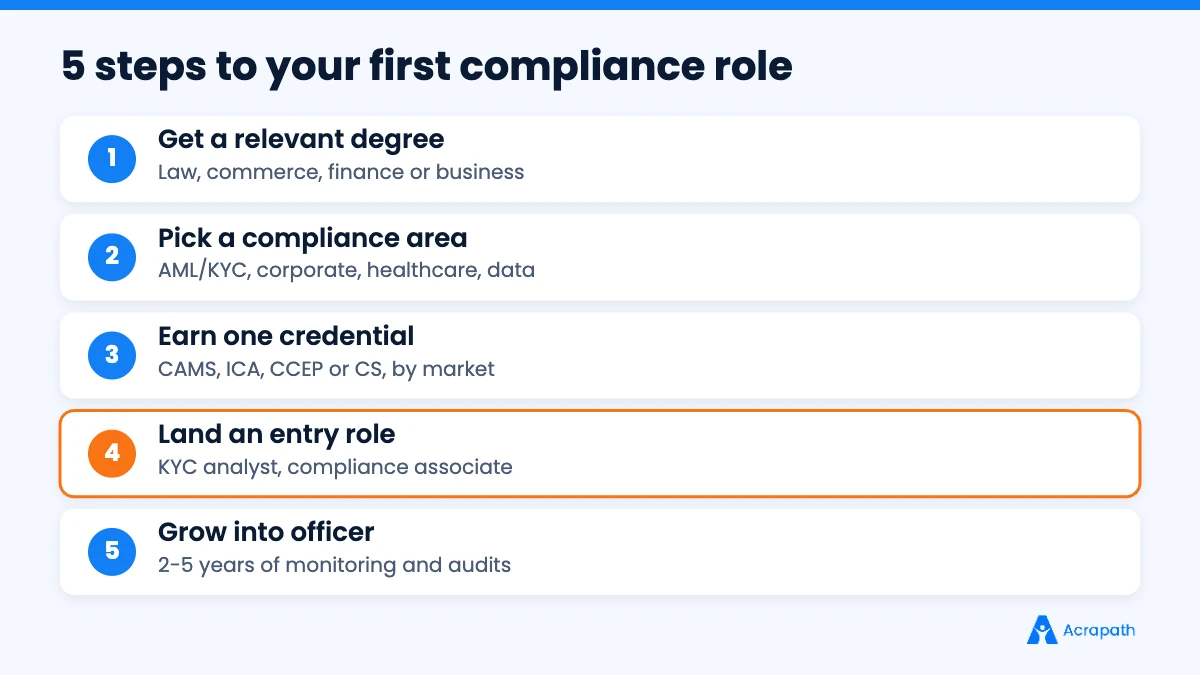
Step 1: Get a Relevant Degree
Most compliance roles ask for a bachelor's degree. The US Bureau of Labor Statistics notes that compliance officers typically need one and often learn the rest on the job.
Useful degrees include:
Law (LLB or equivalent): best for corporate, securities and regulatory roles.
Commerce, finance or economics: strong for AML, banking and audit-linked roles.
Business administration: works well for general corporate compliance.
Pitfall to avoid: don't wait for a master's degree before applying. A postgraduate course helps later, but entry roles rarely require one.
Step 2: Choose a Compliance Area
Compliance is broad. Pick one area for your first two years so your CV tells a clear story.
Ask yourself which you enjoy more: numbers and transactions (AML, financial crime), documents and law (corporate and securities), or technology and data (privacy). Your answer points to your first niche.
Step 3: Earn One Recognised Credential
A credential shows employers you've studied the rules properly. Pick one that matches your area and market.
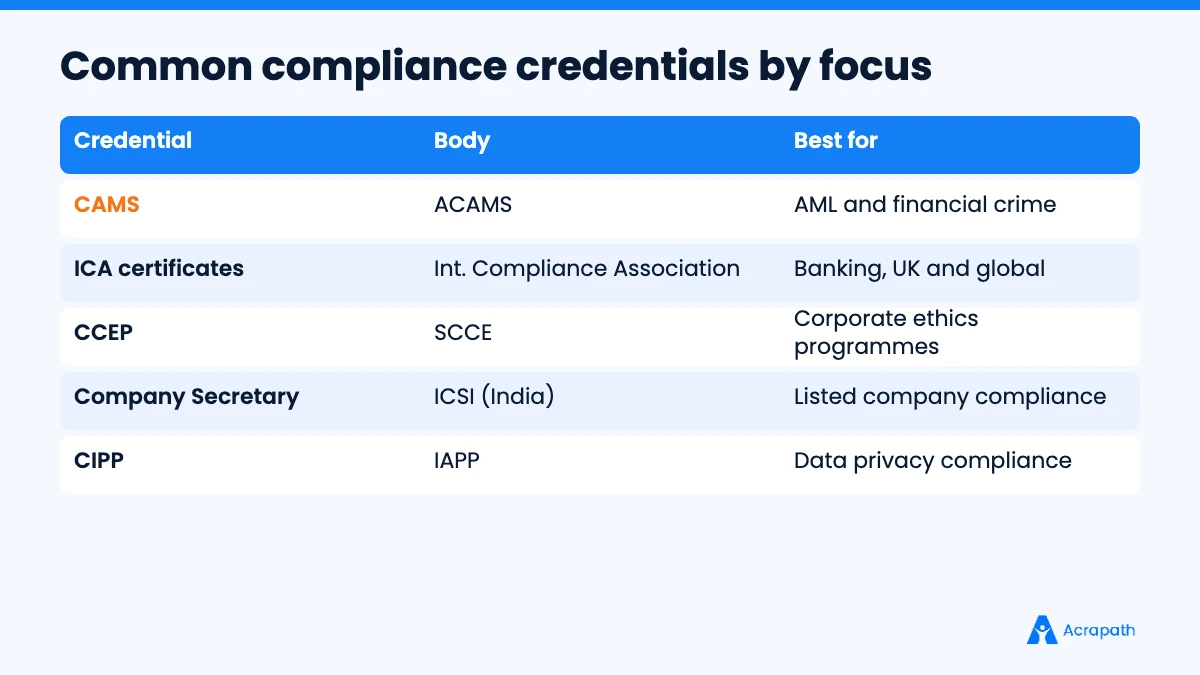
ACAMS awards CAMS, the most widely recognised anti-money laundering credential.
The International Compliance Association offers certificates and diplomas used heavily in banking.
SCCE awards CCEP for corporate compliance and ethics programmes.
In India, the Company Secretary qualification from ICSI is the standard route into listed-company compliance.
IAPP runs the CIPP family for data privacy roles.
Pitfall to avoid: don't stack three certifications before your first job. One relevant credential plus real experience beats a long list.
Step 4: Land an Entry-Level Role
Your first job title probably won't say "compliance officer". Look for:
KYC analyst or onboarding analyst
AML or transaction monitoring analyst
Compliance associate or compliance executive
Legal and compliance intern
Secretarial assistant (company secretarial firms)
Banks, NBFCs, fintechs, payment companies, insurers, consulting firms and listed companies hire for these roles. Our case study on building a KYC and AML compliance team shows how one lender hired juniors and trained them up.
Step 5: Grow Into the Officer Role
After two to five years of monitoring, investigations and audits, you can move into a compliance officer role. Volunteer for policy writing, regulator responses and training sessions. These are the tasks that separate officers from analysts.
Skills Every Compliance Officer Needs
Employers test for skills in interviews and case tasks, so build them on purpose.
Skill | Why it matters | How to build it |
|---|---|---|
Attention to detail | One missed red flag can cost millions | Practise reviewing sample KYC files and contracts |
Clear writing | Policies and reports must be simple | Rewrite a regulation in plain English |
Judgement | Not every alert is a real risk | Study published enforcement cases |
Communication | You train and sometimes say no to sales teams | Run a short session for classmates |
Analytical thinking | Spotting patterns in data | Learn Excel filters and pivot tables |
Integrity | You report problems even when it's awkward | Show examples in interviews |
Technical tools help too. Many teams use screening databases, case management systems and spreadsheets. Basic Excel is non-negotiable; SQL is a bonus in large financial firms.
Compliance Officer Salary
Compliance pay varies widely by country, industry and seniority.
In the US, the BLS reports a median annual wage of $78,420 for compliance officers in May 2024. The lowest-paid 10% earned under $46,230 and the top 10% earned more than $130,030. BLS projects employment to grow 3% from 2024 to 2034, about as fast as the average for all jobs.
Pay usually rises with:
Industry: banking and financial services tend to pay more than other sectors.
Credential: CAMS, CS or a privacy credential can lift offers.
Seniority: managers and chief compliance officers earn several times an analyst's salary.
Location: major financial centres such as Mumbai, Dubai, London and New York pay a premium.
In India, salaries are usually quoted as CTC (cost to company) in lakhs per year. If that term is new, our guide to CTC vs in-hand salary explains how to read an offer.
Compliance Officer Career Path
Most compliance careers follow a clear ladder.
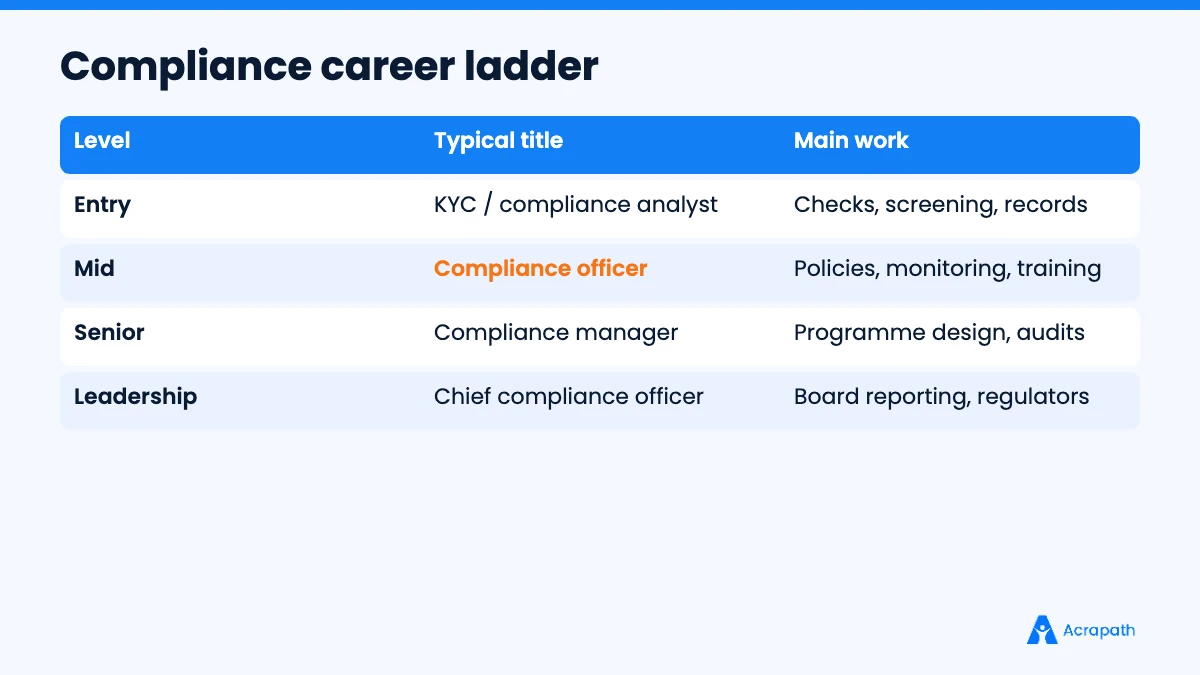
Some officers later move sideways into risk management, internal audit, legal operations or regulatory affairs. Others specialise deeply, for example as a financial crime investigator or privacy lead.
Compliance Officer vs Related Roles
Compliance sits close to several other jobs. This comparison helps you choose.
Role | Focus | Typical background |
|---|---|---|
Compliance officer | Following laws and policies day to day | Law, commerce, finance |
Legal counsel | Legal advice, contracts, disputes | Law degree, bar enrolment |
Internal auditor | Testing controls after the fact | Accounting, CA, CIA |
Risk manager | Measuring and reducing business risk | Finance, statistics |
Company secretary | Board and statutory compliance | CS qualification |
Industries That Hire Compliance Officers
Compliance jobs exist anywhere rules are strict. The biggest employers are:
Banks, NBFCs and payment companies: AML, KYC and regulatory reporting.
Fintech and crypto firms: fast-growing teams that need people who learn quickly.
Insurance and asset management: product, sales and investment rules.
Healthcare and pharma: patient data, marketing rules and product safety.
Listed companies: disclosures, insider trading and board compliance.
Consulting and audit firms: compliance advisory for many clients.
How to Stand Out When You Apply
Your CV should prove you can be trusted with detail. A few tactics work well:
Lead with your compliance area. "Law graduate focused on AML compliance" is stronger than "law graduate seeking opportunities".
Quantify your work. "Reviewed 400+ KYC files in a three-month internship" tells a recruiter far more than "worked on KYC".
Show your credential progress. "CAMS candidate, exam scheduled March" counts.
Make your CV ATS-friendly. Use simple headings and the keywords from the job post. Our ATS-friendly resume guide shows how.
For the interview itself, practise explaining a regulation in plain English and walking through how you'd handle a suspicious transaction. Our interview preparation guide covers research, practice and follow-up, and our list of legal associate interview questions includes several compliance-style scenarios.
A Sample 12-Month Plan for Freshers
If you're starting from zero, this plan gets you job-ready in a year.
Months | Focus | Output |
|---|---|---|
1-2 | Choose your area and read the core rules | One-page notes on your area's main regulations |
3-5 | Study for one credential | Exam booked or passed |
4-6 | Internship or project | 1 real compliance project on your CV |
6-8 | Build tools skills | Excel case log, basic data checks |
8-10 | Apply widely and network | 30-50 targeted applications |
10-12 | Interview and negotiate | First offer as analyst or associate |
A Day in the Life of a Compliance Officer
No two days are identical, but a mid-level compliance officer at a bank or fintech might spend a typical day like this.
Time | What happens |
|---|---|
9:30 AM | Review overnight alerts from the transaction monitoring system and close the obvious false positives |
11:00 AM | Meet the product team about a new feature and flag the rules it touches |
1:00 PM | Update a policy after a regulator publishes a new circular |
3:00 PM | Interview a team member as part of a small internal investigation |
4:30 PM | Draft a short monthly compliance report for senior management |
Notice how much of the day is spent with other teams. Compliance is not a back-room job. The best officers build trust across the business, so people come to them early instead of hiding problems.
Tools Compliance Officers Use
You don't need to master every tool before your first job, but knowing the categories helps you speak confidently in interviews.
Screening and watchlist tools: check customers against sanctions and politically exposed person (PEP) lists.
Transaction monitoring systems: flag unusual payments for review.
Case management software: log alerts, investigations and decisions with an audit trail.
Policy management platforms: store policies, track attestations and training.
Spreadsheets and basic data tools: Excel remains the everyday tool for sampling, testing and reporting.
Regulator portals: many regulators require filings and reports through their own online systems.
If you're a fresher, mention any tool you used in an internship, even briefly. Familiarity with the workflow matters more than the brand name.
Metrics You'll Be Measured On
Compliance teams are judged on outcomes, not hours. Expect your manager to track measures like these:
Alert turnaround time: how quickly you review and close flagged cases.
Quality of decisions: whether reviewers or auditors agree with your conclusions.
Training completion: the share of staff who finish required compliance training on time.
Audit and regulator findings: fewer and less serious findings show the programme works.
Policy currency: whether policies are updated soon after rules change.
Knowing these metrics gives you strong answers to "how would you measure success in this role?", a question that comes up in most compliance interviews.
Common Mistakes to Avoid
Applying everywhere with one generic CV. Tailor it to AML, corporate or privacy roles.
Ignoring soft skills. Compliance officers persuade colleagues every day.
Chasing the title over experience. A strong analyst role at a well-run firm beats a vague "officer" title at a firm with no real compliance programme.
Overlooking related entry points. Operations, audit and legal support roles often lead into compliance.
Conclusion
Becoming a compliance officer is a realistic goal for law, commerce and finance graduates. Choose one compliance area, earn a recognised credential, start as an analyst or associate, and grow into the officer role over two to five years.
Your next step is simple: pick your area this week and shortlist one credential to start on.
When you're ready to apply, browse legal and compliance jobs on Acrapath and set up alerts for analyst and associate roles in your city or abroad.
- #compliance officer
- #legal careers
- #KYC AML
- #career guide
- #certifications
Frequently asked questions
What qualifications do you need to become a compliance officer?
Most compliance officers hold a bachelor's degree in law, commerce, finance or business. Employers then look for a recognised credential tied to the area you work in, such as CAMS for anti-money laundering, ICA certificates in banking, or the Company Secretary qualification for listed companies in India.
Can I become a compliance officer without a law degree?
Yes. Many compliance officers come from commerce, finance, audit, operations or risk backgrounds. A law degree helps you read regulations, but employers often care more about attention to detail, clear writing and a recognised compliance certification than about the exact degree.
How long does it take to become a compliance officer?
Most people need two to five years. Expect three to four years for a degree, then one to three years in an entry role such as KYC analyst or compliance associate before you hold the officer title. Earning a certification early can shorten the path.
What does a compliance officer earn?
Pay depends heavily on country and industry. In the US, the Bureau of Labor Statistics reports a median wage of $78,420 for compliance officers in May 2024. Financial services usually pays more than other sectors because regulation is heavier there.
Is compliance a good career for law freshers?
Compliance is a strong option for law freshers who prefer structured, advisory work over courtroom practice. Banks, fintechs, NBFCs, consultancies and listed companies hire juniors every year, and the skills you build move easily between industries and countries.


