How to Ask for a Raise: Timing, Scripts and What to Bring

Jatin Kashyap
Growth Lead, Acrapath

When to ask for a raise, how much to ask for, what evidence to bring, and word-for-word scripts and emails for the conversation, plus what to do if the answer is no.
Key Takeaways
To ask for a raise, choose the right timing, research your market rate, bring 3-5 results with numbers, name a specific figure and ask in a short, planned meeting.
Mercer's March 2026 survey found US employers paid an average merit increase of 3.1% this year, so a bigger jump needs a stronger case.
The best window is usually 4-8 weeks before salary budgets are set, not during appraisal week.
Bring evidence, not effort: results, new responsibilities and market data beat "I work hard".
If the answer is no, leave with clear criteria and a review date within 3-6 months.
You've delivered more this year than ever. You've picked up work from a colleague who left. You've trained two new joiners. But your pay hasn't moved, and you're not sure how to bring it up without sounding demanding.
Asking for a raise feels uncomfortable for almost everyone. Yet managers expect these conversations, and many will not offer more pay unless you ask.
The difference between a raise and an awkward chat usually comes down to preparation: when you ask, what you bring and what you say.
This guide covers the best timing, how much to ask for, the evidence that persuades, word-for-word scripts and emails, and exactly what to do if your manager says no.
Why Asking for a Raise Matters
Pay rarely catches up on its own. Annual increases are usually small and spread across the whole team. Mercer's March 2026 compensation survey found US employers paid an average merit increase of 3.1% this year, slightly below what they had planned.
If your role has grown, or the market now pays more for your skills, a standard increase may leave you behind. Asking is how you close that gap.
There's also a long-term effect. Every future increase, bonus and job offer tends to build on your current salary, so a raise now compounds for years.
How to Ask for a Raise (Step-by-Step)
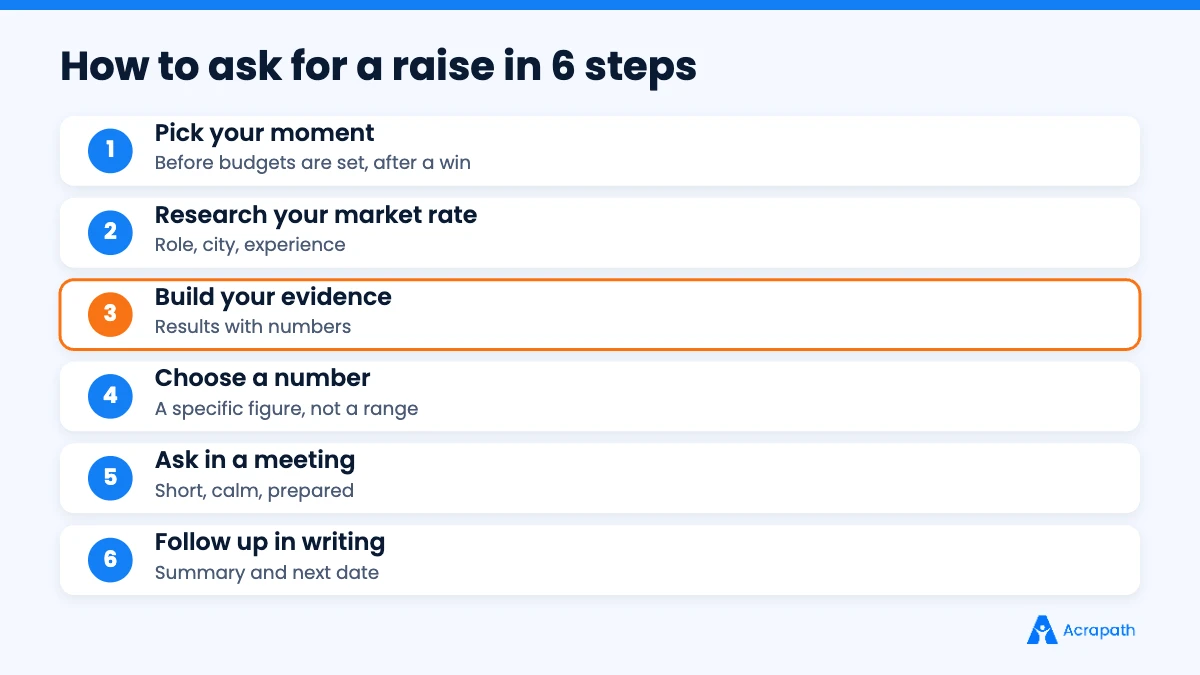
Step 1: Pick the Right Moment
Timing matters more than most people think. The best time to ask is before your company sets its salary budget for the year. Once budgets are locked, even a supportive manager may have little room.
Ask your manager or HR when the budget cycle runs. For many companies it's a few months before the financial year starts.
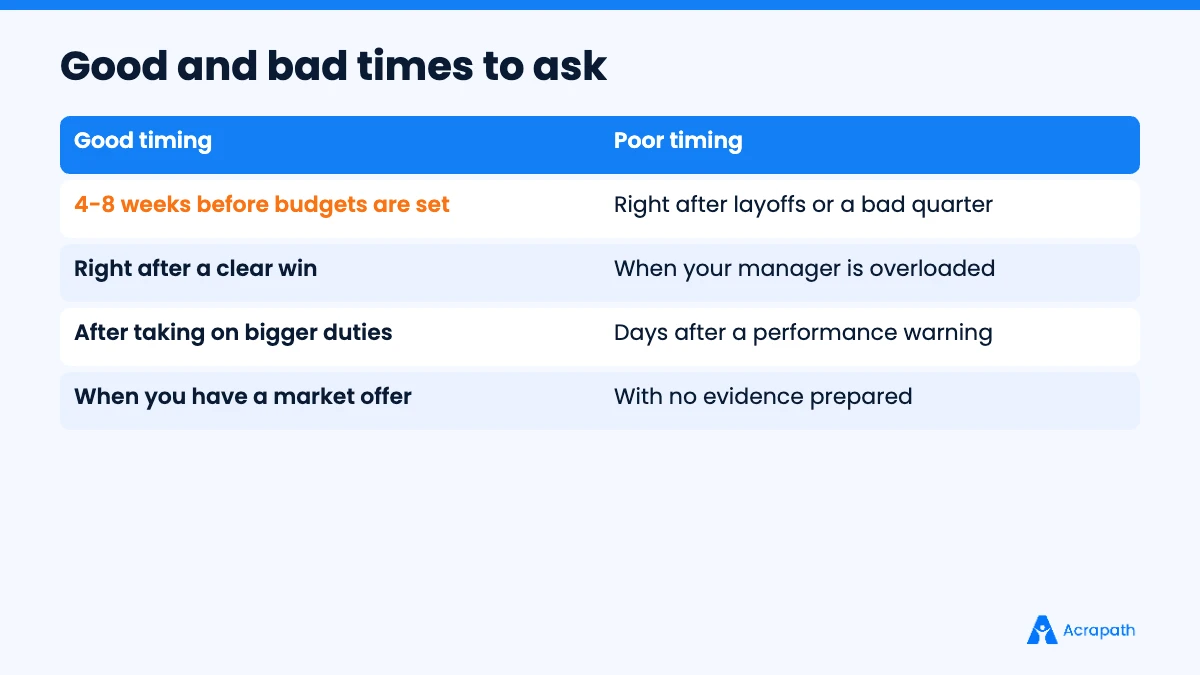
Pitfall to avoid: don't wait for your formal appraisal. By then, increases are often already decided.
Step 2: Research Your Market Rate
Find out what people in your role, city and experience level earn. Use:
Salary ranges in current job postings for similar roles
Published salary surveys for your industry
Conversations with recruiters and peers in your field
Offers you or colleagues have received recently
Write down a realistic range. If you work in India, compare CTC and in-hand figures carefully; our guide to CTC vs in-hand salary explains the difference.
Step 3: Build Your Evidence
Managers approve raises for value, not effort. Prepare three to five results with numbers. Good examples:
"Cut invoice processing time from 5 days to 2 days."
"Closed 18 new accounts worth ₹40 lakh in annual revenue."
"Trained 4 new joiners, who all passed probation."
"Took over the vendor portfolio after my colleague left, with no drop in delivery."
Also list any new responsibilities you've taken on since your last increase. A larger scope is one of the strongest arguments for higher pay.
Step 4: Choose a Specific Number
Ask for a specific figure, not a vague "something more". A clear number shows you've done the research.
Set your figure slightly above your target so there's room to agree in the middle. If your research says ₹9 lakh is fair, asking for ₹9.5-10 lakh is reasonable.
Avoid giving a wide range. If you say "₹8-10 lakh", expect to hear ₹8 lakh.
Step 5: Ask in a Planned Meeting
Book a short, dedicated meeting. Don't raise pay at the end of a stand-up or in a corridor.
Keep the conversation simple: thank your manager, summarise your results, state your number and ask for their view. Then stop talking and listen.
Step 6: Follow Up in Writing
After the meeting, send a short email that recaps what you discussed, the figure you asked for and any agreed next step. This keeps the request alive if your manager needs approval from someone else.
How Much of a Raise Should You Ask For?
There's no single right number, but these guidelines help:
Situation | Reasonable ask |
|---|---|
Doing the same job well | Slightly above your company's standard increase |
Taken on clearly bigger responsibilities | 10-15% |
Paid well below market for your role | Enough to reach the market median |
Moving into a new title or level | In line with your company's promotion increases |
Holding a written outside offer | Close to the outside offer, if you'd genuinely stay |
For context, Mercer's 2027 planning survey found US employers expect total salary increase budgets of about 3.5% next year. Large jumps usually come with promotions or a change in role.
Scripts: What to Say When You Ask for a Raise
Adapt these to your own words. Keep them short and calm.
Asking for the meeting
Hi Priya, could we set up 20 minutes next week to talk about my role and compensation? I'd like to share what I've worked on this year and get your view.
Opening the conversation
Thanks for making time. Over the past year I've taken on the vendor portfolio and cut processing time from five days to two. Based on that wider scope and what similar roles pay in the market, I'd like to discuss moving my salary to ₹9.5 lakh.
If your manager asks how you got the number
I looked at current postings for similar roles in Pune and spoke with two recruiters. Most ranges sit between ₹9 and ₹10.5 lakh for this level of responsibility.
If they say they need to check
That makes sense. When would be a good time to follow up? Is there anything I can prepare to help you make the case?
Raise Request Email Template
Use this after your meeting, or when your manager is remote.
Subject: Follow-up on our compensation conversation
Hi Priya,
Thanks for your time today. As discussed, over the past year I have:
Taken over the vendor portfolio, with no drop in delivery
Cut invoice processing time from 5 days to 2 days
Trained four new team members, all of whom passed probation
Based on this wider scope and current market ranges, I'd like my salary reviewed to ₹9.5 lakh.
You mentioned you'd speak with HR and come back to me by 15 December. Please let me know if you need anything else from me.
Best regards,
Arjun
What to Do If the Answer Is No
A "no" today is not always a "no" forever. Handle it well and you set up the next conversation.
Ask why. Is it budget, timing or your performance? Each needs a different response.
Ask for criteria. "What would I need to achieve to earn this increase?"
Agree a review date. Three to six months is reasonable.
Get it in writing. Send a short email summarising the criteria and the date.
Consider non-salary options. A one-time bonus, a title change, learning budget, flexible work or extra leave may be possible when salary isn't.
If the answer stays no despite strong results, it may be time to see what other employers pay. Our guide to switching careers without starting from zero and our salary negotiation scripts can help you plan that move.
Should You Use an Outside Offer?
An outside offer is strong leverage, but use it carefully.
Only mention it if you'd genuinely accept it. Bluffing can backfire.
Lead with your value, not the threat. "I'd like to stay, and here's why" lands better than an ultimatum.
Be ready for either outcome. Some companies won't counter offers as a policy.
If you do decide to leave, handle the exit professionally. Our resignation letter samples and guide to notice periods help you leave on good terms.
Raise vs Promotion: Which Should You Ask For?
Sometimes the right request isn't more money for the same job, but a new title with more pay. Knowing the difference helps you frame your case.
Raise | Promotion | |
|---|---|---|
What changes | Your salary | Your title, level and usually your salary |
Best when | You do the same job, but better or for below-market pay | You already perform part of the next level's work |
Typical size | Close to the standard increase, unless you're underpaid | Usually larger than a standard increase |
What to bring | Results and market data | Evidence you already work at the next level |
Hiring and pay surveys suggest promotions carry bigger increases than annual merit raises. If you've been leading projects, managing people or owning decisions above your level, ask about a promotion path rather than only a raise.
Prepare for Tough Questions
Your manager may push back. Practise short, calm answers to the questions that usually come up.
"The budget is already fixed this year."
I understand. Could we agree that my salary will be reviewed in the next cycle, and could you note this request now so it's considered when the budget is planned?
"Everyone in your team got the same increase."
I appreciate the team approach. My role has grown since my last review because I've taken over the vendor portfolio, so I'd like my pay to reflect the wider scope.
"Why should we pay you more than the market?"
I'm not asking for more than the market. I'm asking to be paid at the market rate for the responsibilities I now hold.
"Let me think about it."
Of course. Would it help if I sent a short summary of what we discussed? When should I follow up?
Rehearse these answers out loud once or twice. Saying them before the meeting makes them far easier to say during it.
Asking for a Raise When You Work Remotely
Remote and hybrid workers can feel less visible, so make your case easy to see:
Keep a running "wins" document. Add results as they happen, with numbers and dates.
Share progress regularly. Brief weekly or monthly updates keep your work visible long before you ask for more pay.
Use video, not chat. Ask for the raise on a video call so your manager sees your tone and you can read theirs.
Send the summary email the same day. Remote managers juggle many messages, so make the follow-up clear and short.
If you work for a company in another country, research pay for remote roles at that company's level, not only your local market. Rates for the same role can differ widely by country.
Common Mistakes When Asking for a Raise
Making it about personal needs. Rent and EMIs are real, but managers approve raises for value.
Comparing yourself to a named colleague. It puts your manager in an awkward spot.
Asking without a number. It shifts all the work to your manager.
Giving an ultimatum on the first ask. Keep the tone collaborative.
Going silent after a no. Ask for criteria and a review date instead.
Conclusion
Asking for a raise is a normal part of managing your career. Pick the moment before budgets are set, research your market rate, bring three to five results with numbers, name a specific figure and follow up in writing.
Start this week by listing your biggest results since your last increase. That list is the core of your case.
And if you'd like to see what the market would pay you, explore roles on Acrapath and compare offers for your skills.
- #ask for a raise
- #salary hike
- #appraisal
- #salary negotiation
- #career growth
Frequently asked questions
How much of a raise should I ask for?
Ask for a specific figure based on your market rate and your results. Typical annual increases are modest; Mercer's March 2026 survey found US employers paid an average merit increase of 3.1%. If you are clearly underpaid or have taken on a bigger role, asking for 10-20% can be reasonable.
When is the best time to ask for a raise?
The best time is four to eight weeks before your company sets its salary budgets, or soon after a clear achievement. Avoid asking right after layoffs, a poor quarter or a difficult review. Book a dedicated meeting rather than raising it in a hallway or at the end of another call.
Should I ask for a raise by email or in person?
Ask in person or on a video call, then follow up by email. A live conversation lets you explain your case and respond to questions. The follow-up email records what was discussed, the figure you asked for and the date your manager agreed to come back to you.
What should I do if my raise request is denied?
Ask what you would need to achieve to earn the raise, and agree a date to review it, ideally within three to six months. Request the criteria in writing. If the answer stays no despite strong results, it may be time to compare your pay with other employers.
Can I ask for a raise after one year?
Yes. After a year you have enough results to show your impact, and many companies review pay annually. Prepare examples of what you delivered, any new responsibilities, and market salary data for your role and city before you book the conversation.