Do You Still Need a Cover Letter in 2026?

Jatin Kashyap
Growth Lead, Acrapath

Do you still need a cover letter? Usually yes when it's requested, optional, or you have a story to tell. Here's what the 2025-26 survey data says, when to skip it and how to write a short one.
Key Takeaways
Do you need a cover letter? Send one when the job asks for it, when the upload is optional, or when you need to explain a career change or gap. Skip it only when there's no way to attach one or the post says not to.
A Resume Genius survey found 83% of hiring managers read most cover letters they receive, and 45% read the letter before the resume.
Readers differ: Novoresume's 2026 survey found 52.8% of recruiters skip cover letters, while HR managers were far more likely to read them.
A strong cover letter is 200-300 words with 4 parts: hook, proof, fit and close.
For freshers and career switchers, a cover letter often matters more than for anyone else.
Short answer: yes, in most cases you should still send a cover letter in 2026. It isn't always read, but when it is, it can tip a close decision your way, and a short, tailored letter takes only about 20 minutes to write.
You've probably heard both sides. Some people say nobody reads cover letters anymore. Others say a great one landed them the interview.
Both are partly true, and the survey data shows why. Readers vary a lot by role and company, so the safest approach is to treat the cover letter as a cheap way to improve your odds.
This guide explains what the latest data says, when a cover letter helps, when to skip it, and how to write one quickly without sounding generic.
What Is a Cover Letter, and What Is It For?
A cover letter is a short letter sent with your resume that explains why you want this specific job and why you're a strong fit. It adds context your resume can't: motivation, a career change, a gap, or how your experience maps to the role.
Your resume lists what you've done. Your cover letter connects it to what this employer needs.
What the Data Says About Cover Letters in 2025-2026
Surveys disagree, and that's the useful part.
The Resume Genius hiring manager survey found 83% of hiring managers read most cover letters they receive. Even at companies that don't require them, 73% read them anyway, and 45% read the letter before the resume.
Novoresume's 2026 survey found about 60% of HR professionals read cover letters, but recruiters were the least likely readers: 52.8% skipped them entirely. It also found only about a fifth of job seekers believed most hiring managers read them.
What does this mean for you? Who reads your application matters. Recruiters screening hundreds of applicants often skip cover letters. Hiring managers and HR managers, especially at smaller companies, often read them closely.
Since you usually can't tell who'll open your application first, a short letter costs little and can help a lot.
When You Should Send a Cover Letter
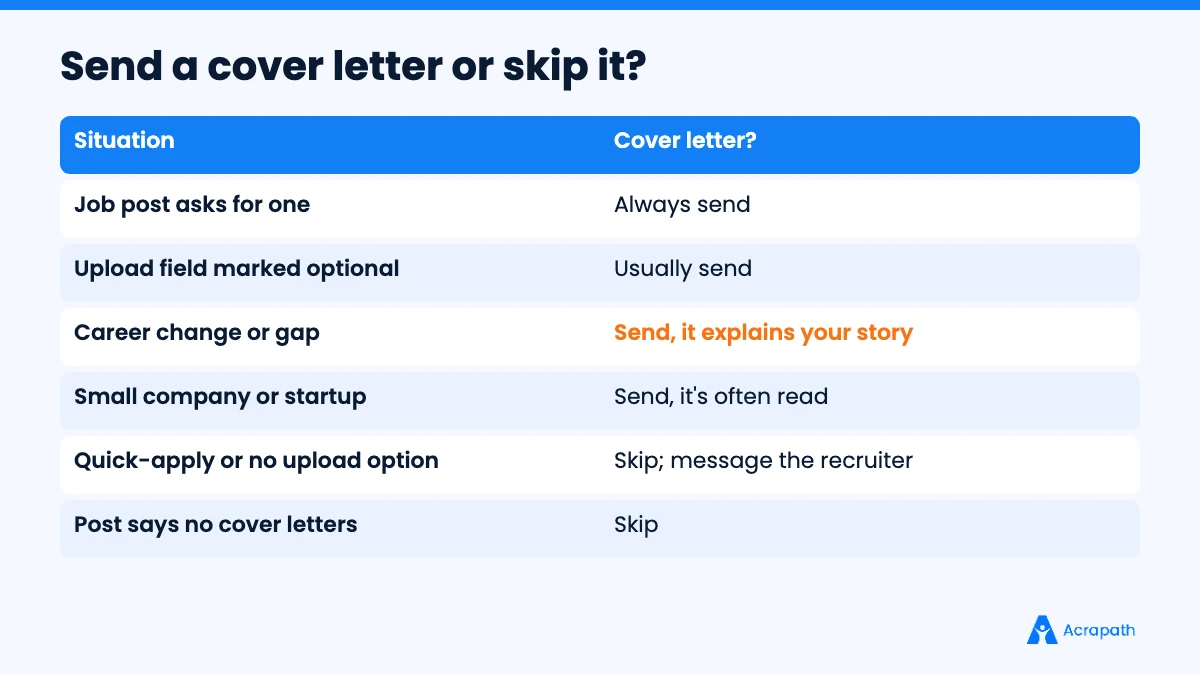
Send one in these situations:
The job post asks for it. Skipping a required document can get you filtered out immediately.
There's an optional upload field. Optional often means "this helps us choose between close candidates".
You're changing careers. A letter explains why your past experience fits a new field. Our guide to switching careers covers how to frame the move.
You have a gap. Address it briefly and positively.
You're applying to a small company or startup. Founders and managers often read every application.
You're a fresher. With limited experience, a letter shows motivation and connects projects to the job.
You're applying abroad or relocating. Explain your relocation plans and availability clearly.
When It's Fine to Skip a Cover Letter
You can reasonably skip it when:
The application has no upload field or text box for one.
The posting explicitly says not to send one.
You're using a one-click or quick-apply form with no attachments.
A recruiter has asked you only for your resume.
In these cases, put the same effort into a tailored resume summary instead. Our ATS-friendly resume guide shows how to match your summary to the job's keywords.
Cover Letter vs Resume: What's the Difference?
Resume | Cover letter | |
|---|---|---|
Purpose | Shows what you've done | Explains why you fit this job |
Format | Structured sections and bullet points | 3-4 short paragraphs |
Length | 1-2 pages | 200-300 words |
Tailoring | Adjust keywords and order for each role | Rewrite the hook and proof for each role |
Read by | Almost everyone, often first by software | Mainly hiring managers and HR |
Your resume does the heavy lifting. If it isn't solid yet, start with our complete guide on how to write a resume.
How to Write a Cover Letter in 20 Minutes
A short, focused cover letter beats a long generic one every time. Use this four-part structure.
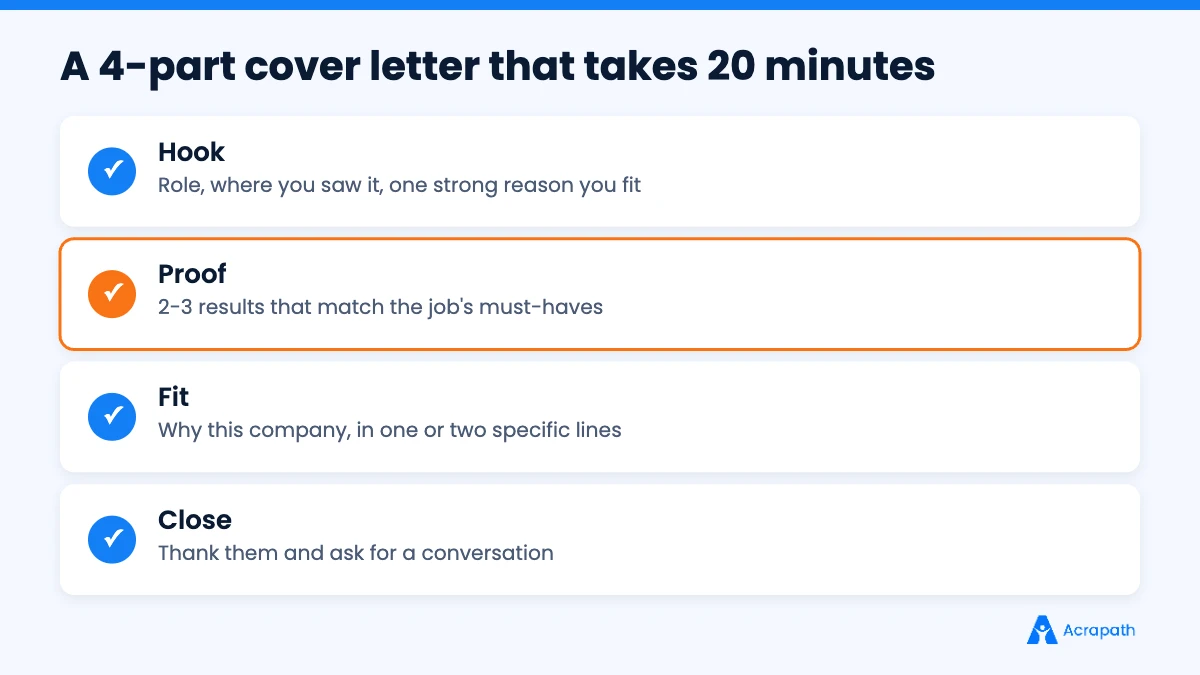
Hook (2-3 lines): Name the role, where you saw it, and your single strongest reason for fitting.
Proof (3-5 lines): Give two or three results that match the job's must-have skills, with numbers where possible.
Fit (2-3 lines): Say why this company, using one specific detail from their website, product or recent news.
Close (1-2 lines): Thank them and ask for a conversation.
Short Cover Letter Example
Dear Ms Mehta,
I'm applying for the Marketing Associate role posted on Acrapath. In my final-year internship, I grew a college club's Instagram following from 1,200 to 5,400 in four months, and I'd love to bring that same energy to your growing D2C brand.
During the internship I planned 40 posts, ran two giveaway campaigns that brought in 600 new email subscribers, and built a simple weekly report in Google Sheets to track what worked.
I've followed your brand since your sustainable packaging launch, and I'd enjoy helping tell that story to new customers.
Thank you for your time. I'd welcome the chance to discuss how I can help your marketing team.
Warm regards,
Riya Sharma
That's about 120 words in the body. Short, specific and easy to read.
Cover Letter Tips for Freshers
If you don't have much work experience, use what you do have:
Projects and coursework that match the job's skills.
Internships and part-time work, even if short.
Clubs, competitions and volunteering with clear results.
Certifications directly relevant to the role.
Pair your letter with a resume built for freshers. Our guide to a resume with no experience shows how to structure it.
How to Format and Send Your Cover Letter
Small formatting choices make your letter easier to read and less likely to get lost:
File type: send a PDF unless the application asks for Word. Name it clearly, for example "Riya-Sharma-Cover-Letter-Marketing-Associate.pdf".
Layout: use the same font and header as your resume, so the two look like a set.
Length: keep it to one page, with plenty of white space between paragraphs.
Text boxes: if the form gives you a text box instead of an upload, paste a shorter version of three paragraphs and drop the address block.
Email applications: put a two-to-three line version in the email body and attach the full letter.
Before you send, read the letter aloud once. You'll catch awkward sentences and typos that spellcheck misses.
Common Cover Letter Mistakes
Repeating your resume word for word. Add context instead.
Using one letter for every job. Generic letters are easy to spot.
Opening with "To whom it may concern". Use a name where you can find one.
Writing a full page about yourself. Focus on what you'll do for them.
Sending an unedited AI draft. Rewrite it in your own voice and check every fact.
Typos in the company or role name. This is the fastest way to be rejected.
Conclusion
Do you still need a cover letter in 2026? In most cases, yes. Surveys show many hiring managers and HR teams still read them, even if many recruiters don't. A short, tailored letter costs about 20 minutes and can make the difference in a close decision.
Keep it to 200-300 words, follow the hook-proof-fit-close structure, and tailor every letter to the role.
Ready to use it? Browse jobs on Acrapath and set up alerts for your role, so your next tailored application goes out early.
- #cover letter
- #job application
- #resume tips
- #job search
- #freshers
Frequently asked questions
Do hiring managers actually read cover letters?
Many do, but not all. A Resume Genius survey found 83% of hiring managers read most cover letters they receive, while Novoresume's 2026 survey found over half of recruiters skip them. Because you can't know who will read yours, a short, tailored letter is a low-risk way to stand out.
Is it okay to skip a cover letter if it says optional?
You can, but it's usually worth sending one. An optional cover letter gives you space to explain your fit, a career change or a gap that your resume can't. If you skip it, make sure your resume summary is tailored to the job instead.
How long should a cover letter be in 2026?
Aim for 200-300 words, or three to four short paragraphs on one page. Hiring managers skim, so lead with your strongest reason for fitting the role, add two or three results with numbers, and close with a clear, polite request for a conversation.
Do freshers need a cover letter?
Freshers benefit from cover letters more than most applicants. With limited work history, a short letter lets you connect projects, internships and coursework to the job's requirements, and shows motivation that a one-page resume can't fully convey.
Can I use AI to write my cover letter?
You can use AI to draft or edit, but rewrite it in your own voice and add specific details about the company and your results. Generic AI-sounding letters are easy to spot and can hurt you. Always check facts, names and the role title before you send it.