Case Study: How a Startup Hired Its First In-House Legal Counsel

Acrapath Team

An illustrative case study of a Series A startup relying on external law firms for every contract, and how it mapped its legal workload, chose a generalist profile and used a contract-review exercise to hire its first in-house counsel.
- Client
- Illustrative scenario: a Series A consumer technology startup
- Industry
- Consumer Technology
Key results
- Legal workload mapped before writing the JD
- Contract-review exercise for all finalists
- Generalist counsel hired with a 90-day plan
Note: This is an illustrative case study. The startup is a composite scenario shared to demonstrate a practical approach to a first legal hire.
The situation
A Series A consumer technology startup sent every contract, policy and legal question to external law firms. Turnaround times slowed down sales deals, and external legal costs kept rising. The founders decided to make their first in-house legal hire.
The challenges
No clarity on what kind of lawyer the company needed
Founders unsure how to evaluate legal skills
A limited budget compared with large companies
Candidates from law firms worried about working alone
The approach
1. Mapping the legal workload
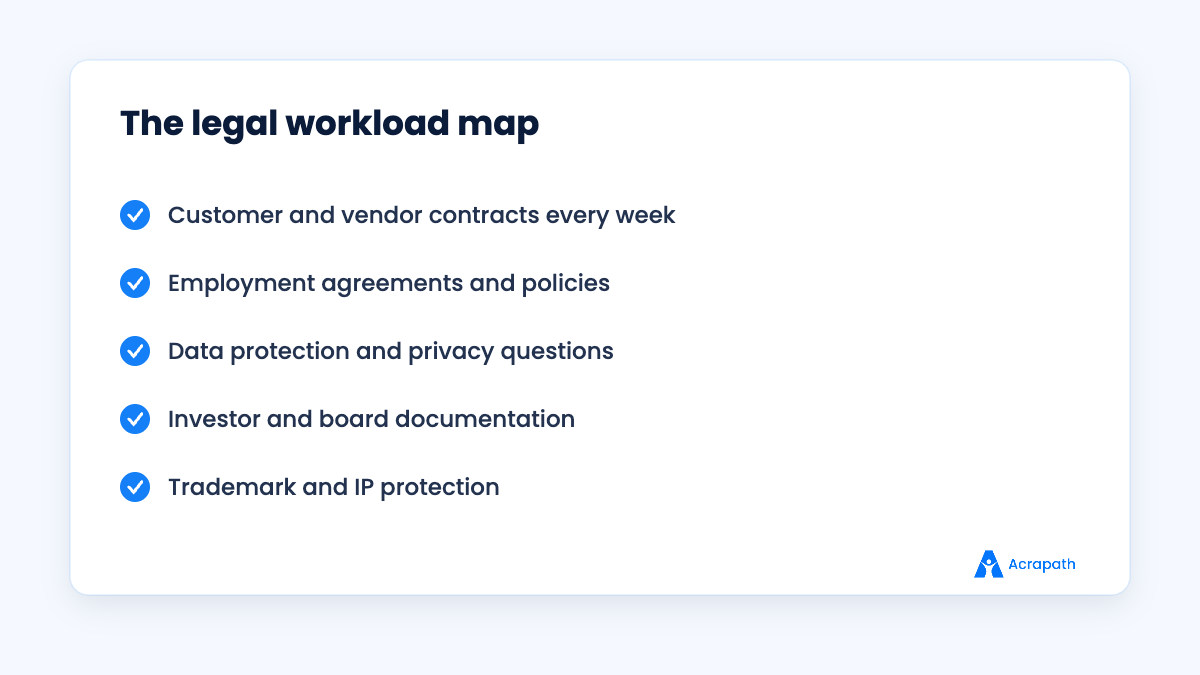
The CFO reviewed three months of legal requests and external invoices to understand where time and money went.
2. Choosing the right profile
The map showed that most work was commercial contracts, employment and privacy. The startup chose a generalist with four to seven years of experience across in-house and law firm roles, rather than a senior general counsel or a narrow specialist.
3. A practical exercise
Finalists reviewed a real-world style customer agreement (with confidential details removed), flagged the top risks and suggested redlines. They then explained their advice to the founders in plain language, which mattered as much as the legal analysis.
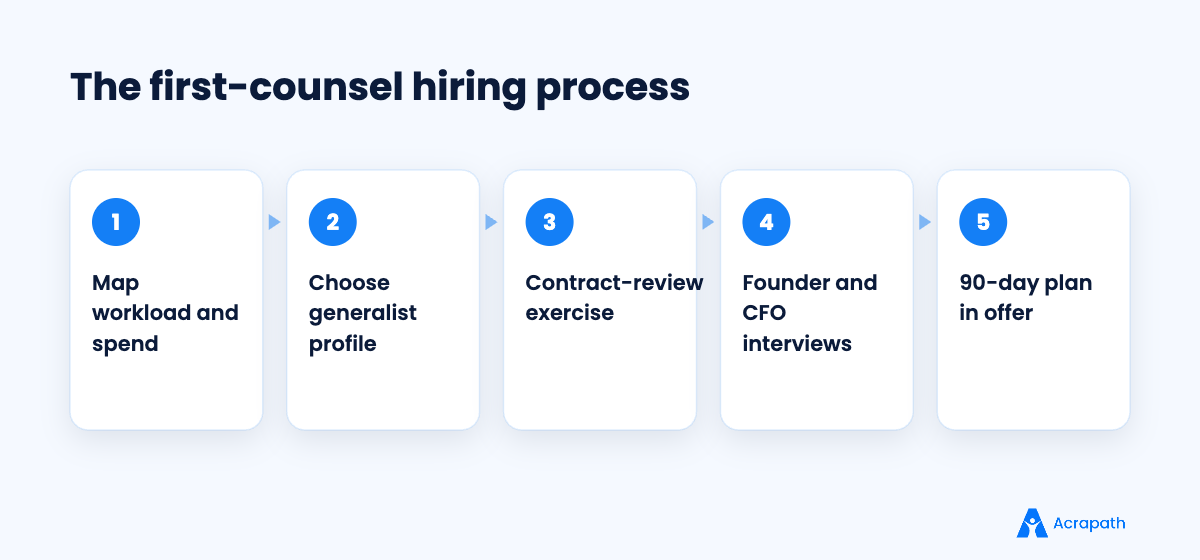
4. Selling the role
The job post on Acrapath emphasised ownership, direct access to founders, a budget for external specialists when needed and the chance to build the legal function from scratch.
The outcome
In this scenario, the startup hired a generalist in-house counsel who joined with a clear 90-day plan: standard contract templates, a contract approval workflow and a privacy review. Deal turnaround improved, and external counsel was used only for specialised matters.
Lessons for startups
Map your legal workload before writing the job description.
Your first legal hire is usually a generalist.
Test practical judgement and communication, not just legal knowledge.
Ownership and impact are strong selling points.
Making your first legal hire? Post the role on Acrapath, search legal professionals in Talbox and track candidates through your interview stages.
- #hiring in-house counsel
- #startup legal hiring
- #first legal hire
- #general counsel
- #employer case study
- #legal recruitment
Frequently asked questions
When should a startup hire in-house legal counsel?
Usually when contract volume slows down deals, external legal costs become significant, or regulatory and privacy questions arise regularly. Many startups make this hire around Series A or B.
Should a startup hire a general counsel or a legal manager first?
Most startups benefit from a generalist with four to seven years of experience who can handle contracts, employment, privacy and corporate work, with external counsel for specialist matters.
How can founders evaluate a lawyer’s skills?
Use a practical contract-review exercise and ask candidates to explain their advice in plain language. Consider involving a trusted external lawyer in the final round.
Is this startup legal case study real?
No. It is an illustrative composite scenario designed to show a practical approach to hiring a first in-house counsel.
How can Acrapath help startups hire legal talent?
Acrapath lets startups post legal roles, search candidate profiles in Talbox and manage candidates in a customisable hiring pipeline.


