Case Study: From Ward Nurse to Critical Care Nurse

Acrapath Team

An illustrative case study of a general ward staff nurse who moved into critical care by earning key certifications, gaining step-down unit experience, preparing for ICU interviews and targeting hospitals with structured ICU training.
- Client
- Illustrative scenario: a staff nurse in a general medical ward
- Industry
- Healthcare / Hospitals
Key results
- Completed BLS, ACLS and a critical care course
- Rotated through step-down unit first
- Moved into an ICU staff nurse role
Note: This is an illustrative case study, a composite scenario based on common nursing career paths, not the story of a specific nurse.
The starting point
A staff nurse with two years of experience in a general medical ward wanted to specialise in critical care. ICU roles offered deeper clinical skills and better growth, but applications were rejected for lacking ICU experience.
The challenge
No direct ICU experience
Only basic life support certification
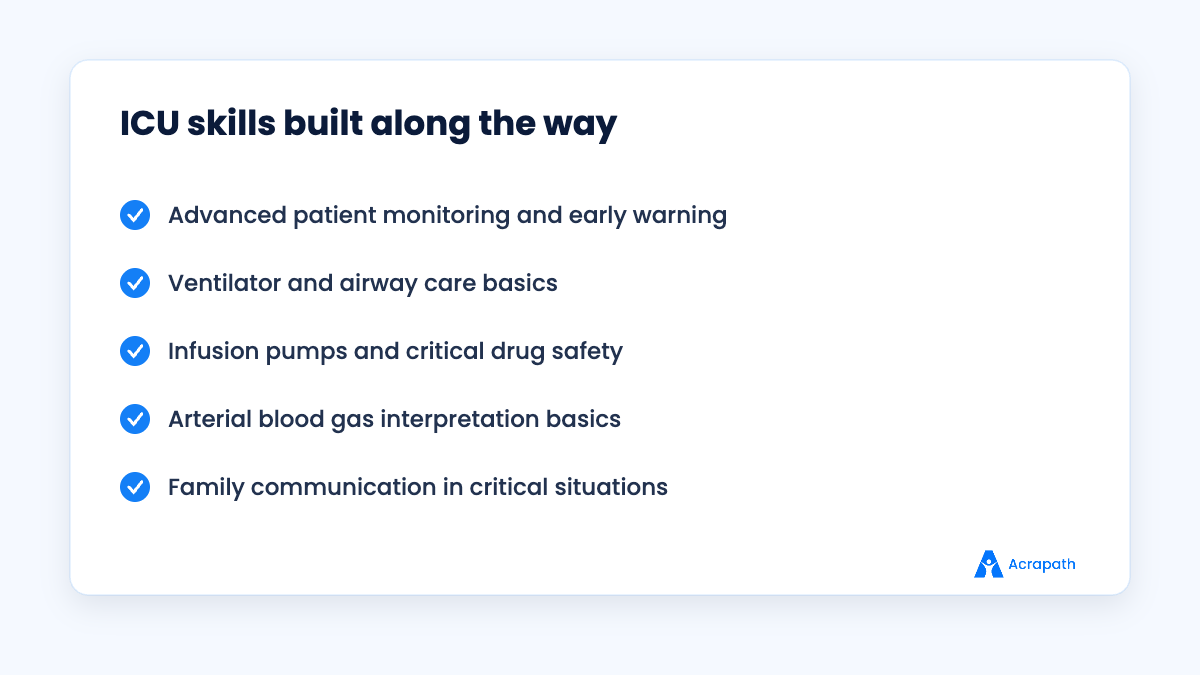
Limited exposure to ventilators and critical drugs
Uncertainty about which hospitals train ward nurses for ICU
The approach
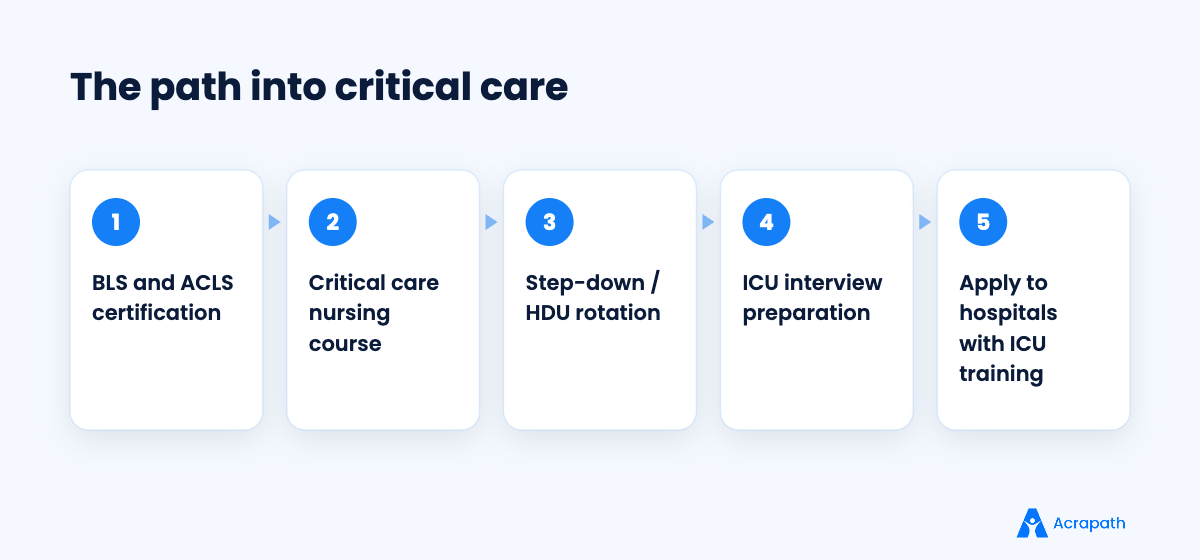
1. Certifications
The nurse renewed BLS, completed ACLS and enrolled in a recognised critical care nursing course, which built knowledge and showed commitment.
2. Step-down experience
The nurse requested a rotation to the hospital's high-dependency (step-down) unit. This provided exposure to closer monitoring, frequent assessments and sicker patients under supervision, which became the most important point on the resume.
3. Building core ICU skills
4. Choosing the right employer
Using Acrapath job alerts for ICU and critical care nurse roles, the nurse focused on hospitals that offered structured ICU orientation and preceptorship for nurses transitioning from wards.
5. Interview preparation
Preparation focused on scenarios such as a deteriorating patient, ventilator alarms and critical drug safety, answered with a clear assess-act-escalate-document approach.
The outcome
In this scenario, the nurse joined a multi-speciality hospital's ICU with a structured orientation programme. The step-down experience and certifications made the difference in the interview.
Takeaways for nurses
Certifications show commitment, but supervised experience matters most.
Ask for step-down or HDU rotations where you work now.
Choose employers with structured ICU orientation.
Practise scenario answers with a safe, structured approach.
Planning to specialise? Update your Acrapath profile with certifications and set alerts for critical care nursing roles.
- #ICU nurse career
- #critical care nursing
- #nurse career growth
- #staff nurse to ICU
- #nursing case study
- #ICU nurse jobs
Frequently asked questions
How can a ward nurse move into the ICU?
Earn BLS and ACLS, complete a critical care nursing course, seek step-down or HDU experience, prepare for scenario-based interviews and target hospitals with structured ICU orientation.
Which certifications help nurses get ICU jobs?
BLS and ACLS are commonly expected. A recognised critical care nursing course or certification strengthens your application further.
Do hospitals hire ICU nurses without ICU experience?
Some do, especially those with structured orientation and preceptorship programmes. Step-down unit experience improves your chances significantly.
Is this nursing case study about a real nurse?
No. It is an illustrative composite scenario, shared to show a practical path into critical care nursing.
Where can I find ICU nurse jobs?
Acrapath lists ICU and critical care nursing roles. Set job alerts by city and specialty to see openings as soon as they are posted.

