Case Study: How a SaaS Startup Hired Its First Product Designer in 3 Weeks

Acrapath Team

An illustrative employer case study: how a growing B2B SaaS company with no in-house designer scoped the role, used a portfolio scorecard and a short paid exercise, and hired its first product designer in three weeks.
- Client
- Illustrative scenario: a 40-person B2B SaaS company
- Industry
- B2B SaaS
Key results
- Role scoped around 3 clear 6-month outcomes
- Shortlist of 6 designers in the first week
- Offer accepted within 3 weeks of posting
Note: This is an illustrative case study. The company is a composite scenario based on common hiring situations, shared to demonstrate a practical process.
The situation
A 40-person B2B SaaS company had grown on the strength of its engineering team. Developers had been designing screens themselves, and customers were starting to complain that the dashboard felt cluttered. The founders decided it was time for hiring a first product designer, but nobody on the team had hired a designer before.
The challenges
No clear definition of what the designer would own
No in-house designer to evaluate portfolios
Pressure to hire quickly before a major product release
Competition from larger companies for the same candidates
The approach
1. Scoping the role around outcomes
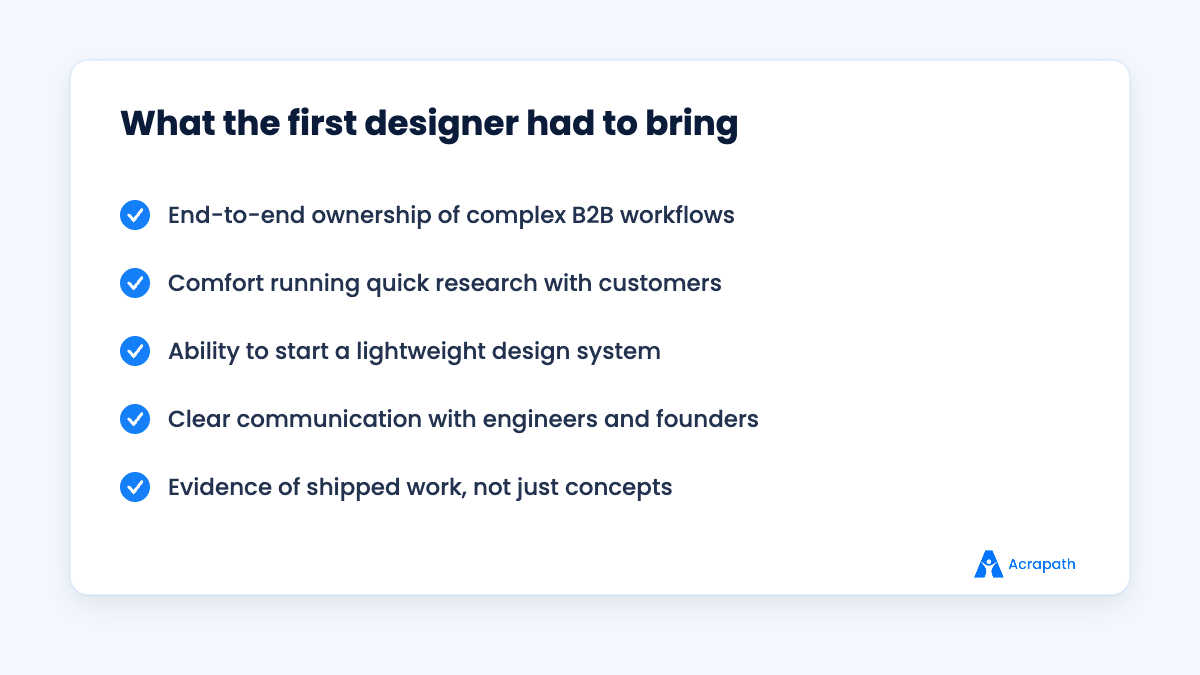
Instead of listing tools, the team defined three six-month outcomes: simplify onboarding for new accounts, redesign the reporting dashboard, and start a basic component library with engineering. This made it clear they needed a generalist product designer, not a visual specialist.
2. Posting and sourcing in parallel
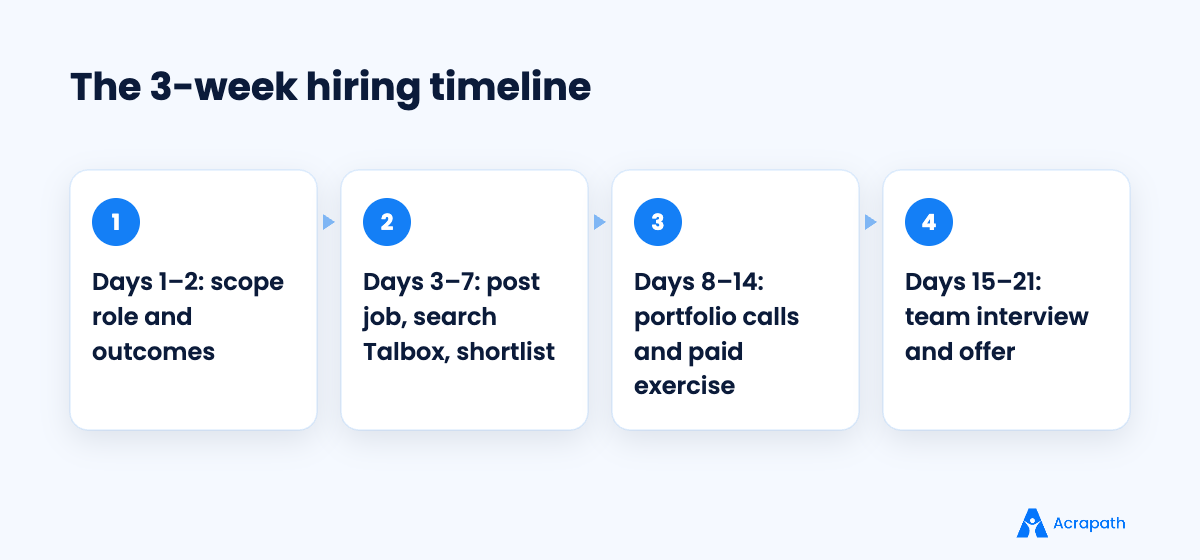
The job was posted on Acrapath with the outcomes, the team structure and the full interview process. At the same time, the hiring manager searched designer profiles in Talbox and contacted candidates whose experience included B2B dashboards.
3. A scorecard for portfolio reviews
Without a designer on staff, the team used a simple scorecard: problem framing, process, craft, impact and communication. Two people scored each portfolio independently and compared notes, which removed a lot of guesswork.
4. A short, paid exercise
Finalists completed a paid, three-hour exercise to improve one onboarding screen, followed by a 45-minute discussion. The conversation about trade-offs mattered more than the final visuals.
5. A fast, transparent offer
All feedback was shared within 48 hours of each round. The pipeline was tracked in the Acrapath Hiring tab, so the founders could see where every candidate stood and avoid losing anyone to silence.
The outcome
In this scenario, the company built a shortlist of six designers in the first week and made an offer within three weeks of posting. The new designer started with a clear brief, which made the first 90 days far more productive.
Lessons for employers
Define outcomes before writing the job description.
Use a scorecard when you do not have design expertise in-house.
Pay for exercises that take more than an hour or two.
Speed and transparency are a competitive advantage in design hiring.
Hiring your first designer? Post the role on Acrapath, search profiles in Talbox and manage every stage in one pipeline. The free employer plan lets you start without upfront cost.
- #hiring first product designer
- #product designer hiring
- #SaaS hiring
- #design hiring process
- #employer case study
- #time to hire
Frequently asked questions
When should a startup hire its first product designer?
Usually when customers start struggling with usability, when engineers spend significant time on design decisions, or when the product is entering a growth phase where onboarding and retention matter more.
How do you evaluate designers if no one on the team is a designer?
Use a structured scorecard covering problem framing, process, craft, impact and communication. Have two people score each portfolio independently, and consider asking an external designer to join the final round.
Should the first designer be a generalist or a specialist?
Most companies benefit from a generalist product designer first, someone who can run research, design end-to-end flows and start a basic design system. Specialists are usually hired later.
Is this case study based on a real company?
No. It is an illustrative composite scenario based on common hiring situations, shared to show a practical process employers can follow.
How can Acrapath help me hire a product designer?
You can post the role on Acrapath, search candidate profiles in Talbox and track applicants through a customisable hiring pipeline from shortlist to offer.


