Case Study: How a Creative Agency Scaled Its Design Team With Skills-First Hiring

Acrapath Team

An illustrative case study of a digital creative agency that needed four designers before peak campaign season, and how a skills-first process with a short brief test and a shared scorecard helped it hire consistently.
- Client
- Illustrative scenario: a 25-person digital creative agency
- Industry
- Advertising & Creative Services
Key results
- Hired 4 designers in one structured hiring cycle
- Same 20-minute brief test for every candidate
- Fewer mis-hires by scoring skills, not degrees
Note: This is an illustrative case study based on a composite agency scenario. It demonstrates a process rather than reporting results from a specific company.
The situation
A 25-person digital creative agency had signed three new retail clients ahead of festive season. It needed two graphic designers, one motion designer and one senior visual designer within six weeks. Previous hiring had relied on resumes and informal portfolio chats, and two recent hires had not worked out.
The challenge
High application volume with very mixed quality
Different interviewers using different standards
Strong candidates dropping out because of slow feedback
A tight deadline before campaign production started
The approach: skills-first hiring
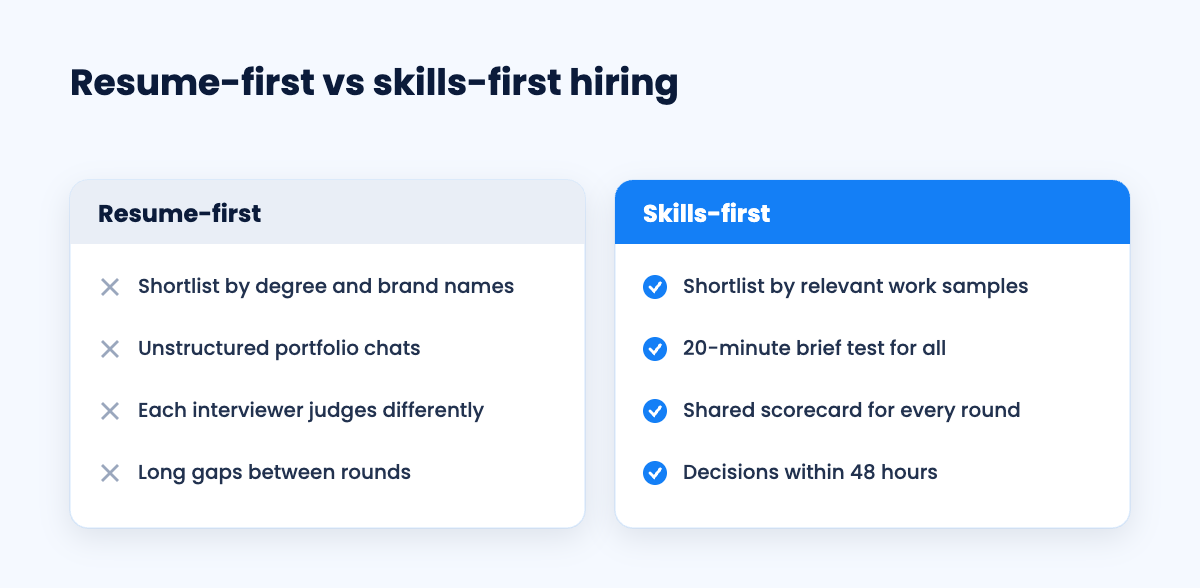
The agency changed one principle: judge the work, not the resume. Skills-based hiring for graphic designers meant every candidate was evaluated on the same tasks and criteria.
Job posts with a sample brief
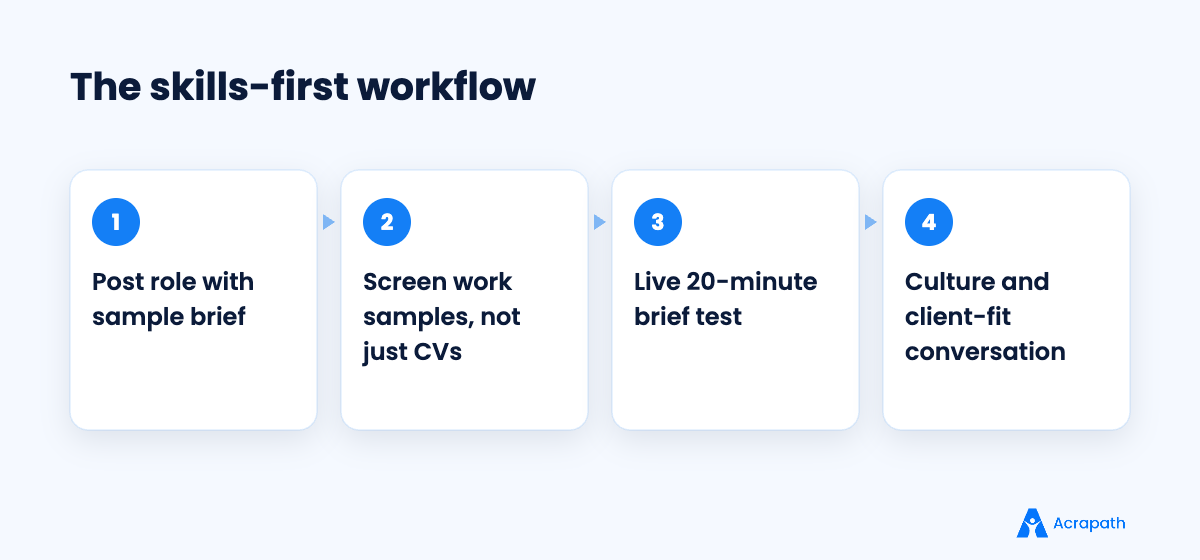
Each role on Acrapath included a short description of a typical client brief. This helped candidates self-select and attracted designers with relevant retail and social campaign experience.
Screening work samples
Recruiters screened for three relevant projects per candidate, rather than education or previous employer names. Profiles found through Talbox were screened the same way.
A live 20-minute brief test
Shortlisted candidates received a small, realistic brief, such as a festive sale banner in two sizes, and talked through their approach while working. The test focused on idea generation, hierarchy and speed, not perfection.
A shared scorecard and fast decisions
Every interviewer scored concept, craft, speed, feedback handling and collaboration. Candidates moved through stages in the Acrapath hiring pipeline, and the team committed to decisions within 48 hours of each round.
The outcome
In this scenario, the agency filled all four roles in a single hiring cycle and onboarded the team before campaign production started. Because everyone had been assessed on the same criteria, onboarding plans were easier to tailor: the scorecards showed exactly where each new hire needed support.
Lessons for agencies and design teams
Short, realistic tests predict on-the-job performance better than resumes.
A shared scorecard reduces bias and disagreement between interviewers.
Fast feedback keeps strong candidates in your process.
Sourcing from a candidate database widens the pool beyond active applicants.
Need to scale your creative team? Post roles on Acrapath, search Talbox and manage every candidate in a pipeline built around your own stages.
- #hiring graphic designers
- #skills-based hiring
- #creative agency hiring
- #design team
- #employer case study
- #recruitment process
Frequently asked questions
What is skills-based hiring for designers?
Skills-based hiring evaluates designers on relevant work samples and practical tasks instead of degrees or previous employers. Every candidate is assessed against the same criteria.
How long should a design test be?
Short live tests of around 20–30 minutes or take-home tasks of a few hours work well. Longer tasks should be paid, and every test should use a realistic, non-client brief.
How can agencies reduce bias when hiring designers?
Use a shared scorecard, ask every candidate the same core questions, review work samples before resumes and have more than one person score each candidate independently.
Is this agency case study real?
No. It is an illustrative composite scenario designed to show a practical skills-first hiring process that agencies can adapt.
How does Acrapath help agencies hire designers?
Agencies can post roles, search candidate profiles in Talbox and move applicants through a customisable hiring pipeline that matches their own interview stages.


