Case Study: How a SaaS Company Hired Full-Stack Developers Faster With a Structured Pipeline

Acrapath Team

An illustrative case study of a SaaS company struggling to hire full-stack developers, and how a shorter interview loop, a realistic take-home, Talbox sourcing and a tracked hiring pipeline helped it close roles faster.
- Client
- Illustrative scenario: a growing SaaS product company
- Industry
- SaaS / Software
Key results
- Interview loop cut to 4 focused rounds
- Feedback shared within 48 hours
- Candidate drop-off reduced between rounds
Note: This is an illustrative case study. The company is a composite scenario used to demonstrate a practical engineering hiring process.
The situation
A growing SaaS company needed to hire full-stack developers (React and Node.js) to keep up with its product roadmap. Despite many applications, roles stayed open for months. Several strong candidates accepted other offers mid-process.
The challenges
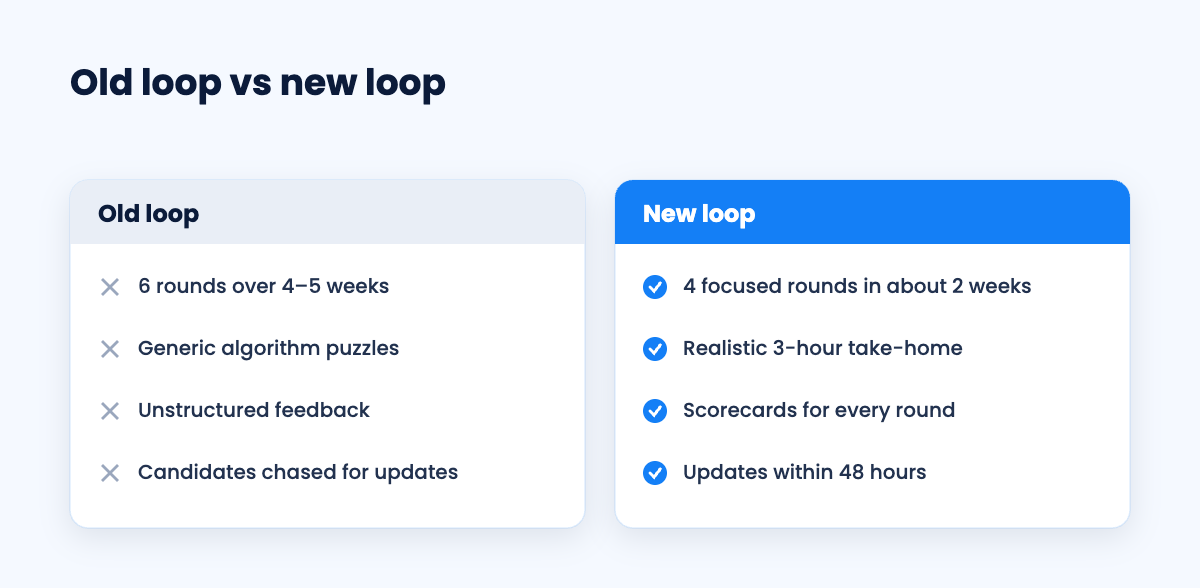
A six-round interview process stretched over a month
Algorithm puzzles that did not reflect the actual work
Interviewers giving vague, unstructured feedback
Candidates waiting days or weeks for updates
The approach
1. Redesigning the interview loop
The engineering lead mapped every round to a skill the job actually required, then removed overlap.
2. A realistic take-home
Candidates built a small feature, a filterable list with an API endpoint, in about three hours. The follow-up pair-programming session extended the same code, so candidates discussed work they already understood.
3. Active sourcing alongside job posts
The role was posted on Acrapath, and the recruiter used Talbox to find developers with React and Node.js experience who were open to opportunities, reaching out with a short, personalised message.
4. Tracking every candidate in one pipeline
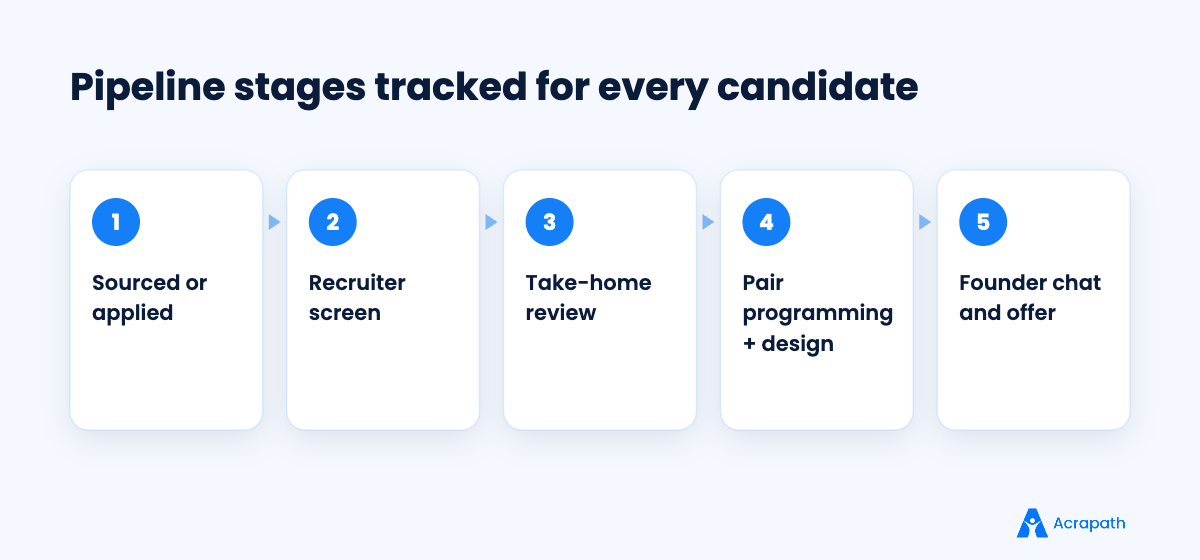
Custom stages in the Acrapath Hiring tab gave the founders and engineering lead one view of every candidate. Anyone stuck in a stage for more than two days was flagged for follow-up.
5. Faster, clearer communication
The team committed to sharing feedback within 48 hours, and every rejected candidate received a short note with the reason.
The outcome
In this scenario, the company completed interview loops in roughly two weeks, fewer candidates dropped out between rounds, and the open full-stack roles were filled. Engineers also spent less time interviewing because each round had a clear purpose.
Lessons for engineering leaders
Every interview round should test a distinct, job-relevant skill.
Realistic take-homes produce better signal than puzzles.
Active sourcing reaches strong developers who are not applying.
Speed and transparency are part of your employer brand.
Need developers? Post roles on Acrapath, source profiles from Talbox and track every candidate in a pipeline designed around your interview loop.
- #hire full stack developers
- #developer hiring
- #engineering hiring pipeline
- #time to hire
- #employer case study
- #tech recruitment
Frequently asked questions
Why do companies lose developer candidates during hiring?
The most common reasons are long interview processes, irrelevant assessments, slow feedback and poor communication. Strong developers often accept faster offers elsewhere.
How many interview rounds should a full-stack developer process have?
Around four focused rounds usually works: a recruiter screen, a practical take-home or technical screen, a pair-programming and design round, and a final conversation with the hiring manager or founder.
What is a good take-home assignment for full-stack developers?
A small, realistic feature, such as a filterable list with an API endpoint, that takes about three hours. Use it as the basis for a follow-up discussion or pair-programming session.
Is this SaaS hiring case study real?
No. It is an illustrative composite scenario designed to show a practical, repeatable engineering hiring process.
How does Acrapath help companies hire developers?
Acrapath lets employers post developer roles, search profiles in Talbox and track candidates through custom pipeline stages in the Hiring tab, so no candidate is left waiting.


