Case Study: How an EdTech Company Scaled Tutor Hiring Without Losing Quality

Acrapath Team

An illustrative case study of an online tutoring company that needed to hire dozens of subject tutors before exam season, and how a standardised screening funnel with recorded demos and rubrics kept quality high at volume.
- Client
- Illustrative scenario: an online tutoring EdTech company
- Industry
- EdTech
Key results
- Standardised 3-step tutor screening
- Recorded demo + rubric for every applicant
- Consistent quality across subjects and cities
Note: This is an illustrative case study. The company is a composite scenario shared to demonstrate a practical hiring process.
The situation
An online tutoring company offering maths and science classes for grades 6 to 12 expected a sharp rise in enrolments before board exams. It needed to hire many part-time and full-time tutors quickly. Earlier hiring had relied on long interviews with academic leads, which did not scale.
The challenge
Hundreds of applications with inconsistent quality
Academic leads spending most of their week interviewing
Uneven teaching quality across new tutors
A fixed deadline before the exam season
The approach: a standardised tutor hiring funnel
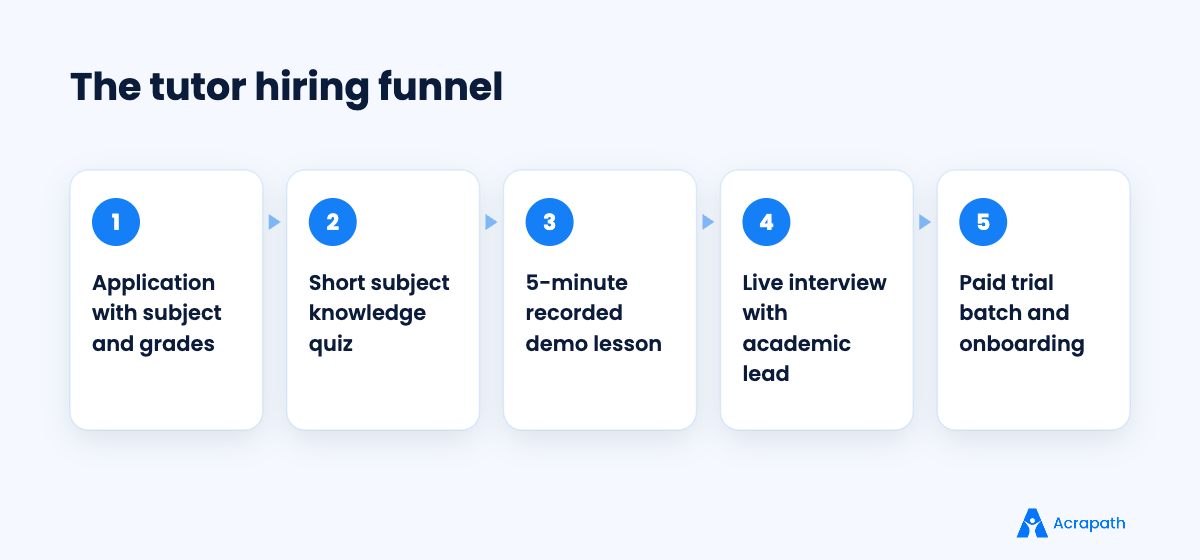
The company designed a funnel in which each stage filtered for one thing, so expensive interview time was spent only on the strongest candidates.
Clear job posts
Roles on Acrapath specified subjects, grade levels, class timings, pay structure and the full selection process, which reduced irrelevant applications.
Recorded demos, scored with a rubric
Instead of live first-round interviews, applicants who passed the subject quiz submitted a five-minute recorded explanation of an assigned topic. Two reviewers scored each demo using the same rubric.

Pipeline tracking
Every applicant moved through custom stages in the Acrapath hiring pipeline, from "Quiz passed" to "Demo approved" to "Trial batch". Rejection reasons were recorded, which helped improve job posts over time.
Paid trial batches
Selected tutors taught a short paid trial batch with feedback from students and academic leads before being confirmed.
The outcome
In this scenario, academic leads spent far less time on first-round interviews, the company onboarded the tutors it needed before exam season, and teaching quality became more consistent because every tutor had cleared the same bar.
Lessons for EdTech and coaching employers
Use cheap, objective filters early (quizzes) and expensive ones late (live interviews).
Recorded demos scale far better than live first rounds.
Rubrics make quality consistent across reviewers.
Recording rejection reasons improves future hiring.
Hiring tutors or faculty in volume? Post roles on Acrapath and manage every stage in a pipeline built around your selection process.
- #tutor hiring
- #EdTech hiring
- #volume hiring
- #teacher recruitment
- #employer case study
- #hiring at scale
Frequently asked questions
How do EdTech companies hire tutors at scale?
Most use a staged funnel: a clear job post, a short subject quiz, a recorded demo lesson scored with a rubric, a live interview for top candidates and a paid trial batch.
What should a tutor demo lesson rubric include?
Include concept clarity, accuracy, engagement and questioning, pace suited to the grade, use of examples and visuals, and online presence such as audio and video quality.
Are recorded demo lessons fair to candidates?
Yes, if every candidate gets the same topic, time limit and instructions, and reviewers use the same rubric. It also lets candidates record at a convenient time.
Is this EdTech case study based on a real company?
No. It is an illustrative composite scenario designed to show a practical, scalable tutor hiring process.
How can Acrapath support high-volume tutor hiring?
Acrapath lets you post multiple tutor roles, create custom pipeline stages such as quiz, demo and trial, record rejection reasons and track every applicant in one dashboard.


